Adaptation to Environment: notes and practice questions
- This topic explores how organisms adapt to their abiotic environment and how these adaptations influence their distribution and the characteristics of ecosystems.
- A habitat is the place where a community, species, population, or organism lives, defined by geographical, physical, and ecosystem type.
- Organisms exhibit adaptations to abiotic factors, which determine their range of tolerance to limiting factors.
- Terrestrial biome distribution is determined by abiotic factors like temperature and rainfall.
- Biomes are groups of ecosystems with similar communities due to similar abiotic conditions and convergent evolution.
- Skills include using transect data to correlate species distribution with abiotic variables (e.g., temperature, light intensity, soil pH).
- Coral reef formation depends on specific conditions: water depth, pH, salinity, clarity, and temperature.
How it is examined
Biome-graph reading is a Paper 1A and Paper 1B item. Paper 2 asks outline adaptations of a named species to a named habitat, 2 to 4 marks, one per adaptation paired with its benefit. Adaptations stated without the benefit ("it has deep roots") score half.
- B4.1.1 Habitat as the place in which a community, species, population or organism lives. A description can include geographical and physical location and the type of ecosystem.
- B4.1.2 Adaptations of organisms to the abiotic environment of their habitat, with a grass species adapted to sand dunes and a tree species adapted to mangrove swamps as the required cases.
- B4.1.3 Abiotic variables affecting species distribution, with examples for both plants and animals, and the idea that adaptations give a species a range of tolerance.
- B4.1.4 Range of tolerance of a limiting factor. Application of skills: use transect data to correlate the distribution of a plant or animal species with an abiotic variable, collected by students from a natural or semi-natural habitat. Sensors could measure temperature, light intensity and soil pH.
Guiding questions
- How are the adaptations and habitats of species related?
- What causes the similarities between ecosystems within a terrestrial biome?
Linking questions
- What are the properties of the components of biological systems?
- Is light essential for life?
Practice questions
7 questions · 2 easy · 4 medium · 1 hardQuestion 1
EasyPaper 1A · calculator1 markWhich pair of abiotic factors are the primary determinants of the distribution of terrestrial biomes?
A. Temperature and precipitation
B. Soil pH and light intensity
C. Wind speed and altitude
D. Salinity and water depth
Consider the major climatic differences between large-scale environments like deserts, rainforests, and tundra. Which two factors are most responsible for these differences?
Question 2
MediumPaper 2 · calculator5 marksThe clownfish (Amphiprioninae) is a genus of fish that lives in a close relationship with sea anemones. The sea anemone has stinging tentacles that are lethal to most other fish, but the clownfish is able to live among them without being harmed.
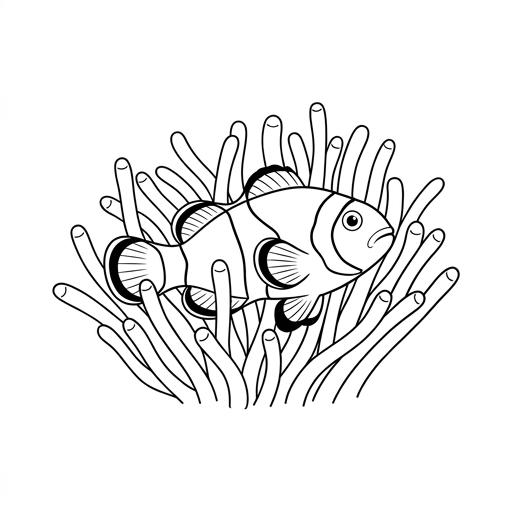
(a) Explain the type of ecological relationship between the clownfish and the sea anemone.
(b) State one adaptation of the clownfish that allows it to live unharmed among the anemone's tentacles.
(c) The relationship with the sea anemone is a key part of the clownfish's realized niche. Distinguish between a fundamental niche and a realized niche.
Consider how each organism is affected by the interaction. Does one benefit? Do both benefit? Does one suffer harm?
Think about what prevents the anemone's stinging cells from affecting the clownfish.
One term refers to the potential role of a species, while the other refers to its actual role. What factors cause the difference between the two?
Question 3
HardPaper 1A · calculator8 marksA student investigated the photosynthetic pigments in two species of algae: Chlorella vulgaris, a green alga found in freshwater, and Porphyra umbilicalis, a red alga found in the intertidal zone. The pigments were extracted from each alga and separated using paper chromatography. The resulting chromatogram is shown below. The solvent front moved 9.0 cm from the origin line.
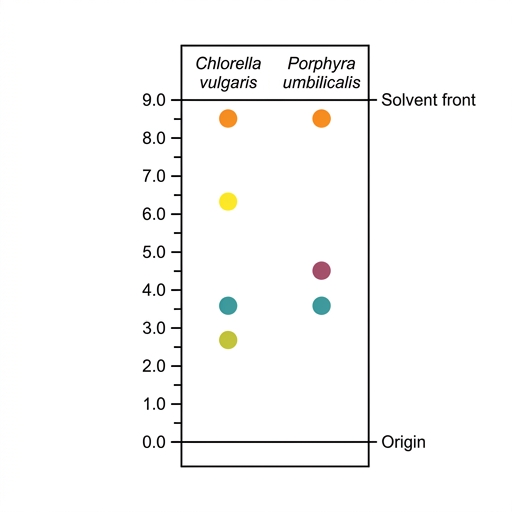
A table of known photosynthetic pigments and their properties is provided.
| Pigment | Colour | value in this solvent |
|---|---|---|
| Carotene | Orange | 0.95 |
| Phaeophytin | Grey-brown | 0.81 |
| Xanthophyll | Yellow | 0.70 |
| Chlorophyll a | Blue-green | 0.40 |
| Chlorophyll b | Yellowish-green | 0.30 |
| Phycoerythrin | Reddish-purple | 0.50 |
(a) Calculate the value for spot B.
(b) Using the data provided, identify the pigments represented by spots A, C, and D in Chlorella vulgaris.
(c) The red alga Porphyra often lives in deeper water than the green alga Chlorella. Explain how the pigments present in Porphyra are an adaptation to this environment.
The value is a ratio. It is calculated by dividing the distance travelled by the spot by the distance travelled by the solvent front. Both distances should be measured from the origin line.
For each spot, you will first need to calculate its value, just as you did in part (a). Then, compare your calculated values to the known values in the table to identify each pigment.
First, identify the pigment that is unique to Porphyra from the chromatogram. Then, consider which wavelengths of light penetrate deepest into water. How does this unique pigment help the alga to survive in its habitat?
Question 4
EasyPaper 1A · calculator1 markA researcher is investigating the factors that determine the distribution of a plant species in a woodland ecosystem. Which of the following is an abiotic factor that the researcher might measure?
A. The grazing of the plants by a population of deer
B. The light intensity reaching the forest floor
C. The infection of the plants by a pathogenic fungus
D. The competition for space with a different plant species
Recall the difference between living (biotic) and non-living (abiotic) components of an ecosystem.
Question 5
MediumPaper 2 · calculator10 marks(a) Outline the concept of a biome.
(b) Distinguish between a habitat and an ecosystem.
(c.i) Plants are adapted to specific abiotic conditions.
Suggest one reason why a plant species adapted to the tundra biome might not survive in a tropical rainforest.
(c.ii) Suggest one reason why a plant species adapted to a tropical rainforest might not survive in the tundra biome.
(d) State three abiotic factors, other than temperature, that can limit the distribution of plant species in a terrestrial habitat.
Think about what groups certain ecosystems together globally and what factors determine where they are found.
Consider what each term includes. One is a location, while the other includes interactions between living and non-living components.
Think about the differences in light availability, temperature, and competition between a tundra and a dense rainforest.
Consider the physical state of water and the extreme temperatures in the tundra.
Think about what plants need from the soil and the air to photosynthesize and grow.
Question 6
MediumPaper 2 · calculator10 marksThe Mesoamerican Barrier Reef is experiencing significant environmental changes due to anthropogenic activities.
Global warming leads to the melting of landfast ice and thermal expansion of oceans. Explain how the resulting sea level rise threatens the survival of coral reefs.
(b) As atmospheric carbon dioxide concentrations increase, more dissolves in the oceans. Explain how this process affects the ability of corals to build their skeletons.
(c) Describe the phenomenon of coral bleaching that occurs when ocean temperatures exceed the normal range of tolerance for corals.
(d) Deforestation on nearby land can lead to soil erosion and increased turbidity in coastal waters. Explain why this turbidity is a threat to coral reefs.
Think about what happens to the water depth above the coral and how that affects the physical conditions they need to survive.
Consider the chemical changes in the ocean water when carbon dioxide dissolves, and what corals use to build their hard structures.
What do corals lose when they are stressed by high temperatures, and what is the visual result?
Turbidity means the water is cloudy with suspended particles. How does this affect the light reaching the reef?
Question 7
MediumPaper 1A · calculator1 markWhich scenario is an example of convergent evolution?
A. The development of similar streamlined body shapes in dolphins and sharks
B. The divergence of Darwin's finches into multiple species with different beak shapes
C. The presence of a pentadactyl limb in both bats and humans
D. The breeding of different dog varieties from a common wolf ancestor
Consider whether the organisms share a recent common ancestor or if they developed similar traits independently due to similar environmental pressures.
No question on this page matches those filters. Try another difficulty or paper.
Every Adaptation to Environment question, marked for you
Every answer is marked mark by mark, IB-style, and the AI tutor helps when you are stuck.
Where marks are lost
- Command terms are consistently under-read. Students answer describe when the question said explain, so they give an account with no reasons and cap at half marks. The reverse also happens on outline, where a student writes an essay for a 2-mark summary and runs out of time.