Sustainability and Change: notes and practice questions
- This topic examines ecosystem stability, human impacts on biodiversity, and climate change.
- Ecosystem stability relies on energy flow, nutrient cycling, genetic diversity, and stable climatic variables.
- Human activities drive species extinction, habitat loss, and biodiversity crises.
- Anthropogenic climate change is caused by increased atmospheric and methane.
- Positive feedback loops (e.g., melting ice, permafrost thaw) accelerate global warming.
- Climate change leads to polar habitat loss, altered ocean currents, and species range shifts.
- Conservation strategies include in situ and ex situ methods, and EDGE species prioritization.
- Sustainable resource harvesting means replacement rate exceeds harvesting rate.
- Carbon sequestration (afforestation, wetland restoration) helps mitigate climate change.
- Coral reefs face threats from ocean acidification and bleaching.
How it is examined
Eutrophication is a chain-of-consequence explain item: nutrients leach in, algal bloom, light blocked, plants die, decomposers multiply, BOD rises, oxygen falls, aerobic organisms die. Marks are awarded per link, so a student who jumps from "algae grow" to "fish die" scores two of six. Biomagnification questions want the reason toxins concentrate, which is that they are persistent and are not excreted, so they accumulate up the chain. At HL, primary succession questions ask outline the changes, and the five named increases are the mark points.
- D4.2.1 Stability as a property of natural ecosystems, illustrated with forest, desert or other ecosystems that have shown continuity over long periods. There is evidence for some ecosystems persisting for millions of years.
- D4.2.2 Requirements for stability in ecosystems: supply of energy, recycling of nutrients, genetic diversity, and climatic variables remaining within tolerance levels.
- D4.2.3 Deforestation of Amazon rainforest as an example of a possible tipping point in ecosystem stability. Include the need for a large area of rainforest to generate atmospheric water vapour by transpiration, with consequent cooling, air flows and rainfall, and the uncertainty over the minimum area sufficient to maintain these processes. Application of skills: calculate percentage change, here the extent of deforestation from the original forest area.
- D4.2.4 Use of a model to investigate the effect of variables on ecosystem stability. Mesocosms can be set up in open tanks, but sealed glass vessels are preferable because entry and exit of matter can be prevented while energy transfer is still possible. Aquatic or microbial ecosystems are likely to be more successful than terrestrial ones.
- D4.2.12 Ecological succession and its causes. Succession can be triggered by changes in both an abiotic environment and in biotic factors.
- D4.2.13 Changes occurring during primary succession. Any suitable terrestrial example can illustrate the general principles: increases in size of plants, amount of primary production, species diversity, complexity of food webs and amount of nutrient cycling.
- D4.2.14 Cyclical succession in ecosystems. In some ecosystems there is a cycle of communities rather than a single unchanging climax community, and students should refer to an example.
- D4.2.15 Climax communities and arrested succession. Given specific environmental conditions, succession tends to lead to a particular type of climax community, but human influences can prevent this. The named examples of arrest are grazing by farm livestock and drainage of wetlands.
Guiding questions
- What features of ecosystems allow stability over unlimited time periods?
- What changes caused by humans threaten the stability of ecosystems?
Linking questions
- What is the distinction between artificial and natural processes?
- Over what timescales do things change in different biological systems?
Practice questions
10 questions · 2 easy · 7 medium · 1 hardQuestion 1
EasyPaper 1A · calculator1 markWhich strategy is most appropriate for restoring biodiversity in a degraded ecosystem, such as the Hinewai Reserve?
A. Rewilding to re-establish natural ecological processes
B. Harvesting resources at a rate equal to their maximum replacement rate
C. Introducing alien species to fill vacant ecological niches
D. Relocating all threatened species to ex situ conservation facilities
Consider which option actively repairs the ecosystem in its original location rather than just preventing further damage or moving species elsewhere.
Question 2
MediumPaper 1A · calculator1 markA large area of temperate forest is destroyed by a wildfire, leaving the soil intact. Which sequence of events correctly describes the process of secondary succession that follows?
A. Pioneer species colonize bare rock → soil formation → climax community established.
B. Grasses and annual plants grow → shrubs appear → fast-growing trees → slow-growing hardwood trees.
C. The climax community is immediately re-established from the soil seed bank.
D. Lichens and mosses colonize the burnt ground → soil depth increases → grasses and weeds grow.
Consider the key difference between primary and secondary succession. What is the condition of the environment immediately after the wildfire described in the question?
Question 3
HardPaper 2 · calculator15 marks(a) Outline how human activities can destabilize ecosystems by causing biodiversity loss.
(b) Describe how positive feedback loops accelerate global warming and how this impacts polar habitats.
(c) Explain how anthropogenic climate change threatens the stability of coral reef ecosystems.
Think about the main anthropogenic causes of extinction and how the loss of species affects the overall ecosystem.
A positive feedback loop amplifies an initial change. Consider what happens when ice melts or permafrost thaws, and how the loss of ice affects specific polar animals.
Discuss the causes of climate change and the two main threats it poses to coral reefs: rising temperatures and changes in ocean chemistry.
Question 4
EasyPaper 1A · calculator1 markWhich of the following is an example of carbon sequestration?
A. Restoration of wetlands
B. Draining of peatlands
C. Combustion of biomass
D. Deforestation
Consider which process removes carbon from the atmosphere and stores it long-term, rather than releasing it.
Question 5
MediumPaper 2 · calculator10 marksThe Mesoamerican Barrier Reef is experiencing significant environmental changes due to anthropogenic activities.
Global warming leads to the melting of landfast ice and thermal expansion of oceans. Explain how the resulting sea level rise threatens the survival of coral reefs.
(b) As atmospheric carbon dioxide concentrations increase, more dissolves in the oceans. Explain how this process affects the ability of corals to build their skeletons.
(c) Describe the phenomenon of coral bleaching that occurs when ocean temperatures exceed the normal range of tolerance for corals.
(d) Deforestation on nearby land can lead to soil erosion and increased turbidity in coastal waters. Explain why this turbidity is a threat to coral reefs.
Think about what happens to the water depth above the coral and how that affects the physical conditions they need to survive.
Consider the chemical changes in the ocean water when carbon dioxide dissolves, and what corals use to build their hard structures.
What do corals lose when they are stressed by high temperatures, and what is the visual result?
Turbidity means the water is cloudy with suspended particles. How does this affect the light reaching the reef?
Question 6
MediumPaper 2 · calculator5 marks(a) Explain why rapid climate change is a major driver of the current biodiversity crisis.
Think about the speed of environmental changes compared to how quickly species can adapt, evolve, or move, and the ultimate consequence for species survival.
Question 7
MediumPaper 1B · calculator10 marksThe graph shows the Keeling Curve, which records atmospheric carbon dioxide () concentrations at the Mauna Loa Observatory from 2010 to 2014.
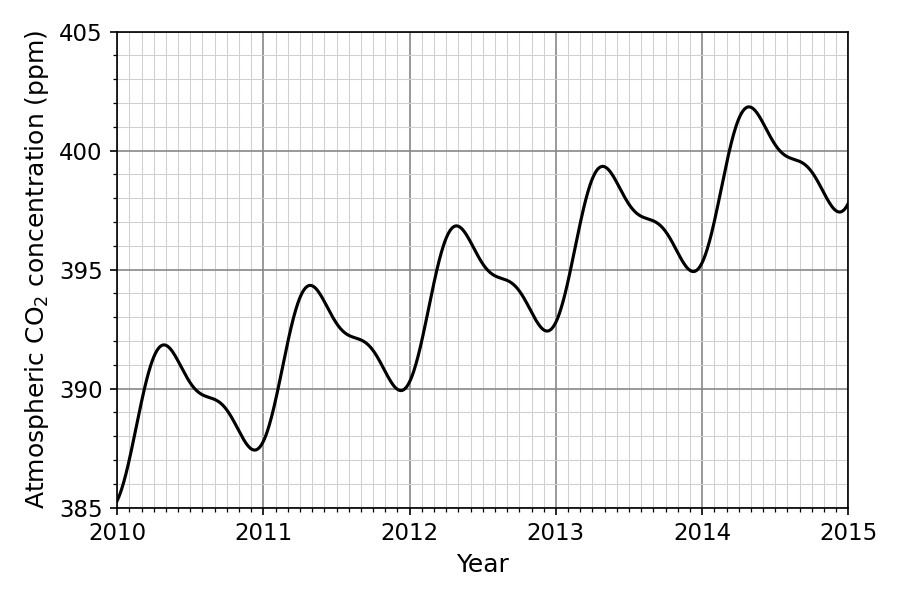
Estimate the seasonal variation in concentration within a single year.
Explain the biological processes responsible for the annual fluctuations in concentration.
Calculate the mean annual increase in concentration between May 2010 and May 2014.
Assuming the mean annual increase remains constant, predict the peak concentration in May 2030.
Outline two anthropogenic activities that contribute to the long-term upward trend in the Keeling Curve.
Look at the difference between the highest point (peak) and the lowest point (trough) of the curve within any single year on the graph.
Think about which biological process removes carbon dioxide from the air and which process adds it, and how the rates of these processes vary with the seasons in the Northern Hemisphere.
Find the concentration at the peak in 2010 and the corresponding peak in 2014, calculate the total difference, and divide by the number of years.
Determine how many years it is from 2014 to 2030, multiply that by your annual increase from (c)(i), and add it to the 2014 peak value.
What human activities release large amounts of carbon dioxide or reduce the Earth's ability to absorb it?
Question 8
MediumPaper 2 · calculator7 marks(a) Explain the anthropogenic causes of climate change and the biological strategies that can be used to mitigate it.
Think about which specific gases are responsible for the greenhouse effect, where they come from, and how processes like photosynthesis and ecosystem restoration can remove them from the atmosphere.
Question 9
MediumPaper 1A · calculator1 markWhich process acts as a positive feedback cycle in global warming?
A. The release of carbon dioxide from warming ocean waters
B. The increased rate of photosynthesis due to higher carbon dioxide concentrations
C. The expansion of afforestation and wetland restoration projects
D. The poleward range shift of bird and insect species
A positive feedback cycle amplifies the initial change. Look for a process where an increase in temperature causes an effect that leads to even more warming.
Question 10
MediumPaper 1A · calculator1 markThe Hinewai Reserve in New Zealand is a well-known example of ecosystem rewilding. Which strategy was a key component of this project?
A. Allowing an exotic weed to act as a nurse canopy for native plants
B. Eradicating all non-native plant species before allowing regeneration
C. Reintroducing locally extinct native apex predators to the reserve
D. Maintaining small, isolated fragments to simplify management
Recall how the Hinewai project dealt with gorse, an invasive shrub, and whether their approach involved heavy human intervention or letting natural succession take its course.
No question on this page matches those filters. Try another difficulty or paper.
Every Sustainability and Change question, marked for you
Every answer is marked mark by mark, IB-style, and the AI tutor helps when you are stuck.
Where marks are lost
- Command terms are consistently under-read. Students answer describe when the question said explain, so they give an account with no reasons and cap at half marks. The reverse also happens on outline, where a student writes an essay for a 2-mark summary and runs out of time.