Cell and Nuclear Division: notes and practice questions
- This topic covers cell division (mitosis and meiosis) for growth, repair, and reproduction.
- Cell division involves nuclear division followed by cytokinesis.
- Mitosis produces two genetically identical diploid daughter cells, maintaining chromosome number.
- Meiosis is a reduction division, producing four genetically varied haploid nuclei for sexual reproduction.
- Genetic variation in meiosis arises from random orientation of bivalents and crossing over.
- Non-disjunction during meiosis can lead to conditions like Down syndrome.
- Skills include identifying mitotic phases in micrographs and understanding diploid/haploid terms.
How it is examined
Mitosis phase identification from a micrograph is a Paper 1A and Paper 1B item. Mitotic index is a calculation: cells in mitosis divided by total cells, and the answer is usually wanted as a decimal or a percentage with the working shown. Compare mitosis and meiosis is a standard Paper 2 table item. Random orientation and crossing over must both be named for full marks on variation questions.
- D2.1.1 Generation of new cells in living organisms by cell division. A parent cell, often called a mother cell, divides to produce two daughter cells.
- D2.1.2 Cytokinesis as splitting of cytoplasm between daughter cells. In an animal cell a ring of contractile actin and myosin pinches the cell membrane together; in a plant cell vesicles assemble sections of membrane and cell wall.
- D2.1.3 Equal and unequal cytokinesis. Division of cytoplasm is usually but not always equal, and both daughter cells must receive at least one mitochondrion and any other organelle that can only be made by dividing a pre-existing structure. Named examples of unequal cytokinesis: oogenesis in humans and budding in yeast.
- D2.1.4 Roles of mitosis and meiosis in eukaryotes. Nuclear division is needed before cell division to avoid producing anucleate cells. Mitosis maintains the chromosome number and genome; meiosis halves the chromosome number and generates genetic diversity.
- D2.1.12 Cell proliferation for growth, cell replacement and tissue repair. Proliferation for growth in plant meristems and early-stage animal embryos; skin as an example of proliferation during routine replacement and wound healing.
- D2.1.13 Phases of the cell cycle. Cell proliferation is achieved using the cell cycle, in the sequence G1, S and G2 as the stages of interphase, followed by mitosis then cytokinesis.
- D2.1.14 Cell growth during interphase. Interphase is metabolically active and growth involves biosynthesis of cell components including proteins and DNA. Numbers of mitochondria and chloroplasts are increased by growth and division of those organelles.
- D2.1.15 Control of the cell cycle using cyclins, limited to the concentration of different cyclins rising and falling during the cycle and a threshold level of a specific cyclin being required to pass each checkpoint.
Guiding questions
- How can large numbers of genetically identical cells be produced?
- How do eukaryotes produce genetically varied cells that can develop into gametes?
Linking questions
- What processes support the growth of organisms?
- How does the variation produced by sexual reproduction contribute to evolution?
Practice questions
13 questions · 3 easy · 7 medium · 3 hardQuestion 1
EasyPaper 1A · calculator1 markThe micrograph shows cells from a whitefish blastula undergoing mitosis.
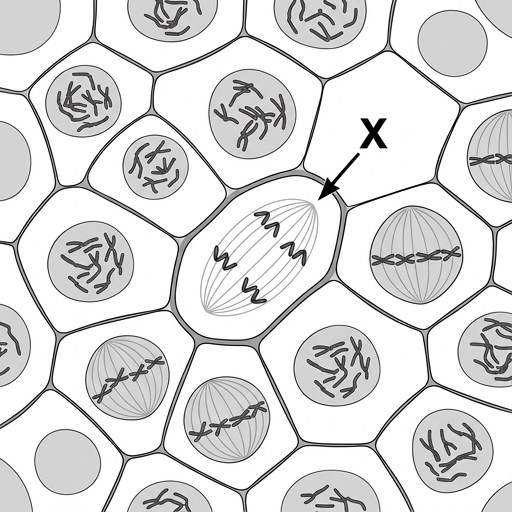
In which phase of mitosis is cell X?
A. Prophase
B. Metaphase
C. Anaphase
D. Telophase
Observe the position and structure of the chromosomes within cell X. Are they condensing, aligning at the equator, separating, or decondensing at the poles?
Question 2
MediumPaper 1A · calculator1 markDuring which phase of meiosis does crossing over occur, leading to the recombination of alleles?
A. Prophase I
B. Metaphase I
C. Prophase II
D. Metaphase II
Consider the stage where homologous chromosomes pair up to form bivalents. This close association is necessary for the exchange of genetic material.
Question 3
HardPaper 2 · calculator10 marks(a) The diagram shows an example of hybridization between a domestic sheep and a goat, which occasionally occurs when they are kept in the same pasture.
Ovis aries (diploid chromosome number = 54) Capra hircus (diploid chromosome number = 60)
interspecific hybrid
Predict, with reasons, the diploid chromosome number of the interspecific hybrid.
(b) Only a few such hybrids have ever been born alive. If more were discovered, predict, with reasons, whether they would be genetically identical.
(c) Explain, with reasons, whether the interspecific hybrid is likely to be able to produce gametes.
Consider the number of chromosomes that each parent will contribute to their gametes during meiosis.
Think about whether all individuals within a single species are genetically identical, and what causes variation in the gametes they produce.
Recall what must happen to chromosomes during prophase I of meiosis for gametes to be successfully produced.
Question 4
EasyPaper 2 · calculator10 marksOrganisms can reproduce using sexual or asexual strategies.
(a) Explain whether the propagation of a cassava plant by planting stem cuttings is sexual or asexual reproduction.
(b) Explain whether in vitro fertilization (IVF) in humans is sexual or asexual reproduction.
(c) Explain whether a single Amoeba dividing into two cells by mitosis is sexual or asexual reproduction.
(d) Explain whether the production of seeds in a flowering plant following cross-pollination is sexual or asexual reproduction.
(e) Explain whether the artificial insemination of a female sheep using semen collected from a ram is sexual or asexual reproduction.
Consider how many parents are involved and whether gametes (sex cells) are fusing.
Think about what is being combined in the glass dish during the IVF procedure.
Recall the purpose and outcome of mitosis in unicellular organisms.
Consider what pollen contains and what it must fuse with to form a seed.
Focus on the biological cells involved in the process, regardless of how they are introduced.
Question 5
MediumPaper 2 · calculator5 marks(a) A patient is diagnosed with a tumour in their lung tissue following exposure to chemical mutagens.
Explain the characteristics and processes that would cause this tumour to be classified as life-threatening.
Think about the difference between benign and malignant tumours, how fast the cells are dividing, and how the cancer might spread to other organs.
Question 6
HardPaper 2 · calculator15 marks(a) Outline the processes that generate genetic variation within a population.
(b) Explain how natural selection acts on this variation to cause evolutionary change.
(c) Discuss how anthropogenic climate change affects the distribution and survival of species in polar habitats, including the emperor penguin.
Think about the original source of new traits and how cell division and reproduction mix these traits.
Consider what happens when a population produces too many offspring, and how advantageous traits affect survival and reproduction.
Include the causes of climate change, its physical effects on polar ice, and specific examples of how this impacts named species like the emperor penguin or walrus.
Question 7
EasyPaper 1A · calculator1 markA researcher observes different types of cell division under a microscope. In one instance, they note that the cytoplasm is divided unequally, resulting in one large cell and one much smaller daughter cell.
Which process is the researcher observing?
A. Yeast undergoing budding
B. Escherichia coli undergoing binary fission
C. B-lymphocytes undergoing clonal expansion
D. A human zygote undergoing cleavage
Think about which form of asexual reproduction produces a smaller outgrowth from the parent cell rather than splitting the cell perfectly in half.
Question 8
MediumPaper 2 · calculator10 marksHumans reproduce sexually, relying on different types of cell division for growth and reproduction.
(a) Compare the outcomes of mitosis and meiosis in human reproduction.
(b) Distinguish between human male and female gametes.
(c) Explain the events that occur during human fertilization after a sperm reaches the egg.
(d) Explain the role of progesterone in the human menstrual cycle.
Think about the number of cells produced, their genetic composition, and their specific roles in the human life cycle.
Focus on differences in size, mobility, numbers produced, and specific structural features like the acrosome or cortical granules.
Describe what happens when the membranes fuse, how the egg prevents other sperm from entering, and what happens to the nuclei.
Consider where progesterone is produced after ovulation and its effects on the uterine lining and pituitary hormones.
Question 9
HardPaper 2 · calculator15 marksSexual reproduction in flowering plants involves the production of gametes by meiosis, followed by pollination and fertilization.
Outline the events that occur during prophase I of meiosis.
Describe the process of fertilization in flowering plants.
Explain how meiosis and sexual reproduction promote genetic variation in a population.
Think about what happens to the chromosomes before they align at the equator. How do homologous chromosomes interact?
Trace the path of the male gamete from the moment a pollen grain lands on the flower until it reaches the egg.
Consider the two main sources of variation during meiosis, and what happens when gametes from two different individuals combine.
Question 10
MediumPaper 1A · calculator1 markMature human red blood cells and mature phloem sieve tube elements both lack a nucleus.
What is a direct consequence of this atypical structure?
A. They cannot divide by mitosis
B. Their genetic material is free in the cytoplasm
C. They are unable to produce ATP
D. They lack a plasma membrane
Think about what a nucleus contains and what cellular processes rely directly on the presence of a nucleus.
Question 11
MediumPaper 1A · calculator1 markWhich event occurs in meiosis but not in mitosis?
A. Separation of sister chromatids
B. Random orientation of bivalents
C. Condensation of chromatin into chromosomes
D. Attachment of spindle microtubules to centromeres
Think about the processes that generate genetic variation and reduce the chromosome number, which are unique to the production of gametes.
Question 12
MediumPaper 1A · calculator1 markWhich event occurs during both mitosis and meiosis?
A. Crossing over between non-sister chromatids
B. Separation of sister chromatids
C. Random orientation of bivalents at the equator
D. Reduction of the chromosome number by half
Consider what happens to the chromosomes during anaphase of mitosis and anaphase II of meiosis.
Question 13
MediumPaper 1A · calculator1 markWhich statements correctly describe the processes that generate genetic variation within a population?
I. Crossing over generates new alleles.
II. Random orientation of bivalents generates new combinations of alleles.
III. Gene mutation is the original source of new alleles.
A. I and II only
B. II and III only
C. I and III only
D. I, II and III
Consider the difference between creating a brand new version of a gene (an allele) and shuffling the versions that already exist.
No question on this page matches those filters. Try another difficulty or paper.
Every Cell and Nuclear Division question, marked for you
Every answer is marked mark by mark, IB-style, and the AI tutor helps when you are stuck.
Where marks are lost
- Command terms are consistently under-read. Students answer describe when the question said explain, so they give an account with no reasons and cap at half marks. The reverse also happens on outline, where a student writes an essay for a 2-mark summary and runs out of time.
- compare and contrast answers give only similarities, or only differences.