Inheritance: notes and practice questions
- This topic covers the mechanisms of heredity, including how genetic information is passed from parents to offspring and the factors influencing trait expression.
- Sexual reproduction involves haploid gametes fusing to form a diploid zygote.
- Genotype is the allele combination, while phenotype is the observable trait.
- Dominant alleles mask recessive ones; codominance and incomplete dominance result in distinct heterozygous phenotypes.
- Sex-linked traits, like haemophilia, are carried on sex chromosomes.
- Genetic crosses, often using Punnett grids, predict offspring genotypic and phenotypic ratios.
- Phenotypic plasticity allows environmental adaptation without genotype alteration.
- Gene mutations are the original source of genetic variation.
- Pedigree charts are used to deduce inheritance patterns in families.
- Continuous variation arises from polygenic inheritance or environmental factors.
How it is examined
Genetics is the most heavily calculated part of the syllabus and appears in every paper. Punnett grid questions want the parental genotypes stated, the gametes shown, the grid completed and the ratio given, and each of those can be a separate mark. Pedigree questions ask deduce whether an allele is dominant or recessive and whether it is autosomal or sex-linked, and the mark is for the evidence (two unaffected parents with an affected child means recessive). At HL, chi-squared on a dihybrid cross needs expected values from the 9:3:3:1 ratio, degrees of freedom of 3, and a conclusion about the null hypothesis.
- D3.2.1 Production of haploid gametes in parents and their fusion to form a diploid zygote as the means of inheritance. This pattern is common to all eukaryotes with a sexual life cycle, and a diploid cell has two copies of each autosomal gene.
- D3.2.2 Methods for conducting genetic crosses in flowering plants, using "P generation", "F1 generation", "F2 generation" and "Punnett grid". Pollen contains male gametes and female gametes are in the ovary, so pollination is needed to carry out a cross. Plants such as peas produce both male and female gametes on the same plant, allowing self-pollination and therefore self-fertilization.
- D3.2.3 Genotype as the combination of alleles inherited by an organism, using "homozygous" and "heterozygous" and distinguishing genes from alleles.
- D3.2.4 Phenotype as the observable traits resulting from genotype and environmental factors. Students should be able to suggest examples of human traits due to genotype only, to environment only, and to interaction between the two.
- D3.2.16 Segregation and independent assortment of unlinked genes in meiosis, linking the movements of chromosomes in meiosis to the outcome of dihybrid crosses involving pairs of unlinked genes.
- D3.2.17 Punnett grids for predicting genotypic and phenotypic ratios in dihybrid crosses involving pairs of unlinked autosomal genes. Students should understand how the 9:3:3:1 and 1:1:1:1 ratios are derived. NOS: these ratios rest on Mendel's second law, which only applies if genes are on different chromosomes or far enough apart on one chromosome for recombination rates to reach 50%. There are exceptions to all biological "laws".
- D3.2.18 Loci of human genes and their polypeptide products. Application of skills: explore genes and their polypeptide products in databases, finding pairs of genes on different chromosomes and pairs in close proximity on the same chromosome.
- D3.2.19 Autosomal gene linkage. In crosses involving linkage, the allele symbols should be shown alongside vertical lines representing homologous chromosomes. Students should understand why alleles of linked genes can fail to assort independently.
Guiding questions
- What patterns of inheritance exist in plants and animals?
- What is the molecular basis of inheritance patterns?
Linking questions
- What are the principles of effective sampling in biological research?
- What biological processes involve doubling and halving?
Practice questions
10 questions · 4 easy · 4 medium · 2 hardQuestion 1
EasyPaper 1A · calculator1 markIn snapdragons (Antirrhinum majus), the allele for red flowers shows incomplete dominance over the allele for white flowers. Heterozygous plants have pink flowers. A pink-flowered snapdragon is crossed with a white-flowered snapdragon. What is the expected phenotypic ratio in the offspring?
A. 100% pink
B. 50% pink and 50% white
C. 25% red, 50% pink and 25% white
D. 50% red and 50% white
First, determine the genotypes of the two parent plants described in the question. Then, construct a Punnett square for this specific cross to find the expected proportions of offspring genotypes and their resulting phenotypes.
Question 2
MediumPaper 1A · calculator1 markFor a trait that shows codominance, if both parents are heterozygous for that trait, how many unique genotypes and phenotypes are possible in the offspring?
| Possible genotypes | Possible phenotypes | |
|---|---|---|
| A. | 2 | 2 |
| B. | 3 | 2 |
| C. | 3 | 3 |
| D. | 2 | 3 |
Consider a cross between two heterozygous individuals (e.g., C^R C^W x C^R C^W). Use a Punnett square to find the possible combinations of alleles in the offspring. Remember that in codominance, both alleles are expressed in the heterozygote, creating a distinct third phenotype.
Question 3
HardPaper 2 · calculator15 marksMutations are the ultimate source of genetic variation.
(a) Sickle cell anaemia is a genetic disease caused by a single base substitution mutation. Outline the consequences of this mutation, from the DNA level to the protein produced.
(b) Haemophilia is a human disease caused by a sex-linked allele. Outline the inheritance pattern of haemophilia.
(c) Explain how the allele for sickle cell anaemia provides an example of natural selection in human populations.
Think about the central dogma: DNA -> mRNA -> protein. How does a change in the DNA base sequence affect the mRNA codon, and in turn, which amino acid is incorporated into the polypeptide chain?
Remember that sex-linked traits are carried on the X or Y chromosome. How does this affect how the trait is passed from parents to offspring, particularly the difference between males and females?
Consider the environmental context, specifically the presence of malaria. How does the sickle cell allele affect an individual's survival and reproduction (their 'fitness') in this environment? Think about the three possible genotypes.
Question 4
EasyPaper 1A · calculator1 markIn pea plants, the allele for purple flowers (P) is dominant to the allele for white flowers (p). A heterozygous purple-flowered plant is crossed with a white-flowered plant. What is the expected ratio of purple-flowered offspring to white-flowered offspring?
A. 1 purple : 1 white
B. 3 purple : 1 white
C. All purple
D. All white
First, determine the genotypes of the two parent plants based on the information given. Then, use a Punnett square to predict the possible genotypes and corresponding phenotypes of the offspring.
Question 5
MediumPaper 1A · calculator1 markThe karyogram is from an animal in the genus Equus. Members of this genus have an XY sex-determination system. Horses (Equus caballus) have a diploid number of 64. Donkeys (Equus asinus) have a diploid number of 62.
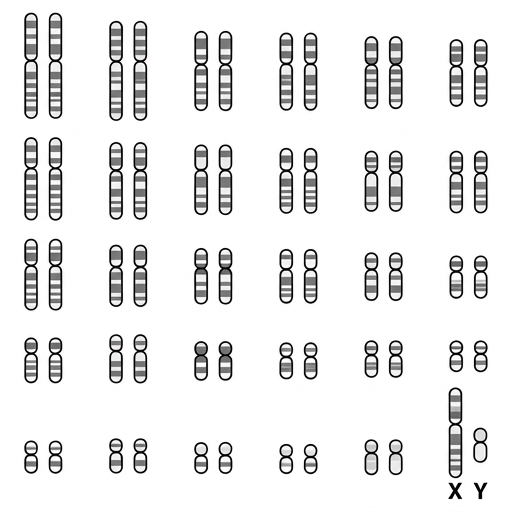
What does the karyogram show?
A. A male horse
B. A female horse
C. A male donkey
D. A female donkey
First, calculate the total number of chromosomes from the description of the karyogram. Then, use the sex chromosomes described to determine the sex of the animal. Finally, match this information with the species data provided.
Question 6
HardPaper 2 · calculator15 marksSexual reproduction in flowering plants involves the production of gametes by meiosis, followed by pollination and fertilization.
Outline the events that occur during prophase I of meiosis.
Describe the process of fertilization in flowering plants.
Explain how meiosis and sexual reproduction promote genetic variation in a population.
Think about what happens to the chromosomes before they align at the equator. How do homologous chromosomes interact?
Trace the path of the male gamete from the moment a pollen grain lands on the flower until it reaches the egg.
Consider the two main sources of variation during meiosis, and what happens when gametes from two different individuals combine.
Question 7
EasyPaper 1A · calculator1 markWhen a homozygous red bull is crossed with a homozygous white cow, all the offspring have a roan coat consisting of both red and white hairs. What is the pattern of inheritance and the reason for this?
| Inheritance | Reason | |
|---|---|---|
| A. | incomplete dominance | offspring show a blended phenotype of the parents' |
| B. | codominance | offspring show a blended phenotype of the parents' |
| C. | incomplete dominance | offspring show both parental phenotypes |
| D. | codominance | offspring show both parental phenotypes |
Consider whether the offspring's coat colour is a uniform intermediate shade (like pink) or if both original colours are distinctly visible at the same time.
Question 8
MediumPaper 2 · calculator5 marks(a) Compare and contrast the inheritance of cystic fibrosis and haemophilia.
Identify the type of chromosome each gene is located on (autosomal vs sex-linked) and whether the alleles are dominant or recessive. Consider how this affects the inheritance patterns and carrier status in males versus females.
Question 9
EasyPaper 1A · calculator1 markIn the four o'clock plant (Mirabilis jalapa), the alleles for red and white flower colour show incomplete dominance. Heterozygous plants produce pink flowers.
Two pink-flowering Mirabilis jalapa plants are crossed. What are the expected percentages of flower colour phenotypes in the offspring?
A. 25% red, 50% pink, 25% white
B. 75% pink, 25% white
C. 50% pink, 50% white
D. 100% pink
Write out the genotypes of the two pink parents, then draw a Punnett grid to find the proportion of each genotype in the offspring.
Question 10
MediumPaper 1A · calculator1 markIn Mirabilis jalapa, the allele for red flowers and the allele for white flowers show incomplete dominance. A plant with pink flowers is crossed with a plant with red flowers. What is the expected phenotype ratio of the offspring?
A. 100% red
B. 50% red and 50% pink
C. 75% red and 25% pink
D. 25% red, 50% pink and 25% white
Write out the genotypes for the pink and red plants, then use a Punnett grid to determine the offspring.
No question on this page matches those filters. Try another difficulty or paper.
Every Inheritance question, marked for you
Every answer is marked mark by mark, IB-style, and the AI tutor helps when you are stuck.
Where marks are lost
- Command terms are consistently under-read. Students answer describe when the question said explain, so they give an account with no reasons and cap at half marks. The reverse also happens on outline, where a student writes an essay for a 2-mark summary and runs out of time.
- compare and contrast answers give only similarities, or only differences.