Mutations and Gene Editing: notes and practice questions
- This topic covers the molecular basis of gene mutations and their role in genetic variation and disease.
- Gene mutations are structural changes at the molecular level, including substitutions, insertions, and deletions.
- Base substitutions may or may not alter the polypeptide due to the degeneracy of the genetic code.
- Insertions and deletions often cause frameshift mutations, leading to non-functional polypeptides.
- Gene mutations are caused by mutagens (chemical, radiation) and errors in DNA replication or repair.
- Mutations in germ cells are heritable, while somatic cell mutations can lead to cancer.
- Mutation is the original source of all genetic variation, essential for evolution by natural selection.
How it is examined
Sickle cell anaemia is the point mutation students bring, and the mark scheme normally accepts any correct named example. Frameshift questions want the reason: every codon downstream is altered, so the amino acid sequence changes from that point. CRISPR appears as a short outline or discuss the ethical issues item and rewards a named application.
- D1.3.1 Gene mutations as structural changes to genes at the molecular level. Distinguish between substitutions, insertions and deletions.
- D1.3.2 Consequences of base substitutions. Single-nucleotide polymorphisms (SNPs) result from base substitution mutations and, because of the degeneracy of the genetic code, may or may not change a single amino acid in a polypeptide.
- D1.3.3 Consequences of insertions and deletions, including the likelihood of polypeptides ceasing to function, either through frameshift changes or through major insertions or deletions.
- D1.3.4 Causes of gene mutation: mutagens, and errors in DNA replication or repair. Include examples of chemical mutagens and mutagenic forms of radiation.
- D1.3.8 Gene knockout as a technique for investigating the function of a gene by changing it to make it inoperative. A library of knockout organisms is available for some model species.
- D1.3.9 Use of the CRISPR sequences and the enzyme Cas9 in gene editing. Students should be familiar with an example of successful use of this technology. NOS: certain potential uses of CRISPR raise ethical issues that must be addressed before implementation, and scientists across the world are subject to different regulatory systems, so there is an international effort to harmonize regulation.
- D1.3.10 Hypotheses to account for conserved or highly conserved sequences in genes. Conserved sequences are identical or similar across a species or a group of species; highly conserved sequences are identical or similar over long periods of evolution. One hypothesis is functional requirements for the gene products, another is slower rates of mutation.
Guiding questions
- How do gene mutations occur?
- What are the consequences of gene mutation?
Linking questions
- How can natural selection lead to both a reduction in variation and an increase in biological diversity?
- How does variation in subunit composition of polymers contribute to function?
Practice questions
9 questions · 1 easy · 6 medium · 2 hardQuestion 1
EasyPaper 1A · calculator1 markIn a flowering plant, a mutation in which of the following cells could be passed on to its offspring?
A. A palisade mesophyll cell in the leaf
B. A guard cell in the epidermis
C. A pollen grain cell in the anther
D. A companion cell in the stem
Consider which of these cells is involved in sexual reproduction and the formation of gametes.
Question 2
MediumPaper 1A · calculator1 markWhich type of gene mutation is most likely to result in the synthesis of a completely non-functional protein?
A. A base substitution that changes a codon for valine (Val) to one for alanine (Ala).
B. A deletion of two nucleotides near the end of the coding sequence.
C. An insertion of one nucleotide near the start of the coding sequence.
D. A deletion of three consecutive nucleotides.
Consider the effect of each type of mutation on the reading frame of the genetic code. Think about where in the gene the mutation occurs and how that affects the length and amino acid sequence of the resulting polypeptide.
Question 3
HardPaper 2 · calculator15 marksMutations are the ultimate source of genetic variation.
(a) Sickle cell anaemia is a genetic disease caused by a single base substitution mutation. Outline the consequences of this mutation, from the DNA level to the protein produced.
(b) Haemophilia is a human disease caused by a sex-linked allele. Outline the inheritance pattern of haemophilia.
(c) Explain how the allele for sickle cell anaemia provides an example of natural selection in human populations.
Think about the central dogma: DNA -> mRNA -> protein. How does a change in the DNA base sequence affect the mRNA codon, and in turn, which amino acid is incorporated into the polypeptide chain?
Remember that sex-linked traits are carried on the X or Y chromosome. How does this affect how the trait is passed from parents to offspring, particularly the difference between males and females?
Consider the environmental context, specifically the presence of malaria. How does the sickle cell allele affect an individual's survival and reproduction (their 'fitness') in this environment? Think about the three possible genotypes.
Question 4
MediumPaper 2 · calculator5 marks(a) A patient is diagnosed with a tumour in their lung tissue following exposure to chemical mutagens.
Explain the characteristics and processes that would cause this tumour to be classified as life-threatening.
Think about the difference between benign and malignant tumours, how fast the cells are dividing, and how the cancer might spread to other organs.
Question 5
HardPaper 2 · calculator15 marks(a) Outline why viruses are classified as obligate parasites rather than living cells.
(b) Explain the concept of convergent evolution in the context of viral origins.
(c) Discuss the mechanisms of rapid evolution in viruses and the consequences for treating viral diseases.
Think about what structures and metabolic processes viruses lack, and what they must obtain from a host cell in order to replicate.
Do all viruses share a single common ancestor? Consider how different lineages might independently develop similar traits to survive as intracellular parasites.
Consider the mutation rates of RNA viruses like HIV or influenza, how new variation is generated, and how this affects the long-term efficacy of vaccines and antiviral drugs.
Question 6
MediumPaper 2 · calculator10 marks(a) Explain the possible effects of a single base substitution mutation on the structure and activity of an enzyme.
(b) Compare and contrast the effects of base substitutions with those of base insertions and deletions.
Think about how changing one letter in the DNA sequence affects the mRNA codons, the amino acids, and ultimately the 3D shape of the active site.
Consider how reading the genetic code in triplets is affected when you swap a base versus when you add or remove one. Make sure to include both similarities and differences.
Question 7
MediumPaper 1B · calculator10 marksAmino acid sequences of two Zika virus proteins were analysed from patient samples between 2015 and 2018 to determine the number of mutations compared to a reference strain. The pie charts show the distribution of mutations for the Envelope (E) protein and the Non-structural protein 5 (NS5).
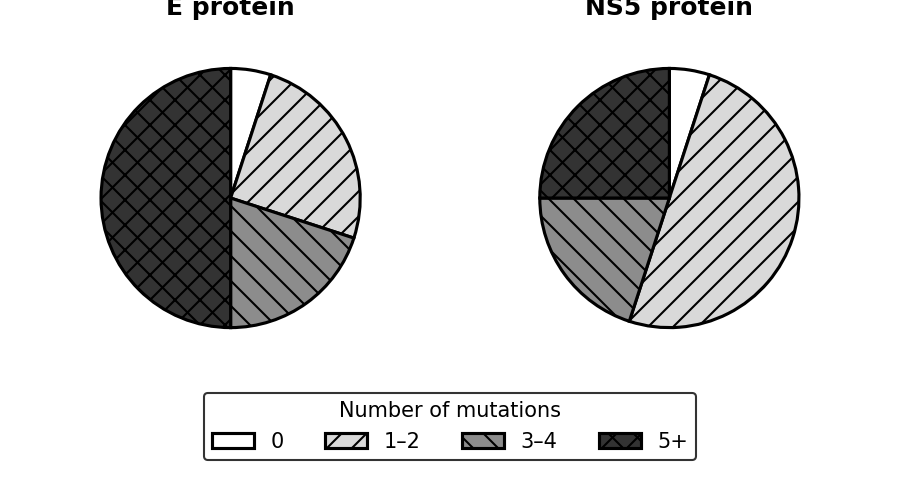
Compare and contrast the data for the two proteins.
The E protein is coded by 1512 bases in the viral genome and the NS5 protein is coded by 2712 bases. Deduce whether the difference in the number of mutations between the E and NS5 proteins is due to their gene lengths.
Mutations occur randomly during viral replication, but some specific base substitutions in the E protein gene were found in many patient samples, while other possible substitutions were never detected. Suggest reasons for these observations.
Look for both similarities (sectors that are the same size) and differences (sectors that are much larger in one chart than the other) to get full marks.
If mutation rate depended only on length, which gene would you expect to have more mutations? Does this match the data in the pie charts?
Think about how natural selection acts on viruses. What happens to a virus if a mutation makes it better at infecting cells, versus a mutation that destroys a crucial protein?
Question 8
MediumPaper 1A · calculator1 markWhat is a consequence of the genetic code being degenerate?
A. A single codon can code for more than one type of amino acid.
B. A base substitution mutation may not alter the polypeptide produced.
C. The same codons are translated into the same amino acids in almost all organisms.
D. A single tRNA molecule can bind to multiple different amino acids.
Recall the definition of 'degenerate' in the context of the genetic code. Does one codon code for many amino acids, or do many codons code for one amino acid?
Question 9
MediumPaper 1A · calculator1 markWhich statement about gene mutations is correct?
A. Base substitutions always change the amino acid sequence of a polypeptide.
B. Deletion of a single nucleotide typically results in a frameshift mutation.
C. Mutations in somatic cells are passed on to offspring.
D. Mutations are directed by the organism to adapt to environmental changes.
Consider the degeneracy of the genetic code and the difference between somatic and germ cells.
No question on this page matches those filters. Try another difficulty or paper.
Every Mutations and Gene Editing question, marked for you
Every answer is marked mark by mark, IB-style, and the AI tutor helps when you are stuck.
Where marks are lost
- Command terms are consistently under-read. Students answer describe when the question said explain, so they give an account with no reasons and cap at half marks. The reverse also happens on outline, where a student writes an essay for a 2-mark summary and runs out of time.
- compare and contrast answers give only similarities, or only differences.