Diversity of Organisms: notes and practice questions
- This topic explores the variation among organisms, species concepts, binomial nomenclature, and genomic diversity.
- Species are defined as groups of organisms that can breed to produce fertile offspring (biological species concept).
- The binomial system uses a capitalized genus name and a lowercase species name for identification.
- Karyotyping involves classifying chromosomes by banding patterns, length, and centromere position.
- Genomes within a species share most information, with diversity arising from variations like single-nucleotide polymorphisms.
- Whole genome sequencing is used to study evolutionary relationships and for personalized medicine.
- Skills include comparing genome sizes from databases and classifying chromosomes from karyograms.
How it is examined
Binomial naming and the biological species concept are Paper 1A and short-answer Paper 2 staples. Karyograms appear as image-based items. Paper 1B has used genome-size or biodiversity tables for compare, deduce and suggest. Marks are lost on the species concept when a student writes "can breed" and omits "fertile offspring".
- A3.1.1 Variation between organisms as a defining feature of life. No two individuals are identical in all their traits, and the patterns of variation are the basis for naming and classifying organisms.
- A3.1.2 Species as groups of organisms with shared traits. This is the original morphological concept used by Linnaeus.
- A3.1.3 Binomial system for naming organisms. First part is the genus, second distinguishes the species. Species in the same genus have similar traits. Genus takes an initial capital, species is lowercase.
- A3.1.4 Biological species concept: a group of organisms that can breed and produce fertile offspring. Include the challenges with this definition and that competing definitions exist.
- A3.1.12 Difficulty applying the biological species concept to asexually reproducing species and to bacteria with horizontal gene transfer.
- A3.1.13 Chromosome number as a shared trait within a species. Cross-breeding between closely related species is unlikely to give fertile offspring if parent chromosome numbers differ.
- A3.1.14 Engagement with local plant or animal species to develop a dichotomous key. Application of skills.
- A3.1.15 Identification of species from environmental DNA in a habitat using barcodes, which lets habitat biodiversity be investigated rapidly.
Guiding questions
- What is a species?
- What patterns are seen in the diversity of genomes within and between species?
Linking questions
- What might cause a species to persist or go extinct?
- How do species exemplify both continuous and discontinuous patterns of variation?
Practice questions
7 questions · 4 easy · 2 medium · 1 hardQuestion 1
EasyPaper 1A · calculator1 markThe image shows a human karyogram. What is the sex of this individual and which pair of chromosomes determines it?
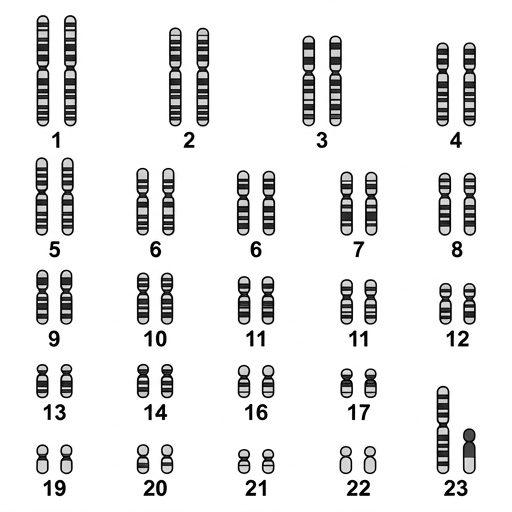
A. Female, determined by pair 22
B. Male, determined by pair 22
C. Female, determined by pair 23
D. Male, determined by pair 23
Remember that human chromosomes are arranged in pairs from largest to smallest. The final pair are the sex chromosomes. Consider the combination of sex chromosomes that determines male versus female.
Question 2
MediumPaper 1A · calculator1 markThe karyogram is from an animal in the genus Equus. Members of this genus have an XY sex-determination system. Horses (Equus caballus) have a diploid number of 64. Donkeys (Equus asinus) have a diploid number of 62.
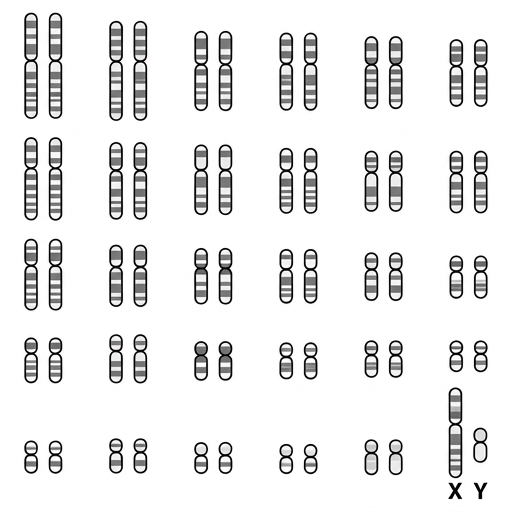
What does the karyogram show?
A. A male horse
B. A female horse
C. A male donkey
D. A female donkey
First, calculate the total number of chromosomes from the description of the karyogram. Then, use the sex chromosomes described to determine the sex of the animal. Finally, match this information with the species data provided.
Question 3
HardPaper 2 · calculator10 marks(a) The diagram shows an example of hybridization between a domestic sheep and a goat, which occasionally occurs when they are kept in the same pasture.
Ovis aries (diploid chromosome number = 54) Capra hircus (diploid chromosome number = 60)
interspecific hybrid
Predict, with reasons, the diploid chromosome number of the interspecific hybrid.
(b) Only a few such hybrids have ever been born alive. If more were discovered, predict, with reasons, whether they would be genetically identical.
(c) Explain, with reasons, whether the interspecific hybrid is likely to be able to produce gametes.
Consider the number of chromosomes that each parent will contribute to their gametes during meiosis.
Think about whether all individuals within a single species are genetically identical, and what causes variation in the gametes they produce.
Recall what must happen to chromosomes during prophase I of meiosis for gametes to be successfully produced.
Question 4
EasyPaper 1A · calculator1 markTwo populations of birds live on adjacent islands. They have similar plumage and feed on the same seeds. Which observation would provide the strongest evidence that they belong to the same species, according to the biological species concept?
A. They have the same diploid number of chromosomes.
B. They can interbreed and produce fertile offspring.
C. They occupy identical ecological niches on both islands.
D. They have similar base sequences in their mitochondrial DNA.
Recall the specific definition of the biological species concept and what it requires for two organisms to be grouped together.
Question 5
MediumPaper 1A · calculator1 markA scientist is studying three microorganisms (P, Q, and R) isolated from a soil sample. The presence (+) or absence (–) of several cellular structures was recorded for each, as shown in the table.
| Feature | Organism P | Organism Q | Organism R |
|---|---|---|---|
| Nucleus | – | + | + |
| 80S ribosomes | – | + | + |
| Mitochondria | – | + | + |
| Chloroplasts | – | + | – |
| Cell wall | + | + | – |
Based on the data, what are the most likely classifications for these microorganisms?
| P | Q | R | |
|---|---|---|---|
| A. | Prokaryote | Plant | Animal |
| B. | Fungus | Plant | Animal |
| C. | Prokaryote | Animal | Plant |
| D. | Plant | Prokaryote | Animal |
First, use the presence or absence of a nucleus to distinguish between prokaryotes and eukaryotes. Then, use the other organelles, such as the cell wall and chloroplasts, to differentiate between the types of eukaryotes.
Question 6
EasyPaper 1A · calculator1 markThe table shows the binomial naming of four plant species.
| Organism | Genus | Species |
|---|---|---|
| P | Pinus | nigra |
| Q | Sambucus | nigra |
| R | Populus | nigra |
| S | Pinus | sylvestris |
What can be concluded?
A. P, Q and R are the most closely related.
B. Q and R are the most closely related.
C. P and S are the most closely related.
D. P is equally related to all the other species.
In the binomial system, the first name is the genus and the second is the species. Organisms in the same genus share a more recent common ancestor.
Question 7
EasyPaper 1A · calculator1 markThe butterfly genus Heliconius from South America has evolved several different forms with distinct wing patterns, depending on their location.
What determines if two of these forms are members of the same species?
A. They occupy the same ecological niche
B. They can interbreed
C. They produce fertile offspring
D. They have similar physical characteristics
Recall the biological species concept. What is the key requirement for the offspring of a mating pair to ensure the lineage continues?
No question on this page matches those filters. Try another difficulty or paper.
Every Diversity of Organisms question, marked for you
Every answer is marked mark by mark, IB-style, and the AI tutor helps when you are stuck.
Where marks are lost
- Command terms are consistently under-read. Students answer describe when the question said explain, so they give an account with no reasons and cap at half marks. The reverse also happens on outline, where a student writes an essay for a 2-mark summary and runs out of time.