Ecological Niches: notes and practice questions
- This topic defines ecological niches and explores how organisms interact with their environment and obtain resources.
- An ecological niche encompasses all biotic and abiotic interactions influencing a species' growth, survival, and reproduction, including its food sources.
- Organisms are classified by oxygen tolerance: obligate anaerobes, facultative anaerobes, and obligate aerobes.
- Modes of nutrition include photosynthesis (autotrophic), holozoic (heterotrophic), mixotrophic (both), and saprotrophic (decomposers).
- Adaptations for feeding, resisting herbivory, and predation are crucial for survival within a niche.
- A fundamental niche represents a species' potential role, while a realized niche is its actual role under competition.
- Competitive exclusion can occur when species compete for limited resources, restricting their realized niches.
How it is examined
Fundamental versus realized niche is a distinguish item where the mark hinges on "in the absence of competition" versus "in the presence of competition". Modes of nutrition questions want the defining feature, so "saprotroph" needs external digestion and absorption of the products, not just "feeds on dead matter". Skull and dentition images appear in Paper 1B.
- B4.2.1 Ecological niche as the role of a species in an ecosystem, including the biotic and abiotic interactions that influence growth, survival and reproduction, and how a species obtains food.
- B4.2.2 Differences between obligate anaerobes, facultative anaerobes and obligate aerobes, limited to their tolerance of the presence or absence of oxygen gas.
- B4.2.3 Photosynthesis as the mode of nutrition in plants, algae and several groups of photosynthetic prokaryotes.
- B4.2.4 Holozoic nutrition in animals. All animals are heterotrophic; in holozoic nutrition food is ingested, digested internally, absorbed and assimilated.
Guiding questions
- What are the advantages of specialized modes of nutrition to living organisms?
- How are the adaptations of a species related to its niche in an ecosystem?
Linking questions
- What are the relative advantages of specificity and versatility?
- For each form of nutrition, what are the unique inputs, processes and outputs?
Practice questions
12 questions · 4 easy · 7 medium · 1 hardQuestion 1
EasyPaper 1A · calculator1 markAn organism secretes extracellular enzymes onto dead organic material and absorbs the digested nutrients. What is its mode of nutrition?
A. Holozoic
B. Parasitic
C. Saprotrophic
D. Autotrophic
Think about the key features of different feeding strategies. Where does digestion occur in this organism compared to, for example, a human?
Question 2
MediumPaper 1A · calculator1 markThe classic experiments by G.F. Gause involved growing two species of protists, Paramecium aurelia and Paramecium caudatum, in laboratory cultures. When grown in separate flasks with a constant supply of bacteria for food, both populations grew to a stable carrying capacity. However, when grown together in the same flask, the population of P. caudatum was driven to extinction. What can be concluded from these results?
I. The fundamental niches of the two species overlap.
II. The realized niche of P. caudatum in the mixed culture was zero.
III. The two species exhibited resource partitioning.
A. I only
B. I and II only
C. II and III only
D. I, II and III
Consider the definitions of fundamental niche, realized niche, competitive exclusion, and resource partitioning. How does the outcome of the experiment (extinction of one species) relate to these concepts?
Question 3
HardPaper 2 · calculator15 marks(a) Distinguish between a fundamental niche and a realized niche.
(b) Compare and contrast the relationships of mutualism and parasitism.
(c) Explain how the carrying capacity of an environment is determined by limiting factors and species interactions.
Think about the difference between where a species could live based on its physical tolerances, versus where it actually lives due to competition.
Identify what both relationships have in common regarding the species involved, and then contrast how each species is affected (positively or negatively).
Consider both the physical resources a population needs to grow and the biological interactions (like predators or diseases) that keep a population from growing indefinitely.
Question 4
EasyPaper 1A · calculator1 markWhich row correctly matches the mode of nutrition with its method of obtaining carbon compounds?
| Mode of nutrition | Method of obtaining carbon compounds | |
|---|---|---|
| A. | Holozoic | Absorption of nutrients directly from the fluids of a living host |
| B. | Saprotrophic | External digestion of dead organic matter followed by absorption |
| C. | Mixotrophic | Exclusive reliance on light energy to synthesize organic molecules |
| D. | Autotrophic | Ingestion of other organisms followed by internal digestion |
Recall the difference between internal and external digestion, and consider which organisms can switch between making their own food and consuming others.
Question 5
MediumPaper 2 · calculator5 marksThe clownfish (Amphiprioninae) is a genus of fish that lives in a close relationship with sea anemones. The sea anemone has stinging tentacles that are lethal to most other fish, but the clownfish is able to live among them without being harmed.
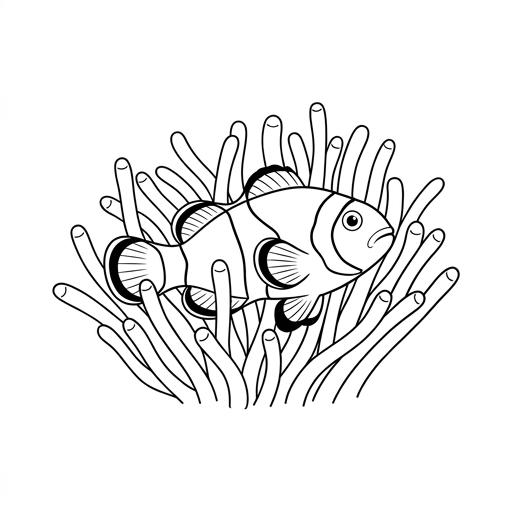
(a) Explain the type of ecological relationship between the clownfish and the sea anemone.
(b) State one adaptation of the clownfish that allows it to live unharmed among the anemone's tentacles.
(c) The relationship with the sea anemone is a key part of the clownfish's realized niche. Distinguish between a fundamental niche and a realized niche.
Consider how each organism is affected by the interaction. Does one benefit? Do both benefit? Does one suffer harm?
Think about what prevents the anemone's stinging cells from affecting the clownfish.
One term refers to the potential role of a species, while the other refers to its actual role. What factors cause the difference between the two?
Question 6
EasyPaper 1A · calculator1 markWhich of the following correctly describes a saprotrophic mode of nutrition?
A. Ingestion of solid organic matter followed by internal digestion
B. Synthesis of organic molecules from inorganic substances using light energy
C. Secretion of digestive enzymes into the environment and absorption of the products
D. Obtaining energy from both photosynthesis and the ingestion of other organisms
Think about how decomposers like fungi obtain their nutrients compared to animals or plants.
Question 7
MediumPaper 2 · calculator7 marks(a) Distinguish between a fundamental niche and a realized niche.
(b) Distinguish between holozoic and saprotrophic modes of nutrition.
(c) Distinguish between an obligate anaerobe and a facultative anaerobe.
Think about the theoretical range of conditions a species can survive in versus where it actually lives due to interactions with other species.
Consider where the digestion of food takes place for each type of organism.
How does the presence or absence of oxygen affect the survival and respiration of these two types of organisms?
Question 8
EasyPaper 1A · calculator1 markWhat distinguishes saprotrophic nutrition from holozoic nutrition?
A. Saprotrophs digest organic matter externally, whereas holozoic organisms digest it internally.
B. Saprotrophs feed exclusively on living organisms, whereas holozoic organisms feed on dead organic matter.
C. Saprotrophs are always unicellular, whereas holozoic organisms are always multicellular.
D. Saprotrophs absorb inorganic carbon, whereas holozoic organisms absorb organic carbon.
Consider where the enzymes are released and where the actual breakdown of the food molecules takes place for each mode of nutrition.
Question 9
MediumPaper 2 · calculator10 marks(a.i) Ruminococcus albus is a bacterium found in the rumen (first stomach) of cattle. It breaks down cellulose from ingested grass and produces acetate () as a waste product.
Identify, with a reason, whether R. albus is autotrophic, heterotrophic or mixotrophic.
(a.ii) Identify, with a reason, whether R. albus is holozoic or saprotrophic.
(b) R. albus is difficult to study in standard laboratory conditions because it dies rapidly when exposed to air. Explain two conclusions that can be drawn from this observation.
(c) The epithelial cells of the cow's rumen absorb the acetate produced by the bacteria. Suggest how the cow's cells might use this substance.
Consider the source of carbon for this bacterium and whether it has access to light energy in its habitat.
Think about how bacteria process their food compared to animals that possess a digestive tract.
What term describes organisms that cannot tolerate oxygen, and what does this imply about the conditions inside the cow's stomach?
Acetate is a carbon compound. What cellular process uses carbon compounds to release energy?
Question 10
MediumPaper 1A · calculator1 markAn influx of agricultural fertilizer into a lake causes a rapid increase in the population of algae. Following the death of the algae, the dissolved oxygen concentration in the lake drops significantly.
Which process is directly responsible for this decrease in oxygen?
A. Aerobic respiration by saprotrophic bacteria
B. Cessation of photosynthesis by the dead algae
C. Anaerobic respiration by decomposers
D. Aerobic respiration by primary consumers
Consider what happens to the organic matter of the algae after they die and which organisms are responsible for breaking it down.
Question 11
MediumPaper 1A · calculator1 markWhich statement(s) correctly describe(s) the ecological niche of a species?
I. The fundamental niche represents the potential range of conditions a species can tolerate.
II. Interspecific competition can cause a species' realized niche to be smaller than its fundamental niche.
III. Two species with identical realized niches can coexist indefinitely in the same habitat.
A. I only
B. I and II only
C. II and III only
D. I, II and III
Recall the competitive exclusion principle and the difference between the potential conditions a species can survive in versus the actual conditions it occupies when competitors are present.
Question 12
MediumPaper 1A · calculator1 markOn the rocky shores of Scotland, two species of barnacles, Chthamalus stellatus and Balanus balanoides, occupy different zones. Chthamalus is typically found in the upper intertidal zone, while Balanus is found in the lower intertidal zone. When Balanus was experimentally removed from the lower zone, Chthamalus was able to colonize and thrive in this area. However, Balanus could not survive in the upper zone, even when Chthamalus was removed, due to excessive desiccation (drying out).
What can be concluded from these observations?
I. The fundamental niche of Chthamalus is larger than its realized niche.
II. The distribution of Balanus is limited by an abiotic factor.
III. The two species are in a mutualistic relationship.
A. I only
B. I and II only
C. II and III only
D. I, II and III
Consider the definitions of fundamental and realized niches. The fundamental niche is where a species could live without competition, while the realized niche is where it does live. Also, consider what limits the distribution of each species – is it another species (biotic) or a physical factor (abiotic)?
No question on this page matches those filters. Try another difficulty or paper.
Every Ecological Niches question, marked for you
Every answer is marked mark by mark, IB-style, and the AI tutor helps when you are stuck.
Where marks are lost
- Command terms are consistently under-read. Students answer describe when the question said explain, so they give an account with no reasons and cap at half marks. The reverse also happens on outline, where a student writes an essay for a 2-mark summary and runs out of time.
- compare and contrast answers give only similarities, or only differences.