Homeostasis: notes and practice questions
- This topic covers the maintenance of constant internal conditions in organisms, known as homeostasis.
- Homeostatic variables include body temperature, blood pH, blood glucose concentration, and blood osmotic concentration.
- Negative feedback loops return homeostatic variables to a set point, counteracting fluctuations.
- Regulation of blood glucose involves insulin and glucagon from pancreatic endocrine cells.
- Thermoregulation is a negative feedback control involving peripheral thermoreceptors, hypothalamus, pituitary gland, thyroxin, muscle, and adipose tissue.
- Human thermoregulation mechanisms include vasodilation, vasoconstriction, shivering, sweating, uncoupled respiration in brown adipose tissue, and hair erection.
- Understand physiological changes, risk factors, and treatment for type 1 and type 2 diabetes.
How it is examined
Blood glucose regulation is a guaranteed outline or explain item, and the mark scheme awards separately for the rise, the pancreatic cell type, the hormone, the target organ, the effect and the return to set point. Type 1 versus type 2 diabetes is a distinguish item where the mark hinges on failure to produce insulin against failure of target cells to respond. At HL, ADH questions want the aquaporin relocation, not just "more water is reabsorbed".
- D3.3.1 Homeostasis as maintenance of the internal environment of an organism. Variables are kept within preset limits despite fluctuations in the external environment. The named homeostatic variables in humans are body temperature, blood pH, blood glucose concentration and blood osmotic concentration.
- D3.3.2 Negative feedback loops in homeostasis. Students should understand why negative rather than positive feedback is used, and that negative feedback returns variables to the set point from values both above and below it.
- D3.3.3 Regulation of blood glucose as an example of the role of hormones in homeostasis, including control of secretion of insulin and glucagon by pancreatic endocrine cells, transport in blood, and the effects on target cells.
- D3.3.4 Physiological changes that form the basis of type 1 and type 2 diabetes, together with risk factors and methods of prevention and treatment.
Human thermoregulation only. Detail for other endotherms is not required.
- D3.3.7 Role of the kidney in osmoregulation and excretion, including the distinction between the two. Osmoregulation is regulation of osmotic concentration, and the units are osmoles per litre (osmol L^-1).
- D3.3.8 Role of the glomerulus, Bowman's capsule and proximal convoluted tubule in excretion. Ultrafiltration removes solutes from blood plasma and useful substances are then reabsorbed, leaving toxins and other unwanted solutes in the filtrate to be excreted in urine.
- D3.3.9 Role of the loop of Henle, limited to active transport of sodium ions in the ascending limb to maintain high osmotic concentrations in the medulla, facilitating water reabsorption in the collecting ducts.
- D3.3.10 Osmoregulation by water reabsorption in the collecting ducts, including the roles of osmoreceptors in the hypothalamus, changes to the rate of antidiuretic hormone secretion by the pituitary gland, and the resulting switches in location of aquaporins between cell membranes and intracellular vesicles in collecting duct cells.
Guiding questions
- How are constant internal conditions maintained in humans?
- What are the benefits to organisms of maintaining constant internal conditions?
Linking questions
- For what reasons do organisms need to distribute materials and energy?
- What biological systems are sensitive to temperature changes?
Practice questions
12 questions · 3 easy · 8 medium · 1 hardQuestion 1
EasyPaper 1A · calculator1 markWhich of the following is an example of a positive feedback mechanism?
A. The release of glucagon when blood glucose levels are low.
B. The constriction of blood vessels in the skin when body temperature falls.
C. The release of oxytocin to stimulate contractions during childbirth.
D. An increase in the rate of breathing when blood CO₂ concentration rises.
Positive feedback mechanisms amplify or reinforce the initial change, moving the system further away from its starting state. Negative feedback mechanisms counteract the change to restore balance.
Question 2
MediumPaper 2 · calculator15 marksLiving organisms must maintain a stable internal environment, a process known as homeostasis.
(a) Explain the control of blood glucose concentration in humans.
(b) Explain the effect of pH on the activity of enzymes.
(c) Distinguish between the transport of glucose and oxygen in the blood, with reference to the properties of water.
Think about the two key hormones released from the pancreas. What triggers the release of each hormone, what are their target cells, and what is the resulting effect on blood glucose levels?
Consider how pH affects the chemical bonds that maintain a protein's specific three-dimensional shape. What is the term for the irreversible change in an enzyme's structure, and how does this affect its function?
Compare the polarity of glucose and oxygen molecules. How does this property affect how well each substance can dissolve in the main component of blood plasma, which is water?
Question 3
HardPaper 2 · calculator10 marksA group of volunteers participated in an Arctic expedition where they were exposed to extreme cold. During the expedition, their core body temperatures and blood glucose concentrations were continuously monitored.
Compare the roles of insulin and glucagon in regulating the volunteers' blood glucose concentrations.
One of the volunteers was previously diagnosed with Type 2 diabetes. Distinguish between Type 1 and Type 2 diabetes.
Outline the roles of muscle and adipose tissue in the physiological responses used by the volunteers to maintain their core body temperature.
Think about where these hormones are produced, what organs they target, and how their effects on blood glucose levels differ.
Consider the underlying causes (beta cells vs. receptors), typical age of onset, risk factors, and how each type is primarily treated.
Identify the different types of muscle (skeletal, smooth) and adipose tissue (brown, white) and describe how each contributes to generating heat or preventing heat loss.
Question 4
EasyPaper 1A · calculator1 markThe diagram shows part of the negative feedback mechanism that regulates blood glucose concentration.
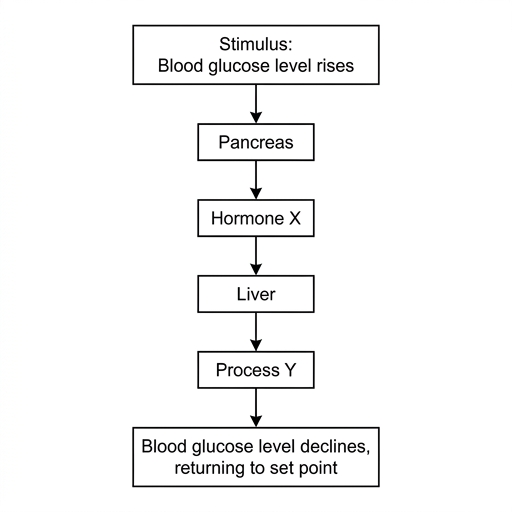
Which row correctly identifies Hormone X and Process Y?
| Hormone X | Process Y | |
|---|---|---|
| A. | Glucagon | Glycogen is converted to glucose |
| B. | Insulin | Glycogen is converted to glucose |
| C. | Glucagon | Glucose is converted to glycogen |
| D. | Insulin | Glucose is converted to glycogen |
When blood glucose levels are high, the body needs to store the excess glucose. Consider which hormone is released by the pancreas in this situation and what molecule glucose is converted into for storage in the liver.
Question 5
MediumPaper 2 · calculator15 marksThe circulatory system transports essential substances, including hormones, which are vital for maintaining a stable internal environment (homeostasis).
(a) Outline how the structures of arteries and capillaries are related to their functions.
(b) Explain the roles of insulin and glucagon in the homeostatic control of blood glucose concentration.
(c) Discuss the causes and treatments for type 2 diabetes.
Think about the pressure of the blood in each vessel type. How does the wall structure and the size of the lumen help the vessel perform its job of either transporting blood under pressure or exchanging materials?
This is a negative feedback loop. Consider what happens when blood sugar is too high and what happens when it is too low. Which hormone is released in each case, where does it come from, and what does it make the target cells do?
Focus on type 2 diabetes specifically. What is the underlying problem with the insulin signalling pathway? How can lifestyle changes and medical interventions help manage this condition?
Question 6
EasyPaper 1A · calculator1 markWhich row correctly matches the endocrine gland, the hormone it secretes, and its primary action?
| Gland | Hormone | Action | |
|---|---|---|---|
| A. | Pancreas | Insulin | Increases blood glucose concentration |
| B. | Adrenal | Epinephrine | Prepares the body for vigorous activity |
| C. | Pineal | Melatonin | Increases metabolic rate |
| D. | Thyroid | Thyroxin | Regulates circadian rhythms |
Recall which hormone is responsible for the 'fight or flight' response and where it is produced. Pay close attention to whether the action listed matches the specific hormone.
Question 7
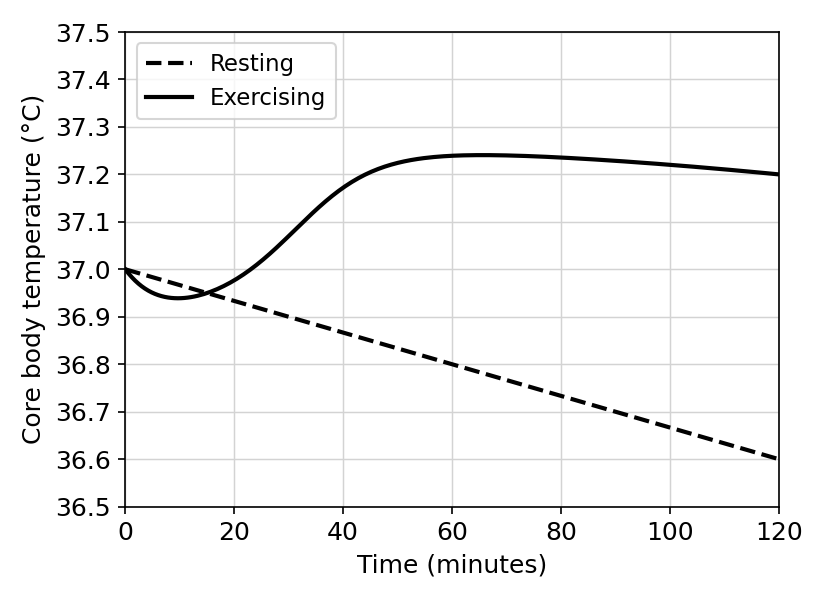
MediumPaper 2 · calculator12 marksThermoregulation is a key homeostatic process. A study investigated the response of human participants to a cold environment (). Participants were divided into two groups: one group remained at rest, while the other performed moderate exercise on a stationary bicycle. Core body temperature was measured every 15 minutes for two hours.
{width="3.6in"}
(a) Describe the trend in core body temperature for the exercising group.
(b) Compare the core body temperature in the resting group with the exercising group over the 120-minute period.
(c) Suggest a reason for the difference in core body temperature observed between the two groups.
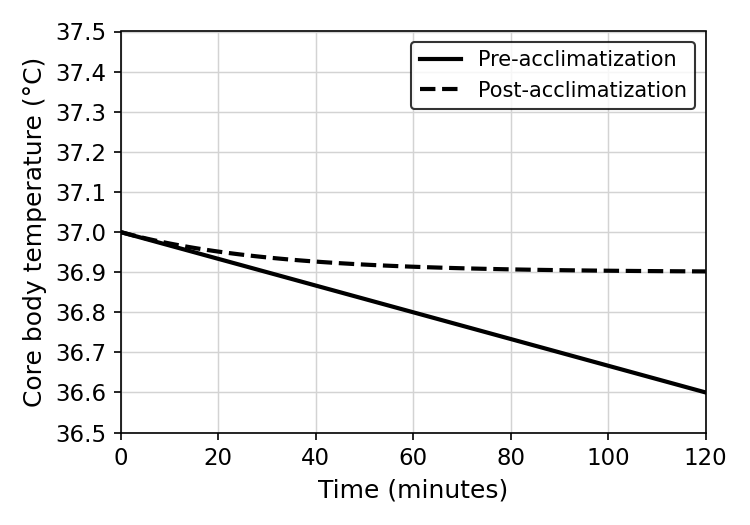
(d) The resting group then underwent a 10-week cold acclimatization program, involving regular, controlled exposure to cold. Their core body temperature response to the same cold environment () at rest was measured again.
{width="3.6in"}
Distinguish between the results pre- and post-acclimatization.
(e) Suggest why participants were required to rest in a thermoneutral room () for 30 minutes before each experimental trial.
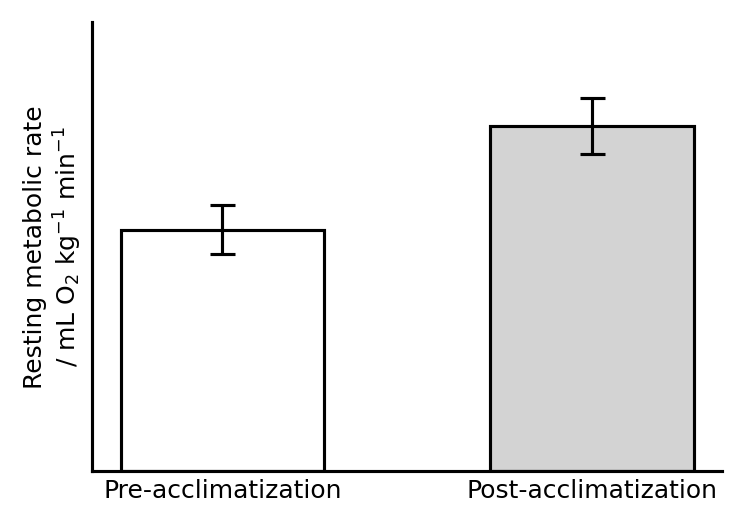
(f) The study also measured the resting metabolic rate of the participants before and after the acclimatization program.
{width="3.6in"}
Describe the difference in resting metabolic rate before and after the program.
(g) Suggest how an increased resting metabolic rate might contribute to the improved tolerance to cold shown in part (d).
(h) The hormone thyroxin is involved in regulating metabolic rate. Outline the role of thyroxin in thermoregulation.
Look at the line representing the 'Exercising' group. How does the temperature change from the start of the experiment to the end? Break down the trend into different phases if necessary.
A comparison requires you to state both similarities and differences. Look at the starting points, the direction of change, and the final values for both lines on the graph.
Consider the physiological effects of exercise. What does muscle activity produce besides movement?
To distinguish is to point out the differences. How does the 'Post-acclimatization' curve differ from the 'Pre-acclimatization' curve in terms of the magnitude and rate of temperature change?
Think about the principles of a controlled experiment. Why is it important for all subjects to begin the experiment from the same physiological state?
Simply state the change shown in the bar chart. Compare the height of the 'Post-acclimatization' bar to the 'Pre-acclimatization' bar.
What is the relationship between metabolic rate and body heat? If the body's 'engine' is running faster at rest, what effect does this have on heat production?
Recall the endocrine control of metabolism. Which gland secretes thyroxin, and what is its primary effect on the body's cells that relates to heat?
Question 8
MediumPaper 1B · calculator9 marks(a) The graph shows the results of an experiment in which the oxygen consumption rate of deer mice (Peromyscus maniculatus) was measured at various environmental temperatures from to . Between and , the mice maintained a constant core body temperature, but above their body temperature increased.
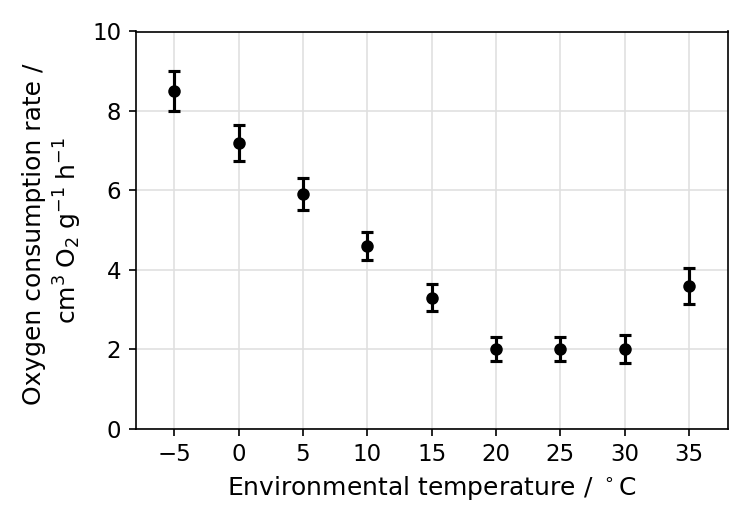
Describe the relationship between environmental temperature and oxygen consumption rate in the deer mice.
(b) Explain the change in oxygen consumption rate as the environmental temperature drops from to .
(c) Suggest a reason for the change in oxygen consumption rate as environmental temperatures increased from to .
(d) Suggest two reasons for the variation in oxygen consumption rate between individual mice at each environmental temperature.
Look at the three distinct sections of the graph: below , between and , and above . State what happens to the oxygen consumption in each temperature range.
Consider what oxygen is used for in cells and how the products of this process help a mammal survive in cold temperatures.
Think about what physiological processes a mammal might use to cool down, and whether these processes require energy.
What natural differences exist between individuals of the same species that could affect their metabolism or heat loss?
Question 9
MediumPaper 2 · calculator5 marksThe emperor penguin (Aptenodytes forsteri) lives in the Antarctic, where external temperatures can drop significantly. Despite this, it maintains a constant internal environment.
Explain the costs and benefits of homeostasis for organisms such as the emperor penguin.
Think about why enzymes and cells need specific conditions to function properly, and what the organism must expend to keep these conditions stable when the outside environment changes.
Question 10
MediumPaper 1A · calculator1 markThe table shows the relative rates of cellular respiration and ATP production in two human tissues, X and Y, during exposure to a cold environment (5 °C).
| Tissue | Rate of cellular respiration | Rate of ATP production |
|---|---|---|
| X | High | Low |
| Y | High | High |
Which of the following correctly identifies tissue X and its thermoregulatory mechanism?
A. Brown adipose tissue; it generates heat through uncoupled respiration.
B. Skeletal muscle; it generates heat through involuntary shivering.
C. White adipose tissue; it provides thermal insulation to reduce heat loss.
D. Skin arterioles; they undergo vasoconstriction to redirect blood flow.
Consider what happens to the energy released from cellular respiration if it is not being captured in ATP molecules.
Question 11
MediumPaper 1A · calculator1 markWhich physiological mechanism directly increases heat production when a human is exposed to a cold environment?
A. Vasoconstriction of peripheral blood vessels
B. Uncoupled respiration in brown adipose tissue
C. Contraction of hair erector muscles
D. Decreased secretion of thyroxin by the thyroid gland
Distinguish between mechanisms that conserve existing body heat by reducing heat loss, and those that actively generate new heat.
Question 12
MediumPaper 1A · calculator1 markWhich combination of physiological responses occurs when human body temperature rises above the normal set point?
A. Vasodilation of skin arterioles and decreased thyroxin secretion
B. Vasoconstriction of skin arterioles and increased sweating
C. Vasodilation of skin arterioles and increased uncoupled respiration in brown adipose tissue
D. Vasoconstriction of skin arterioles and increased thyroxin secretion
Consider which mechanisms increase heat loss to the environment and which mechanisms reduce internal heat production.
No question on this page matches those filters. Try another difficulty or paper.
Every Homeostasis question, marked for you
Every answer is marked mark by mark, IB-style, and the AI tutor helps when you are stuck.
Where marks are lost
- Command terms are consistently under-read. Students answer describe when the question said explain, so they give an account with no reasons and cap at half marks. The reverse also happens on outline, where a student writes an essay for a 2-mark summary and runs out of time.
- compare and contrast answers give only similarities, or only differences.