Water Potential: notes and practice questions
- This topic covers the movement of water into and out of cells by osmosis and its consequences for living organisms.
- Water acts as a solvent due to hydrogen bonding and attractions to polar or charged molecules.
- Water moves from less concentrated (hypotonic) to more concentrated (hypertonic) solutions via osmosis.
- In an isotonic environment, there is dynamic equilibrium of water movement.
- Animal cells swell and burst in hypotonic solutions, and shrink (crenation) in hypertonic solutions.
- Plant cells develop turgor pressure in hypotonic solutions and undergo plasmolysis in hypertonic solutions due to the cell wall.
- Isotonic solutions are used in medical applications, such as intravenous fluids.
How it is examined
The potato-in-sucrose experiment is the canonical data item: percentage change in mass plotted against solute concentration, with the isotonic point read off where the line crosses zero. That appears in Paper 1B and in Paper 2 data questions, and the mark for the isotonic point requires the student to say it is where there is no net change in mass. At HL, sign conventions matter: water moves from less negative to more negative water potential, and getting the direction backwards costs every mark in the chain.
- D2.3.1 Solvation with water as the solvent, including hydrogen bond formation between solute and water molecules, and attractions between both positively and negatively charged ions and polar water molecules.
- D2.3.2 Water movement from less concentrated to more concentrated solutions. Students should express the direction of movement in terms of solute concentration, not water concentration, and should use "hypertonic", "hypotonic" and "isotonic".
- D2.3.3 Water movement by osmosis into or out of cells. Students should predict the direction of net movement in a hypotonic or hypertonic environment, and understand that in an isotonic environment there is dynamic equilibrium rather than no movement of water.
- D2.3.4 Changes due to water movement in plant tissue bathed in hypotonic and hypertonic solutions. Application of skills: measure changes in tissue length and mass, analyse data to deduce isotonic solute concentration, and use standard deviation and standard error in the analysis. Standard error can be shown graphically as error bars.
- D2.3.8 Water potential as the potential energy of water per unit volume. It is impossible to measure the absolute quantity, so values relative to pure water at atmospheric pressure and 20 degrees Celsius are used. Units are usually kilopascals (kPa).
- D2.3.9 Movement of water from higher to lower water potential, understood in terms of potential energy.
- D2.3.10 Contributions of solute potential and pressure potential to the water potential of cells with walls. Use the equation: > ψw = ψs + ψp where ψw is water potential, ψs is solute potential and ψp is pressure potential. Solute potentials range from zero downwards. Pressure potentials are generally positive inside cells, although negative pressure potentials occur in xylem vessels where sap is transported under tension.
- D2.3.11 Water potential and water movements in plant tissue. Students should be able to explain, in terms of solute and pressure potentials, the changes that occur when plant tissue is bathed in either a hypotonic or hypertonic solution.
Guiding questions
- What factors affect the movement of water into or out of cells?
- How do plant and animal cells differ in their regulation of water movement?
Linking questions
- What variables influence the direction of movement of materials in tissues?
- What are the implications of solubility differences between chemical substances for living organisms?
Practice questions
7 questions · 2 easy · 2 medium · 3 hardQuestion 1
EasyPaper 1A · calculator1 markA sample of mammalian red blood cells is placed into a hypertonic sodium chloride solution.
Predict the direction of net water movement and the effect on the cells.
A. Net water movement is into the cells, causing them to swell and burst.
B. Net water movement is into the cells, causing them to undergo crenation.
C. Net water movement is out of the cells, causing them to undergo crenation.
D. Net water movement is out of the cells, causing them to undergo plasmolysis.
Recall that during osmosis, net water movement occurs toward the solution with the higher solute concentration. Consider the specific term used for an animal cell shrinking when it loses water.
Question 2
MediumPaper 2 · calculator3 marksIntravenous (IV) fluids administered to patients, such as normal saline (), must be isotonic to human blood.
Explain the importance of using an isotonic solution for intravenous infusions.
Consider the solute concentration inside versus outside the blood cells, the net direction of water movement by osmosis, and what happens to animal cells without cell walls if the balance is disrupted.
Question 3
HardPaper 2 · calculator4 marksCompare and contrast the effects of water movement on a human red blood cell and a plant palisade mesophyll cell when placed in hypotonic and hypertonic media.
Consider the direction of water movement and the resulting structural consequences for both cell types in each medium. Remember that 'compare and contrast' requires both similarities and differences, and consider the role of the cell wall.
Question 4
EasyPaper 1A · calculator1 markWhich statement correctly describes the interaction between water and solute particles during solvation?
A. Covalent bonds form between water molecules and solute particles.
B. Hydrogen bonds form between water molecules and polar solutes.
C. Positively charged ions are attracted to the partially positive hydrogen atoms of water.
D. Negatively charged ions are attracted to the partially negative oxygen atoms of water.
Consider the polarity of a water molecule: oxygen carries a partial negative charge while hydrogen carries a partial positive charge. Think about the types of non-covalent interactions water forms with polar molecules versus charged ions.
Question 5
MediumPaper 1A · calculator1 markThe image shows cells from an onion epidermis after being placed in a concentrated sucrose solution for 10 minutes.
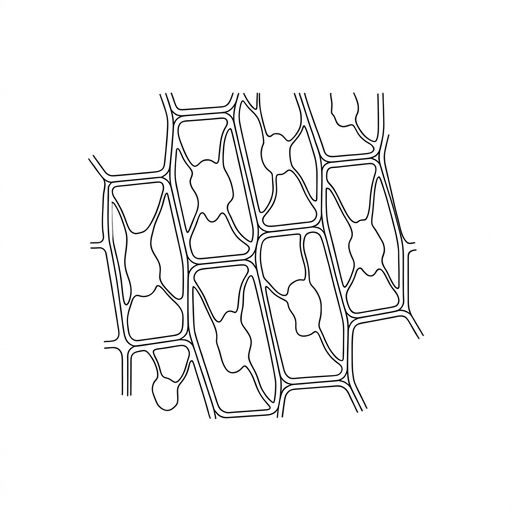
What can be concluded about the cells and the solution?
A. The cells are turgid because the solution is hypotonic.
B. The cells are plasmolysed because the solution is hypertonic.
C. The cells are turgid because the solution is hypertonic.
D. The cells are plasmolysed because the solution is hypotonic.
Consider the direction of water movement by osmosis when a plant cell is placed in a solution with a lower water potential (higher solute concentration) than its cytoplasm. What is the term for the resulting state of the cell?
Question 6
HardPaper 2 · calculator10 marksThe movement of water across the plasma membrane is a fundamental process in both plant and animal cells.
Explain how the net movement of water across a cell membrane is driven by differences in solute concentration.
Describe the role of aquaporins in facilitating the movement of water across the plasma membrane.
Explain how pressure potential affects the movement of water into a plant cell.
Think about the terms hypotonic and hypertonic, and how solutes interact with water molecules to affect their ability to move freely.
Consider the structure of the phospholipid bilayer and why water might need a specialized protein to cross it rapidly.
What happens when a plant cell takes in water and expands against its cell wall? How does this physical pressure change the overall water potential?
Question 7
HardPaper 2 · calculator8 marksThe movement of water into and out of cells is critical for maintaining cell structure and function.
(a) Explain why intravenous fluids administered to patients must be isotonic to blood plasma.
(b) (AHL only) Explain how solute potential and pressure potential determine the movement of water into a plant cell.
Consider what would happen to red blood cells if the fluid had a higher or lower solute concentration than the cytoplasm.
Think about the equation for water potential and how the cell wall responds as water enters the cell.
No question on this page matches those filters. Try another difficulty or paper.
Every Water Potential question, marked for you
Every answer is marked mark by mark, IB-style, and the AI tutor helps when you are stuck.
Where marks are lost
- Command terms are consistently under-read. Students answer describe when the question said explain, so they give an account with no reasons and cap at half marks. The reverse also happens on outline, where a student writes an essay for a 2-mark summary and runs out of time.
- compare and contrast answers give only similarities, or only differences.