Approximation of decimal places, significant figures; Upper & Lower bounds, Percentage error, estimation: notes and practice questions
- IB exam default accuracy: 3 significant figures (3 s.f.) for non-exact answers.
- Use exact values (e.g., , ) in working to avoid rounding errors.
- Standard rounding: round up if digit is , otherwise leave as is.
- Currency rounding: 2 decimal places for dollars/euros/pounds; nearest whole for yen/yuan/peso.
- Contextual rounding: Apply logical rounding (up or down) based on real-world scenarios.
- Range of possible values for a rounded number : .
- To find bounds:
- Identify degree of accuracy.
- Halve the degree of accuracy.
- Upper Bound (UB): Add half-value to the number.
- Lower Bound (LB): Subtract half-value from the number.
- Calculating with bounds:
- Addition: Max , Min .
- Multiplication: Max , Min .
- Subtraction: Max , Min .
- Division: Max , Min .
- Percentage error formula: .
- is exact value, is approximate value.
- Absolute value ensures a positive percentage error.
- Estimation: Round numbers to 1 significant figure before calculation for quick approximation.
- GDC usage: Store unrounded intermediate values; enter exact values (surds, ) directly; use `Abs` function for percentage error.
How it is examined
The accuracy rules bite across the whole paper, not just here. AI mark schemes expect three significant figures unless the question says otherwise, and this is the subtopic that justifies it. Percentage error questions are short, one or two marks, and the classic trap is dividing by the approximate value instead of the exact one. Bounds questions usually feed into an area or volume, so the answer is a range and both ends must be right.
Percentage error, , where is the exact value and the approximate value.
- Approximate to a given number of decimal places or significant figures.
- Find upper and lower bounds of rounded numbers.
- Calculate percentage errors.
- Estimate.
Linking questions
- Other contexts: currency approximations, often to the nearest whole unit for the peso or yen and to the nearest cent for the euro, dollar or pound. Meteorology and alternative rounding methods.
- Links to other subjects: orders of magnitude (physics), uncertainty and precision of measurement (sciences).
- Aim 8: caring about approximations and their ethical implications.
- TOK: is mathematical reasoning different from scientific reasoning, or from reasoning in other areas of knowledge?
Practice questions
64 questions · 50 medium · 14 hardQuestion 1
MediumPaper 1 · calculator4 marksA cartographer, Elara, is calculating the diagonal distance across a square region with side length 1 unit. This involves the value of . She uses the following expression to approximate this value:
Calculate Elara's approximation, correct to four decimal places.
Calculate the percentage error in using Elara's four decimal place approximation of , compared to the exact value of in your calculator.
Carefully evaluate the innermost fraction first, then work your way outwards. Remember to round your final answer to the specified number of decimal places.
Recall the formula for percentage error: . Use the unrounded value from your calculator for .
Question 2
HardPaper 1 · calculator8 marksA scientist is preparing a cylindrical container for an experiment. She measures the radius of the base, , to be 5.0 cm and the height, , to be 12 cm.
Calculate the volume of the cylindrical container using these measurements. Give your answer to three significant figures.
It is known that the measurements are accurate to the number of significant figures given.
Find the lower bound and upper bound of the volume of the cylindrical container. Give your answers to three significant figures.
Find, with justification, the largest possible percentage error if the answer to part (a) is recorded as the volume of the cylindrical container.
Recall the formula for the volume of a cylinder. Pay attention to the required number of significant figures for the final answer.
For a measurement given to 'n' significant figures, the lower bound is the value minus half of the place value of the last significant digit, and the upper bound is the value plus half of the place value of the last significant digit. For example, 5.0 (2 sf) means the actual value is between 4.95 and 5.05. For 12 (2 sf), it means the actual value is between 11.5 and 12.5.
Percentage error is calculated as . To find the largest possible percentage error, you should compare the calculated value from part (a) with both the upper and lower bounds found in part (b). The 'true value' in this context refers to the bound that maximizes the error.
Question 3
MediumPaper 1 · calculator7 marksA manufacturing company purchases a new specialized machine. The machine's value depreciates exponentially over time. The value of the machine, , in thousands of dollars, years after its purchase, is modelled by the function , for .
The initial value of the machine was 150 thousand dollars. After 3 years, its value had decreased by 40%.
(a) Find the value of .
(b) Calculate the value of the machine after 5 years and 6 months, giving your answer to two decimal places.
(c) The company believes that, according to this model, the machine will always have some residual value, however small.
State a mathematical reason why the company might believe this.
(d) Write down one possible limitation of the domain of the model.
The initial value of the machine corresponds to . If the value decreased by 40%, what percentage of the initial value remains after 3 years? Use this to set up an equation for .
Ensure the time is expressed in years for the model. Use the value of found in part (a).
Consider the behaviour of exponential functions as approaches infinity.
The domain is given as . Think about real-world scenarios that might make this model unrealistic for certain values of .
Question 4
HardPaper 2 · calculator11 marksA rectangular prism with length 10 cm, width 8 cm, and height 6 cm is used as a base for a sculpture. One corner, vertex H, is cut off by a flat plane passing through points P, Q, and R. Point P is on edge HE such that HP = 3 cm. Point Q is on edge HG such that HQ = 4 cm. Point R is on edge HD such that HR = 3 cm.
(a) Calculate the volume of the remaining part of the prism.
(b) Calculate the total surface area of the remaining part of the prism.
First, find the volume of the original rectangular prism. Then, determine the dimensions of the pyramid that has been cut off from vertex H to calculate its volume. The remaining volume is the difference.
Start with the surface area of the original rectangular prism. Identify the three triangular areas that are removed from the faces meeting at H. Then, calculate the area of the new triangular face PQR. You will need to use the Pythagorean theorem to find the side lengths of triangle PQR and Heron's formula to find its area.
Question 5
MediumPaper 1 · calculator7 marksThe diagram below shows a hot air balloon hovering at point H, m vertically above a landing pad.
Point A is the point on the ground, directly below the hot air balloon.
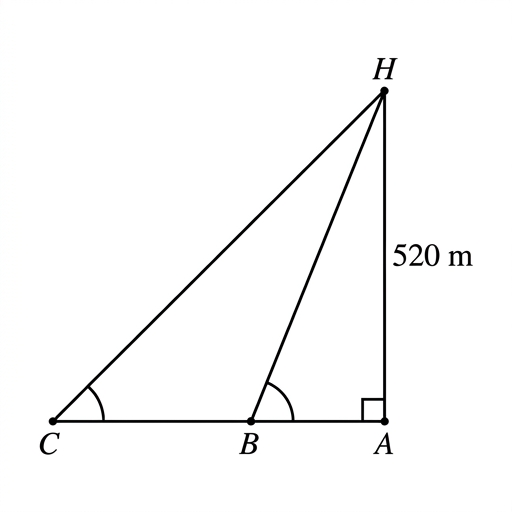
An observer starts walking at a constant speed from point C towards point A. From point C, the observer looks upward at the hot air balloon at an angle of elevation of . After minutes, the observer is at point B and observes the same hot air balloon at an angle of elevation of .
Write down the size of the angle of depression from H to C.
Find the horizontal distance from A to C.
Calculate the distance the observer walked from C to B.
Determine the observer's average speed, in metres per hour.
The angle of depression from H to C is equal to the angle of elevation from C to H due to alternate interior angles.
Consider the right-angled triangle formed by points H, A, and C. You know the height HA and the angle at C. Which trigonometric ratio relates these to AC?
First, find the distance from A to B using the new angle of elevation. Then, use the distance AC you found in part (b) to determine BC.
Speed is distance divided by time. Remember to convert the time from minutes to hours.
Question 6
HardPaper 2 · calculator12 marks(a) A cylindrical grain silo with a radius of m and an initial grain height of m is being emptied. The rate at which the grain is removed from the silo is proportional to the square root of the height of the grain.
Using for the volume of grain in the silo and for the height of the grain, write down a differential equation relating these variables.
(b) Apply the chain rule and the formula for the volume of a cylinder to show that . Hence, write your answer to part (a) in terms of and .
(c) After minutes, the height of the grain has dropped to m. Predict how long it will take for the silo to be completely empty from the initial height of m.
Recall that 'proportional to' means there is a constant of proportionality. Since the silo is emptying, the rate of change of volume with respect to time should be negative.
The volume of a cylinder is . Use the given radius to find , then apply the chain rule .
Solve the differential equation from part (b) by separating variables and integrating. Use the given initial conditions to find the constant of integration and the constant of proportionality.
Question 7
MediumPaper 1 · calculator5 marksA team of engineers is monitoring the flow of water into a large storage tank during a heavy rainfall. Let be the flow rate, in litres per hour, and be the time in hours since the monitoring began.
When is plotted against , the total volume of water collected in the tank is represented by the area between the graph and the horizontal -axis.
The flow rate, , is measured over the course of three hours. The results are shown in the following table.
| (hours) | 0 | 0.5 | 1.0 | 1.5 | 2.0 | 2.5 | 3.0 |
|---|---|---|---|---|---|---|---|
| (litres/hour) | 100 | 120 | 150 | 130 | 110 | 90 | 80 |
(a) Use the trapezoidal rule with an interval width of 0.5 hours to estimate the total volume of water collected in the tank during these three hours.
(b) The actual volume of water collected during these three hours was 340 litres.
Find the percentage error of the estimate found in part (a).
Recall the formula for the trapezoidal rule: . Identify the interval width and the function values.
The percentage error is calculated as .
Question 8
HardPaper 2 · calculator14 marksA specialized chemical reactor is designed to produce a certain compound. The rate of change of the concentration of a key reactant, , with respect to time, , is modeled by the differential equation .
At minute, the concentration is mol/L.
(a) Use Euler's method with a step size of to find approximate values of when , , and minutes. Give your answers to three decimal places.
(b) Solve the differential equation to find the exact concentration as a function of . Hence, find the absolute errors for each of your approximations in part (a). Give your exact values to five decimal places and absolute errors to five decimal places.
Remember Euler's method formula: . In this case, . Calculate the derivative at each step using the current approximate values of and .
To solve the differential equation, use the method of separation of variables. Remember to use the initial condition to find the constant of integration. For absolute error, calculate for each time point.
Question 9
MediumPaper 1 · calculator8 marksA biologist is studying the effect of a new toxin on a bacterial culture. The number of active bacterial cells, (in thousands), remaining after exposure to a toxin dose (in mg/L) follows the relationship:
, for some constant .
In an experiment, it was observed that when the toxin dose was 2 mg/L, there were 1000 thousand (i.e., 1,000,000) active cells remaining.
(a) Find the value of .
The relationship for this bacterial culture can also be written in the form .
(b) Find the value of .
(c) Given that the toxin dose is between 0.5 mg/L and 4.0 mg/L (i.e., ), find the range for .
The effectiveness score, , of a new antidote is inversely proportional to the number of active cells, , remaining after toxin exposure, such that .
(d) A new antidote was tested on a culture exposed to a dose of 4.5 mg/L. Calculate the effectiveness score, , for this antidote. Give your answer to 3 significant figures.
Substitute the given values of and into the equation and solve for . Remember that is in thousands.
Convert the logarithmic equation into an exponential form. Alternatively, substitute known values of and along with the value of found in part (a) into the given equation .
Calculate the values of at the boundary doses and using the equation . Remember to use the value of found in part (a).
First, calculate the number of active cells for a toxin dose of mg/L using the equation . Then, use the formula to find the effectiveness score.
Question 10
HardPaper 2 · calculator12 marksA microbiologist is studying the interaction between two competing species of bacteria, species A and species B, in a controlled environment. Let represent the population of species A (measured in millions) and represent the population of species B (measured in millions). Let represent time, in hours.
The interaction can be modelled by the coupled differential equations:
State the two equilibrium points for this model.
Initially, there are million bacteria of species A and million bacteria of species B. Use the Euler method with a step size of hours to estimate the population of species A and species B after hour (to the nearest integer). Show the intermediate values that are obtained in the working, in the format of a table.
Suggest whether stating the population of bacteria to the nearest integer is a valid level of accuracy when using Euler's method in part (b).
Equilibrium points occur when the rates of change for both populations are zero. Set and and solve the resulting system of equations.
Recall the Euler method formulas for coupled differential equations:
Calculate values for .
Consider the nature of Euler's method as an approximation and the units of the population measurements.
Question 11
MediumPaper 1 · calculator5 marksThe height of a diver above the water surface after jumping from a diving board is modelled by the function
where is the height in metres and is the time in seconds after the diver leaves the board.
(a) Write down the height of the diving board above the water surface.
(b) Find the value of when the diver enters the water. Give your answer to three significant figures.
(c) State an appropriate domain for in this model.
Consider the value of at the instant the diver leaves the board.
The diver enters the water when the height is zero. You will need to solve a quadratic equation.
The model starts when the diver leaves the board and ends when they enter the water.
Question 12
HardPaper 1 · calculator12 marksA construction company, 'BuildFast', is undertaking a large infrastructure project. The project is divided into 12 distinct phases.
Two teams, Team Alpha and Team Beta, are assigned to complete the project, working in parallel on different aspects.
Team Alpha's efficiency: The first phase takes them minutes seconds. Due to a new process, the time Team Alpha takes to complete each subsequent phase is seconds less than the previous phase.
Team Beta's efficiency: The first phase also takes them minutes seconds. Due to a continuous learning curve, the time Team Beta takes to complete each subsequent phase is times the time they took for the previous phase.
(a) (i) State the time Team Alpha takes to complete the third phase of the project.
(a) (ii) Show that Team Beta takes approximately minutes seconds (to the nearest second) to complete the third phase of the project.
(b) Both teams complete all phases of the project. Show that Team Beta completes the entire project faster than Team Alpha.
(c) Hence, state the value of the time difference, correct to the nearest second, between their total project completion times.
Team Alpha's completion times form an arithmetic sequence. Remember to convert the initial time to seconds for easier calculation.
Team Beta's completion times form a geometric sequence. Calculate the third term and then convert to minutes and seconds, rounding to the nearest second.
You need to calculate the sum of the first 12 terms for both the arithmetic and geometric sequences. Then compare the total times.
Subtract the total times calculated in part (b) and round the result to the nearest second.
Question 13
MediumPaper 1 · calculator8 marksA colony of bacteria is growing in a nutrient solution. The rate of change of the population, , with respect to time, (in hours), is modelled by the differential equation . At time , the population is .
(a) By using Euler's method with a step length of 0.1, find an approximate value for the population when . Give your answer to three significant figures.
(b) By solving the differential equation, find the percentage error in your approximation for the population when . Give your answer to three significant figures.
Remember the formula for Euler's method: . You will need to apply this formula iteratively for and .
This is a separable differential equation. Integrate both sides after separating variables. Remember to use the initial condition to find the constant of integration. The percentage error is calculated as .
Question 14
HardPaper 2 · calculator16 marksA new electronics company, 'TechFlow', launched its flagship product. Let be the number of years since the product's launch. The sales team recorded the following data for the first two years.
| Year () | Units Sold () |
|---|---|
| 1 | 5000 |
| 2 | 5400 |
Calculate the percentage increase in units sold from the first year to the second year.
It is assumed that the number of units sold each year will follow a geometric sequence, .
Write down the common ratio of the sequence.
Find an expression for .
Find the number of units TechFlow expects to sell when . Express your answer to the nearest integer.
In the first year, TechFlow's production facility had a capacity of units. The company plans to increase its production capacity by units every year.
Let represent the production capacity of the facility in year .
Write down an expression for .
For the first years, TechFlow ensures that all units produced are sold. Each unit sold generates a profit of $30.
Calculate the total profit generated from units sold in the first years.
When , the number of units demanded (sales) will, for the first time, exceed the production capacity.
Find .
State whether, for all , TechFlow will consistently have sales exceeding its production capacity.
Justify your answer.
To calculate the percentage increase, use the formula: .
The common ratio of a geometric sequence is found by dividing any term by its preceding term.
The general term of a geometric sequence is given by , where is the first term and is the common ratio.
Substitute into your expression for and calculate the value. Remember to round to the nearest integer.
The production capacity follows an arithmetic sequence. The general term of an arithmetic sequence is , where is the first term and is the common difference.
First, find the total number of units produced (and sold) in the first 12 years using the sum of an arithmetic sequence formula: . Then multiply by the profit per unit.
You need to find the smallest integer for which . You can do this by setting up an inequality and solving it graphically or by testing values.
Consider the long-term behavior of geometric sequences versus arithmetic sequences. How do their growth rates compare?
Question 15
MediumPaper 1 · calculator6 marksA car enthusiast, Mr. Henderson, purchases two classic cars for his collection. The first is a popular sedan, initially costing 75000, and is expected to depreciate at a rate of 15% per year.
(a) Estimate the value of the popular sedan after 4 years.
(b) Find the number of years, , after which both cars will have the same estimated value. Give your answer to three significant figures.
(c) Comment on the validity of your answer to part (b).
Recall the formula for compound depreciation: , where is the future value, is the principal amount, is the annual depreciation rate, and is the number of years.
Set up an equation where the future values of both cars are equal. You will need to use logarithms to solve for .
Consider real-world factors that might influence car values over a long period, beyond a simple depreciation model.
Question 16
HardPaper 2 · calculator14 marksA botanical garden is constructing a large planter box for exotic plants. The planter is shaped like an inverted frustum of a right pyramid, with a horizontal square top opening of side length metres and a smaller horizontal square base of side length metres.
The depth of the planter is metres.
Find the angle of inclination of the side walls of the planter to the horizontal.
(b) The point V is the theoretical vertex of the full pyramid from which the frustum is cut, and C is the centre of the square top opening.
(i) Find the total height of the pyramid from its theoretical vertex V to the centre of the top opening C.
(ii) Hence or otherwise, show that the volume of the planter is .
The botanical garden orders bags of a special soil mix, with each bag containing of soil. Determine whether the ordered soil is sufficient to fill the planter.
To prevent soil erosion and water leakage, the entire interior surface of the planter (including the bottom base and the four side walls) needs to be lined with a waterproof membrane. Calculate the total area that needs to be lined.
Consider a vertical cross-section of the planter. Identify a right-angled triangle formed by the depth, half the difference in side lengths, and the inclined wall. Use trigonometry to find the angle.
Use similar triangles or the angle found in part (a) to relate the height of the full pyramid to its base dimensions.
The volume of a frustum can be found by subtracting the volume of the smaller pyramid (that was cut off) from the volume of the larger, complete pyramid. The formula for the volume of a pyramid is .
Calculate the total volume of soil delivered and compare it to the volume of the planter found in part (b.ii).
The area to be lined consists of the area of the bottom square base and the lateral surface area of the frustum (four trapezoidal sides). You will need to calculate the slant height of the trapezoidal side walls using Pythagoras' theorem.
Question 17
MediumPaper 1 · calculator7 marksA monument features a prominent pyramidal cap. The length of the slant edge from the apex, A, to any corner of its square base is measured as 2.8 m, accurate to the nearest tenth of a meter. The side length of the square base is exactly 3.2 m. Let C be a corner of the base.
Write down the upper bound and lower bound for the possible lengths of edge AC.
Let H be the midpoint of one of the base edges. Determine the upper bound and lower bound for AH, the slant height of the pyramid's triangular faces.
For structural stability, the angle between the slant height (AH) and the base of the pyramid must be less than 35°. Show whether this monument's pyramidal cap meets this stability requirement. Justify your answer.
Remember how to determine the upper and lower bounds for a measurement given to a certain degree of accuracy. Consider the smallest and largest values that would round to the given measurement.
Consider the right-angled triangle formed by the apex (A), a corner of the base (C), and the midpoint of the base edge (H). Use the Pythagorean theorem. Remember to use the appropriate bounds for AC to find the bounds for AH.
Identify the right-angled triangle relevant to the angle in question. To determine if the requirement is met, calculate the maximum possible angle between the slant height and the base. This will involve using the upper bound of AH found in part (b) and the half-side length of the base.
Question 18
HardPaper 2 · calculator18 marksA tech company launches a new social media app. The number of active users, , can be modelled by the function
,
where is the number of hours since the app was launched, and is a positive constant.
Write down the value of .
Interpret what this value means in this context.
4 hours after the app was launched, the number of active users was 4050.
Find the value of .
Find the number of active users 2 hours and 15 minutes after the app was launched.
A competitor launches a similar app, whose user base, , can be modelled by the function
,
where is the number of hours since both apps were launched.
Find the value of when the number of users for both apps is equal.
It takes hours and minutes for the number of users of the first app to reach 15000.
Find the value of and , giving as an integer.
Each user of the first app requires MB of server storage. The total available server capacity is MB.
Determine how long it would take for the app's user base to exceed the server capacity.
The value of represents the number of users at time . Substitute into the given function.
Consider what signifies in the context of the app launch.
Substitute the given values of and into the function and solve for .
First, convert 2 hours and 15 minutes into a decimal number of hours. Then, use the value of found in part (b) and substitute this time into the model.
Set the two user base functions, and , equal to each other and solve for . You will need to use logarithms.
Set the function for the first app, , equal to 15000 and solve for . The integer part of will be . Convert the decimal part of into minutes and round to the nearest integer for .
Calculate the total storage required by users and set this equal to the total server capacity. Solve for .
Question 19
MediumPaper 1 · calculator8 marksThe cross-section of a proposed tunnel entrance is modelled by a curve. The heights of the tunnel are measured at horizontal intervals and are given in the table below. All measurements are in cm.
Horizontal distance, x (cm)
0
10
20
30
40
50
60
Vertical distance, y (cm)
0
1.875
6.0
10.125
12.0
9.375
0
(a) Use the trapezoidal rule with to find an approximation for the cross-sectional area of the tunnel entrance.
(b)
It is given that the equation of the curve is , for .
(i) Write down an integral to find the exact cross-sectional area.
(ii) Calculate the value of the cross-sectional area to two decimal places.
(c) Find the percentage error in the area found using the trapezoidal rule. Give your answer to two decimal places.
Remember the formula for the trapezoidal rule: . Carefully substitute the given values.
The area under a curve from to is given by the definite integral .
Use your GDC to evaluate the definite integral you wrote down in part (b)(i).
The percentage error is calculated as .
Question 20
HardPaper 2 · calculator24 marksA landscape architect is designing a new public park. The northern boundary of the park is modelled by the function , and other boundaries are straight lines. The plan view of the park is shown in the following diagram, where both axes represent distance and are measured in metres.
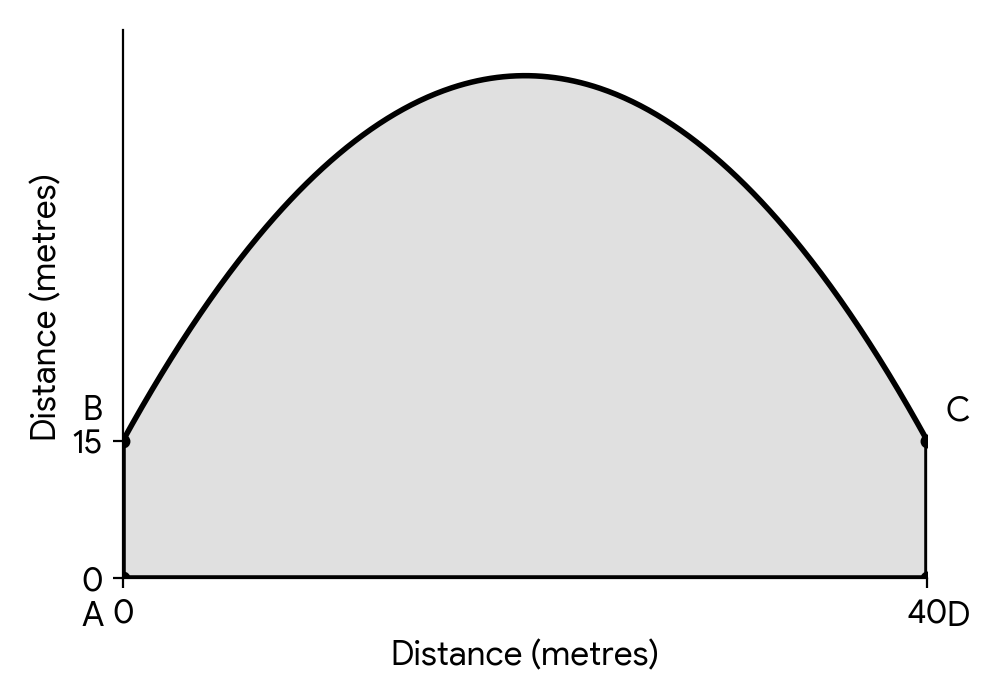
The function models the northern boundary of the park between points B and C and is given by
, for .
(i) Find .
(ii) Hence find the coordinates of the point on the park's northern boundary that is furthest north.
Point A has coordinates , point B has coordinates , point C has coordinates and point D has coordinates .
(i) Write down the integral which can be used to find the area of the shaded region representing the park.
(ii) Find the area of the park.
(i) A landscaper uses the trapezoidal rule with 4 intervals to estimate the area of the park. Calculate this estimate.
(ii) Calculate the percentage error in the landscaper's estimate.
(iii) Suggest how the landscaper might be able to reduce the error whilst still using the trapezoidal rule.
A square-shaped meditation garden, PQRS, is to be built within the park. The side [PS] lies on the southern boundary (x-axis), and the side [QR] lies on the eastern boundary of the park (). Point Q lies on the northern boundary curve .
(i) Find the x-coordinate of point P for the largest area of the meditation garden.
(ii) Find the largest area of the meditation garden.
Recall the power rule for differentiation: if , then . The derivative of a constant term is zero.
The point furthest north corresponds to the maximum value of . To find this, set the derivative to zero and solve for . Then substitute this -value back into to find the corresponding -coordinate.
The area under a curve from to is given by the definite integral . Identify the function and the limits of integration from the problem description.
Evaluate the definite integral you wrote down in part (b)(i). Use your GDC for calculation if allowed, or integrate term by term.
The trapezoidal rule formula is , where . For 4 intervals over , . Calculate at .
Percentage error is given by . Use the exact area from part (b)(ii) and the estimate from part (c)(i).
Consider how the number of intervals affects the accuracy of numerical integration methods like the trapezoidal rule.
Let the x-coordinate of P be . The side length of the square will be . Since Q lies on , its y-coordinate is . For a square, the side length must equal the height, so equate to and solve for . Remember that must be within the park's boundaries.
Once you have the x-coordinate of P, calculate the side length of the square using . Then square this side length to find the area.
No question on this page matches those filters. Try another difficulty or paper.
44 more Approximation of decimal places, significant figures; Upper & Lower bounds, Percentage error, estimation questions in the app
Every answer is marked mark by mark, IB-style, and the AI tutor helps when you are stuck.
Where marks are lost
- Using your own wrong value after failing a "show that." All follow through is withdrawn for the rest of that question.
- Leaving an answer in calculator notation. Never accepted in a final answer, and AI's constant calculator use makes this the easiest slip in the whole subject.