Tangents & Normals at a given point: notes and practice questions
- Tangent: Straight line touching a function's graph at exactly one point.
- Normal: Straight line passing through the point, perpendicular to the tangent.
- The gradient of the function at a point is equal to the gradient of the tangent at .
- The derivative is the function that calculates the exact gradient of for any given .
- Standard straight-line equation:
- Gradient of a tangent at :
- Equation of a tangent:
- Gradient of a normal at :
- Equation of a normal:
- Procedure:
- Differentiate to find .
- Substitute into to find , giving the point .
- Substitute into to find the gradient of the tangent.
- For a normal, calculate the negative reciprocal of the tangent's gradient.
- Use the point and the appropriate gradient in .
- Rearrange the equation into the specific format requested.
- Use a GDC to check numerical gradients and visualize, but show full algebraic working.
- Remember: gives the y-coordinate; gives the gradient.
- Always format the final answer as requested (e.g., clear fractions for ).
- Fundamental concepts and formulas are identical for SL and HL; HL may involve more complex differentiation.
How it is examined
Three marks, reliably: differentiate, evaluate at the point, write the equation. The normal gradient is and forgetting the negative reciprocal is the standard slip. Because technology is allowed, a student can read the tangent straight off the GDC, so a mark scheme should accept an answer with no differentiation shown.
Tangents and normals at a given point, and their equations.
Linking questions
- Links to other subjects: instantaneous velocity and optics, equipotential surfaces (physics); price elasticity (economics).
- TOK: in what ways has technology changed how knowledge is produced and shared in mathematics? Does technology simply let us arrange existing knowledge in new ways, or should that arrangement itself count as knowledge?
Practice questions
27 questions · 23 medium · 4 hardQuestion 1
MediumPaper 1 · calculator7 marksThe height of a section of a roller coaster track, in metres, can be modelled by the function , where is the horizontal distance in metres from a central point.
(a) Find an expression for the gradient function of the track, .
(b) At a specific point on the track, where , a support beam L is tangent to the track. The coordinates of this point are .
Use your answer to part (a) to find the gradient of the support beam L.
(c) Determine the number of other points on the track where the tangent line is parallel to the support beam L. Justify your answer.
Remember the power rule for differentiation: . Apply it to each term of the function.
The gradient of the tangent line at a point is given by the value of the derivative at that point.
Parallel lines have the same gradient. Set your derivative equal to the gradient found in part (b) and solve for . Remember to exclude the original point.
Question 2
HardPaper 1 · calculator8 marksA botanical garden features a winding path for visitors. The path can be modelled by the function . All distances in the garden are in kilometres.
A new straight maintenance path needs to be constructed. This path will start at point P on the visitor path, which has coordinates .
(a) Using your graphic display calculator, find the value of .
(b) Find the equation of the line normal to at point P.
(c) The maintenance path connects point P to another point Q on the visitor path, where the normal line intersects the path again. For safety regulations, point Q must have a positive x-coordinate. Determine the length of this new maintenance path.
Remember how to use the derivative function on your GDC for a specific point. You are looking for the gradient of the tangent at .
The gradient of the normal line is the negative reciprocal of the gradient of the tangent line at that point. Use the point-gradient form of a straight line equation.
First, find the coordinates of point Q by setting the equation of the normal line equal to the function and solving for using your GDC. Remember that P is one of the intersection points. Then, use the distance formula between P and Q.
Question 3
MediumPaper 1 · calculator7 marksA designer is creating a decorative curve for a new architectural feature. The profile of the curve can be modelled by the function , for .
(a) Find .
(b) The designer wants to place a support beam perpendicular to the curve at the point where . Given that the point on the curve is , find the equation of the normal to the curve at this point, in the form , where .
Recall the power rule for differentiation. For a term like , rewrite it using a negative exponent before differentiating.
First, find the gradient of the tangent at using . Then, determine the gradient of the normal, which is the negative reciprocal of the tangent's gradient. Finally, use the point-slope form of a line.
Question 4
HardPaper 2 · calculator14 marks(a) An architect is designing a decorative archway for a park entrance. The cross-section of one half of the archway is modeled. The archway is symmetrical about the y-axis.
The architect models the base section of the archway as a straight line passing through the points and , where all units are in metres.
Find the equation of the line passing through these two points.
(b) The architect initially models the curved upper section of the archway using the following measured points:
, , , and .
(i) Find the equation of the least squares regression quadratic curve for these four points.
(ii) By considering the gradient of this curve when , explain why it may not be a good model for the archway.
(c) The architect decides that a better model for the curved section would be a quadratic curve with a maximum point at and that passes through the endpoint .
Find the equation of this new quadratic model.
(d) Believing this to be a better model for the archway, the architect wants to estimate the volume of the solid generated by rotating this half-archway about the x-axis.
(i) Write down an expression for this estimate of the volume as a sum of two integrals.
(ii) Find the value of this estimate.
Recall the formula for the gradient of a straight line given two points, and then use the point-slope form or slope-intercept form to find the equation of the line.
Use a graphing display calculator (GDC) to perform a quadratic regression on the given data points. Ensure your calculator is set to the appropriate regression type.
Calculate the gradient of the straight line from part (a) at and the gradient of the quadratic curve from part (b.i) at . Compare these values to assess the smoothness of the transition.
Use the vertex form of a quadratic equation, , where is the maximum point. Substitute the maximum point and the given endpoint to solve for the constant .
The volume of revolution about the x-axis is given by . You need to set up two integrals, one for the straight line segment and one for the quadratic curve, with their respective limits.
Evaluate the integrals from part (d.i) using your GDC. Remember to multiply by .
Question 5
MediumPaper 1 · calculator5 marks(a) Write down the gradient of the signal path .
(b) Find the equation of the signal path in the form .
(c) Show that is not the line that is normal to at point .
Remember the relationship between the gradients of two perpendicular lines.
Use the gradient found in part (a) and the coordinates of point P to find the equation of the line.
A line normal to a function at a point must pass through that point. Check if point P lies on line S2.
Question 6
HardPaper 2 · calculator28 marks(a) (i) Consider the function . Find .
(ii) The first section of the stone wall's profile is given by for . A straight glass panel is to be installed tangent to this section of the wall at the point where . Find the equation of this tangent line.
The full profile of the stone wall, , is defined by:
A smaller, decorative stone insert is designed using a transformation of . The graph of is obtained from the graph of by:
- a stretch scale factor of in the direction,
- followed by a stretch scale factor of in the direction,
- followed by a translation of units to the right.
Point P lies on the graph of and has coordinates . Point Q is the image of P under the given transformations and has coordinates .
Find the value of and the value of .
The piecewise function is given by
(c) Find
(i) an expression for .
(ii) the value of .
(iii) the value of .
(d) (i) Calculate the total area of the profile of the stone wall, enclosed by , the -axis, and the line .
The decorative insert is placed within the main wall profile . The region of the main wall profile that is not covered by the insert is to be painted a contrasting colour. This region is bounded by , the -axis, and the lines and , excluding the area under from to . Find the area of this region.
Recall the power rule for differentiation: if , then .
First, find the y-coordinate of the point of tangency. Then, use the derivative from part (a)(i) to find the gradient of the tangent at that point. Finally, use the point-slope form of a linear equation, .
Apply each transformation step-by-step to the coordinates of point P. Remember that a stretch in the x-direction affects the x-coordinate, a stretch in the y-direction affects the y-coordinate, and a translation shifts the point.
To transform a function :
- Stretch by scale factor in -direction: replace with .
- Stretch by scale factor in -direction: replace with (or multiply by ).
- Translate units to the right: replace with .
Combine these transformations to find in terms of , then substitute the expression for the first part of .
The value is the new boundary point for the piecewise function . This corresponds to the original boundary point in after the x-transformations have been applied.
Substitute the second part of (the linear function) into the general transformation equation for derived in part (c)(i). Simplify the expression to find the constant term .
The function is piecewise. You will need to calculate two separate definite integrals and sum their results. The first integral will be for from to , and the second for from to .
The region to be painted consists of two parts: the area under from to , and the area between and from to . You have already calculated some of these areas in previous parts.
Question 7
MediumPaper 1 · calculator9 marksA landscape architect is designing a walking path in a new park. The path consists of three segments. The first segment is a straight path connecting point A(0, 0) to point B(2, 4).
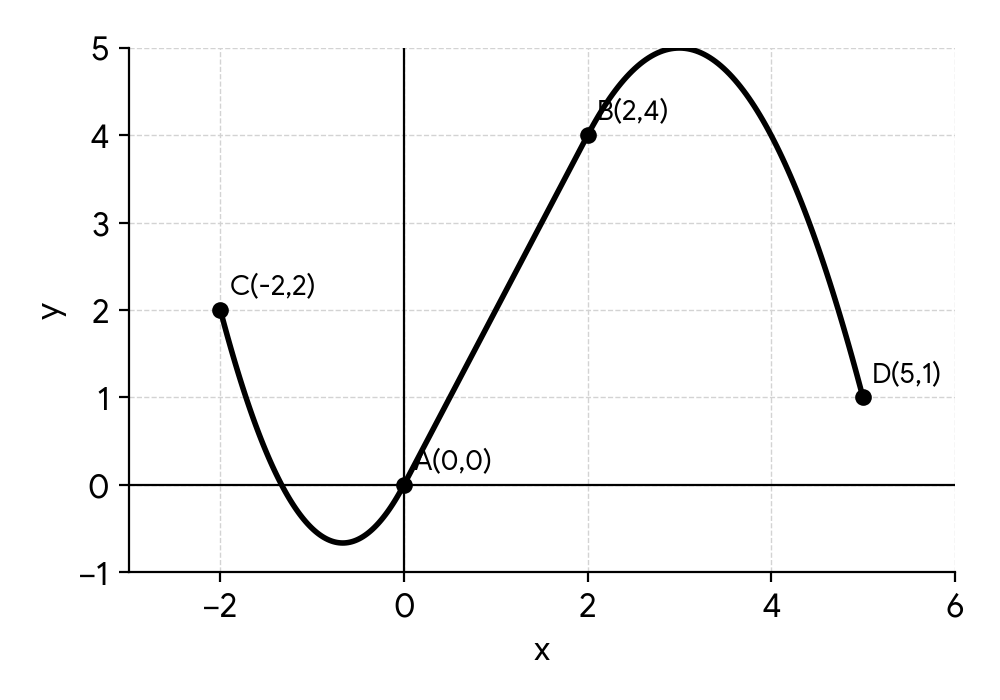
Write down the equation of the line segment for .
A curved section of the path, modeled by a quadratic function, connects point C(-2, 2) to point A(0, 0). At point A(0, 0), the curve has the same gradient as the straight path segment AB.
Find the equation of the curve between (-2, 2) and (0, 0).
The second curved section of the path, also modeled by a quadratic function, connects point B(2, 4) to point D(5, 1). At point B(2, 4), the curve has the same gradient as the straight path segment AB.
Find the equation of this curve.
Write down the equation of the entire walking path as a piecewise function, .
Recall the formula for the equation of a straight line given two points. The gradient can be found using the coordinates of points A and B.
Assume the quadratic equation is of the form . Use the given points and the gradient condition at (0,0) to set up and solve a system of equations for a, b, and c.
Similar to part (b), use the general quadratic form . You have two points and one gradient condition, which will lead to a system of three linear equations in a, b, and c.
Combine the equations from parts (a), (b), and (c), specifying the correct domain for each segment.
Question 8
HardPaper 2 · calculator17 marksEmily and Liam are researching the adoption of smart home devices in a specific region to create a model predicting future usage. They collect the following data:
| Year | Years after 2000 () | Number of devices (in thousands) () |
|---|---|---|
| 2000 | 0 | 10 |
| 2005 | 5 | 150 |
| 2010 | 10 | 400 |
| 2015 | 15 | 750 |
| 2020 | 20 | 1000 |
| 2025 | 25 | 1100 |
Emily proposes the number of devices can be modelled using quadratic regression to find a function of the form , where is the number of years after 2000.
Find the equation of Emily's model.
Emily finds the coefficient of determination for her model is to five significant figures.
State whether the coefficient of determination supports Emily's proposal. Justify your answer.
Comment on the validity of Emily's model with reference to one of the parameters in the equation.
(i) Find the value of and interpret this value in context.
(ii) By considering the changes in device adoption in the table, use the value found in part (d)(i) to comment on the validity of Emily's model.
Liam proposes that the device adoption instead follows a logistic model of the form
where is the number of years after 2000 and is the number of devices in thousands.
State a reason why it may be valid to use Liam's proposal to predict future device adoption.
(i) Find .
(ii) Hence find the year, according to Liam's model, during which the greatest device adoption growth rate occurred.
Use your GDC's regression features (e.g., QuadraticReg) to find the coefficients , , and . Ensure you input the 'Years after 2000' as your -values and 'Number of devices (in thousands)' as your -values.
Recall what a coefficient of determination () value close to 1 indicates about the model's fit to the data.
Consider the real-world implications of the values of or in the context of device adoption. Can the number of devices be negative, or can it decrease indefinitely?
For (i), differentiate with respect to to find , then substitute . The derivative represents the rate of change. For (ii), compare the model's predicted rate of change with the actual data in the table, especially for the period around .
Think about the long-term behaviour of logistic models, especially in the context of growth phenomena like technology adoption.
For (i), use the chain rule or quotient rule to differentiate . Remember that . For (ii), the maximum growth rate for a logistic function occurs when , where is the coefficient of in the denominator.
Question 9
MediumPaper 1 · calculator7 marksA civil engineer is designing a parabolic arch for a new bridge. The cross-section of the arch can be modelled by the curve . The arch passes through the point P(1, -2). At this point, the gradient of the normal to the curve is .
Calculate the value of and the value of .
First, find the gradient of the tangent at point P. Then, use the point and the original equation to form one linear equation, and use the point and the derivative to form a second linear equation. Solve these two equations simultaneously.
Question 10
MediumPaper 1 · calculator7 marks12. [Maximum mark: 7]
The path of a small drone flying over a landscape can be modelled by the curve with equation , where is the horizontal distance in meters from a reference point and is the altitude in meters.
(a) Find .
(b) Write down the gradient of the path when the drone is at a horizontal distance of meters.
(c) Hence, find the equation of the normal to the drone's path at .
Remember to rewrite as before differentiating using the power rule.
Substitute the given value into your derivative from part (a).
The normal line is perpendicular to the tangent line. If the gradient of the tangent is , the gradient of the normal is . You'll also need the -coordinate of the point on the curve.
Question 11
MediumPaper 1 · calculator7 marksThe vertical position, meters, of a particle moving along a curved path is given by the equation , where is the horizontal distance in meters.
(a) Find .
(b) Write down the gradient of the curve at .
(c) Hence, find the equation of the normal to the curve at .
Remember to rewrite the term with in the denominator using negative exponents before differentiating. Apply the power rule for differentiation.
Substitute the value of into the derivative you found in part (a).
First, find the -coordinate of the point on the curve at . Then, determine the gradient of the normal line using the gradient of the tangent from part (b). Finally, use the point-gradient form of a linear equation.
Question 12
MediumPaper 1 · calculator8 marksA section of a roller coaster track is modeled by the curve with equation , for , where and are measured in metres. The track is shown in the following diagram.
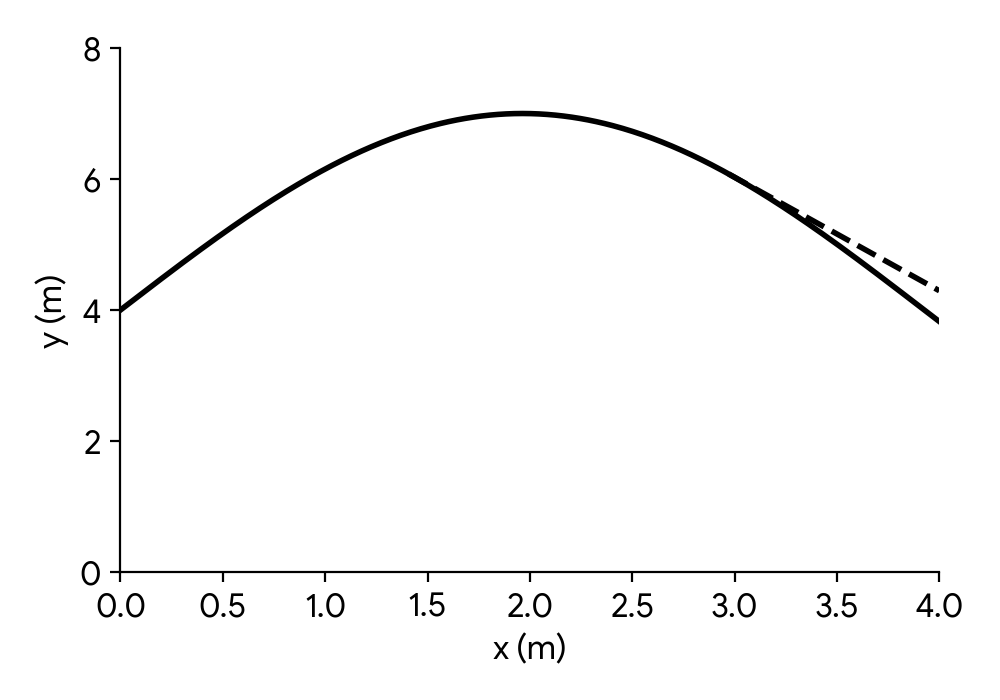
A temporary support beam is to be placed against the track. For structural integrity, the beam must make an angle of 60° with the horizontal ground, supporting the track as it descends.
Find the vertical height above the ground at which the support beam touches the track.
Consider the relationship between the angle the support beam makes with the horizontal ground and the gradient of the curve at the point of contact. Remember that the track is descending at the point of contact.
Question 13
MediumPaper 1 · calculator7 marksA drone's altitude, (in metres), above ground level at a horizontal distance (in metres) from its launch point is modelled by the function .
(a) Find the equation of the normal to the drone's flight path at the point where . Give your answer in the form , where .
First, find the coordinates of the point on the curve where . Then, differentiate the function to find the gradient of the tangent at that point. The gradient of the normal is the negative reciprocal of the tangent's gradient. Finally, use the point-slope form of a linear equation to find the equation of the normal.
Question 14
MediumPaper 1 · calculator11 marks(a) The profile of a section of a mountain trail can be modelled by the function , where is the altitude in hundreds of metres and is the horizontal distance in hundreds of metres. Find the gradient of the trail at the point where the horizontal distance is (and the altitude is ).
(b) A company's profit, , in thousands of dollars, from selling units of a new product is modelled by the function . Find the number of units at which the profit's rate of change is zero. State the corresponding profit for each of these values of .
(c) The concentration of a certain chemical in a solution, , measured in milligrams per litre, is modelled by the function , where is the time in minutes after the chemical is added. Find the rate of change of the concentration with respect to time at the instant when minutes.
To find the gradient of the curve, you need to differentiate the function with respect to and then substitute the given -value into the derivative.
The rate of change of profit is given by the derivative of the profit function, . Set to find the values of where the rate of change is zero. Then substitute these -values back into the original profit function to find the corresponding profit.
The rate of change of concentration with respect to time is given by the derivative of with respect to . Differentiate the function and then substitute into the derivative.
Question 15
MediumPaper 2 · calculator13 marksA company's profit, , in thousands of dollars, from selling thousand units of a new smart device, is modelled by the function , for .
Find an expression for .
Find the equation of the tangent to the profit curve at the point where .
Determine the number of units sold (to the nearest unit) that maximizes the company's profit, and state the maximum profit (to two decimal places).
Determine the range of values of (number of thousands of units sold) for which the company's profit is increasing.
Use the quotient rule for differentiation. Recall that if , then .
To find the equation of a tangent line, you need a point and the gradient . The point can be found by evaluating at , and the gradient is .
Maximum profit occurs when the gradient of the profit function is zero, i.e., . Solve for and then calculate at that value. Remember is in thousands of units and is in thousands of dollars.
The profit is increasing when the derivative is positive. Use your result from part (a) and the roots found in part (c). Remember that .
Question 16
MediumPaper 1 · calculator10 marks(a) A drone's displacement, metres, from a fixed charging station after minutes (where ) is given by the equation .
Calculate the distance travelled by the drone in the first 3 minutes.
(b) Find an expression for the velocity, , of the drone. Hence, determine if the drone ever becomes stationary for .
To find the distance travelled, first determine the displacement at the start and end of the interval. Then, consider if the drone changes direction within the interval by checking its velocity.
Recall the rules for differentiation, especially the quotient rule for rational functions and the chain rule for logarithmic functions. A drone is stationary when its velocity is zero.
Question 17
MediumPaper 1 · calculator14 marks(a) A company's profit, , in thousands of dollars, from selling units of a new product can be modelled by the function , for .
Calculate the coordinates of the stationary points of the profit function .
(b) Find the equation of the normal to the curve at the point where . Give your answer in the form , where .
(c) Determine the second derivative of the profit function, .
(d) Use the second derivative to classify the nature of the stationary points found in part (a).
To find stationary points, you need to find the first derivative of the function, set it to zero, and solve for . Then substitute the -values back into the original function to find the corresponding values.
First, find the -coordinate of the point when . Then, calculate the gradient of the tangent at that point using the first derivative. The gradient of the normal is the negative reciprocal of the tangent's gradient. Finally, use the point-slope form of a line to find the equation of the normal.
The second derivative is found by differentiating the first derivative, .
Substitute the -coordinates of the stationary points into the second derivative. If , it's a local minimum. If , it's a local maximum.
Question 18
MediumPaper 1 · calculator7 marksThe path of a small remote-controlled aircraft is modelled by the function , where is the altitude in metres and is the horizontal distance in metres from a starting point.
(a) Find the equation of the normal to the path of the aircraft at the point where . Give your answer in the form , where .
First, find the coordinates of the point on the curve where . Then, differentiate the function to find the gradient of the tangent at that point. The gradient of the normal is the negative reciprocal of the tangent's gradient. Finally, use the point-gradient form of a line to find the equation of the normal.
Question 19
MediumPaper 1 · calculator7 marksA section of a roller coaster track is modelled by the function , where is the height of the track in metres and is the horizontal distance in metres from a reference point. At a horizontal distance of metres, the height of the track is metres. At this point, the gradient of the track is . Find the value of and the value of .
You are given a quadratic function and two pieces of information: a point on the curve and the gradient of the tangent at that point. Use the point to form one equation and the derivative (gradient function) to form a second equation. Then, solve the resulting system of linear equations for and .
Question 20
MediumPaper 1 · calculator4 marks(a) A drone's flight path is modelled by the function , where is the altitude in metres and is the horizontal distance in metres. At a certain point P on its path, the line perpendicular to the flight path (the normal) has a gradient of .
Find the coordinates of point P.
First, find the derivative of the function to represent the gradient of the tangent to the flight path. Remember the relationship between the gradient of the normal and the gradient of the tangent.
No question on this page matches those filters. Try another difficulty or paper.
7 more Tangents & Normals at a given point questions in the app
Every answer is marked mark by mark, IB-style, and the AI tutor helps when you are stuck.
Where marks are lost
- Using your own wrong value after failing a "show that." All follow through is withdrawn for the rest of that question.
- Leaving an answer in calculator notation. Never accepted in a final answer, and AI's constant calculator use makes this the easiest slip in the whole subject.