Area under/between a curve, volumes of revolution: notes and practice questions
- Integration is anti-differentiation.
- Definite integral calculates exact accumulation with specific boundary values (limits and ).
- Constant of integration () is not needed for definite integrals as it cancels out.
- For physical area, use modulus (absolute value) if the definite integral evaluates to a negative number (area below x-axis or left of y-axis).
- Volume of Revolution (HL): 3D solid formed by rotating a 2D area radians around an axis.
- Fundamental Theorem of Calculus:
- Area under a curve (x-axis):
- Area between a curve and the y-axis (HL): (Rearrange to ).
- Volume of Revolution around the x-axis (HL):
- Volume of Revolution around the y-axis (HL): (Rearrange to ).
- Always sketch the graph to identify limits and potential negative areas.
- If limits are not given, find axis intercepts (roots).
- For area against y-axis or volume around y-axis, rearrange to make the subject ().
- For area between curve and line: Find intersection points, determine if areas need to be added or subtracted.
- GDC 'Variable Dummy Trick': When integrating with respect to (e.g., ), type 'x' as the dummy variable on the GDC (e.g., ).
- Use GDC's absolute value function ('Abs' or ) for areas that cross an axis.
- For exact volumes with , evaluate the integral without on GDC, convert to fraction, then multiply by .
- SL: Area under curve (x-axis), area between curves/lines.
- HL: Area between curve and y-axis, all Volumes of Revolution.
- Do not include the constant of integration () in definite integrals.
- Always sketch to avoid errors from positive and negative areas cancelling out.
How it is examined
The rotation axis is the detail that decides which variable the integral runs over, and a question that rotates about the y-axis expects the curve rearranged as in terms of first. Region-enclosed-by-a-curve questions that dip below the axis need the interval split at the root and each piece's absolute value summed, or the negative and positive parts cancel and understate the true area.
and .
- Find the area of the region enclosed by a curve and the x-axis or y-axis over a given interval, including where the integral is negative.
- Find volumes of revolution about the x-axis or y-axis, or .
Linking questions
- Other contexts: industrial design, architecture.
- International-mindedness: Liu Hui's calculation of the volume of a cylinder, the use of infinitesimals by Greek geometers, and Ibn al-Haytham's integration of a function to find the volume of a paraboloid.
Practice questions
40 questions · 25 medium · 15 hardQuestion 1
MediumPaper 1 · calculator8 marks(a) An architect is designing the entrance to a new tunnel. The shape of the entrance is modelled by a quadratic curve, with the base of the tunnel on the x-axis. The curve has end points (0, 6) and (10, 6), and its vertex is (5, 9). Distances are measured in metres.
The quadratic curve can be expressed in the form for .
(a.i) Write down the value of .
(a.ii) Hence, form two equations in terms of and .
(a.iii) Hence, find the equation of the quadratic curve.
(b) Calculate the area of the tunnel entrance.
Consider the y-intercept of the quadratic curve.
Substitute the given points into the general quadratic equation (using the value of found in part (a.i) ).
Solve the system of linear equations from part (a.ii) for and .
The area under a curve can be found using definite integration. Remember to use the correct limits of integration.
Question 2
HardPaper 1 · calculator10 marksA mathematical model for a physical phenomenon involves the expression .
(a) Expand .
The rate of change of a certain quantity is given by .
(b) Find the indefinite integral .
A designer is creating a custom-shaped container. The cross-sectional profile of the container is defined by the curve for . The container is formed by rotating this region about the x-axis.
(c) Calculate the volume of the solid formed. Give your answer in the form , where .
Remember the formula for .
Integrate each term separately. Remember that for , and . Don't forget the constant of integration.
The volume of revolution about the x-axis is given by . Use your result from part (b) for the integral of and apply the given limits of integration.
Question 3
MediumPaper 1 · calculator7 marksThe internal shape of a specialized chemical reactor vessel is formed by rotating the curve , for , about the -axis, where and are measured in centimetres. The vessel contains a liquid to a height of cm.
Show that the volume of the liquid, , in terms of is .
Hence find the maximum capacity of the reactor vessel in cm. Give your answer to three significant figures.
Recall the formula for the volume of revolution about the y-axis. You will need to express in terms of before integrating.
The maximum capacity occurs when the liquid height is at its maximum possible value for the vessel.
Question 4
HardPaper 1 · calculator9 marksA landscape architect is designing a decorative water channel. The cross-section of the channel is modelled by the function , for . The shaded region, , represents the cross-sectional area of the channel, bounded by the graph of and the -axis.
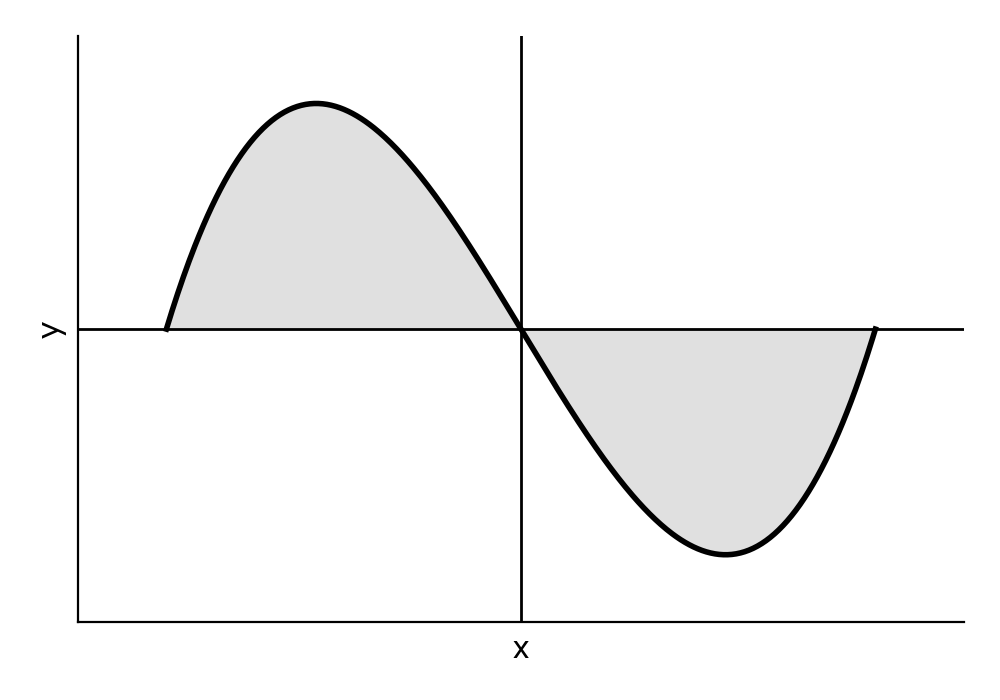 and below for x in [0,2].]
Write down an integral that represents the area of .
Find the area of .
The architect considers a modified design, where the cross-section is given by .
On the following set of axes, the graph of has been drawn. On the same set of axes, sketch the graph of .
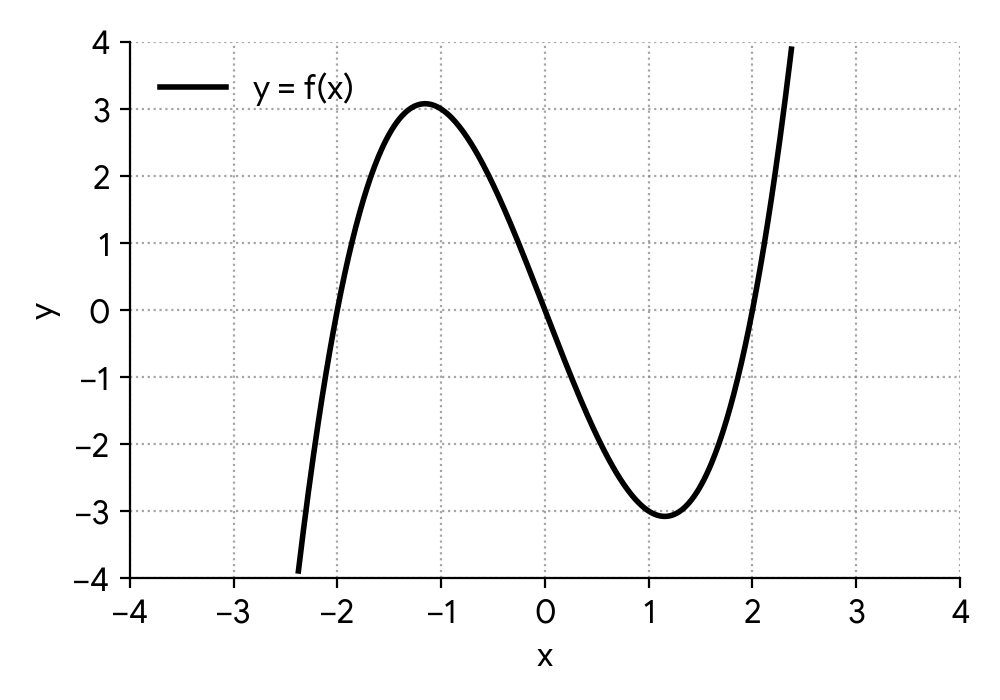
The region (the original cross-section) is rotated through radians about the -axis to form a three-dimensional decorative element. Find the volume of this element.
Remember that area is always positive. Consider how the function behaves on different parts of the interval, or use the absolute value function.
Use your GDC to evaluate the definite integral you wrote in part (a)(i).
Recall the rules for transformations . How does the factor 'a' affect the graph, and how does the term 'b' affect it?
The formula for the volume of revolution about the x-axis is . Remember to square the function before integrating.
Question 5
MediumPaper 1 · calculator4 marksA rocket engineer is designing a new nozzle. The internal shape of the nozzle is formed by rotating a curve about the central axis (y-axis).
The nozzle is 12 cm long. The internal radius of the nozzle is measured at 3 cm intervals along its length:
| Length from base (cm) | Radius (cm) |
|---|---|
| 0 | 5 |
| 3 | 4 |
| 6 | 3 |
| 9 | 2 |
| 12 | 1.5 |
Use the trapezoidal rule to estimate the internal volume of the nozzle.
Remember the formula for the volume of revolution when using the trapezoidal rule. Ensure you square the radius values before applying the rule, and correctly identify the interval 'h'.
Question 6
HardPaper 1 · calculator7 marks(a) A designer is creating a unique component for a specialized optical instrument. The cross-section of the component's profile can be modelled by the curve for . The component is formed by rotating this curve about the -axis.
Calculate the exact volume of this solid of revolution. Give your answer in the form or a similar exact form, and then to three significant figures.
Recall the formula for the volume of a solid of revolution about the -axis: . You will need to use integration by parts to evaluate the definite integral.
Question 7
MediumPaper 1 · calculator10 marksA landscape architect is designing a section of a park. The boundary of a planned pathway can be modelled by the line and a decorative flower bed by the curve . These two features intersect at points and , as shown in the following diagrams.
In diagram 1, the region enclosed by the line , , and the -axis has been shaded.
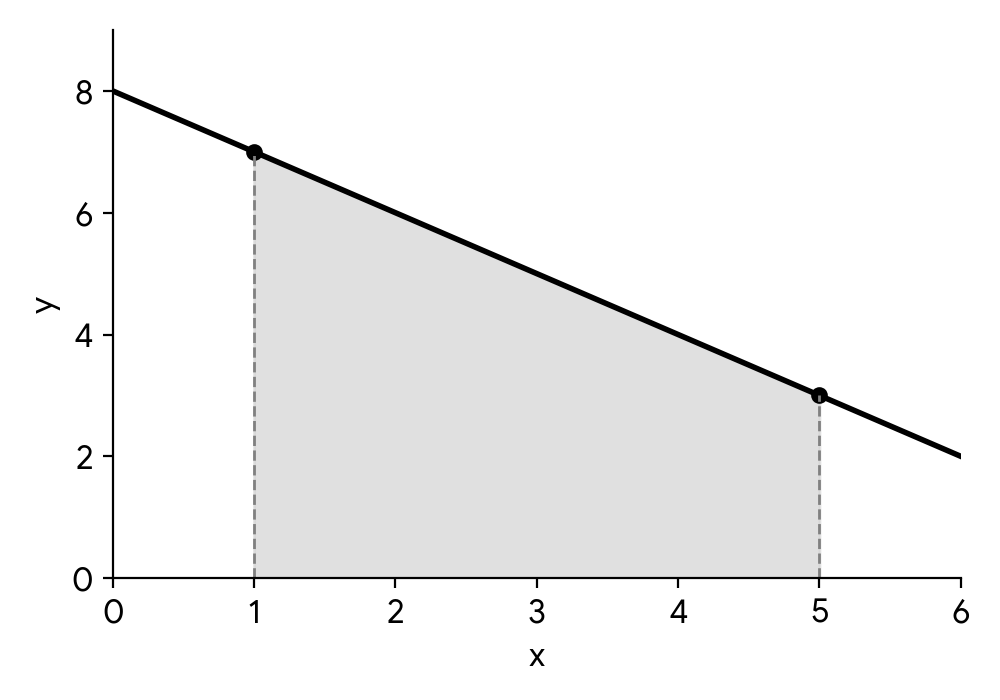
Calculate the area of the shaded region in diagram 1.
In diagram 2, the region enclosed by the curve , and the lines , and the -axis has been shaded.
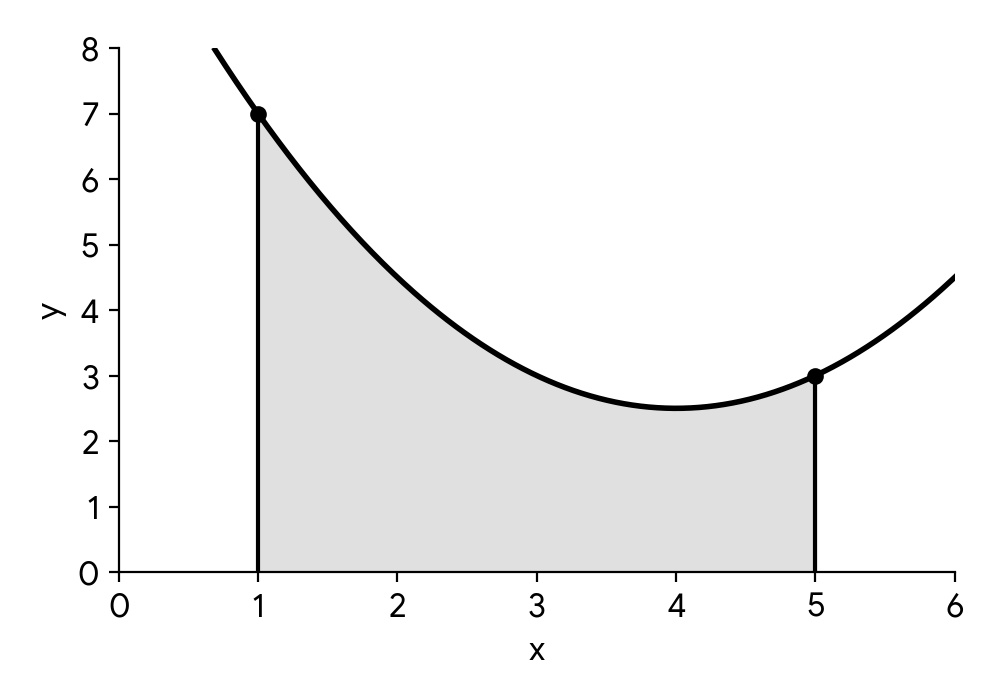
Write down an integral for the area of the shaded region in diagram 2.
Calculate the area of this region.
Hence, determine the area enclosed between the line and the curve .
The shaded region is a trapezoid. You can use the formula for the area of a trapezoid or a definite integral to find its area. Remember the limits of integration are the x-coordinates of the intersection points.
Remember to include the correct limits of integration, the function itself, and the differential 'dx'.
Use your GDC to evaluate the definite integral you wrote down in part (b.i).
The area enclosed between two curves can be found by subtracting the area under the lower curve from the area under the upper curve over the given interval.
Question 8
HardPaper 1 · calculator10 marksAlex is preparing for a calculus exam and encounters a series of integrals. For each integral, identify whether it can be evaluated analytically using standard techniques (and if so, state the appropriate analytical method) or if it requires numerical approximation using technology (e.g., a GDC).
(a)
(b)
(c)
(d)
(e)
(f)
Consider if a simple substitution can transform the integral into a basic trigonometric integral.
Look for a function and its derivative within the integrand. Think about u-substitution.
This integral involves a product of two different types of functions (polynomial and trigonometric). Consider integration by parts.
Try to think of any standard integration techniques. If none seem to work, it might be a non-elementary integral.
The numerator is related to the derivative of the denominator. Consider u-substitution for a logarithmic result.
Similar to part (d), consider if this definite integral can be found using elementary functions or if it's a non-elementary form.
Question 9
MediumPaper 1 · calculator6 marksA landscape architect designs a decorative water feature for a public park. The cross-section of the feature, when viewed from the side, is a region bounded by the vertices , , , , and . This region is rotated about the y-axis to form a solid water basin.
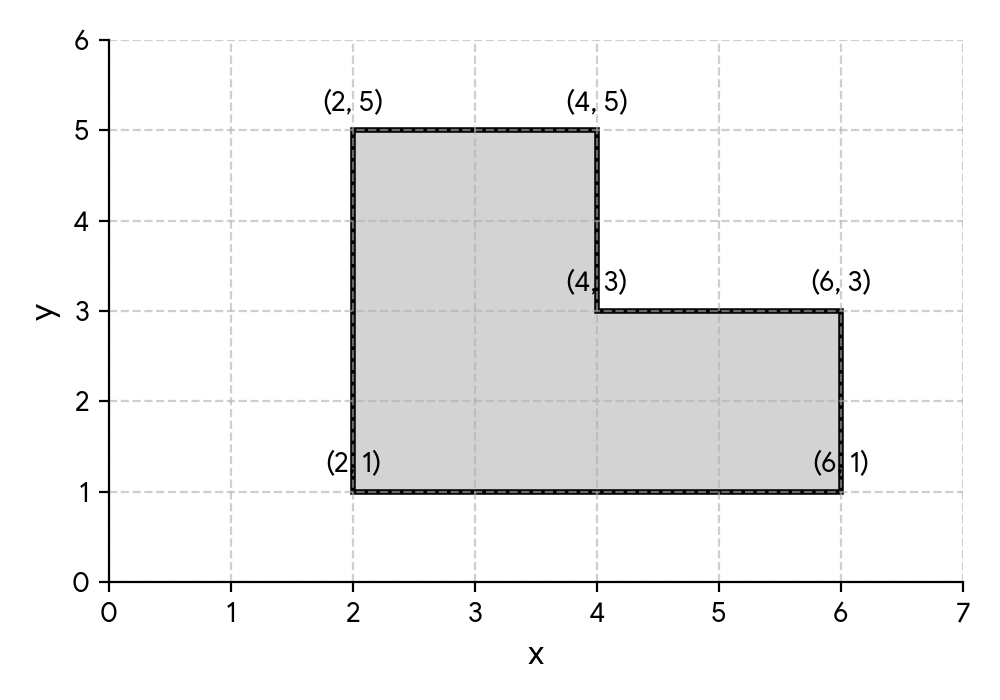
(a) Find the volume of this water basin.
Consider splitting the region into simpler geometric shapes or using the washer method for integration. The solid can be seen as two cylindrical shells stacked vertically.
Question 10
HardPaper 1 · calculator11 marks(a) A designer is creating a prototype for a decorative vase. The cross-section of the vase can be modelled by the function , for .
Sketch the graph of on the following pair of axes.
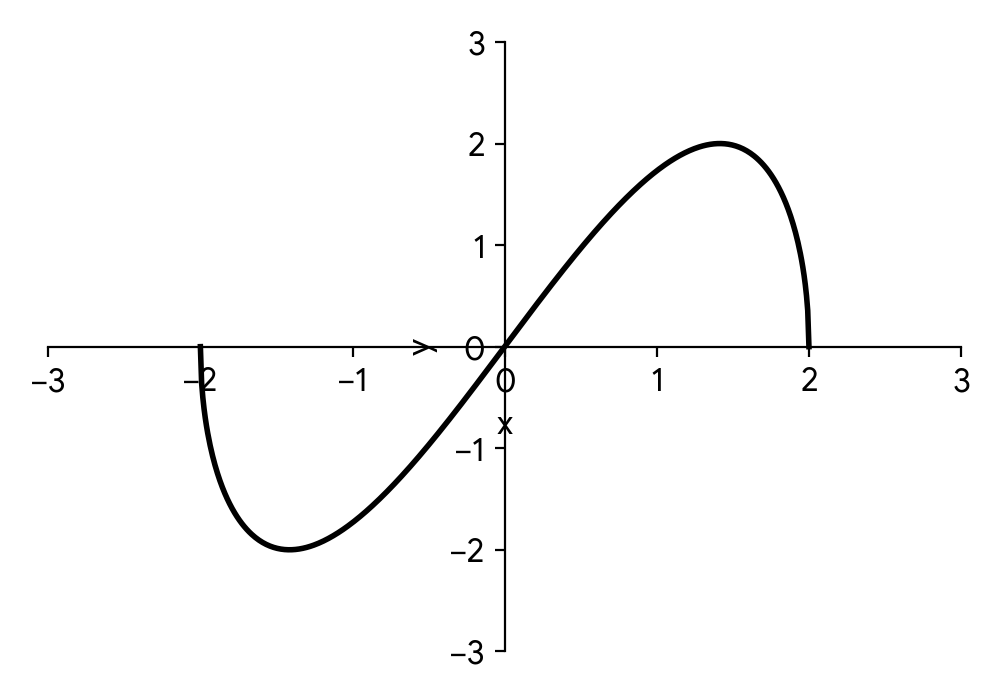
(b) The region enclosed by the graph of and the x-axis is rotated about the x-axis to form the body of the vase.
(i) Write down an integral that represents the volume of this vase.
(ii) Calculate the value of this integral.
(c) The designer decides to create a new, larger version of the vase, , by applying the following transformations to the original cross-section :
- A horizontal stretch by a scale factor of 3, parallel to the x-axis.
- A vertical stretch by a scale factor of 0.75, parallel to the y-axis.
Find the volume of this new vase.
To sketch the graph, identify key features such as x-intercepts, y-intercepts, and local maximum/minimum points. The domain is given as . Consider the symmetry of the function.
The formula for the volume of revolution about the x-axis is . Remember to use the given function and its domain as the limits of integration.
First, simplify the integrand . Then, integrate the resulting polynomial term by term. Remember to evaluate the definite integral using the limits and multiply by .
Consider how transformations affect the integral for the volume of revolution. If , how does the new integral relate to the original integral? Alternatively, express explicitly and then set up and evaluate the new integral.
Question 11
MediumPaper 1 · calculator8 marksThe rate of profit, , in thousands of dollars per month, for a new product is modelled by the piecewise function
where and . For a smooth transition in the profit rate, it is required that .
Find the value of .
Show that .
The total profit from the product at time is zero.
Find the time when the total profit returns to its initial position.
To find the value of T where the two functions meet, set equal to and solve for T.
First, find the derivatives of and . Then, substitute the value of found in part (a) into both derivatives to show they are equal.
The total profit is the integral of the profit rate. Set the sum of the definite integrals over the two phases (from 0 to T, and from T to k) equal to zero, where k is the time when the total profit returns to zero.
Question 12
HardPaper 1 · calculator7 marksA population of microorganisms grows according to the function , where is the population in thousands and is the time in hours, for hours.
The population is zero when , and hours.
Find the value of .
Calculate the total population growth (area enclosed by the curve and the -axis) from hour to hours.
Another species of microorganism has its population modelled by (in thousands). The total population growth of species from to hours is equal to the total population growth of species from to hours.
Find the value of , where .
The population is zero when . You are given two roots of the cubic equation. For a cubic polynomial with roots , the sum of the roots is and the product of the roots is . You can also use your GDC to find all roots.
The total population growth over an interval is found by integrating the population function over that interval. Remember to use the value of found in part (a). Use your GDC for the definite integral.
Set up an equation where the definite integral of from to is equal to the definite integral of from to . You can then rearrange this equation to and solve for using your GDC's numerical solver (e.g., 'solve' or 'intersect' function on the graph).
Question 13
MediumPaper 1 · calculator7 marksThe rate of change of a certain quantity, , with respect to time, (in minutes), is modelled by the function .
(a) Find an expression for in terms of , assuming an arbitrary constant of integration.
(b) Given that the model is valid for , find the exact total change in the quantity from minute to minutes. Give your answer in the form , where .
Recall the integration rule for functions of the form . Consider using a substitution or recognizing the pattern for the derivative of a logarithmic function.
Use the result from part (a) and apply the Fundamental Theorem of Calculus. Remember to use the properties of logarithms to simplify the expression into the required form.
Question 14
HardPaper 2 · calculator9 marksThe cross-section of a decorative garden bed is modelled by the curve , where and are measured in metres. The garden bed is built on flat ground, represented by the -axis.
(a) Write down the -intercepts of this curve.
(b) Write down a definite integral that represents the area of the cross-section of the garden bed.
(c) Find the value of this area.
The -intercepts occur when . Consider the factored form of the equation.
The area between a curve and the -axis from to is given by . Determine if the curve is above or below the -axis in the relevant interval.
First, expand the expression . Then, integrate the resulting polynomial term by term and evaluate the definite integral using the limits found in part (a).
Question 15
MediumPaper 1 · calculator6 marksA landscape architect is designing a new feature for a botanical garden. The boundary of a particular flower bed is defined by two curves. The upper boundary can be modelled by the equation and the lower boundary by , where and are measured in metres.
(a) Find the area of the flower bed.
First, find the points of intersection of the two curves by setting their equations equal to each other. Then, determine which function is above the other in the interval defined by these intersection points. Finally, set up and evaluate the definite integral of the difference between the upper and lower functions over this interval.
Question 16
HardPaper 1 · calculator8 marksA landscape architect is designing a large decorative fountain for a new public park. The outer structure of the fountain consists of a cylindrical base topped by a conical section. The inner part of the fountain, which holds the water, is a hollow space created by rotating a specific curve around the vertical axis.
The shape of the inner hollow is based on a transformation of the graph . The curve that defines the profile of the inner hollow is given by . This transformation involves a vertical translation of units and a stretch parallel to the x-axis with a scale factor of .
(a.i) Write down the value of .
(a.ii) Find the value of .
The cylindrical base of the fountain has a radius of m and a height of m. The conical section on top has the same base radius of m and a height of m. The inner hollow, described by the curve , extends from the base of the fountain () up to the total height of the outer structure.
Find the volume of the solid material that makes up the fountain (i.e., the volume of the outer structure minus the volume of the inner hollow).
A vertical translation shifts the entire graph up or down. For a function , a vertical translation by units results in . Compare the constant term in the transformed equation to the original form.
A stretch parallel to the x-axis by a scale factor means replacing with in the original function. So, . Compare this to the given transformed equation after accounting for the vertical translation.
First, calculate the total volume of the outer structure (cylinder + cone). Then, calculate the volume of the inner hollow using integration. Remember to express in terms of for the volume of revolution about the y-axis, and integrate from to the total height of the outer structure. The total height is the sum of the cylinder and cone heights.
Question 17
MediumPaper 1 · calculator10 marks(a) A landscape architect is designing a curved retaining wall for a garden. The height of the wall, metres, is measured at m intervals along its horizontal length, metres, from one end. The measurements are given in the table below.
| (m) | |||||||||
|---|---|---|---|---|---|---|---|---|---|
| (m) |
Use the trapezium rule to estimate the cross-sectional area of the wall, giving your answer correct to decimal places.
(b) It is later discovered that the equation connecting and is .
Calculate the true value of the cross-sectional area of the wall.
(c) Find the percentage error in your estimation of the area you made in part (a).
(d) Explain why, in this case, the trapezium rule underestimates the true value.
Recall the formula for the trapezium rule: . Identify the strip width and the corresponding -values from the table.
The true cross-sectional area can be found by integrating the function over the given interval. Set up a definite integral from to .
The percentage error is calculated using the formula: .
Consider the shape of the curve defined by and how the trapezoids fit under it. Think about concavity.
Question 18
HardPaper 2 · calculator14 marks(a) An architect is designing a decorative archway for a park entrance. The cross-section of one half of the archway is modeled. The archway is symmetrical about the y-axis.
The architect models the base section of the archway as a straight line passing through the points and , where all units are in metres.
Find the equation of the line passing through these two points.
(b) The architect initially models the curved upper section of the archway using the following measured points:
, , , and .
(i) Find the equation of the least squares regression quadratic curve for these four points.
(ii) By considering the gradient of this curve when , explain why it may not be a good model for the archway.
(c) The architect decides that a better model for the curved section would be a quadratic curve with a maximum point at and that passes through the endpoint .
Find the equation of this new quadratic model.
(d) Believing this to be a better model for the archway, the architect wants to estimate the volume of the solid generated by rotating this half-archway about the x-axis.
(i) Write down an expression for this estimate of the volume as a sum of two integrals.
(ii) Find the value of this estimate.
Recall the formula for the gradient of a straight line given two points, and then use the point-slope form or slope-intercept form to find the equation of the line.
Use a graphing display calculator (GDC) to perform a quadratic regression on the given data points. Ensure your calculator is set to the appropriate regression type.
Calculate the gradient of the straight line from part (a) at and the gradient of the quadratic curve from part (b.i) at . Compare these values to assess the smoothness of the transition.
Use the vertex form of a quadratic equation, , where is the maximum point. Substitute the maximum point and the given endpoint to solve for the constant .
The volume of revolution about the x-axis is given by . You need to set up two integrals, one for the straight line segment and one for the quadratic curve, with their respective limits.
Evaluate the integrals from part (d.i) using your GDC. Remember to multiply by .
Question 19
MediumPaper 2 · calculator7 marks(a) A designer is creating a decorative glass orb. The profile of the orb's cross-section is modelled by the curve for , where is the radius of the orb.
The designer rotates the curve around the -axis by radians. State the geometrical name of the solid generated.
(b) Write down a definite integral, including limits, that represents the volume of this solid.
(c) If the radius of the glass orb is cm, calculate the exact volume of the orb.
Consider the shape formed when a semi-circle is rotated completely around its diameter.
The formula for the volume of revolution around the -axis is . Substitute the given function and its domain.
Substitute into the integral from part (b) and evaluate it. Remember to include the constant .
Question 20
HardPaper 2 · calculator15 marksA drone is launched vertically upwards from a platform. Its vertical velocity, , at time seconds, is given by the function:
, for .
Find the times when the drone is momentarily at rest.
Find the magnitude of the drone's vertical acceleration at seconds.
Find the greatest speed of the drone in the interval .
The drone starts from an initial height of metres above the ground. Find an expression for the height of the drone, metres, above the ground at time seconds.
Find the total distance travelled by the drone in the interval .
The drone is momentarily at rest when its vertical velocity is zero. Set the velocity function equal to zero and solve for .
Acceleration is the derivative of velocity with respect to time, . Differentiate the given velocity function and then substitute . Remember to find the magnitude.
Speed is the magnitude of velocity, . The greatest speed can occur at the endpoints of the interval or at a critical point where acceleration is zero. Evaluate at these points and find the maximum absolute value.
Height is the integral of velocity with respect to time, . Use the initial condition to find the constant of integration.
Total distance travelled is the integral of the speed, . Remember that velocity can change sign, so you might need to split the integral at points where . The roots of are and .
No question on this page matches those filters. Try another difficulty or paper.
20 more Area under/between a curve, volumes of revolution questions in the app
Every answer is marked mark by mark, IB-style, and the AI tutor helps when you are stuck.
Where marks are lost
- Using your own wrong value after failing a "show that." All follow through is withdrawn for the rest of that question.
- Leaving an answer in calculator notation. Never accepted in a final answer, and AI's constant calculator use makes this the easiest slip in the whole subject.