Circles (arc length, sector area): notes and practice questions
- Arc: Part of a circle's circumference. Minor arc ( or rad), Major arc ( or rad).
- Sector: Region of a circle enclosed by two radii and an arc. Minor sector (), Major sector ().
- Radian: Angle where arc length equals radius (for unit radius, arc length is 1).
- Full circle: radians.
- Degrees to Radians: Multiply by .
- Radians to Degrees: Multiply by .
- Common conversions: , , , , .
- Arc Length () (Degrees):
- Sector Area () (Degrees):
- Arc Length () (Radians):
- Sector Area () (Radians):
- Perimeter of a Sector: Perimeter =
- Always check GDC angle mode (Degrees/Radians); default to radians if not specified.
- Read questions carefully to distinguish between arc length and perimeter.
- Draw diagrams for described scenarios, labeling radii, angle, and major/minor regions.
How it is examined
A short question, one or two marks, usually inside a composite-shape problem rather than alone. The degree form of the formula is the one to use in SL questions and mark schemes. Writing an SL question with in radians is out of syllabus.
The arc length and the sector area , with in degrees.
The circle: the length of an arc, and the area of a sector.
Radians are not required at SL. Everything is in degrees, so the arc length and sector area are fractions of the whole circle.
Linking questions
- TOK: does personal experience play a role in forming knowledge claims in mathematics? Does it play a different role there than in other areas of knowledge?
Practice questions
16 questions · 14 medium · 2 hardQuestion 1
MediumPaper 1 · calculator7 marksA graphic designer is creating a logo for a new technology company. The logo features a stylized 'C' shape, which is a circular arc. This arc is part of a circle with centre O and a radius of 8 cm. The arc subtends an angle of 120° at the centre O. The straight edge of the 'C' is a chord connecting the endpoints of the arc.
The logo component is shown as the curved boundary in the following diagram.
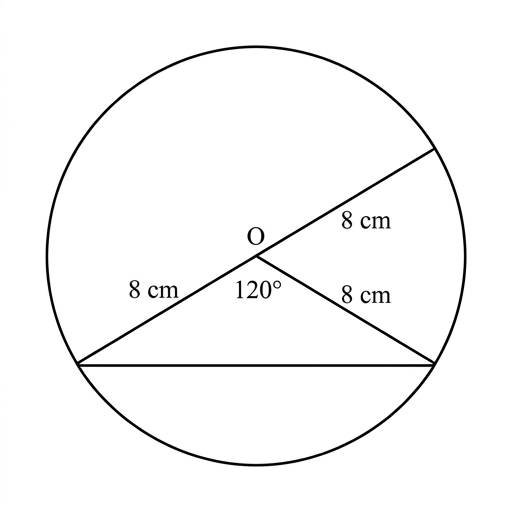
(a) Find the length of the curved boundary of this logo component.
(b) Find the area of the region enclosed by the arc and the straight edge (the segment of the circle).
Remember to convert the angle from degrees to radians when using the arc length formula , or use the proportion of the circle's circumference.
The area of the segment is the area of the sector minus the area of the triangle formed by the two radii and the chord.
Question 2
HardPaper 2 · calculator20 marksA large water wheel is used for irrigation. The lowest point a bucket on the wheel reaches is m above the water surface, and its highest point is m above the water surface.
(a) (i) Show that the radius of the water wheel is m.
(ii) Calculate the circumference of the water wheel.
(b) When the wheel rotates , find the distance that a bucket travels along the circumference.
The height in metres, above the water surface, of a particular bucket is modelled by the function:
, for ,
where is the time, measured in minutes.
The wheel takes minutes to complete revolution.
(c) (i) Find the value of .
(ii) Find the value of .
(iii) Hence, write down the equation of the sinusoidal model.
(d) Use the model to find the values of when the height of this bucket is m above the water surface for .
The water wheel operates for days, and each day it rotates nonstop for hours.
(e) Calculate the total number of rotations that the water wheel has made. Give your answer in the form where and is an integer.
The radius of a circular object can be found by taking half the difference between its highest and lowest points.
The formula for the circumference of a circle is , where is the radius.
The distance traveled along the circumference for a given angle is an arc length. The formula for arc length is when is in degrees.
The period of the sinusoidal function is the time it takes for one complete revolution. For a function , the period is given by if is in degrees, or if is in radians.
The value of represents the vertical shift or the midline of the sinusoidal function. It is the average of the maximum and minimum heights.
Recall that represents the amplitude, which is equal to the radius of the wheel.
Substitute into your equation from part (c)(iii) and solve for . Remember that the sine function has multiple solutions within a given period.
First, calculate the total operating time in minutes. Then, divide by the time it takes for one revolution.
Question 3
MediumPaper 1 · calculator9 marksA landscape architect is designing a modular planter box for a new urban garden. The planter box has a base and top that are identical sectors of a circle, each with radius cm and angle radians. The height of the planter box is cm. The total length of metal frame used for all edges of the planter box is cm. This includes two circular arcs, four radial edges for the top and bottom sectors, and three vertical connecting edges.
(a) Show that .
(b) The planter box is designed to hold soil, enclosing a volume, .
(i) Find an expression for in terms of .
(ii) Find the expression for .
(iii) Solve algebraically to find the value of that will maximize the volume, .
Carefully identify all the edges that contribute to the total length of the metal frame. Remember the formula for the arc length of a sector.
Recall the formula for the area of a circular sector and how it relates to the volume of a prism.
Remember to use the quotient rule for differentiation, or rewrite the expression using a negative exponent and apply the product rule.
To maximize a function, you typically find where its derivative is equal to zero.
Question 4
HardPaper 3 · calculator27 marks(a) A ground crew on Luna Prime is tracking a supply drone. From the Aether station's control tower, the drone is observed to be km East and km North in a localized flat-map approximation.
(i) Find the straight-line distance from the Aether station to the drone.
(ii) Find the bearing of the drone from the Aether station. Give your answer in degrees, correct to one decimal place.
(b) The Aether station (A) is located at the origin of a 3D Cartesian coordinate system for this part. A research probe (P) is located at km. A navigation beacon (B) is located at km.
(i) Show that the position vector of the research probe, , is perpendicular to the position vector of the navigation beacon, .
(ii) Assuming the probe and beacon are on the surface of Luna Prime with a radius of km, calculate the shortest distance along the surface between the research probe and the navigation beacon.
(c) Consider the Aether station (A) at km, the Boreas station (B) at km, and a North Pole reference point (N) at km. Let , , and be their respective position vectors from the centre of Luna Prime.
(i) Find the vector .
(ii) Show that the angle at vertex A in the spherical triangle formed by Aether, Boreas, and the North Pole (ABN) is .
(d) A supply route between Aether and a new outpost, Delta, has an arc length of km. Given that the radius of Luna Prime is km, show that the central angle between Aether and Delta is , correct to three significant figures.
(e) The Aether station (A) is located at N, E, and the Boreas station (B) is located at N, E on Luna Prime, which has a radius of km. Find the shortest distance along the surface from Aether to Boreas.
(f) Using the vector method from part (c), find the initial bearing from Aether to Boreas. Give your answer in degrees, correct to one decimal place.
Use the Pythagorean theorem to find the hypotenuse of a right-angled triangle formed by the east-west and north-south displacements.
Use an appropriate inverse trigonometric ratio (e.g., arctan) to find the angle. Remember that bearings are measured clockwise from North.
Two vectors are perpendicular if their scalar (dot) product is zero.
Since the position vectors are perpendicular, the central angle between the probe and the beacon is . Use the arc length formula , where is in radians.
Use the formula for the cross product of two 3D vectors: .
The angle at vertex A of a spherical triangle formed by points A, B, N is the dihedral angle between the planes OAB and OAN. This angle can be found by taking the dot product of the normal vectors to these planes. The normal vector to plane OAB is , and the normal vector to plane OAN is .
Use the arc length formula , where must be in radians. Then convert the angle to degrees.
Convert the spherical coordinates (latitude, longitude) to 3D Cartesian coordinates for both stations. Then use the scalar product formula to find the central angle . Finally, use the arc length formula to find the distance.
The bearing at A is the angle between the great circle arc AN (North direction) and the great circle arc AB. This angle can be found by taking the angle between the normal vectors to the planes OAN and OAB. The normal vector to plane OAN is , and the normal vector to plane OAB is . Remember to consider the direction of the bearing (clockwise from North).
Question 5
MediumPaper 1 · calculator6 marks(a) A newly discovered exoplanet, Xylos, has a moon, Luna Prime, orbiting it in a perfectly circular path. Scientists have determined that Luna Prime completes one full orbit around Xylos in 2.5 days. If the linear speed of Luna Prime in its orbit is approximately ** m/s**,
Determine the radius of Luna Prime's orbit around Xylos. Express your answer in km using standard form correct to 3 significant figures.
Recall the relationship between linear speed, angular speed, and radius for circular motion. Remember to convert all units to be consistent before calculation.
Question 6
MediumPaper 1 · calculator6 marksA circular pizza has a radius of cm. It is cut into several equal slices, with each slice subtending a central angle of at the center of the pizza.
(i) Calculate the length of the crust (arc length) of one slice.
(ii) Calculate the area of one slice of pizza.
Remember the formulas for arc length and area of a sector when the central angle is given in degrees. Ensure you use the correct value for or leave your answer in terms of if specified.
Question 7
MediumPaper 1 · calculator4 marksA designer is creating a pattern for a stained glass window. One element of the design is a circular sector with a radius of cm. The arc length of this sector is cm.
Find the area of the sector.
Recall the formulas for arc length and area of a circular sector. Remember that the angle must be in radians.
Question 8
MediumPaper 2 · calculator13 marksA robotic arm is designed to sweep through a fixed angle of 60 degrees. The arm starts with an initial length of 5 cm and then extends by 2 cm for each subsequent sweep. The path traced by the tip of the arm forms an arc of a circle.
(a) Find the length of the arc traced during the first sweep.
(b) Find the length of the arc traced during the second sweep.
(c) Find the length of the arc traced during the third sweep.
(d) Describe the relationship between the lengths of the arcs traced during the first, second, and third sweeps. Hence, find the lengths of the arcs traced during the fourth and fifth sweeps without performing full calculations.
(e) Determine the area of the sector traced by the arm during its sixth sweep.
Remember to convert the angle to radians before using the arc length formula, .
The arm extends by 2 cm for each subsequent sweep. What is the new radius?
Continue the pattern of extension for the radius.
Look for a common difference or common ratio between the arc lengths. Once you identify the pattern, apply it to find the subsequent terms.
First, find the radius of the arm during its sixth sweep. Then use the formula for the area of a sector, .
Question 9
MediumPaper 2 · calculator23 marksThree emergency service stations are located at points , , and in a city's coordinate grid, where coordinates are in kilometres.
A central command hub is to be built at a point , equidistant from all three stations.
(a)(i) Find the midpoint of the line segment .
(a)(ii) Find the gradient of the line .
(a)(iii) Hence, find the equation of the perpendicular bisector of the line segment .
(b)(i) Find the midpoint of the line segment .
(b)(ii) Find the gradient of the line .
(b)(iii) Hence, find the equation of the perpendicular bisector of the line segment .
(c) Determine the coordinates of the central command hub .
(d) The city regulations state that the central command hub must be within a service radius of km from each station for effective communication. Determine if the proposed location meets this regulation.
(e) Calculate the area of the circular service region covered by the central command hub, assuming its effective radius is the distance to any of the stations. Give your answer to one decimal place.
To find the midpoint of a line segment with endpoints and , use the formula .
The gradient of a line passing through points and is given by .
The gradient of a line perpendicular to a line with gradient is . Use the midpoint found in (a.i) and the perpendicular gradient to form the equation of the line.
Remember the midpoint formula: .
The gradient of a line passing through points and is given by .
The gradient of a line perpendicular to a line with gradient is . Use the midpoint found in (b.i) and the perpendicular gradient to form the equation of the line.
The central command hub is equidistant from all three stations, meaning it is the intersection point of the perpendicular bisectors. Solve the system of equations for the perpendicular bisectors of and .
Calculate the distance between point and any one of the stations (e.g., ) using the distance formula. Compare this distance to the regulation radius of km.
The radius of the service region is the distance calculated in part (d). The area of a circle is given by .
Question 10
MediumPaper 1 · calculator6 marksA circular clock face has a radius . The minute hand pivots at the centre of the clock face. A small decorative jewel is fixed at point , which is located at the 12 o'clock position on the edge of the clock face. A smaller, transparent circular display is designed to be centred at and passes through the pivot point . This display partially overlaps the main clock face.
(a) Calculate the area of the region that is covered by the transparent display but is outside the main clock face, in terms of .
Establish a coordinate system to define the equations of both circles. The area of the region can be found by taking the area of the smaller display and subtracting the area of the overlapping region (intersection). The area of intersection can be calculated by summing the areas of two circular segments.
Question 11
MediumPaper 1 · calculator6 marks(a) A designer is creating a logo that features a circular segment. The segment is part of a circle with a radius of cm, and the central angle subtended by the arc is radians.
Calculate the perimeter and the area of this circular sector.
Remember the formulas for arc length and area of a sector when the angle is given in radians. The perimeter of a sector includes the arc length and two radii.
Question 12
MediumPaper 1 · calculator5 marks(a) A circular stained-glass window has its center at the origin O. A rectangular decorative panel, ODEF, is fitted inside the window. Vertex D lies on the positive x-axis, vertex F lies on the positive y-axis, and vertex E lies on the circumference of the window. The length OD is cm and the length OF is cm.
Calculate the length of the arc from point E to the point where the window intersects the positive x-axis. Give your answer to three significant figures.
To find the radius of the circular window, consider the coordinates of point E and its distance from the origin. Remember that the arc length formula requires the angle to be in radians. You can find the angle using trigonometric ratios in the right-angled triangle formed by O, D, and E.
Question 13
MediumPaper 1 · calculator9 marksA company is designing a new logo. Part of the logo involves a shaded region on a coordinate plane. This region is bounded by the line segment connecting the points and , the -axis, and the vertical lines and .
Write down a definite integral that represents the area of this shaded region.
Calculate the area of the region.
Another part of the logo design involves a curved section. This section is represented by the region bounded by the curve and the -axis.
Write down a definite integral that represents the area of this region.
Calculate the area of the region.
First, find the equation of the line passing through points and . This equation will be the integrand. The limits of integration are given by the vertical lines.
Evaluate the definite integral you wrote in part (a.i). Alternatively, recognize the shape as a trapezoid and use the geometric formula for its area.
Identify the shape represented by the equation . This will help determine the limits of integration along the -axis.
The curve describes a semi-circle. Use the geometric formula for the area of a semi-circle.
Question 14
MediumPaper 2 · calculator15 marksA circular park has a central monument. A straight walking path cuts across the park. The radius of the park is m. The shortest distance from the center of the park to the path is m.
(a) (i) Calculate the angle in degrees.
(a) (ii) The region of the park bounded by the path and the arc is a flower bed. Calculate the area of this flower bed.
A square performance stage has a special effect light at its center. The stage has a side length of m. The light projects a circular pattern on the stage floor with a radius of m.
(b) (i) Calculate the total area of the circular light pattern if it were projected onto an infinite surface.
(b) (ii) Calculate the area of the stage floor that is lit by the special effect light.
Let be the brightness of the special effect light, measured in lumens, and be the time in minutes since the light was switched on.
The rate of change of brightness is given by .
(c) Find the value of at which the brightness of the light is increasing at the greatest rate.
Consider the right-angled triangle formed by the center of the park, the midpoint of the path, and one end of the path. Use trigonometry to find half of the angle .
The flower bed is a circular segment. Its area can be found by subtracting the area of the triangle from the area of the sector . Remember to use radians for the angle when calculating the area of the sector.
The area of a circle is given by the formula .
The light pattern extends beyond the square stage. The lit area is the area of the full circle minus the four segments that fall outside the square. The distance from the center to each side of the square is half the side length.
To find when the rate is greatest, you need to find the maximum of the function . This involves finding the derivative of and setting it to zero.
Question 15
MediumPaper 2 · calculator17 marksA drone is used for aerial surveillance of a research facility. Three key locations are the Launch Pad (L), a Data Collection Point (D), and a Scientist's observation post (S).
The distance between the Launch Pad (L) and the Data Collection Point (D) is m.
The Scientist (S) is observing such that . The distance from the Scientist to the Launch Pad is m. The angle is obtuse.
Calculate the size of .
Calculate the area of triangle .
An Automated Repair Station (R) is located such that it is m from the Launch Pad (L). The angle .
Calculate the distance between the Data Collection Point (D) and the Repair Station (R).
A new Target (T) is identified. The distance from the Repair Station (R) to the Target (T) is m. From the Scientist's observation post (S), the angle . From the Repair Station (R), the angle .
Determine whether the Scientist (S) or the Repair Station (R) is closer to the Target (T).
The drone needs to travel from the Repair Station (R) to the Target (T) along a semi-circular maintenance track. This track has its centre at the Launch Pad (L). The angle subtended by the arc at the centre L is .
Calculate the distance the drone travels along this track.
Use the Sine Rule to find the angle . Remember to consider the given condition that is obtuse, which will help confirm the correct value for .
To calculate the area of triangle , you can use the formula . You have two sides ( and ) and the included angle (which you can find using the sum of angles in a triangle from part (a) ).
You have two sides ( and ) and the included angle () of triangle . Use the Cosine Rule to find the unknown side .
First, find the third angle in triangle . Then, use the Sine Rule to calculate the distance from the Scientist (S) to the Target (T). Compare this distance with the given distance from the Repair Station (R) to the Target (T).
The distance the drone travels is the arc length of the sector . Use the arc length formula where is in radians, or . The radius is the distance from part (c).
Question 16
MediumPaper 2 · calculator7 marksA circular stained-glass window has a radius of . A horizontal decorative metal bar acts as a chord, dividing the window into two segments. The length of this metal bar is .
Find the area of the smaller segment of the stained-glass window.
Recall the formula for the area of a circular segment, which involves the area of a sector and the area of a triangle. You will first need to determine the central angle subtended by the chord. Ensure your calculator is in radian mode for area calculations involving angles.
No question on this page matches those filters. Try another difficulty or paper.
Every Circles (arc length, sector area) question, marked for you
Every answer is marked mark by mark, IB-style, and the AI tutor helps when you are stuck.
Where marks are lost
- Using your own wrong value after failing a "show that." All follow through is withdrawn for the rest of that question.