Perpendicular bisectors (from 2 points or line + midpoint): notes and practice questions
- A perpendicular bisector cuts a line segment in half at , with every point on it equidistant from the segment's endpoints.
- Perpendicular Gradients:
- Product of gradients: .
- Perpendicular gradient: .
- Exception: Rule does not apply for vertical lines (undefined gradient); horizontal () and vertical () lines are perpendicular.
- Key Formulas:
- Midpoint: .
- Gradient: .
- Point-gradient form: .
- Method to find Perpendicular Bisector:
- 1. Find midpoint of the line segment.
- 2. Find gradient of the line segment.
- 3. Calculate the perpendicular gradient.
- 4. Use midpoint and perpendicular gradient in point-gradient form.
- 5. Rearrange to required format (e.g., or ).
- Voronoi Diagrams:
- Edges are segments of perpendicular bisectors between sites.
- Voronoi vertices (e.g., "Toxic Waste Dump" location) are intersections of perpendicular bisectors, equidistant from surrounding sites.
- GDC Tips:
- Visualize lines to confirm perpendicularity and midpoint intersection.
- Solve systems of linear equations (e.g., ) to find intersection points.
How it is examined
Exists mainly to make SL 3.6 possible, and is very often part (a) of a Voronoi question. Three steps, three marks: midpoint, perpendicular gradient, equation. The perpendicular gradient is where errors cluster, particularly when the original gradient is a fraction or is zero.
Equations of perpendicular bisectors.
Linking questions
- The guide lists no connections for SL 3.5.
Practice questions
9 questions · 8 medium · 1 hardQuestion 1
MediumPaper 1 · calculator7 marksTwo observation posts, Alpha (A) and Bravo (B), are located in a national park. Their positions are given by coordinates in kilometres relative to a central ranger station. Post A is at and Post B is at . A new patrol route is established along the line that is equidistant from both posts. This route is represented by the perpendicular bisector of the line segment [AB].
(a) Find the equation of the line that the patrol route follows.
A supply drop point, Charlie (C), is located on the patrol route. Post C is due east of Post A.
(b) Find the x-coordinate of Post C.
First, find the midpoint of the line segment connecting the two observation posts. Then, calculate the gradient of the line segment [AB]. Remember that the patrol route is perpendicular to [AB], so its gradient will be the negative reciprocal. Finally, use the point-gradient form to find the equation of the line.
If Post C is due east of Post A, what does that tell you about their y-coordinates? Use this information with the equation of the patrol route found in part (a).
Question 2
HardPaper 2 · calculator15 marksA geological survey team is setting up sensors in a remote area. A map of the area is represented on the following coordinate axes.
Three sensor locations are positioned at , and .
All measurements are in kilometres.
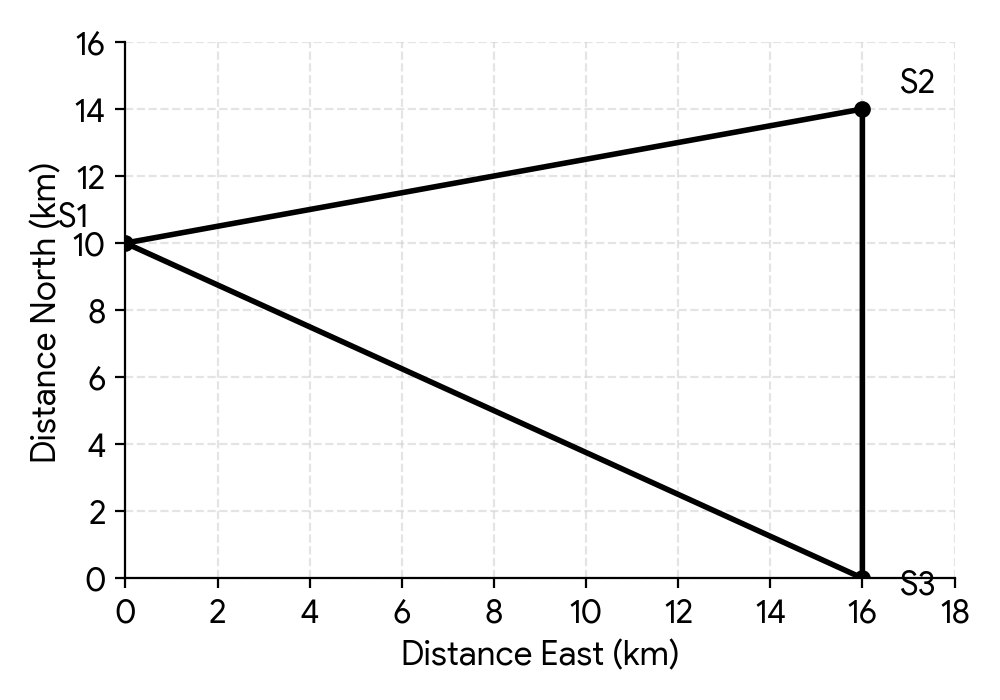
(a) Write down the distance between and .
(b) Calculate the distance between and .
(c) A geological team member is at sensor and needs to walk directly to sensor . Calculate the bearing of from .
A communication relay station is to be installed at a point that is an equal distance from each of the sensors at , , and .
(i) Write down the gradient of the line segment .
(ii) Write down the coordinates of the midpoint of the line segment .
(iii) Hence, calculate the coordinates of the communication relay station.
The distance between two points and can be found using the distance formula . For points on a vertical or horizontal line, this simplifies to the absolute difference in the changing coordinate.
Use the distance formula for the points and . Remember to take the square root of the sum of the squared differences in coordinates.
Bearings are measured clockwise from North. First, determine the change in easting and northing from to . Then, use trigonometry to find the angle relative to the North-South line and convert it to a bearing.
The gradient of a line segment connecting and is given by .
The midpoint of a line segment connecting and is given by .
The communication relay station is equidistant from , , and . This means it is the circumcenter of the triangle formed by these points. The circumcenter is the intersection of the perpendicular bisectors of the sides of the triangle. You already have the gradient and midpoint for . Find the perpendicular bisector for another side, for example , and solve the system of equations.
Question 3
MediumPaper 1 · calculator7 marksTwo historical landmarks are located at points A(4, 10) and B(16, 2) on a coordinate map. A proposed new scenic path, represented by the line R with equation , passes near these landmarks. A new visitor centre is to be built on this scenic path such that it is equidistant from both landmarks.
(a) Find the equation of the perpendicular bisector of the line segment [AB]. Give your equation in the form .
(b) Determine the coordinates of the point on the scenic path R where the visitor centre should be located.
First, calculate the gradient and midpoint of the line segment [AB]. Then, use the negative reciprocal of the gradient to find the gradient of the perpendicular bisector. Finally, use the midpoint and the perpendicular gradient to form the equation of the line.
The visitor centre is at the intersection of the perpendicular bisector (found in part a) and the scenic path R. Solve the two equations simultaneously.
Question 4
MediumPaper 1 · calculator6 marksThree sensor stations, Alpha (A), Beta (B), and Gamma (C), are positioned in a national park. Their coordinates are A(2, 8), B(10, 4), and C(6, 0) respectively.
The diagram below shows these points and the perpendicular bisectors of the segments connecting them.
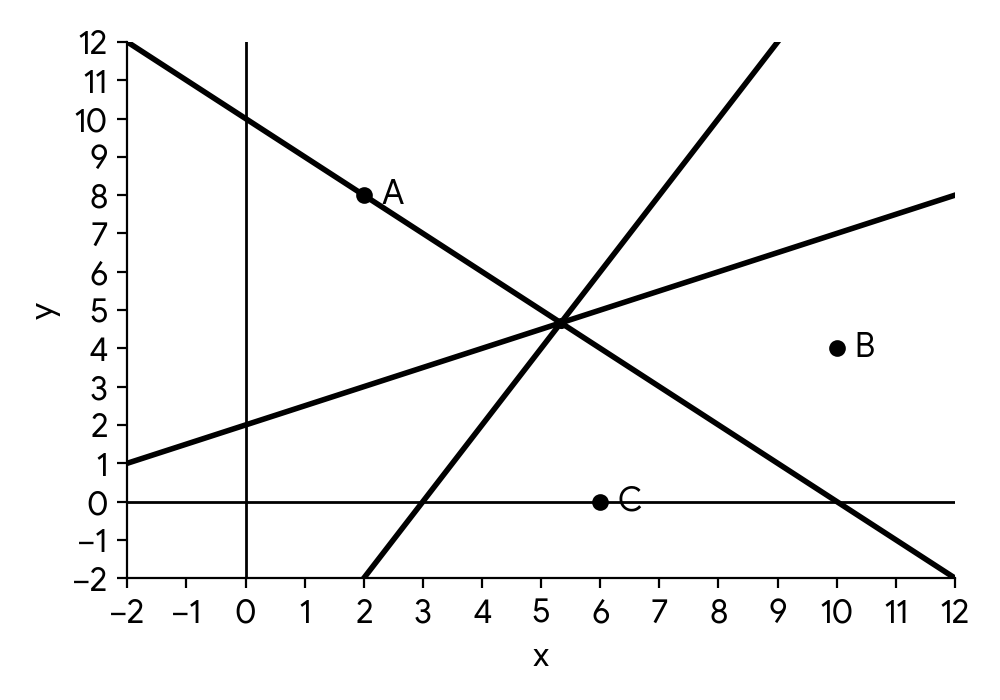
The perpendicular bisector of the line segment [BC] intercepts the axes at coordinates (0, 10) and (10, 0).
Write down the equation of the perpendicular bisector of [BC].
The equation of the perpendicular bisector of [AB] is .
Find the coordinates of point V, where the three perpendicular bisectors meet. Give your answer to four significant figures.
A Voronoi diagram is constructed with sensor stations A, B, and C as the three sites.
Draw, clearly, the edges of the Voronoi diagram on the given diagram.
Recall the formula for the equation of a straight line given two points or its intercepts. The intercepts provided can help determine the gradient and y-intercept.
To find the intersection point of two lines, set their equations equal to each other and solve for x, then substitute x back into one of the equations to find y. Remember to round to four significant figures.
The edges of a Voronoi diagram are the perpendicular bisectors of the line segments connecting adjacent sites. The intersection point V is a vertex of the Voronoi diagram.
Question 5
MediumPaper 2 · calculator11 marksArchaeologists are planning to establish a central research station in a newly discovered ancient region. They have identified three key excavation sites, A, B, and C, whose positions can be mapped on a Cartesian coordinate system. The coordinates of these sites, in kilometres, are A(1, 7), B(5, 1), and C(9, 5).
The research station needs to be built at a location equidistant from all three excavation sites. To find this location, the archaeologists first need to determine the equations of the perpendicular bisectors of the lines connecting the sites. Find the equations of the perpendicular bisectors of the line segments [BC] and [AC].
Using your results from part (a), determine the coordinates of the optimal location for the central research station.
Calculate the distance from the optimal research station location to any of the three excavation sites.
Recall how to find the midpoint of a line segment, the gradient of a line, and the gradient of a line perpendicular to it. Then use the point-gradient form to find the equation of each bisector.
The optimal location is equidistant from all three sites, which means it is the intersection point of the perpendicular bisectors found in part (a). Solve the system of linear equations.
Use the distance formula between the coordinates of the research station and one of the excavation sites. Since the station is equidistant, choosing any site will yield the same result.
Question 6
MediumPaper 2 · calculator23 marksThree emergency service stations are located at points , , and in a city's coordinate grid, where coordinates are in kilometres.
A central command hub is to be built at a point , equidistant from all three stations.
(a)(i) Find the midpoint of the line segment .
(a)(ii) Find the gradient of the line .
(a)(iii) Hence, find the equation of the perpendicular bisector of the line segment .
(b)(i) Find the midpoint of the line segment .
(b)(ii) Find the gradient of the line .
(b)(iii) Hence, find the equation of the perpendicular bisector of the line segment .
(c) Determine the coordinates of the central command hub .
(d) The city regulations state that the central command hub must be within a service radius of km from each station for effective communication. Determine if the proposed location meets this regulation.
(e) Calculate the area of the circular service region covered by the central command hub, assuming its effective radius is the distance to any of the stations. Give your answer to one decimal place.
To find the midpoint of a line segment with endpoints and , use the formula .
The gradient of a line passing through points and is given by .
The gradient of a line perpendicular to a line with gradient is . Use the midpoint found in (a.i) and the perpendicular gradient to form the equation of the line.
Remember the midpoint formula: .
The gradient of a line passing through points and is given by .
The gradient of a line perpendicular to a line with gradient is . Use the midpoint found in (b.i) and the perpendicular gradient to form the equation of the line.
The central command hub is equidistant from all three stations, meaning it is the intersection point of the perpendicular bisectors. Solve the system of equations for the perpendicular bisectors of and .
Calculate the distance between point and any one of the stations (e.g., ) using the distance formula. Compare this distance to the regulation radius of km.
The radius of the service region is the distance calculated in part (d). The area of a circle is given by .
Question 7
MediumPaper 1 · calculator11 marks(a) Two proposed locations for new fire stations are and . The city wants to build a new community centre that is equidistant from both proposed fire stations. Find the equation of the perpendicular bisector of the line segment connecting and .
(b) Four existing emergency stations are located at , , , and . A new critical facility is being built at . Determine which existing emergency station is the closest to the new facility at . Justify your answer with calculations.
(c) An incident occurs at location . Emergency services define a "rapid response" as being within km of the closest emergency station. State whether a rapid response is guaranteed for the incident at . Justify your answer with calculations.
First, find the midpoint of the line segment . Then, calculate the gradient of . The perpendicular bisector will have a gradient that is the negative reciprocal of the gradient of . Finally, use the point-gradient form of a linear equation with the midpoint and the perpendicular gradient.
To determine the closest station, calculate the distance from the facility to each of the four stations () using the distance formula. The station with the shortest distance is the closest.
Similar to part (b), calculate the distance from the incident location to each of the four stations (). Identify the minimum distance. Then, compare this minimum distance to the km rapid response criterion.
Question 8
MediumPaper 2 · calculator13 marksThe following grid shows a city's emergency service layout. There are four service stations centred at points A, B, C, and D. A Voronoi diagram for these four points could be constructed. One unit represents 1 kilometre.
Fire station A is located at .
The equation of the perpendicular bisector of the line segment is .
(a) Write down the coordinates of fire station B.
Police station C is located at , and police station D is located at .
(b) Find
(i) the coordinates of the midpoint of the line segment .
(ii) the equation of the perpendicular bisector of . Give your answer in the form .
A city is served by four emergency service stations: Fire Station A , Fire Station B , Police Station C , and Police Station D . The average response times (in minutes) for each station are given in the table below.
| Station | A | B | C | D |
|---|---|---|---|---|
| Average response time (minutes) | 12 | 8 | 15 | 6 |
Using nearest-neighbour interpolation, find the average response time for an incident occurring at point .
The city council wants to determine if the average emergency response time for fire incidents () is different from the average response time for police incidents (). They decide to use a two-sample -test at a level of significance.
For this test, the null hypothesis is:
(d) State the alternative hypothesis.
To gather data on response times, the city council decides to select every 10th incident report from the past year's records.
(e) (i) State which one of the following methods best describes this sampling technique:
convenience, systematic, or stratified.
(ii) State one disadvantage of this sampling technique.
The city council instead collects the data using simple random sampling.
The -value for the sampled data is .
(f) State the conclusion for the test. Justify your answer.
The perpendicular bisector of a line segment passes through its midpoint. For a vertical perpendicular bisector , the x-coordinate of the midpoint is . The y-coordinates of the two points on the segment will be the same.
Use the midpoint formula: .
First, find the gradient of the line segment . Then, find the negative reciprocal of this gradient to get the gradient of the perpendicular bisector. Use the midpoint found in part (b)(i) and the perpendicular gradient to form the equation of the line.
Calculate the distance from the point to each of the four stations. The station with the shortest distance is the 'nearest neighbour'. Then, read the average response time for that station from the table.
The alternative hypothesis should reflect the research question: whether the response times are 'different'.
Consider the definition of each sampling method. 'Every nth item' is characteristic of a specific method.
Think about potential biases or issues that could arise if there's a pattern in the data that aligns with the sampling interval.
Compare the -value to the significance level (given as or ). If , reject the null hypothesis. Otherwise, do not reject it.
Question 9
MediumPaper 2 · calculator17 marksThe telecommunications company "ConnectAll" is optimizing its cell tower network. The locations of six existing cell towers (labelled A, B, C, D, E, and F) are given by their coordinates in a local grid system, where distances are measured in kilometres.
Tower A:
Tower B:
Tower C:
Tower D:
Tower E:
Tower F:
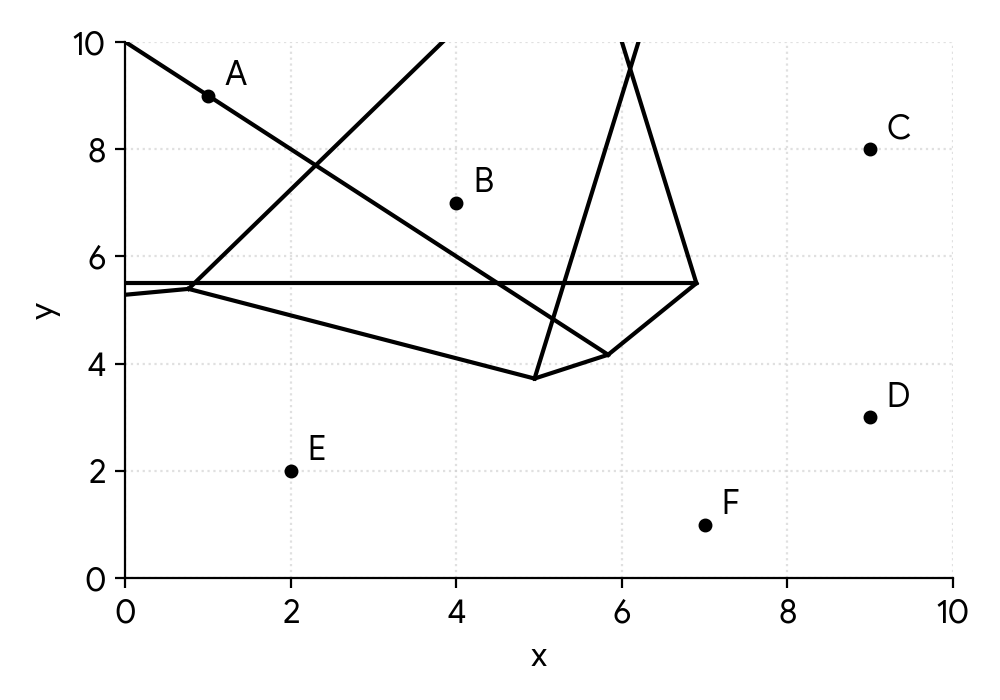
A customer at coordinates wants to connect to the closest cell tower. Write down the tower they should connect to.
A customer at coordinates wants to connect to the closest cell tower. Tower E is currently offline for maintenance. Write down the tower they should connect to.
Tower C is at and Tower D is at .
Find the equation of the perpendicular bisector of the line segment CD.
Tower B is at and Tower C is at .
Find the equation of the perpendicular bisector of the line segment BC.
Hence find
(i) the coordinates of the point which is of equal distance from towers B, C, and D.
Hence find
(ii) the distance of this point from Tower D.
To determine the closest tower, you would typically use a Voronoi diagram. However, without the diagram, you can calculate the distance from the customer's location to each tower and find the minimum distance. The tower corresponding to the minimum distance is the closest.
Exclude Tower E from your distance calculations. Calculate the distance from the customer's location to all other operational towers and identify the shortest distance.
First, find the midpoint of the line segment CD. Then, determine the gradient of CD. The perpendicular bisector will have a gradient that is the negative reciprocal of CD's gradient and will pass through the midpoint. Note any special cases for vertical or horizontal lines.
First, find the midpoint of BC. Then, calculate the gradient of BC. The gradient of the perpendicular bisector will be the negative reciprocal of the gradient of BC. Use the point-slope form of a linear equation, , with the midpoint and the perpendicular gradient.
The point equidistant from three points is the circumcentre of the triangle formed by those points. This point is the intersection of the perpendicular bisectors of the sides of the triangle. You have already found two such bisectors in parts (b) and (c). Solve the system of equations for these two bisectors.
Use the distance formula to calculate the distance between the point found in part (d.i) and the coordinates of Tower D.
No question on this page matches those filters. Try another difficulty or paper.
Every Perpendicular bisectors (from 2 points or line + midpoint) question, marked for you
Every answer is marked mark by mark, IB-style, and the AI tutor helps when you are stuck.
Where marks are lost
- Answering to the wrong accuracy. Two significant figures, or six, where the rule says exactly or three. Common wherever a GDC's full decimal display gets copied straight down.
- Rounding an intermediate value and then using it in a later part. Costs a mark every time, and AI's multi-part modelling questions give it more chances to happen than AA's shorter, more self-contained ones.
- Writing the answer and nothing else, where the mark scheme has an explicit M1 rather than an implied one. A bare answer cannot score full marks there.