Trapezoidal rule: notes and practice questions
- Trapezoidal Rule: numerical method to approximate area under a curve by dividing it into `n` trapezoids (strips).
- `n` strips correspond to `n+1` function values ().
- Trapezoidal Rule formula:
- Width of each trapezoid:
- `a`: lower limit of integral; `b`: upper limit of integral; `n`: number of trapezoids.
- `y_i`: function values calculated at each `x`-coordinate, where and .
- Percentage Error formula:
- Procedure:
- Calculate .
- Determine `x`-values starting from and adding `h` repeatedly.
- Calculate corresponding `y`-values () for each `x`-value.
- Substitute `h` and `y`-values into the trapezoidal rule formula.
- If required, calculate percentage error, taking the absolute value of the result.
- Show working (e.g., table of x/y values) for method marks.
- Use GDC's numerical integration feature to find the exact area if not provided for percentage error calculations.
- Avoid heavy rounding of `y`-values during intermediate steps to prevent compounding errors.
- The principles, formulas, and methods are identical for IB Math AI SL and HL.
How it is examined
Distinctive to AI. Because it works on a table of data as well as on a function, it is the tool for an area with no formula, which is exactly the AI framing. The strip width has to be uniform, so a question with unequal intervals is out of syllabus. A frequent follow-up asks whether the estimate is an overestimate or an underestimate, which is answered from the concavity of the curve, and that is a reasoning mark rather than a calculation.
The trapezoidal rule, , where .
Approximating areas using the trapezoidal rule.
Linking questions
- Other contexts: irregular areas that are not described by mathematical functions, for example lakes.
- Links to other subjects: kinematics (physics).
- Use of technology: use dynamic graphing software to calculate the approximate area under a curve and interpret its meaning.
- Enrichment only, so not examinable: other numerical integration techniques such as Simpson's rule.
Practice questions
18 questions · 1 easy · 15 medium · 2 hardQuestion 1
EasyPaper 1 · calculator6 marksConsider the function with the following data points:

Estimate the area between the curve of and the x-axis from until x.
The equation of curve is , find the exact area between the curve of and the x-axis from until x.
Find the percentage error of the answer in part (a).
Estimation means approximation and approximating areas under curve can be done through the trapezoidal rule.
Area under curve can be found when having the function through integration.
Apply the percentage error formula.
Question 2
MediumPaper 1 · calculator5 marksA team of engineers is monitoring the flow of water into a large storage tank during a heavy rainfall. Let be the flow rate, in litres per hour, and be the time in hours since the monitoring began.
When is plotted against , the total volume of water collected in the tank is represented by the area between the graph and the horizontal -axis.
The flow rate, , is measured over the course of three hours. The results are shown in the following table.
| (hours) | 0 | 0.5 | 1.0 | 1.5 | 2.0 | 2.5 | 3.0 |
|---|---|---|---|---|---|---|---|
| (litres/hour) | 100 | 120 | 150 | 130 | 110 | 90 | 80 |
(a) Use the trapezoidal rule with an interval width of 0.5 hours to estimate the total volume of water collected in the tank during these three hours.
(b) The actual volume of water collected during these three hours was 340 litres.
Find the percentage error of the estimate found in part (a).
Recall the formula for the trapezoidal rule: . Identify the interval width and the function values.
The percentage error is calculated as .
Question 3
HardPaper 2 · calculator24 marksA landscape architect is designing a new public park. The northern boundary of the park is modelled by the function , and other boundaries are straight lines. The plan view of the park is shown in the following diagram, where both axes represent distance and are measured in metres.
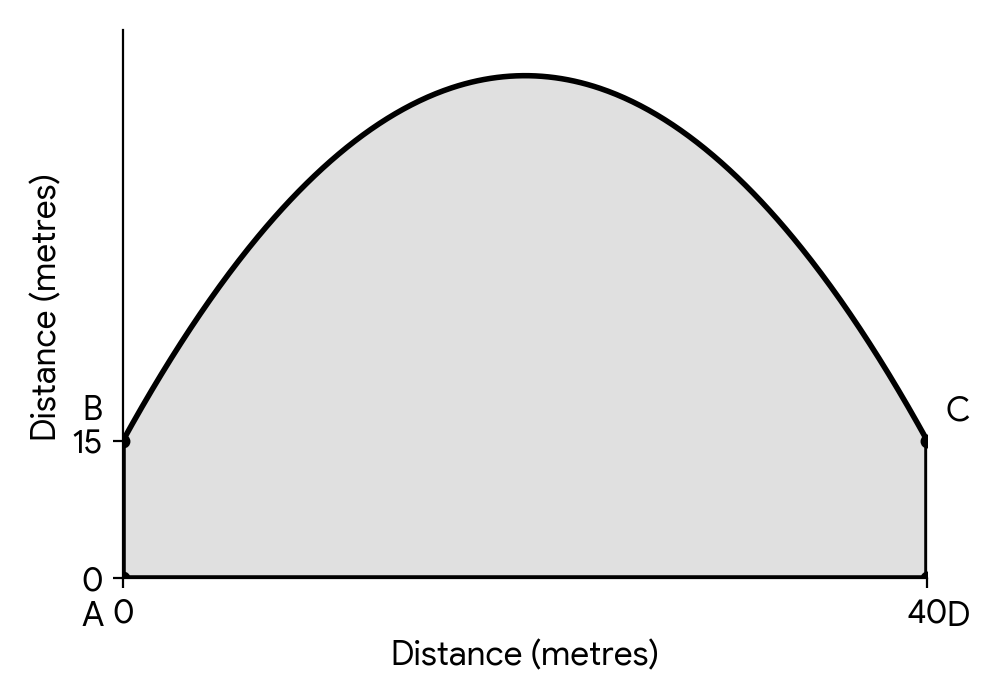
The function models the northern boundary of the park between points B and C and is given by
, for .
(i) Find .
(ii) Hence find the coordinates of the point on the park's northern boundary that is furthest north.
Point A has coordinates , point B has coordinates , point C has coordinates and point D has coordinates .
(i) Write down the integral which can be used to find the area of the shaded region representing the park.
(ii) Find the area of the park.
(i) A landscaper uses the trapezoidal rule with 4 intervals to estimate the area of the park. Calculate this estimate.
(ii) Calculate the percentage error in the landscaper's estimate.
(iii) Suggest how the landscaper might be able to reduce the error whilst still using the trapezoidal rule.
A square-shaped meditation garden, PQRS, is to be built within the park. The side [PS] lies on the southern boundary (x-axis), and the side [QR] lies on the eastern boundary of the park (). Point Q lies on the northern boundary curve .
(i) Find the x-coordinate of point P for the largest area of the meditation garden.
(ii) Find the largest area of the meditation garden.
Recall the power rule for differentiation: if , then . The derivative of a constant term is zero.
The point furthest north corresponds to the maximum value of . To find this, set the derivative to zero and solve for . Then substitute this -value back into to find the corresponding -coordinate.
The area under a curve from to is given by the definite integral . Identify the function and the limits of integration from the problem description.
Evaluate the definite integral you wrote down in part (b)(i). Use your GDC for calculation if allowed, or integrate term by term.
The trapezoidal rule formula is , where . For 4 intervals over , . Calculate at .
Percentage error is given by . Use the exact area from part (b)(ii) and the estimate from part (c)(i).
Consider how the number of intervals affects the accuracy of numerical integration methods like the trapezoidal rule.
Let the x-coordinate of P be . The side length of the square will be . Since Q lies on , its y-coordinate is . For a square, the side length must equal the height, so equate to and solve for . Remember that must be within the park's boundaries.
Once you have the x-coordinate of P, calculate the side length of the square using . Then square this side length to find the area.
Question 4
MediumPaper 1 · calculator8 marksThe cross-section of a proposed tunnel entrance is modelled by a curve. The heights of the tunnel are measured at horizontal intervals and are given in the table below. All measurements are in cm.
Horizontal distance, x (cm)
0
10
20
30
40
50
60
Vertical distance, y (cm)
0
1.875
6.0
10.125
12.0
9.375
0
(a) Use the trapezoidal rule with to find an approximation for the cross-sectional area of the tunnel entrance.
(b)
It is given that the equation of the curve is , for .
(i) Write down an integral to find the exact cross-sectional area.
(ii) Calculate the value of the cross-sectional area to two decimal places.
(c) Find the percentage error in the area found using the trapezoidal rule. Give your answer to two decimal places.
Remember the formula for the trapezoidal rule: . Carefully substitute the given values.
The area under a curve from to is given by the definite integral .
Use your GDC to evaluate the definite integral you wrote down in part (b)(i).
The percentage error is calculated as .
Question 5
HardPaper 2 · calculator12 marksThe diagram shows the cross-section of a newly constructed road tunnel. A coordinate system has been added with the origin, O, at the point where the tunnel meets the road surface on one side. All units are in metres.
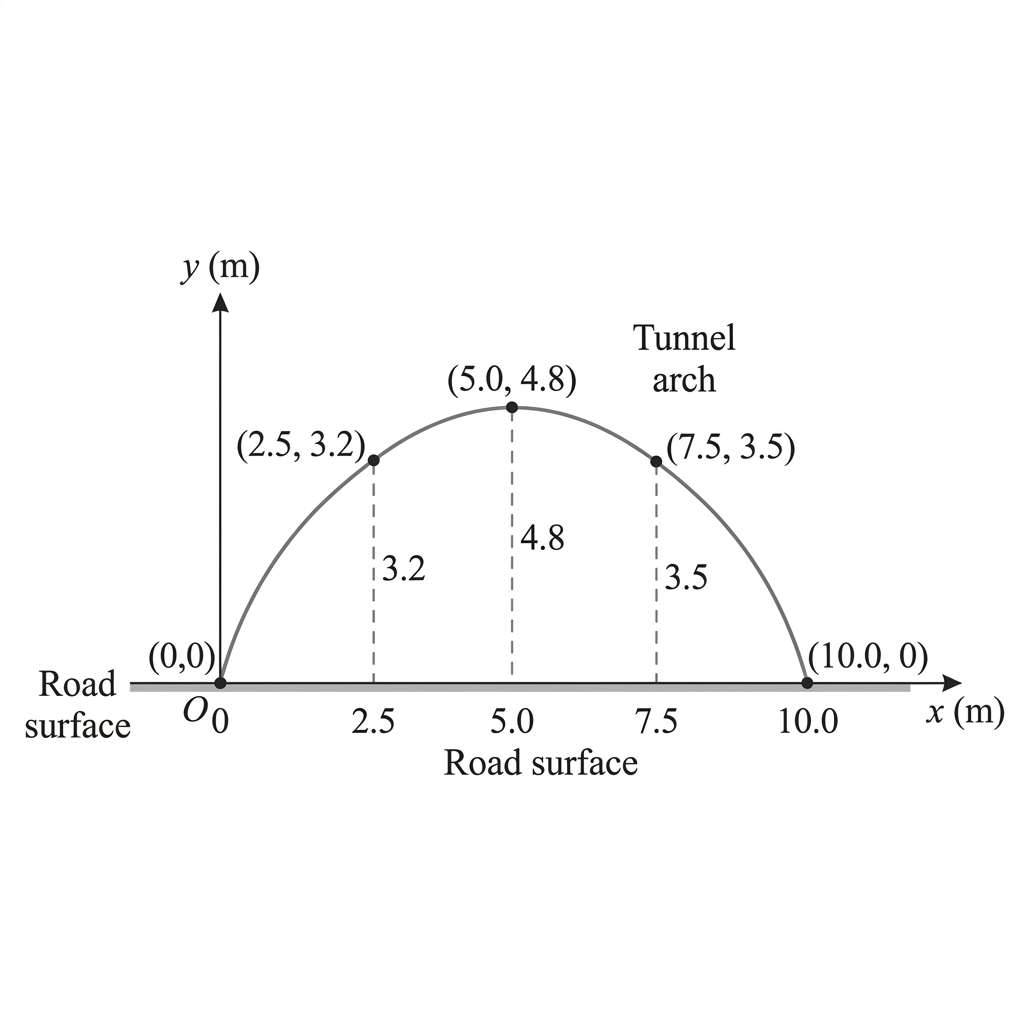
To determine the air volume capacity, measurements of the tunnel's vertical height are taken every m from O. The heights are shown in the following table.
| Horizontal distance from O in metres | 0 | 2.5 | 5.0 | 7.5 | 10.0 |
|---|---|---|---|---|---|
| Vertical height of tunnel in metres | 0 | 3.2 | 4.8 | 3.5 | 0 |
Use the trapezoidal rule to find the cross-sectional area of the tunnel opening above the road surface.
A ventilation system pushes air through the tunnel at a rate of m s.
Find the volume of air that passes through the tunnel each second.
A maintenance vehicle, m tall, needs to perform inspections. Find the vertical clearance between the top of the vehicle and the tunnel ceiling at a horizontal distance of m from the entrance.
The curved arch of the tunnel can be modelled by the equation , for .
Find the maximum height of the tunnel arch above the road surface.
A large cargo truck, m wide and m tall, needs to pass through the tunnel. The truck must stay in the centre of the road.
Determine whether the truck will be able to pass through the tunnel. Justify your answer.
Recall the formula for the trapezoidal rule: , where is the width of each interval and are the heights.
The volume of air passing per second is the cross-sectional area multiplied by the flow rate.
Subtract the vehicle's height from the tunnel's height at the specified horizontal distance.
The maximum height of a parabola occurs at , or by setting the first derivative to zero.
Consider the truck's width and height. Since the truck must stay in the centre, determine the horizontal positions of its sides. Then, calculate the tunnel's height at these positions and compare it to the truck's height. Alternatively, find the width of the tunnel at the truck's height and compare it to the truck's width.
Question 6
MediumPaper 1 · calculator5 marksA city council is monitoring the rate at which water flows into a new reservoir during a storm. Let R be the rate, in thousands of litres per hour, at which water is flowing into the reservoir and t be the time in hours since the storm began.
When R is plotted against t, the total amount of water collected in the reservoir is represented by the area between the graph and the horizontal t-axis.
The rate, R, is measured over the course of three hours. The results are shown in the following table.
| t (hours) | 0 | 0.5 | 1.0 | 1.5 | 2.0 | 2.5 | 3.0 |
|---|---|---|---|---|---|---|---|
| R (thousands of litres/hour) | 10 | 25 | 40 | 35 | 20 | 15 | 30 |
The real amount of water collected during these three hours was 70 thousand litres.
Use the trapezoidal rule with an interval width of 0.5 hours to estimate the total amount of water collected during these three hours.
Find the percentage error of the estimate found in part (a).
Remember the formula for the trapezoidal rule: , where is the interval width and are the ordinates.
The percentage error is calculated as .
Question 7
MediumPaper 1 · calculator4 marksA rocket engineer is designing a new nozzle. The internal shape of the nozzle is formed by rotating a curve about the central axis (y-axis).
The nozzle is 12 cm long. The internal radius of the nozzle is measured at 3 cm intervals along its length:
| Length from base (cm) | Radius (cm) |
|---|---|
| 0 | 5 |
| 3 | 4 |
| 6 | 3 |
| 9 | 2 |
| 12 | 1.5 |
Use the trapezoidal rule to estimate the internal volume of the nozzle.
Remember the formula for the volume of revolution when using the trapezoidal rule. Ensure you square the radius values before applying the rule, and correctly identify the interval 'h'.
Question 8
MediumPaper 1 · calculator8 marksA civil engineer is surveying a river to estimate its cross-sectional area for flow rate calculations. The depth of the river is measured at regular horizontal intervals across its width, as shown in the table below.
| Horizontal distance, x (m) | 0 | 10 | 20 | 30 | 40 | 50 | 60 |
|---|---|---|---|---|---|---|---|
| Depth, y (m) | 0 | 2.5 | 8 | 13.5 | 16 | 12.5 | 0 |
Use the trapezoidal rule with m to find an approximation for the cross-sectional area of the river.
It is given that the equation of the curve modelling the riverbed cross-section is , for .
Write down an integral to find the exact cross-sectional area.
Calculate the value of the cross-sectional area to two decimal places.
Find the percentage error in the area found using the trapezoidal rule compared to the exact area.
Recall the formula for the trapezoidal rule: . Make sure to correctly identify and the values from the table.
The exact area under a curve from to is given by the definite integral . Ensure your limits match the given range for .
Evaluate the definite integral you wrote down in part (b.i). You can use your GDC for this calculation.
The percentage error is calculated as . Use your results from parts (a) and (b.ii).
Question 9
MediumPaper 1 · calculator10 marks(a) A landscape architect is designing a curved retaining wall for a garden. The height of the wall, metres, is measured at m intervals along its horizontal length, metres, from one end. The measurements are given in the table below.
| (m) | |||||||||
|---|---|---|---|---|---|---|---|---|---|
| (m) |
Use the trapezium rule to estimate the cross-sectional area of the wall, giving your answer correct to decimal places.
(b) It is later discovered that the equation connecting and is .
Calculate the true value of the cross-sectional area of the wall.
(c) Find the percentage error in your estimation of the area you made in part (a).
(d) Explain why, in this case, the trapezium rule underestimates the true value.
Recall the formula for the trapezium rule: . Identify the strip width and the corresponding -values from the table.
The true cross-sectional area can be found by integrating the function over the given interval. Set up a definite integral from to .
The percentage error is calculated using the formula: .
Consider the shape of the curve defined by and how the trapezoids fit under it. Think about concavity.
Question 10
MediumPaper 1 · calculator4 marksA research submarine is undergoing tests to measure its descent capabilities. During one test, its vertical velocity (rate of descent) is recorded at regular intervals, as shown in the table below.
| Time ( in s) | Velocity ( in m/s) |
|---|---|
| 0 | 0.0 |
| 10 | 2.5 |
| 20 | 6.0 |
| 30 | 11.5 |
| 40 | 18.0 |
| 50 | 25.5 |
| 60 | 34.0 |
Apply the trapezoidal rule to estimate the total vertical distance the submarine has descended by the time its velocity reaches m/s.
Remember the formula for the trapezoidal rule: . Here, is the time interval, and is the velocity.
Question 11
MediumPaper 1 · calculator4 marks(a) A scientist is studying the growth of a bacterial colony. The rate of growth, in arbitrary units, can be modelled by the function , where is the time in hours.
Estimate the total growth (area under the graph) of the colony from to hours using four trapezoids. Give your answer correct to four significant figures.
Recall the trapezoidal rule formula: . First, determine the width of each trapezoid, , and the -values for each trapezoid.
Question 12
MediumPaper 1 · calculator3 marksA research drone is used to measure the speed of a river current at various distances from its bank. The data collected is presented in the table below.
| Distance from bank ( m) | Speed of current ( m/s) |
|---|---|
| 0 | 0 |
| 2 | 3 |
| 4 | 5 |
| 6 | 4 |
| 8 | 0 |
(a) Use the trapezoidal rule to estimate the area under the graph of speed versus distance from m to m.
Remember the formula for the trapezoidal rule: , where is the width of each interval and are the function values.
Question 13
MediumPaper 2 · calculator11 marks(a) A chemical reaction produces a substance at a rate given by grams per minute, where is the time in minutes. Estimate the total amount of substance produced (in grams) over the interval minutes using four trapezoids. Give your answer correct to four significant figures.
(b) (i) Write down a definite integral that represents the exact total amount of substance produced.
(b) (ii) Hence, find the actual total amount of substance produced. Give your answer correct to four significant figures.
(c) Find the percentage error made with the estimation found in part (a).
The total amount of substance produced is the area under the rate function. Use the trapezoidal rule formula: . Remember to calculate the width first.
The total amount is the definite integral of the rate function over the given interval.
Recall the integral of . Use the fundamental theorem of calculus.
Percentage error is given by .
Question 14
MediumPaper 2 · calculator16 marksA civil engineer is designing a cross-section for a new pedestrian tunnel. The shape of the tunnel's ceiling can be modelled by the curve , where and are measured in metres. The tunnel's base is along the -axis, and it starts from the -axis, extending to where the ceiling meets the -axis.
(a) Sketch the curve, showing the region representing the cross-sectional area of the tunnel. Shade this region.
(b) Using the trapezium rule with five strips, determine an approximation for the cross-sectional area of the tunnel.
(c) Explain why your answer to part (b) will be an underestimate for the actual cross-sectional area.
(d) Using integration, determine the exact value of the cross-sectional area of the tunnel.
(e) Find the percentage error of your approximation from part (b) compared with the exact value found in part (d).
Identify the intercepts with the - and -axes to help sketch the curve accurately. The area described is in the first quadrant.
Remember the formula for the trapezium rule: . First, find the width of each strip, , and then calculate the -values at the endpoints of each strip.
Consider the second derivative of the function to determine its concavity.
Integrate the function from to the positive -intercept.
Percentage error . Use the unrounded values from parts (b) and (d) for accuracy.
Question 15
MediumPaper 1 · calculator4 marksThe rate at which water flows into a reservoir, (in /hour), is measured at various times, (in hours), over an 8-hour period. The data is shown in the table below.
| (hours) | |||||
|---|---|---|---|---|---|
| (/hour) |
Estimate the total volume of water that flowed into the reservoir during this 8-hour period, using the trapezoidal rule.
Recall the formula for the trapezoidal rule. The strip width can be found by subtracting consecutive values. The total volume is the area under the rate-time graph.
Question 16
MediumPaper 1 · calculator18 marksThe diagram below shows a cross-section of a sculpted garden feature. The shaded area is bounded by the -axis, the vertical line , the line and the curve .
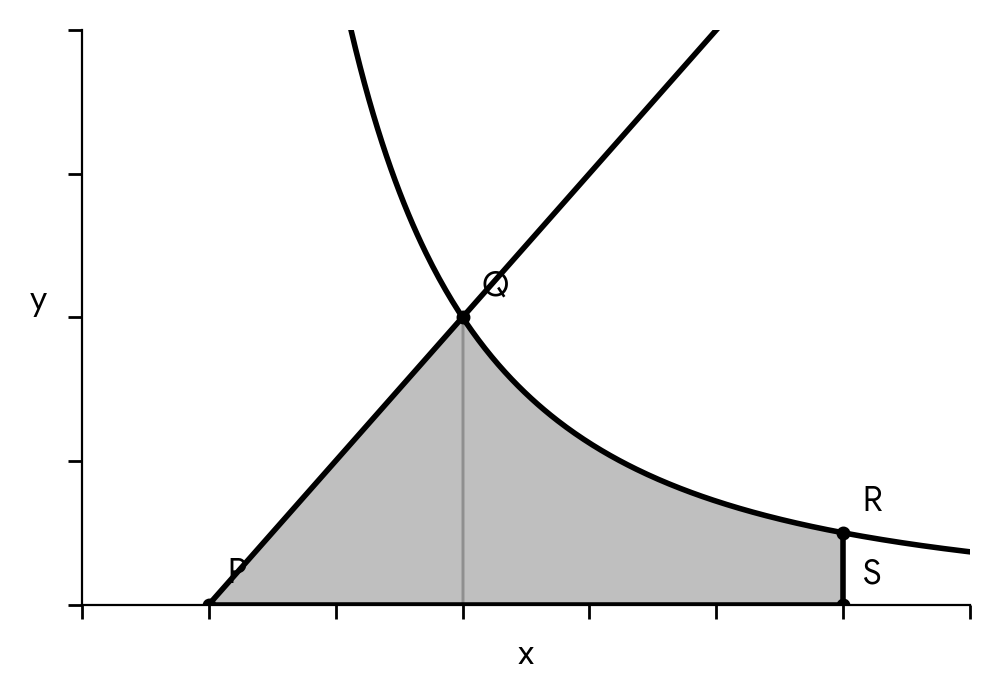
Using technology or otherwise, find the coordinates of points , , and .
Approximate the area of the cross-section using the trapezoidal rule with 5 strips of equal width over the interval .
Explain why the approximation in part (b) is an overestimate.
Determine the exact area of the cross-section using integration.
Find the percentage error of your approximation from part (b), compared with the exact value from part (d).
Points P and S lie on the -axis. Point Q is the intersection of the line and the curve. Point R is on the curve at . Remember to show your working for finding intersection points.
The width of each strip is . The trapezoidal rule formula is . Remember to use the correct function for each -value.
Consider the concavity of the curve over the interval where it is used in the approximation. How does the trapezoidal rule behave with concave up/down curves?
The area is split into two regions at the intersection point Q. Integrate each function over its respective interval and sum the results.
The formula for percentage error is .
Question 17
MediumPaper 2 · calculator13 marks(a) The depth, in metres, of a decorative planter box's cross-section is modelled by the function , for , where is the horizontal distance in metres from the left edge of the box.
(i) Find .
(ii) Hence, find the maximum depth of the planter box.
(b) The depths of the planter box at , , , and are m, m, m, and m respectively.
Use the trapezoidal rule with three intervals to estimate the cross-sectional area of the planter box.
(c)
(i) Write down the integral which can be used to find the exact cross-sectional area of the planter box.
(ii) Hence, find the exact cross-sectional area of the planter box.
To find the derivative of a polynomial function, apply the power rule to each term. Remember that the derivative of is .
The maximum depth occurs where the gradient of the function is zero. Set and solve for . Then substitute this -value back into the original function to find the maximum depth.
The trapezoidal rule formula for intervals is . With three intervals from to , the width of each interval will be .
The cross-sectional area can be found by integrating the function with respect to over the given interval.
Evaluate the definite integral you wrote down in part (c)(i). You can use your GDC for this calculation.
Question 18
MediumPaper 2 · calculator12 marksA landscape architect is designing a decorative arch for a garden entrance. The cross-section of the arch is modelled by the curve with equation , for , where is the horizontal distance in metres from the start of the arch and is the height in metres above the ground. The architect wants to estimate the area under the arch.
Find the values of , and , shown in the table below, which represent the height of the arch at different horizontal distances.
| x (m) | 0 | 2.5 | 5 | 7.5 | 10 |
|---|---|---|---|---|---|
| y (m) | 1 | a | b | c | 1 |
The architect uses the trapezoidal rule with four intervals to estimate the area under the arch. Using the values from part (a), find this estimate of the area.
Write down the integral that can be used to find the exact area under the arch.
Hence, use your graphic display calculator to find the exact area under the arch. Give your answer correct to one decimal place.
Calculate the percentage error of the architect's estimate in part (b) compared to the exact area found in part (c.ii).
To find the values of , , and , substitute the corresponding values into the given equation for . Remember to round your answers appropriately for intermediate values.
The formula for the trapezoidal rule is . Identify the interval width and the -values from the table.
The exact area under a curve from to is given by the definite integral . Identify the function and the limits of integration from the problem description.
Use the numerical integration feature on your GDC to evaluate the definite integral you wrote down in part (c.i). Ensure your calculator is in the correct mode if necessary.
The formula for percentage error is . Use the unrounded values from parts (b) and (c.ii) for maximum accuracy before rounding the final answer.
No question on this page matches those filters. Try another difficulty or paper.
Every Trapezoidal rule question, marked for you
Every answer is marked mark by mark, IB-style, and the AI tutor helps when you are stuck.
Where marks are lost
- Leaving an answer in calculator notation. Never accepted in a final answer, and AI's constant calculator use makes this the easiest slip in the whole subject.