Optimisation problems: notes and practice questions
- Optimisation: Finding the absolute maximum or minimum value of a quantity.
- Method: Model the quantity as a function of one variable, then find its turning points.
- Turning Point Condition: Set the first derivative to zero ().
- Variable Naming: Capital letters for dependent variables (e.g., , , ), lowercase for independent (e.g., , ).
- Single-Variable Equation Formation:
- Express the quantity to optimise using one independent variable.
- Use constraints to substitute and eliminate other variables.
- GDC Use:
- Plot the single-variable function (map problem variables to ).
- Use built-in "minimum" or "maximum" analysis tools to find the turning point.
- Interpretation: State the final answer in the context of the problem.
- "Show That" Steps: Provide clear algebraic working for substitutions and derivations.
- Contextual Validity: Ensure answers are physically sensible (e.g., positive lengths, volumes).
- Example Area Constraint:
- Example Optimised Function (Perimeter):
- Example Derivative for Optimisation:
- Example Solution: Setting yields .
How it is examined
A long SL question, five or six marks, and the structure is always the same: form an expression from the context, eliminate a variable using a constraint, differentiate, solve , then answer the original question in context with units. The last step is the one students drop, giving the value of rather than the minimum cost. The explicit ban on kinematics at SL is the constraint to hold when writing an SL optimisation question.
Optimisation problems in context.
In SL examinations, questions on kinematics will not be set. Kinematics is HL only, at AHL 5.13 and AHL 3.12.
Linking questions
- Other contexts: efficient use of material in packaging.
- Links to other subjects: kinematics (physics); allocative efficiency (economics).
- TOK: how can the rise in tax for plastic containers, for example plastic bags and plastic bottles, be justified using optimization?
Practice questions
34 questions · 20 medium · 14 hardQuestion 1
MediumPaper 1 · calculator6 marksA company is designing a closed cylindrical container to hold a specific volume of liquid. The total surface area of the container, in cm, with a fixed volume of cm and a radius of cm, is given by the function , where .
Find .
Solve .
Interpret your answer to (b)(i) in context.
Recall the power rule for differentiation. You may find it helpful to rewrite the term using a negative exponent before differentiating.
Set the derivative you found in part (a) equal to zero and solve for . Remember that .
Consider what setting the derivative to zero tells you about the original function, and relate it back to the problem of designing the container.
Question 2
HardPaper 1 · calculator10 marksA group of engineers is designing a new observation Ferris wheel. The height, , in metres, of a passenger capsule above the ground is modelled by the function , where is the time in seconds after the capsule begins its ascent from the highest point.
The lowest point a capsule reaches is 2 metres above the ground, and the highest point is 32 metres above the ground. The Ferris wheel completes one full rotation in 200 seconds.
Find the values of and .
Using your values from part (a), the function is .
(i) Find .
(ii) Find .
The engineers are particularly interested in the moment when the capsule's vertical speed is at its maximum, for the first time after . This occurs at time .
Calculate the value of .
Calculate the height of the capsule at this time .
The amplitude of a sinusoidal function is half the difference between its maximum and minimum values. The vertical shift (midline) is the average of the maximum and minimum values. Consider the starting point () to determine the sign of .
Remember the chain rule for differentiation. For , the derivative is . The derivative of is .
The vertical speed is given by . To find when the speed is maximum, you need to find the maximum value of . This occurs when or at the endpoints of the domain. Consider the range of the sine function.
Substitute the value of you found in part (c.i) into the original height function .
Question 3
MediumPaper 1 · calculator9 marksA landscape architect is designing a modular planter box for a new urban garden. The planter box has a base and top that are identical sectors of a circle, each with radius cm and angle radians. The height of the planter box is cm. The total length of metal frame used for all edges of the planter box is cm. This includes two circular arcs, four radial edges for the top and bottom sectors, and three vertical connecting edges.
(a) Show that .
(b) The planter box is designed to hold soil, enclosing a volume, .
(i) Find an expression for in terms of .
(ii) Find the expression for .
(iii) Solve algebraically to find the value of that will maximize the volume, .
Carefully identify all the edges that contribute to the total length of the metal frame. Remember the formula for the arc length of a sector.
Recall the formula for the area of a circular sector and how it relates to the volume of a prism.
Remember to use the quotient rule for differentiation, or rewrite the expression using a negative exponent and apply the product rule.
To maximize a function, you typically find where its derivative is equal to zero.
Question 4
HardPaper 2 · calculator19 marks(a) A space probe, 'Voyager Alpha', is launched from a space station. The position of the probe at time days after launch is given by the vector
Distances are measured in thousands of kilometres.
Find the position vector of the probe days after launch.
(b) A second space probe, 'Explorer Beta', is launched from a different station. The position vector of this probe is given by the vector
Determine if the two flight paths intersect and, if so, state the point of intersection.
(c) The two probes were launched at the same time, so .
State, with a reason, whether the two probes actually collide.
(d) Calculate the distance between the two space stations (the initial launch points).
(e) Calculate the shortest distance that ever exists between the two probes and the time when this occurs. Assume days.
Substitute the given time value into the vector equation for the probe's position.
Equate the components of the two position vectors to form a system of linear equations. Solve for and using two of the equations, then check if these values satisfy the third equation.
Consider the results from part (b). For a collision to occur, the paths must intersect AND the probes must be at the intersection point at the same time.
The initial launch points are the constant vectors in the position equations (when or ). Use the 3D distance formula.
Form a vector representing the difference in position of the two probes at time (since they launched simultaneously, ). Find the magnitude squared of this difference vector, then differentiate with respect to and set to zero to find the minimum. Remember to consider the domain .
Question 5
MediumPaper 1 · calculator9 marksA surveillance drone D is flying with a constant velocity, , measured in kilometres per hour, where
.
At time the drone is at a point A(50, 20) relative to an origin O, where distances are
measured in kilometres.
Find the position vector of the drone at time hours.
A protected bird's nest is located at a point N(99, 2).
Find the value of when the drone will be closest to the bird's nest.
An environmental sensor will trigger if the drone flies within 18 kilometres of the nest.
State whether the sensor will trigger. Give a reason for your answer.
Recall that the position vector of an object moving with constant velocity is given by , where is the initial position vector and is the velocity vector.
The drone is closest to the nest when the vector connecting the nest to the drone is perpendicular to the drone's velocity vector. This means their dot product is zero.
Calculate the minimum distance between the drone and the nest using the value of found in part (b), then compare it to the given trigger distance.
Question 6
HardPaper 2 · calculator13 marksA company is designing an open-top storage container with a square base. The side length of the base is cm and the height is cm. The container needs to have a volume of cm.
Explain why .
Rearrange the equation in part (a) to make the subject.
Write down an expression for the surface area, , of the open-top container.
Show that this can be written as
Plot the graph of for .
Find the minimum surface area and the value of when this occurs.
Recall the formula for the volume of a rectangular prism (or cuboid). The base is a square.
Isolate the variable on one side of the equation.
The container has a square base and four rectangular sides. Remember it is open-top.
Substitute the expression for from part (b) into the surface area formula from part (c).
Use your GDC to plot the function. Ensure you choose an appropriate window to see the minimum point.
You can use the GDC's 'minimum' function or calculus by finding the derivative and setting it to zero.
Question 7
MediumPaper 1 · calculator5 marksA conical tank is being filled with water. The tank has a height of 12 cm and a radius of 4 cm at its top. Water is poured into the tank such that the volume of water is increasing at a rate of 10 cms.
(a) Find the height of the water in the tank when its volume is 8 cm.
(b) Hence or otherwise, find the rate of change of the height of the water at this instant.
Recall the formula for the volume of a cone, . Use similar triangles to establish a relationship between the radius () and height () of the water in the conical tank.
You have the volume in terms of height . Differentiate with respect to to find . Then, use the chain rule, , to find .
Question 8
HardPaper 2 · calculator15 marks(a) A pharmaceutical company is designing a new cylindrical container for a special liquid. The container has a fixed volume .
The radius of the container is and the height is .
Show that .
(b) Find an expression for the total surface area of the container.
(c) Substitute an expression for (from part (a) ) into your expression for (from part (b) ) and hence show that .
(d) Find .
(e) Find the minimum value of and the values of and when this occurs. Show that this value of is indeed a minimum.
Recall the formula for the volume of a cylinder. Substitute the given volume into this formula.
The total surface area of a cylinder consists of the area of the two circular bases and the area of the curved side.
From part (a), isolate . Then substitute this expression for into the formula for from part (b). Simplify the resulting expression.
Differentiate the expression for with respect to . Remember that can be written as .
To find the minimum value, set and solve for . Then use this value of to find and . To show it's a minimum, use the second derivative test.
Question 9
MediumPaper 1 · calculator10 marksA landscape architect is designing a series of modular planter boxes for an urban garden project. The volume, cm, of a particular planter box is modelled by the function , where is the depth of the planter in cm.
(a) Use your graphic display calculator to find the value of that will produce the maximum volume.
(b) Show that the maximum volume of the planter box is cm.
The width of the planter is cm, and the length is cm.
(c) The architect is interested in the total linear dimension , which is defined as the sum of the depth, width, and length of the planter. Hence find the value of when the volume is maximized.
To find the maximum volume, you need to find the value of where the rate of change of volume with respect to is zero. You can use your GDC to find the maximum point of or the root of .
Integrate the derivative to find the volume function . Remember that the volume is 0 when the depth is 0. Then substitute the value of found in part (a) into .
First, write an expression for in terms of . Then, use the value of that maximizes the volume from part (a).
Question 10
HardPaper 2 · calculator24 marksA landscape architect is designing a new public park. The northern boundary of the park is modelled by the function , and other boundaries are straight lines. The plan view of the park is shown in the following diagram, where both axes represent distance and are measured in metres.
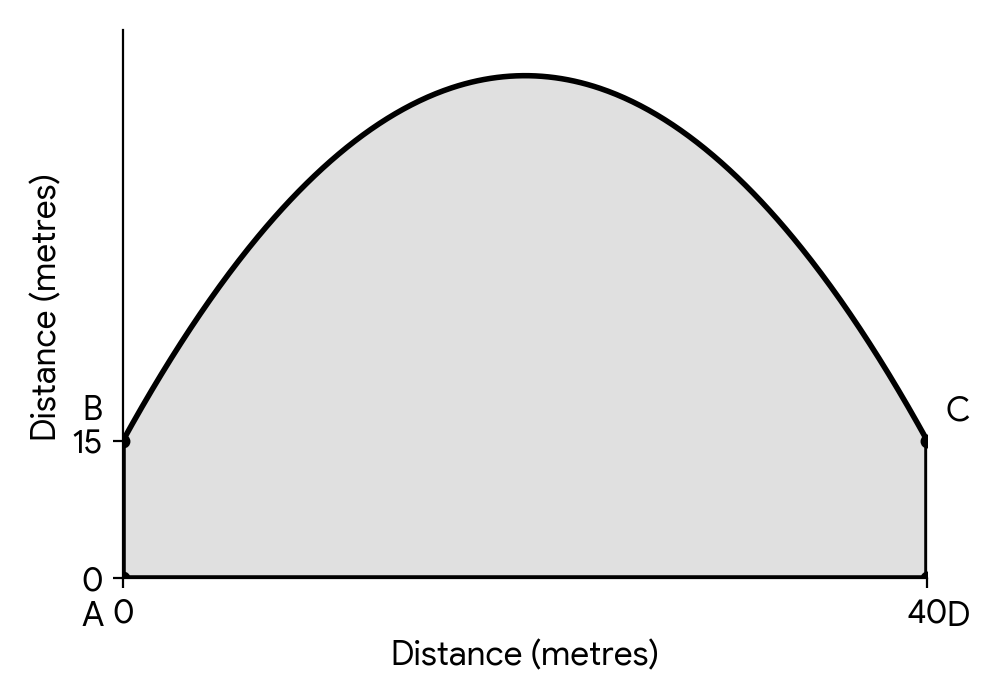
The function models the northern boundary of the park between points B and C and is given by
, for .
(i) Find .
(ii) Hence find the coordinates of the point on the park's northern boundary that is furthest north.
Point A has coordinates , point B has coordinates , point C has coordinates and point D has coordinates .
(i) Write down the integral which can be used to find the area of the shaded region representing the park.
(ii) Find the area of the park.
(i) A landscaper uses the trapezoidal rule with 4 intervals to estimate the area of the park. Calculate this estimate.
(ii) Calculate the percentage error in the landscaper's estimate.
(iii) Suggest how the landscaper might be able to reduce the error whilst still using the trapezoidal rule.
A square-shaped meditation garden, PQRS, is to be built within the park. The side [PS] lies on the southern boundary (x-axis), and the side [QR] lies on the eastern boundary of the park (). Point Q lies on the northern boundary curve .
(i) Find the x-coordinate of point P for the largest area of the meditation garden.
(ii) Find the largest area of the meditation garden.
Recall the power rule for differentiation: if , then . The derivative of a constant term is zero.
The point furthest north corresponds to the maximum value of . To find this, set the derivative to zero and solve for . Then substitute this -value back into to find the corresponding -coordinate.
The area under a curve from to is given by the definite integral . Identify the function and the limits of integration from the problem description.
Evaluate the definite integral you wrote down in part (b)(i). Use your GDC for calculation if allowed, or integrate term by term.
The trapezoidal rule formula is , where . For 4 intervals over , . Calculate at .
Percentage error is given by . Use the exact area from part (b)(ii) and the estimate from part (c)(i).
Consider how the number of intervals affects the accuracy of numerical integration methods like the trapezoidal rule.
Let the x-coordinate of P be . The side length of the square will be . Since Q lies on , its y-coordinate is . For a square, the side length must equal the height, so equate to and solve for . Remember that must be within the park's boundaries.
Once you have the x-coordinate of P, calculate the side length of the square using . Then square this side length to find the area.
Question 11
MediumPaper 2 · calculator13 marksA company's profit, , in thousands of dollars, from selling thousand units of a new smart device, is modelled by the function , for .
Find an expression for .
Find the equation of the tangent to the profit curve at the point where .
Determine the number of units sold (to the nearest unit) that maximizes the company's profit, and state the maximum profit (to two decimal places).
Determine the range of values of (number of thousands of units sold) for which the company's profit is increasing.
Use the quotient rule for differentiation. Recall that if , then .
To find the equation of a tangent line, you need a point and the gradient . The point can be found by evaluating at , and the gradient is .
Maximum profit occurs when the gradient of the profit function is zero, i.e., . Solve for and then calculate at that value. Remember is in thousands of units and is in thousands of dollars.
The profit is increasing when the derivative is positive. Use your result from part (a) and the roots found in part (c). Remember that .
Question 12
HardPaper 2 · calculator23 marks(a) A confectionery company is designing a new wrapper for a chocolate bar. The wrapper is in the shape of a rectangular prism with a square base of side length cm. The height, cm, is twice the side length of the base.
Write down an expression for in terms of .
(b) The chocolate bar has a volume of cm.
Find the value of and .
(c) Calculate the total external surface area of this rectangular prism wrapper.
(d) The company also considers a cylindrical wrapper with radius cm and height cm. This wrapper must also hold cm of chocolate.
Find an expression for the height, , of the cylindrical wrapper in terms of .
(e) Let the total external surface area of the cylindrical wrapper be cm.
Show that .
(f) Find .
(g.i) Hence or otherwise, find the value of that will minimize .
(g.ii) Find the minimum value of for the cylindrical wrapper.
(h) To account for manufacturing waste and overlap, an additional of the calculated surface area is required for the rectangular prism wrapper, and for the cylindrical wrapper.
Determine which wrapper design the company should choose to minimize material usage. Justify your answer.
The question states a direct relationship between the height and the side length of the square base.
The volume of a rectangular prism is given by the area of the base multiplied by the height. Use the expression from part (a) to relate the height to the base side length.
The total surface area of a rectangular prism with a square base is the sum of the areas of the two square bases and the four rectangular sides. Use the values of and found in part (b).
The volume of a cylinder is given by . Use the given volume to express in terms of .
The total surface area of a cylinder is . Substitute the expression for from part (d) into this formula.
Differentiate the expression for with respect to . Remember that and .
To find the minimum value of , set the derivative to zero and solve for . Alternatively, you can use a GDC to find the minimum point of the function or the root of .
Substitute the value of found in part (g.i) into the surface area formula .
Calculate the total material needed for each wrapper type by adding the respective percentage increases to their surface areas. Then compare the two total amounts.
Question 13
MediumPaper 2 · calculator9 marksA construction company is designing a drainage channel with a rectangular cross-section. They have a total of metres of a special waterproof lining material to form the base and the two vertical sides of the channel's cross-section. Let represent the height of the channel in metres.
(a) Find an expression for the cross-sectional area, , of the channel in terms of , in its simplest form.
(b) Determine the value of that maximizes the cross-sectional area.
(c) Calculate the maximum cross-sectional area of the channel.
Let the width of the channel be . Express the total length of the lining material in terms of and . Then, express in terms of and substitute it into the formula for the area of a rectangle.
To find the maximum value of a quadratic function, you can use calculus (finding the derivative and setting it to zero) or the formula for the x-coordinate of the vertex of a parabola.
Substitute the value of found in part (b) into the area expression from part (a).
Question 14
HardPaper 2 · calculator31 marksA marine engineer is modelling the vertical displacement, meters, of a buoy from its equilibrium position at time minutes after being disturbed by a wave. The motion is described by the differential equation:
.
This equation can be rewritten as a system of coupled first-order differential equations:
.
Find the general solution for .
Initially, the buoy is at its equilibrium position () and has an initial upward velocity of m/min ().
Find an expression for in terms of .
Sketch against in the interval .
The engineer is interested in the maximum upward displacement of the buoy.
Find the time, in minutes, when this maximum displacement occurs.
Calculate the maximum upward displacement of the buoy.
An improved model for the buoy's motion, considering an external periodic force, is given by:
.
The same initial conditions as in part (b.i) apply ( and ).
Use Euler's method with a -interval of to predict the value of when .
To find the general solution of a second-order linear homogeneous differential equation, first find the characteristic equation by assuming a solution of the form . Then solve for the eigenvalues .
Use the initial conditions to set up a system of linear equations for the constants and from your general solution in part (a). Remember to differentiate your general solution first to use the initial velocity condition.
Consider the behavior of the function as increases. What is ? What is the limit as ? Is there a maximum or minimum point? Use your GDC to help you plot the function.
To find the maximum displacement, you need to find the critical points of the function . This involves setting the first derivative to zero and solving for .
Once you have the time at which the maximum displacement occurs, substitute this value of back into the original function to find the maximum displacement.
First, rewrite the second-order differential equation as a system of two first-order equations: and . Then apply Euler's method iteratively for and for 10 steps, starting from with a step size of .
Question 15
MediumPaper 2 · calculator19 marks(a) Two drones, P and Q, are launched simultaneously. Drone P is launched from the origin of a coordinate system, while Drone Q is launched from a point units along the positive horizontal axis. The velocity equations for the two drones are given by and where:
and
Write down vector equations for the displacement, and , of the two drones at time .
(b) Find an expression for the vector joining the centre of Drone P to the centre of Drone Q.
(c) Hence find the shortest distance between the two drones.
(d) The pilot of Drone P adjusts its initial velocity vector to . The velocity equation for Drone P is now .
Find the values of and if the two drones collide when seconds.
(e) Using the values of and found in part (d), find the angle to the horizontal at which Drone P was initially launched.
To find the displacement vector from the velocity vector, integrate each component with respect to time. Remember to include the initial position as the constant of integration.
The vector joining Drone P to Drone Q is given by . Subtract the corresponding components of the displacement vectors found in part (a).
The shortest distance occurs when the magnitude of the relative position vector is minimized. This is equivalent to minimizing the square of the magnitude. Find the derivative of the squared magnitude with respect to and set it to zero.
For a collision to occur, the position vectors of the two drones must be equal at the specified time. First, find the new displacement vector for Drone P using the adjusted velocity. Then, set the components of and equal to each other at to solve for and .
The initial velocity vector for Drone P is . The angle to the horizontal can be found using the components of this initial velocity vector and trigonometry (e.g., tangent function).
Question 16
HardPaper 2 · calculator20 marks(a) SweetTreats is designing new packaging for a line of artisanal chocolates. The initial design is a box in the shape of a cuboid with a square base of side length cm. Its height, cm, is twice the length of the base.
Write down an expression for in terms of .
(b) The box is designed to hold cm of chocolates.
Find the value of and .
(c) Calculate the total external surface area of the box.
(d) To minimize the amount of material needed, SweetTreats is considering changing the shape to a cylinder with radius cm and height cm. The cylindrical container must also hold cm of chocolates.
Find an expression for the height, , of the container in terms of .
(e) Let the total external surface area of the cylindrical container be cm.
Show that .
(f) Find .
(g.i) Hence or otherwise, find the value of that will minimize .
(g.ii) Find the minimum value of needed for the cylinder.
(h.i) Find .
(h.ii) Hence determine whether the graph of is concave-up or concave-down for . Justify your answer.
The question states a direct relationship between the height and the base length . Express this relationship mathematically.
The volume of a cuboid is given by base area multiplied by height. Use the expression from part (a) to relate the volume to only, then solve for . Once is found, calculate .
The total external surface area of a cuboid with a square base consists of two square bases and four rectangular sides. Use the dimensions found in part (b).
Recall the formula for the volume of a cylinder. Use the given volume to express in terms of .
The total surface area of a cylinder is the sum of the areas of the two circular bases and the curved surface area. Substitute the expression for from part (d) into the surface area formula.
Differentiate the expression for with respect to . Remember that can be written as .
To find the minimum value of , set its derivative to zero and solve for . You may need a GDC for the final calculation.
Substitute the value of found in part (g.i) back into the expression for from part (e).
Differentiate with respect to .
The sign of the second derivative determines concavity. If , the graph is concave-up. If , it's concave-down.
Question 17
MediumPaper 2 · calculator13 marks(a) A builder is designing a rectangular enclosure for a new community garden. The total length of fencing available for the enclosure is metres.
The builder wants to maximize the area of the garden. Calculate the maximum possible area of the enclosure.
(b) To ensure structural stability, the builder also needs to consider the sum of the squares of the lengths of the sides. Calculate the minimum possible value for the sum of the squares of the lengths of the sides of the enclosure.
(c) Justify that the value found in part (b) is indeed a minimum.
Let the length of the rectangle be and the width be . Form an equation for the perimeter and express the area in terms of a single variable. Then use calculus to find the maximum.
Using the relationship between length and width from part (a), express the sum of the squares of the sides as a function of a single variable. Then use calculus to find the minimum.
Consider the second derivative of the function you formed in part (b) or the properties of the quadratic function.
Question 18
HardPaper 2 · calculator18 marksThe rate of change of pollution, (in tonnes per day), in a protected lake is modelled by , where is the time in days since monitoring began, for .
(i) Find the value of at days.
(ii) Interpret the meaning of your answer to part (a) (i) in context.
Use to find the value of when the pollution in the lake reaches its maximum level.
Two days after monitoring began, the pollution in the lake was tonnes.
Find an expression for in terms of , for .
Hence, find the maximum pollution level in the lake.
A second source of pollution, from a nearby factory, is modelled by , where is the pollution in tonnes and is the time in days, for .
Write down the initial pollution from this factory.
Each day, the pollution from the factory increases by %.
Find the value of .
Find the value of when the pollution from the initial lake source and the factory are the same.
Substitute the given value of into the expression for .
Consider what represents and what the positive value signifies.
The maximum level of pollution occurs when its rate of change is zero.
Integrate the expression for to find . Use the given condition to find the constant of integration.
Substitute the value of found in part (b) into the expression for found in part (c).
The initial pollution occurs at .
For an exponential growth model , the growth factor is . The percentage increase is .
Set the expressions for and equal to each other and solve using your GDC.
Question 19
MediumPaper 2 · calculator11 marksA rectangular sheet of metal, measuring by , has a square of side length cut from each corner. The sides are then folded up to form an open-top box in the shape of a cuboid.
Show that the volume of the cuboid may be expressed as .
Find an expression for .
Hence show that the cuboid will have a maximum volume when .
Using technology, find the maximum possible volume of the cuboid. Give your answer correct to one decimal place.
Consider how cutting squares from the corners and folding the flaps changes the dimensions of the base and the height of the box. The volume of a cuboid is given by length width height.
Differentiate the volume expression with respect to using the power rule.
To find the maximum volume, set the first derivative to zero. Then simplify the resulting equation.
Solve the quadratic equation from part (c) for . Remember that must be a positive value and less than half of the smallest original dimension of the sheet. Substitute the valid value back into the original volume formula .
Question 20
HardPaper 2 · calculator15 marksThe 'EcoPack' company designs sustainable packaging. They produce a standard closed rectangular storage container with a length of cm, a width of cm, and a height of cm. The information is shown in the diagram.
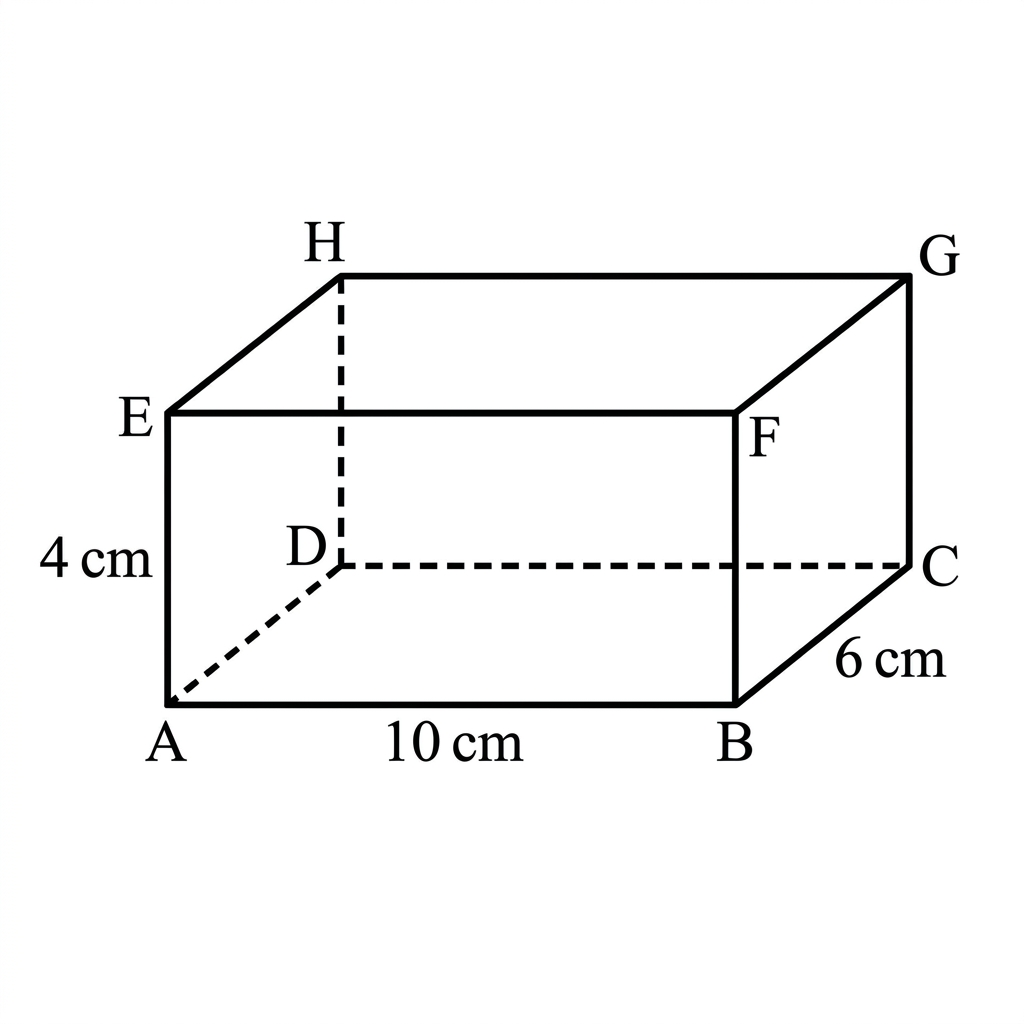
Calculate the surface area of the container in cm.
(b) Calculate the length of the longest internal diagonal of the container.
(c) Each week, EcoPack sells thousand containers. It is known that , for , where is the weekly profit, in dollars, from the sale of thousand containers.
Find the number of containers that should be sold each week to maximize the profit.
(d) The profit from the sale of containers is $2500.
Find .
(e) Find the least number of containers which must be sold each week in order to make a profit.
The surface area of a rectangular prism is given by the formula , where is length, is width, and is height.
The longest internal diagonal of a rectangular prism can be found using the 3D Pythagorean theorem: .
To maximize profit, set the derivative of the profit function, , equal to zero and solve for . Remember that is in thousands of containers.
Integrate the derivative to find . Use the given profit information to find the constant of integration.
To make a profit, must be greater than zero. Find the values of for which and choose the smallest integer value of that results in a profit.
No question on this page matches those filters. Try another difficulty or paper.
14 more Optimisation problems questions in the app
Every answer is marked mark by mark, IB-style, and the AI tutor helps when you are stuck.
Where marks are lost
- Using your own wrong value after failing a "show that." All follow through is withdrawn for the rest of that question.
- Leaving an answer in calculator notation. Never accepted in a final answer, and AI's constant calculator use makes this the easiest slip in the whole subject.