Euler method for First order differential equations (single and coupled systems): notes and practice questions
- Euler's Method: A numerical method for approximating solutions to differential equations.
- It works by treating derivatives as constant over short, discrete steps ().
- Accuracy improves with a smaller step size; inherent error exists due to constant gradient approximation.
- For a single first-order differential equation :
- For coupled first-order differential equations and :
- Variables: is the step number, are values at step , is the constant step size.
- Procedure for single equation: Rearrange to , identify initial conditions () and , then calculate steps sequentially.
- Procedure for coupled systems: Ensure format and , identify initial conditions (), apply recursion simultaneously.
- Converting second-order equations (HL only): Substitute , then , to transform into a pair of coupled first-order equations.
- Use the GDC's sequence/recursion feature for calculations; carefully map variables.
- Euler's method for differential equations is an HL-only topic.
- To improve approximation accuracy, always make the step size smaller.
- Determine the exact number of steps needed: .
- Organize working in a table (columns for ) for clarity and method marks.
How it is examined
The test is understanding what each step of the iteration represents, step size, current point, gradient at that point, next point, rather than performing many iterations by hand: the GDC or a given spreadsheet output does the arithmetic. For the coupled system, a question typically gives a predator-prey style pair of equations and asks for a small number of steps or for the values to be read from provided technology output.
- Use Euler's method to find the approximate solution to a first order differential equation, numerically solving .
- Numerically solve a coupled system, and .
Enrichment only, so not examinable: Runge-Kutta methods.
Linking questions
- Other contexts: the SIR model for infection as an extension of the method, Lotka-Volterra predator-prey models.
- TOK: to what extent is certainty attainable in mathematics? Is certainty attainable, or desirable, in other areas of knowledge?
Practice questions
19 questions · 1 easy · 11 medium · 7 hardQuestion 1
EasyPaper 1 · calculator5 marksConsider the differential equation:
At take . Use Euler's method with a step size of 0.1 and estimate at .
Remember to use the given differential equations to prepare the correct formulas to solve using Euler's methods.
Question 2
MediumPaper 1 · calculator8 marksIf a vehicle is moving along a straight road, where its position at time for is given by the following differential equation:
At take .
Use Euler's method with a step size of 0.1 and estimate at .
By solving the differential equation analytically, calculate the percentage error in your approximation from part (a) at
Remember to use the given differential equations to prepare the correct formulas to solve using Euler's methods.
Attempt to separate the variables then solve the differential equation to find the exact value of to be used in finding the percentage error.
Question 3
HardPaper 2 · calculator14 marksA specialized chemical reactor is designed to produce a certain compound. The rate of change of the concentration of a key reactant, , with respect to time, , is modeled by the differential equation .
At minute, the concentration is mol/L.
(a) Use Euler's method with a step size of to find approximate values of when , , and minutes. Give your answers to three decimal places.
(b) Solve the differential equation to find the exact concentration as a function of . Hence, find the absolute errors for each of your approximations in part (a). Give your exact values to five decimal places and absolute errors to five decimal places.
Remember Euler's method formula: . In this case, . Calculate the derivative at each step using the current approximate values of and .
To solve the differential equation, use the method of separation of variables. Remember to use the initial condition to find the constant of integration. For absolute error, calculate for each time point.
Question 4
MediumPaper 1 · calculator8 marksIf a transformation maps the vector to as follows:
If the image of a point , due to this transformation, has coordinates (0,16), Find the coordinates of point .
If a quadrilateral undergoes the transformation , what happens to the area of its image?
To reverse what happened you need to find the inverse matrix .
Calculate the determinant of the transformation matrix which is an indicator of the scale factor of the image.
Question 5
HardPaper 2 · calculator12 marksA microbiologist is studying the interaction between two competing species of bacteria, species A and species B, in a controlled environment. Let represent the population of species A (measured in millions) and represent the population of species B (measured in millions). Let represent time, in hours.
The interaction can be modelled by the coupled differential equations:
State the two equilibrium points for this model.
Initially, there are million bacteria of species A and million bacteria of species B. Use the Euler method with a step size of hours to estimate the population of species A and species B after hour (to the nearest integer). Show the intermediate values that are obtained in the working, in the format of a table.
Suggest whether stating the population of bacteria to the nearest integer is a valid level of accuracy when using Euler's method in part (b).
Equilibrium points occur when the rates of change for both populations are zero. Set and and solve the resulting system of equations.
Recall the Euler method formulas for coupled differential equations:
Calculate values for .
Consider the nature of Euler's method as an approximation and the units of the population measurements.
Question 6
MediumPaper 1 · calculator8 marksA colony of bacteria is growing in a nutrient solution. The rate of change of the population, , with respect to time, (in hours), is modelled by the differential equation . At time , the population is .
(a) By using Euler's method with a step length of 0.1, find an approximate value for the population when . Give your answer to three significant figures.
(b) By solving the differential equation, find the percentage error in your approximation for the population when . Give your answer to three significant figures.
Remember the formula for Euler's method: . You will need to apply this formula iteratively for and .
This is a separable differential equation. Integrate both sides after separating variables. Remember to use the initial condition to find the constant of integration. The percentage error is calculated as .
Question 7
HardPaper 2 · calculator22 marksThe concentration of a chemical, (in mol dm), in a reaction vessel at time seconds is modelled by the differential equation
(a) (i) Use the substitution to show that this equation can be written as
.
(ii) Find the eigenvalues for the matrix .
(iii) Hence state the long-term rate of change of the chemical concentration.
The chemical reaction is now subjected to an external input, and the equation for the concentration is amended to
.
(b) (i) Use the substitution to write the differential equation as a system of coupled, first order differential equations. State the initial conditions given that, at , the concentration of chemical C is mol dm and its rate of change is mol dm s.
(ii) Use Euler's method with a step length of to find the concentration of the chemical when s. Give your answer to three significant figures.
(iii) Find the long-term rate of change of the chemical concentration.
Substitute and into the given second-order differential equation. Then, express both and in terms of and to form the matrix equation.
To find the eigenvalues of a matrix , solve the characteristic equation , where is the identity matrix.
Consider the sign of the eigenvalues. What does this imply about the stability of the system and the behavior of and as ?
Similar to part (a.i), but now include the non-homogeneous term in the equation for . Don't forget to state the initial values for and .
Set up the recurrence relations for and using Euler's method. You will need to perform 10 iterations to reach from . Keep track of , , and at each step.
For a non-homogeneous second-order ODE with a constant forcing term, the long-term solution (particular solution) will be a polynomial of the same degree as the forcing term. In this case, since the forcing term is , assume a particular solution of the form . Then, find .
Question 8
MediumPaper 1 · calculator5 marksA buoy floats in a harbour. Its vertical displacement, metres, from its equilibrium position at time seconds, satisfies the differential equation
Initially, at , the buoy is at and its vertical velocity is .
(a) Use Euler's method with a step size of to estimate the maximum vertical displacement of the buoy during the first second.
Consider converting the second-order differential equation into a system of two first-order equations. Remember to track both displacement and velocity values at each step.
Question 9
HardPaper 2 · calculator31 marksA marine engineer is modelling the vertical displacement, meters, of a buoy from its equilibrium position at time minutes after being disturbed by a wave. The motion is described by the differential equation:
.
This equation can be rewritten as a system of coupled first-order differential equations:
.
Find the general solution for .
Initially, the buoy is at its equilibrium position () and has an initial upward velocity of m/min ().
Find an expression for in terms of .
Sketch against in the interval .
The engineer is interested in the maximum upward displacement of the buoy.
Find the time, in minutes, when this maximum displacement occurs.
Calculate the maximum upward displacement of the buoy.
An improved model for the buoy's motion, considering an external periodic force, is given by:
.
The same initial conditions as in part (b.i) apply ( and ).
Use Euler's method with a -interval of to predict the value of when .
To find the general solution of a second-order linear homogeneous differential equation, first find the characteristic equation by assuming a solution of the form . Then solve for the eigenvalues .
Use the initial conditions to set up a system of linear equations for the constants and from your general solution in part (a). Remember to differentiate your general solution first to use the initial velocity condition.
Consider the behavior of the function as increases. What is ? What is the limit as ? Is there a maximum or minimum point? Use your GDC to help you plot the function.
To find the maximum displacement, you need to find the critical points of the function . This involves setting the first derivative to zero and solving for .
Once you have the time at which the maximum displacement occurs, substitute this value of back into the original function to find the maximum displacement.
First, rewrite the second-order differential equation as a system of two first-order equations: and . Then apply Euler's method iteratively for and for 10 steps, starting from with a step size of .
Question 10
MediumPaper 1 · calculator6 marksThe angular displacement, (radians), of a damped pendulum at time (seconds) is modelled by the differential equation:
At , the pendulum is released from rest with an initial angular displacement of radians. That is, and when .
Use Euler's method, with a step length of seconds, to estimate the value of when seconds.
First, convert the second-order differential equation into a system of two first-order differential equations. Let . Then apply Euler's method iteratively for both and . Remember the formulas: and .
Question 11
HardPaper 3 · calculator27 marksThis question explores models for the temperature of a cooling metal object.
A metal object is heated and then allowed to cool in a room where the ambient temperature is °C. The temperature, °C, of the object is recorded every minutes, starting from minutes.
| Time ( minutes) | Temperature ( °C) |
|---|---|
| 0 | 90.0 |
| 5 | 74.5 |
| 10 | 62.5 |
| 15 | 53.1 |
| 20 | 45.8 |
| 25 | 40.1 |
The data is first modelled using a linear function, , where .
Find the equation of the regression line of on .
Interpret the meaning of the parameter in the context of the model.
Suggest why using this linear regression equation to predict the time it will take for the object to cool to °C could be unreliable.
The data is then modelled using a quadratic function, , where .
Find the equation of the least squares quadratic regression curve.
Use this quadratic equation to predict the time it will take for the object to cool to °C.
Hence, write down a suitable domain for the function in the context of this cooling process.
A metal object with a constant heat capacity Joules/°C is cooling in a room. The rate of heat transfer from the object to its surroundings is given by , where is the rate of heat loss in Joules/minute, is the heat transfer coefficient, is the surface area of the object, is the object's temperature, and is the ambient temperature. The rate of change of the object's internal energy is given by .
Given that the ambient temperature is °C and assuming that all heat loss is due to this process, show that the differential equation for the temperature of the object can be written as , where is a positive constant.
By solving the differential equation , show that the general solution is given by , where .
Use the general solution from part (d) and the initial condition °C, along with the data point °C, to find the values of and . Hence, predict the time it takes for the object to cool to °C.
If the object was initially heated to a different temperature, °C, such that it cools to °C in minutes, find this new initial temperature . Use the value of from part (e).
Now, consider a scenario where the object is cooling, but also receives a small amount of heat from an external source that decreases over time. The temperature of the object, °C, is modelled by the differential equation .
Given the initial temperature °C, use Euler's method with a step length of minutes to estimate the temperature of the object at minutes.
Use your GDC to perform linear regression on the given data. Ensure you input time as the independent variable and temperature as the dependent variable.
Consider what the slope of a temperature-time graph represents.
Think about the physical process of cooling and how it typically behaves over time. Also consider the limitations of extrapolating beyond the given data range.
Use your GDC to perform quadratic regression on the given data.
Set and solve the resulting quadratic equation for . Remember to consider which solution is physically reasonable.
Consider when the cooling process starts and when the model becomes less physically realistic (e.g., when the object stops cooling or starts reheating according to the model).
Relate the rate of change of internal energy to the rate of heat loss. Remember that heat loss means the internal energy is decreasing.
This is a separable differential equation. Separate the variables and , then integrate both sides. Remember to include the constant of integration.
First, use to find . Then, substitute into the equation to find . Finally, set and solve for .
The general solution is . You are given and . Use these to find . Then, is .
Euler's method formula is , where . Perform three steps to reach minutes.
Question 12
MediumPaper 1 · calculator6 marksThe rate of change of the concentration of a chemical compound, (in mol/L), in a reaction vessel with respect to time, (in minutes), is modeled by the differential equation
, for .
Given that when .
Explain why Euler's method cannot be used to find an approximate value for when .
By solving the differential equation, show that .
Hence deduce the value of when .
Consider the value of the derivative at the initial condition given.
Separate the variables and and then integrate both sides. Remember to use the initial condition to find the constant of integration.
Substitute the given value of into the formula derived in part (b) and calculate the result.
Question 13
HardPaper 3 · calculator28 marksA small scientific probe is launched into a dense liquid to collect data. Its descent is affected by gravity, buoyancy, and liquid resistance. The direction downwards is taken to be positive.
Initially, a simple model for the probe's velocity, ms, at time seconds, assumes constant effective acceleration due to gravity and buoyancy, ms, given by:
When the probe enters the liquid at m, its initial velocity is ms. The displacement from its initial position is metres.
(i) Use the chain rule to show that .
(ii) Assuming that is a constant, solve the differential equation to find as a function of .
(iii) Using ms, determine whether the model predicts that the probe will reach a velocity of ms at some point before it reaches a depth of m. Justify your answer.
To test the model , the probe conducted a trial descent, and data for against was recorded.
(i) If the model is correct, describe the shape of the graph of against .
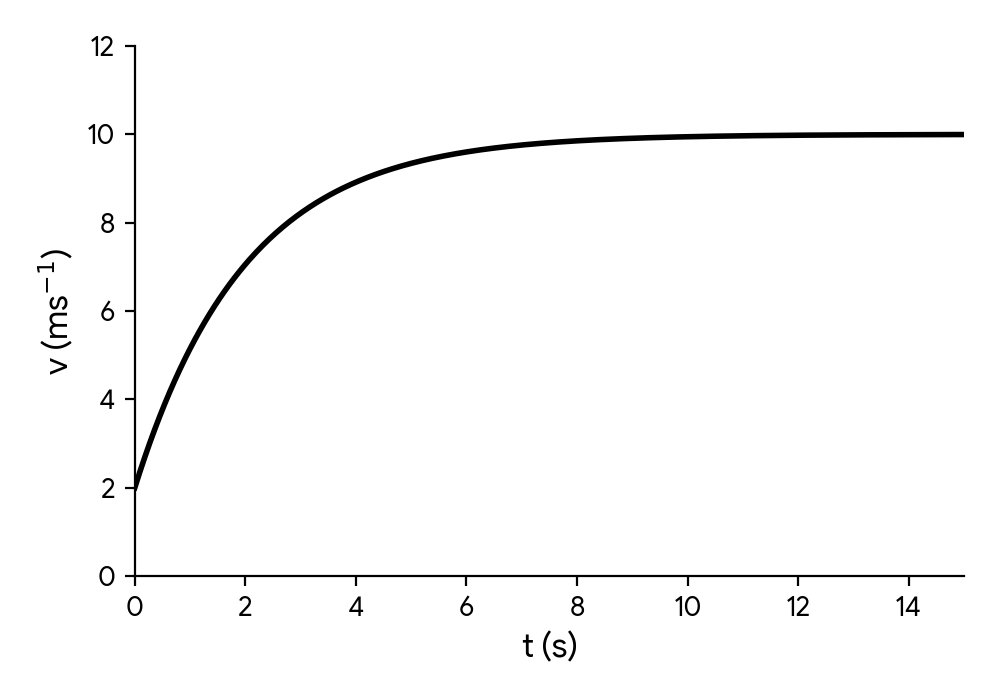
(ii) The observed data showed a graph where the velocity increased rapidly at first, then its rate of increase slowed down, eventually approaching a constant value. Use this observation to comment on the validity of the model in part (a).
An improved model considers liquid resistance, using
where is a positive constant. You are reminded that initially and . You may assume that .
(i) By using , solve the differential equation to find in terms of , and .
The probe's engineers use the graph of against from the trial descent to estimate the value of .
(ii) The gradient is estimated to be ms when ms. Taking to be ms, use this information to show that the engineers found that .
(iii) Hence, find the value of predicted by this model, as tends to infinity.
(iv) Find the upper bound for the velocity according to this model, given that . Give your answer to four significant figures.
(d) A more refined model for the probe's descent suggests that the rate of change of velocity with respect to displacement is given by . Use Euler's method with a step length of m to estimate the value of when m. Take the initial velocity ms at m.
(i) Suggest one improvement to the use of Euler's method which might increase the accuracy of the prediction of the model.
(ii) Suggest one factor not explicitly considered by the model in part (d) which might lead to a difference between the model's prediction and the data collected.
Recall the chain rule for derivatives involving an intermediate variable. In this case, is a function of , and is also a function of . You also know the relationship between velocity and displacement.
Separate the variables and , then integrate both sides. Remember to use the initial conditions () to find the constant of integration.
Substitute and into your equation from part (a)(ii) to find the displacement at which this velocity is reached. Then compare this value with m.
Consider what kind of function would result from integrating .
Compare the observed behavior (rate of increase slowing down) with the prediction of the simple model (constant rate of increase).
Substitute into the given differential equation. Then, separate variables and integrate using a substitution method (e.g., ). Finally, apply the initial conditions to solve for the constant of integration.
Substitute the given values for , , and into the improved model's differential equation and solve for .
Consider what happens to the exponential term as . Alternatively, recall that terminal velocity occurs when .
Since velocity is an increasing function of depth, the upper bound will occur at the maximum depth, m. Substitute this value into your equation from part (c)(i).
Euler's method for is . Perform the calculations step-by-step until reaches m.
Consider factors that affect the accuracy of numerical methods for solving differential equations.
Think about real-world conditions that could affect a probe's descent in liquid that are not included in the mathematical model.
Question 14
MediumPaper 2 · calculator16 marksA chemical reaction's rate is modelled by the differential equation , where represents the concentration of a product at time (in minutes), for and . At minute, the concentration is units.
(a) Use Euler's method with a step size of to find an approximation for the concentration at minutes. For each value of , show the corresponding value of in your working.
(b) Solve the differential equation , giving the answer in the form for some function .
(c) Hence, find the exact value of the concentration at minutes.
(d) Find the absolute percentage error in the value of given by Euler's method. Give your answer to significant figures.
Recall Euler's method formula: . Start with the given initial conditions and iterate until you reach . Remember to show each step clearly.
This is a separable differential equation. Separate the variables and to opposite sides of the equation, then integrate both sides. Don't forget the constant of integration and use the initial condition to find its value.
Substitute into the exact solution you found in part (b).
The formula for absolute percentage error is . Use the values from parts (a) and (c).
Question 15
HardPaper 3 · calculator29 marksIn this question, marine biologists are studying the population dynamics of a rare species of "Azurefin" fish in a newly established protected reef area.
Historically, the Azurefin population in this region maintained a stable size of individuals. Following a period of environmental disturbance, the population was reduced to fish. At this point, the area was designated a protected marine reserve, and conservation efforts began, leading to a recovery in the fish population.
Researchers wish to model the size of the Azurefin population, , as a function of , where is the time, in years, since the establishment of the protected reserve.
Initially, the researchers consider using the logistic model:
, where .
The researchers decide to set .
State the assumption being made by setting .
At , the population of Azurefin fish is .
Find the value of .
At years, the population of Azurefin fish is found to have increased to .
Find the value of . Give your answer correct to three significant figures.
Use your model to predict the size of the Azurefin population in the area years after it became protected. Give your answer correct to the nearest whole number.
An alternative model for population growth is called the Gompertz model. When applied by the researchers to the Azurefin population, this model satisfies the differential equation:
, .
Write down the value of when .
Interpret your answer to part (b)(i) in context.
Consider the function , where .
Show that .
Hence, use separation of variables to show that the general solution of
, where ,
can be written as
,
where is an arbitrary positive constant.
Use the size of the Azurefin population at to find the value of .
Give your answer in the form , where .
Use the size of the Azurefin population at , given in part (a), to show that , correct to three significant figures.
Use the Gompertz model to predict the size of the Azurefin population at . Give your answer correct to the nearest whole number.
After years, the Azurefin population is measured and is found to be .
Comment on the predictions made by the two models.
By tracking individual Azurefin fish, the researchers find that about of the population migrates out of the protected area each year.
They decide to adapt the Gompertz model to allow for this. The new model will satisfy the differential equation:
.
Use Euler's method, with a step size of years and an initial value of when , to find an estimate for the size of the Azurefin population when .
Give your answer correct to the nearest whole number.
Comment on your answer.
Consider what the parameter represents in the context of a logistic growth model for a population.
Substitute the given initial conditions ( and ) into the logistic model equation.
Substitute the known values of , , , and into the logistic model equation and solve for . Remember to use the value of found in the previous part.
Substitute and the values of , , and into the logistic model equation.
Substitute into the given differential equation and evaluate.
Consider what a zero rate of change means for a population that is at its carrying capacity.
Use the chain rule for differentiation. Remember that .
Rearrange the differential equation to separate and terms. Use the result from part (b)(iii) for the integral of the term. Remember to introduce a constant of integration.
Substitute and into the general solution and solve for .
Substitute , , and the value of found in the previous part into the general solution and solve for .
Substitute and the values of , , and into the Gompertz model solution . Then solve for .
Compare the actual measured value () with the predictions from the logistic model (part a.iv) and the Gompertz model (part b.vii).
Euler's method uses the formula . You will need to apply this iteratively from to with a step size of . The function is given by the differential equation.
Compare the Euler's method prediction to the actual measured population at and the predictions from the other models.
Question 16
MediumPaper 1 · calculator4 marksA certain biological population's growth rate is modeled by the differential equation , where is the population size in thousands and is the time in years.
Given that the initial population is thousand () when , use Euler's method with a step length of years to estimate the population size when years.
Recall Euler's method formula: . In this case, is , is , and . You will need to perform multiple iterations with until .
Question 17
MediumPaper 1 · calculator4 marksA biologist is studying the growth of a bacterial colony. The rate of change of the colony's size, , with respect to time, (in hours), is modelled by the differential equation .
Given that the initial size of the colony is when , use Euler's method with a step size of to find the approximate size of the colony when hours.
Recall Euler's method formula: . Identify , the initial conditions, and the step size. Perform the calculations iteratively until you reach the target value.
Question 18
MediumPaper 1 · calculator10 marksA chemical engineer is studying the concentration of a pollutant, , in mol/L, in a closed system. The rate of change of the pollutant's concentration at time , in hours, is modelled by the differential equation
.
At the start of the experiment (), the concentration of the pollutant is mol/L and its rate of change is mol/L per hour.
By using Euler's method with a step size of hours, find the estimated concentration of the pollutant after hours.
Find the first estimated time the concentration of the pollutant reaches mol/L.
After hours, the chemical engineer measures the concentration of the pollutant as mol/L, accurate to the nearest mol/L.
Calculate the maximum possible percentage error between your estimate from part (a)(i) and the measured concentration after hours.
First, rearrange the differential equation to make the subject. Then, apply Euler's method iteratively for both and using the given step size and initial conditions. Remember to perform enough iterations to reach hours.
Continue the Euler's method iterations from part (a)(i) until the estimated concentration becomes less than or equal to mol/L. The time at which this first occurs is your answer.
To find the maximum possible percentage error, you need to consider the range of the actual measured value. Since the measurement is accurate to the nearest mol/L, determine the lower and upper bounds of this measurement. Then, choose the bound that maximizes the difference from your estimated value from part (a)(i) for the percentage error calculation.
Question 19
MediumPaper 1 · calculator6 marksA biologist is studying the interaction between two species of microorganisms, X and Y, in a controlled environment. The population dynamics are modelled by the system of coupled differential equations:
The following phase portrait illustrates the general behaviour of trajectories for this system.
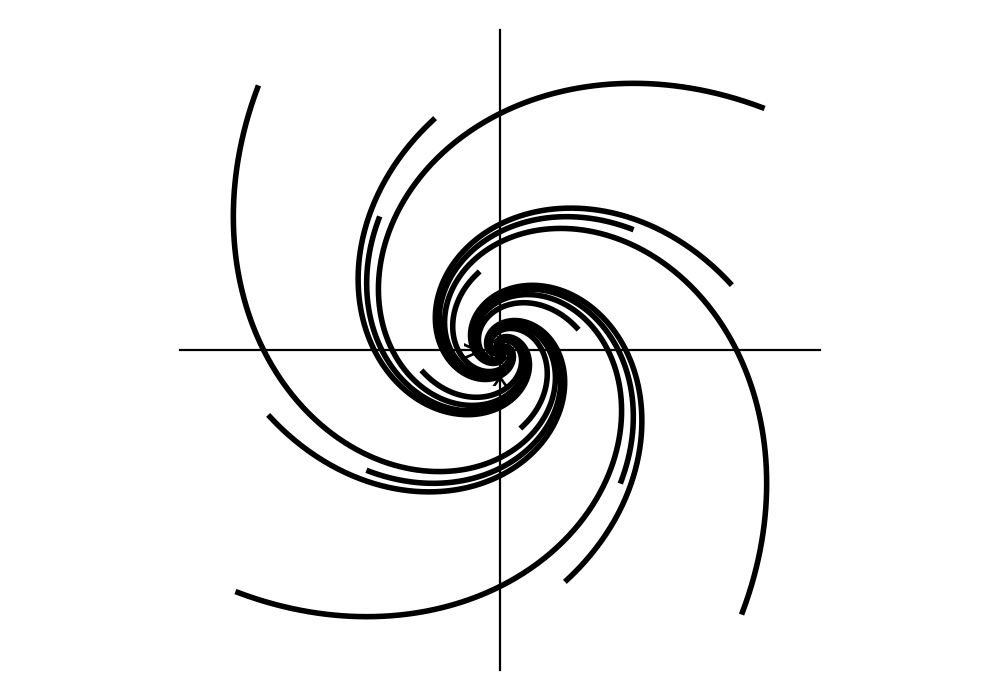
Write down which one of the following could be an eigenvalue for the system.
A.
B.
C.
D.
Using Euler's method with a step length of , find the approximate values of and when , given that at , and . Give your answers to three significant figures.
Analyze the given system of differential equations to determine its characteristic matrix. Then, find the eigenvalues of this matrix. The nature of the phase portrait (e.g., spiral, node, saddle) can also give clues about the type of eigenvalues (real, complex, purely imaginary, positive/negative real part).
Recall Euler's method formulas: and . Apply these iteratively, starting from with until you reach . Make sure to calculate and using the given system at each step.
No question on this page matches those filters. Try another difficulty or paper.
Every Euler method for First order differential equations (single and coupled systems) question, marked for you
Every answer is marked mark by mark, IB-style, and the AI tutor helps when you are stuck.
Where marks are lost
- Using your own wrong value after failing a "show that." All follow through is withdrawn for the rest of that question.
- Leaving an answer in calculator notation. Never accepted in a final answer, and AI's constant calculator use makes this the easiest slip in the whole subject.