Special functions derivatives & chain/product/quotient rules (+related rates): notes and practice questions
- Special functions include trigonometric (), exponential (), and natural logarithmic () functions.
- Chain Rule: Differentiates composite functions ().
- Product Rule: Differentiates a product of two functions ().
- Quotient Rule: Differentiates a ratio of two functions ().
- Related Rates: Finds the rate of change of one quantity by relating it to others.
- Derivative of is .
- Derivative of is .
- Derivative of is .
- Derivative of is .
- Chain Rule formula: .
- Product Rule formula (for ): .
- Quotient Rule formula (for ): .
- Chain Rule method: Differentiate the outer function, then multiply by the derivative of the inner function.
- Product Rule method: Identify , find their derivatives , then apply .
- Quotient Rule method: Identify , find their derivatives , then apply .
- GDC must be in Radians mode for trigonometric calculus.
- GDC can check numerical gradients, but exact algebraic answers are required.
- These topics are exclusive to the IB Higher Level (HL) syllabus (Topic 5.2).
- A quotient can be rewritten as and differentiated using the product and chain rules.
How it is examined
The rule to spot in a mixed expression is usually the product or quotient rule attached to a chain rule inside one of the factors, which is where marks go missing when a student only applies one rule. Related rates of change is the most distinctive application: it asks for given and , and the chain rule step, , is usually its own method mark.
The derivatives of , , , , and , and the chain, product and quotient rules.
- Differentiate , , , , and for .
- Apply the chain rule, product rule and quotient rule.
- Solve related rates of change problems.
Linking questions
- Links to other subjects: uniform circular motion and induced emf (physics).
- TOK: Euler advanced mathematical analysis before calculus had a solid theoretical foundation. What does that suggest about how progress happens in mathematics compared with other areas of knowledge?
Practice questions
39 questions · 2 easy · 29 medium · 8 hardQuestion 1
EasyPaper 1 · calculator5 marksAssume that a balloon was inflated with warm air and then left outside to cool down, where the temperature, , in is modelled accordingly:
where is taken as the time, in minutes, after the balloon was left outside.
Find the rate of change of temperature with respect to time at .
According to the given model, find the atmospheric temperature.
Since the function looks similar to , apply chain rule to differentiate it.
It would be the limit temperature of the model.
Question 2
MediumPaper 1 · calculator6 marksIf someone said that the green area in a city was said to be changing at a rate of
where A is taken as the green area in and is the time in years since 2000.
Determine according to this model whether there would be an increase or decrease in the green area during 2010.
Determine the expression of if the green area was considered to be 765 during 2010.
The sign of the rate of a variable determines whether its increasing (if positive rate) or decreasing (If negative rate).
To reach a function from its derivative you need to integrate and be careful to the constant c.
Question 3
HardPaper 1 · calculator10 marksA group of engineers is designing a new observation Ferris wheel. The height, , in metres, of a passenger capsule above the ground is modelled by the function , where is the time in seconds after the capsule begins its ascent from the highest point.
The lowest point a capsule reaches is 2 metres above the ground, and the highest point is 32 metres above the ground. The Ferris wheel completes one full rotation in 200 seconds.
Find the values of and .
Using your values from part (a), the function is .
(i) Find .
(ii) Find .
The engineers are particularly interested in the moment when the capsule's vertical speed is at its maximum, for the first time after . This occurs at time .
Calculate the value of .
Calculate the height of the capsule at this time .
The amplitude of a sinusoidal function is half the difference between its maximum and minimum values. The vertical shift (midline) is the average of the maximum and minimum values. Consider the starting point () to determine the sign of .
Remember the chain rule for differentiation. For , the derivative is . The derivative of is .
The vertical speed is given by . To find when the speed is maximum, you need to find the maximum value of . This occurs when or at the endpoints of the domain. Consider the range of the sine function.
Substitute the value of you found in part (c.i) into the original height function .
Question 4
EasyPaper 1 · calculator7 marksIf the velocity, , of a particle, starting from the origin, at time, seconds, is .
Find the displacement equation.
Find acceleration after 1 second.
Remember that displacement is the integral of velocity.
Remember that acceleration is the derivative of velocity with respect to time
Question 5
MediumPaper 1 · calculator6 marksConsider the function .
(a) Find .
(b) Find how many points of inflection does this function contain.
To find the point of inflection you need to set the second derivative equal to zero and calculate at which value this happens.
Points of inflection are the points at which the second derivative of a function is equal to zero.
Question 6
HardPaper 2 · calculator12 marks(a) A cylindrical grain silo with a radius of m and an initial grain height of m is being emptied. The rate at which the grain is removed from the silo is proportional to the square root of the height of the grain.
Using for the volume of grain in the silo and for the height of the grain, write down a differential equation relating these variables.
(b) Apply the chain rule and the formula for the volume of a cylinder to show that . Hence, write your answer to part (a) in terms of and .
(c) After minutes, the height of the grain has dropped to m. Predict how long it will take for the silo to be completely empty from the initial height of m.
Recall that 'proportional to' means there is a constant of proportionality. Since the silo is emptying, the rate of change of volume with respect to time should be negative.
The volume of a cylinder is . Use the given radius to find , then apply the chain rule .
Solve the differential equation from part (b) by separating variables and integrating. Use the given initial conditions to find the constant of integration and the constant of proportionality.
Question 7
MediumPaper 1 · calculator6 marksConsider the function .
Find .
Find how many points of inflection does this function contain.
To find the point of inflection you need to set the second derivative equal to zero and calculate at which value this happens.
Points of inflection are the points at which the second derivative of a function is equal to zero.
Question 8
HardPaper 2 · calculator13 marksA company models the growth of its user base, , and its server capacity, , over time (in months) using the functions:
where and are in thousands of users.
(a) Solve .
(b) (i) Write down the integral that represents the area of the region enclosed between the graphs of and .
(ii) Calculate the area of this region.
(c) At a certain time , the rate of change of the user base is equal to the rate of change of the server capacity. Find the value of .
Use a graphing display calculator (GDC) to plot both functions and find the points of intersection. Remember to set the window appropriately to see all intersection points.
The area between two curves and from to is given by . Determine which function is above the other in the interval of interest.
Use the definite integral function on your GDC with the integral you wrote down in part (b)(i).
The rate of change of a function is given by its derivative. Find the derivatives of and and then set them equal to each other to solve for . You may need your GDC to solve the resulting equation.
Question 9
MediumPaper 1 · calculator5 marksThe diagram shows the slope field for the differential equation for and .
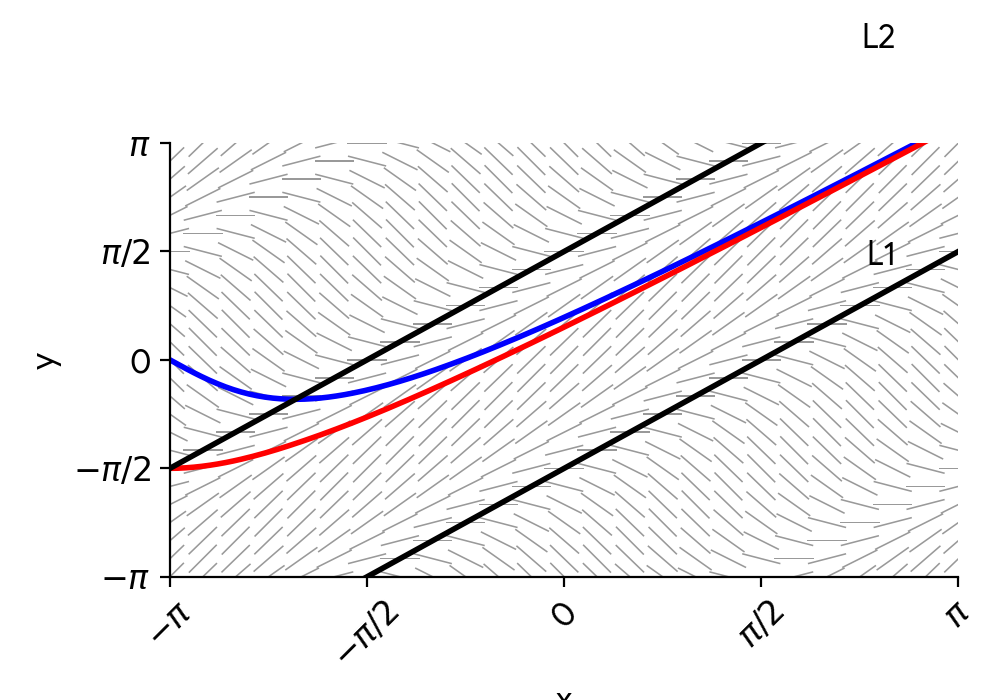
The local maximum points for solutions to the differential equation lie on the straight line .
Find the equation of , giving your answer in the form .
Find the equation of the straight line on which all local minimum points lie within the given domain, giving your answer in the form .
To find local maximum points, you need to find where and then use the second derivative test or analyze the sign change of . Remember to consider the domain for and .
Similar to part (a), but consider the condition for local minimum points. What must be the sign of the second derivative?
Question 10
HardPaper 2 · calculator23 marks(a) A confectionery company is designing a new wrapper for a chocolate bar. The wrapper is in the shape of a rectangular prism with a square base of side length cm. The height, cm, is twice the side length of the base.
Write down an expression for in terms of .
(b) The chocolate bar has a volume of cm.
Find the value of and .
(c) Calculate the total external surface area of this rectangular prism wrapper.
(d) The company also considers a cylindrical wrapper with radius cm and height cm. This wrapper must also hold cm of chocolate.
Find an expression for the height, , of the cylindrical wrapper in terms of .
(e) Let the total external surface area of the cylindrical wrapper be cm.
Show that .
(f) Find .
(g.i) Hence or otherwise, find the value of that will minimize .
(g.ii) Find the minimum value of for the cylindrical wrapper.
(h) To account for manufacturing waste and overlap, an additional of the calculated surface area is required for the rectangular prism wrapper, and for the cylindrical wrapper.
Determine which wrapper design the company should choose to minimize material usage. Justify your answer.
The question states a direct relationship between the height and the side length of the square base.
The volume of a rectangular prism is given by the area of the base multiplied by the height. Use the expression from part (a) to relate the height to the base side length.
The total surface area of a rectangular prism with a square base is the sum of the areas of the two square bases and the four rectangular sides. Use the values of and found in part (b).
The volume of a cylinder is given by . Use the given volume to express in terms of .
The total surface area of a cylinder is . Substitute the expression for from part (d) into this formula.
Differentiate the expression for with respect to . Remember that and .
To find the minimum value of , set the derivative to zero and solve for . Alternatively, you can use a GDC to find the minimum point of the function or the root of .
Substitute the value of found in part (g.i) into the surface area formula .
Calculate the total material needed for each wrapper type by adding the respective percentage increases to their surface areas. Then compare the two total amounts.
Question 11
MediumPaper 1 · calculator9 marksA landscape architect is designing a modular planter box for a new urban garden. The planter box has a base and top that are identical sectors of a circle, each with radius cm and angle radians. The height of the planter box is cm. The total length of metal frame used for all edges of the planter box is cm. This includes two circular arcs, four radial edges for the top and bottom sectors, and three vertical connecting edges.
(a) Show that .
(b) The planter box is designed to hold soil, enclosing a volume, .
(i) Find an expression for in terms of .
(ii) Find the expression for .
(iii) Solve algebraically to find the value of that will maximize the volume, .
Carefully identify all the edges that contribute to the total length of the metal frame. Remember the formula for the arc length of a sector.
Recall the formula for the area of a circular sector and how it relates to the volume of a prism.
Remember to use the quotient rule for differentiation, or rewrite the expression using a negative exponent and apply the product rule.
To maximize a function, you typically find where its derivative is equal to zero.
Question 12
HardPaper 2 · calculator17 marksEmily and Liam are researching the adoption of smart home devices in a specific region to create a model predicting future usage. They collect the following data:
| Year | Years after 2000 () | Number of devices (in thousands) () |
|---|---|---|
| 2000 | 0 | 10 |
| 2005 | 5 | 150 |
| 2010 | 10 | 400 |
| 2015 | 15 | 750 |
| 2020 | 20 | 1000 |
| 2025 | 25 | 1100 |
Emily proposes the number of devices can be modelled using quadratic regression to find a function of the form , where is the number of years after 2000.
Find the equation of Emily's model.
Emily finds the coefficient of determination for her model is to five significant figures.
State whether the coefficient of determination supports Emily's proposal. Justify your answer.
Comment on the validity of Emily's model with reference to one of the parameters in the equation.
(i) Find the value of and interpret this value in context.
(ii) By considering the changes in device adoption in the table, use the value found in part (d)(i) to comment on the validity of Emily's model.
Liam proposes that the device adoption instead follows a logistic model of the form
where is the number of years after 2000 and is the number of devices in thousands.
State a reason why it may be valid to use Liam's proposal to predict future device adoption.
(i) Find .
(ii) Hence find the year, according to Liam's model, during which the greatest device adoption growth rate occurred.
Use your GDC's regression features (e.g., QuadraticReg) to find the coefficients , , and . Ensure you input the 'Years after 2000' as your -values and 'Number of devices (in thousands)' as your -values.
Recall what a coefficient of determination () value close to 1 indicates about the model's fit to the data.
Consider the real-world implications of the values of or in the context of device adoption. Can the number of devices be negative, or can it decrease indefinitely?
For (i), differentiate with respect to to find , then substitute . The derivative represents the rate of change. For (ii), compare the model's predicted rate of change with the actual data in the table, especially for the period around .
Think about the long-term behaviour of logistic models, especially in the context of growth phenomena like technology adoption.
For (i), use the chain rule or quotient rule to differentiate . Remember that . For (ii), the maximum growth rate for a logistic function occurs when , where is the coefficient of in the denominator.
Question 13
MediumPaper 1 · calculator7 marksThe power output , in watts (W), of a solar panel is modelled by the equation
where is the angle of inclination of the panel to the sun in degrees. Find an expression for .
At a particular moment, the solar panel is inclined at an angle of 30 degrees, and this angle is increasing at a rate of 2 degrees per minute.
Find the rate of change of the power output at this time.
Remember the power rule for differentiation: .
Use the chain rule: .
Question 14
HardPaper 2 · calculator20 marks(a) SweetTreats is designing new packaging for a line of artisanal chocolates. The initial design is a box in the shape of a cuboid with a square base of side length cm. Its height, cm, is twice the length of the base.
Write down an expression for in terms of .
(b) The box is designed to hold cm of chocolates.
Find the value of and .
(c) Calculate the total external surface area of the box.
(d) To minimize the amount of material needed, SweetTreats is considering changing the shape to a cylinder with radius cm and height cm. The cylindrical container must also hold cm of chocolates.
Find an expression for the height, , of the container in terms of .
(e) Let the total external surface area of the cylindrical container be cm.
Show that .
(f) Find .
(g.i) Hence or otherwise, find the value of that will minimize .
(g.ii) Find the minimum value of needed for the cylinder.
(h.i) Find .
(h.ii) Hence determine whether the graph of is concave-up or concave-down for . Justify your answer.
The question states a direct relationship between the height and the base length . Express this relationship mathematically.
The volume of a cuboid is given by base area multiplied by height. Use the expression from part (a) to relate the volume to only, then solve for . Once is found, calculate .
The total external surface area of a cuboid with a square base consists of two square bases and four rectangular sides. Use the dimensions found in part (b).
Recall the formula for the volume of a cylinder. Use the given volume to express in terms of .
The total surface area of a cylinder is the sum of the areas of the two circular bases and the curved surface area. Substitute the expression for from part (d) into the surface area formula.
Differentiate the expression for with respect to . Remember that can be written as .
To find the minimum value of , set its derivative to zero and solve for . You may need a GDC for the final calculation.
Substitute the value of found in part (g.i) back into the expression for from part (e).
Differentiate with respect to .
The sign of the second derivative determines concavity. If , the graph is concave-up. If , it's concave-down.
Question 15
MediumPaper 1 · calculator10 marksA company models the profit from a new product launch using the function , where is the profit in thousands of dollars and is the time in months since launch.
Find .
Find .
The company observes that the rate of change of profit growth begins to slow down after a certain point, indicating a point of inflexion. Find the time, , in months at which this point of inflexion occurs.
Remember to use the product rule for differentiation. Let and .
Differentiate the expression for obtained in part (a.i). You will need to apply the product rule again for the term involving .
A point of inflexion occurs where the second derivative is equal to zero. Set and solve for .
Question 16
HardPaper 2 · calculator14 marks(a) A drone launches a rescue package from an initial position of metres, relative to an origin on the ground. The package is launched with an initial speed of at an angle to the horizontal ground, where .
The velocity components of the package, seconds after it is launched, are given by and .
Find an expression for , the horizontal displacement from the origin, in terms of and .
(b) It is given that the vertical displacement of the package from the ground is . When the package hits the ground, show that .
(c) Let be the value of when the package hits the ground.
Find an expression for in terms of only.
(d) Hence, find the value of which maximizes the value of .
(e) The model is adapted to account for a horizontal wind with speed acting in the opposite direction to the initial horizontal motion.
(i) In this new model, the horizontal velocity component is . The time taken for the package to hit the ground remains .
Find an expression for , the value of when the package hits the ground, in terms of only.
(ii) Hence, find the value of which maximizes the value of .
To find the position from the velocity component , you need to integrate with respect to . Remember to include the initial horizontal position as the constant of integration.
The package hits the ground when its vertical displacement is equal to zero. Solve the equation for . Remember that represents the launch time.
Substitute the expression for (from part (b) ) into your expression for (from part (a) ).
Recall the trigonometric identity . This can simplify the expression for . The maximum value of is . Consider what value of makes within the given domain for .
First, integrate the new horizontal velocity component to find the new expression for , including the initial position. Then, substitute the time when the package hits the ground into this new expression.
To maximize , you need to find the derivative of with respect to and set it to zero. Remember to use the chain rule for or product rule for . You will likely end up with a quadratic equation in terms of . Alternatively, use your GDC to graph the function and find the maximum.
Question 17
MediumPaper 1 · calculator7 marksA small drone is tracking a moving target. Its position vector, , relative to a fixed origin at time (in seconds, ) is given by
.
(a) Find the velocity vector of the drone, .
(b) Show that the velocity vector of the drone is never parallel to its position vector for .
Remember to apply the product rule when differentiating each component of the position vector with respect to time.
Two vectors are parallel if one is a scalar multiple of the other, or if the angle between them is 0 or . Consider using the dot product to find the cosine of the angle between the vectors.
Question 18
HardPaper 3 · calculator29 marksIn this question, marine biologists are studying the population dynamics of a rare species of "Azurefin" fish in a newly established protected reef area.
Historically, the Azurefin population in this region maintained a stable size of individuals. Following a period of environmental disturbance, the population was reduced to fish. At this point, the area was designated a protected marine reserve, and conservation efforts began, leading to a recovery in the fish population.
Researchers wish to model the size of the Azurefin population, , as a function of , where is the time, in years, since the establishment of the protected reserve.
Initially, the researchers consider using the logistic model:
, where .
The researchers decide to set .
State the assumption being made by setting .
At , the population of Azurefin fish is .
Find the value of .
At years, the population of Azurefin fish is found to have increased to .
Find the value of . Give your answer correct to three significant figures.
Use your model to predict the size of the Azurefin population in the area years after it became protected. Give your answer correct to the nearest whole number.
An alternative model for population growth is called the Gompertz model. When applied by the researchers to the Azurefin population, this model satisfies the differential equation:
, .
Write down the value of when .
Interpret your answer to part (b)(i) in context.
Consider the function , where .
Show that .
Hence, use separation of variables to show that the general solution of
, where ,
can be written as
,
where is an arbitrary positive constant.
Use the size of the Azurefin population at to find the value of .
Give your answer in the form , where .
Use the size of the Azurefin population at , given in part (a), to show that , correct to three significant figures.
Use the Gompertz model to predict the size of the Azurefin population at . Give your answer correct to the nearest whole number.
After years, the Azurefin population is measured and is found to be .
Comment on the predictions made by the two models.
By tracking individual Azurefin fish, the researchers find that about of the population migrates out of the protected area each year.
They decide to adapt the Gompertz model to allow for this. The new model will satisfy the differential equation:
.
Use Euler's method, with a step size of years and an initial value of when , to find an estimate for the size of the Azurefin population when .
Give your answer correct to the nearest whole number.
Comment on your answer.
Consider what the parameter represents in the context of a logistic growth model for a population.
Substitute the given initial conditions ( and ) into the logistic model equation.
Substitute the known values of , , , and into the logistic model equation and solve for . Remember to use the value of found in the previous part.
Substitute and the values of , , and into the logistic model equation.
Substitute into the given differential equation and evaluate.
Consider what a zero rate of change means for a population that is at its carrying capacity.
Use the chain rule for differentiation. Remember that .
Rearrange the differential equation to separate and terms. Use the result from part (b)(iii) for the integral of the term. Remember to introduce a constant of integration.
Substitute and into the general solution and solve for .
Substitute , , and the value of found in the previous part into the general solution and solve for .
Substitute and the values of , , and into the Gompertz model solution . Then solve for .
Compare the actual measured value () with the predictions from the logistic model (part a.iv) and the Gompertz model (part b.vii).
Euler's method uses the formula . You will need to apply this iteratively from to with a step size of . The function is given by the differential equation.
Compare the Euler's method prediction to the actual measured population at and the predictions from the other models.
Question 19
MediumPaper 1 · calculator9 marks(a) A drone's vertical velocity, metres per second, at time seconds, is given by .
Find an expression for the vertical acceleration of the drone.
(b) Hence, or otherwise, find its greatest vertical acceleration for seconds.
(c) The drone starts at ground level (displacement is 0). Find an expression for the vertical displacement of the drone.
(d) Hence show that the drone never descends below ground level.
Recall the product rule for differentiation: if , then . Also, remember the chain rule for differentiating composite functions like .
You will need to use your GDC to find the maximum value of the acceleration function over the given interval. Plot the acceleration function and use the maximum-finding feature.
Displacement is the integral of velocity with respect to time. You will need to use a substitution method for integration. Remember to use the initial condition to find the constant of integration.
Consider the range of the cosine function. How does this affect the range of your displacement function? Ground level corresponds to a displacement of zero.
Question 20
MediumPaper 1 · calculator5 marksA conical tank is being filled with water. The tank has a height of 12 cm and a radius of 4 cm at its top. Water is poured into the tank such that the volume of water is increasing at a rate of 10 cms.
(a) Find the height of the water in the tank when its volume is 8 cm.
(b) Hence or otherwise, find the rate of change of the height of the water at this instant.
Recall the formula for the volume of a cone, . Use similar triangles to establish a relationship between the radius () and height () of the water in the conical tank.
You have the volume in terms of height . Differentiate with respect to to find . Then, use the chain rule, , to find .
No question on this page matches those filters. Try another difficulty or paper.
19 more Special functions derivatives & chain/product/quotient rules (+related rates) questions in the app
Every answer is marked mark by mark, IB-style, and the AI tutor helps when you are stuck.
Where marks are lost
- Using your own wrong value after failing a "show that." All follow through is withdrawn for the rest of that question.
- Leaving an answer in calculator notation. Never accepted in a final answer, and AI's constant calculator use makes this the easiest slip in the whole subject.