Modelling (linear, quadratic, exponential growth/decay, cubic, sinusoidal): notes and practice questions
- Modelling: Simplifies real-world situations for prediction/analysis.
- Domain restrictions: Always consider real-life context (e.g., , , ).
- Extrapolation: Generally unreliable for predictions outside known data range.
- Forming equations: Substitute given coordinates into function, solve for parameters using GDC.
- Linear Model:
- : constant rate of change (gradient).
- : initial value (when ).
- Piecewise linear: Multiple linear models joined over different domain intervals.
- Quadratic Model:
- : initial value.
- Exactly one turning point (max or min).
- Axis of symmetry: .
- Cubic Model:
- : initial value.
- Useful for data with one local max and one local min, or monotonic with varying rates.
- Exponential Model: or
- Initial value (at ): .
- Horizontal asymptote: .
- Half-life: Time for amount to halve; set function equal to half the initial amount and solve for .
- Sinusoidal Model: or
- : amplitude (max vertical distance from principal axis).
- : principal axis.
- Period: (degrees) or (radians).
- : horizontal phase shift.
- GDC Regression: Use GDC statistics lists for raw data to find model parameters (Linear, Quad, Cubic, Exp, Sine regression).
- GDC Graphing: Adjust zoom/window to visualize key features (turning points, intercepts, asymptotes).
- GDC Solving: Use intersection, root finder, or max/min analysis tools for contextual questions.
- GDC Mode: Ensure correct mode (radians/degrees) for sinusoidal functions.
How it is examined
The centre of gravity of both SL papers. A context arrives, the student picks the model, finds its parameters (SL 2.6), then answers questions about it with the GDC (SL 2.4). The sinusoidal restriction is the one most often broken when writing questions: no to conversion, no phase shift, and the period in degrees. Direct and inverse variation is restricted to integer , so a square-root model is out at SL.
The axis of symmetry of a quadratic, . The model forms themselves are given in the question, not the booklet.
- Linear models, .
- Quadratic models, , , with axis of symmetry, vertex, zeros and roots, and intercepts on the -axis and -axis.
- Exponential growth and decay models, , (for ), and , with the equation of the horizontal asymptote.
- Direct and inverse variation, , , with the -axis as a vertical asymptote when .
For sinusoidal models, **students will not be expected to translate between and **, and will only be required to predict or find the amplitude (), the period (), or the equation of the principal axis (). Note the period is given in degrees at SL, because radians are AHL 3.7.
Linking questions
- Other contexts, by model: conversion graphs such as Fahrenheit to Celsius, and hire at a daily rate with a fixed deposit (linear); cost functions, satellite dishes, bridges, projectile motion (quadratic); population growth, radioactive decay, cooling of a liquid, spread of a virus, compound interest, depreciation and amortization (exponential); Boyle's law and Charles's law, laws of supply and demand (direct and inverse variation); the volume of a box with fixed surface area, wasted space in a can of tennis balls, power from a wind turbine against wind speed (cubic); tides, weather patterns, ferris and bicycle wheels, annual temperatures (sinusoidal).
- Links to other subjects: population growth and spread of a virus (biology); radioactive decay and half-life, X-ray attenuation, cooling of a liquid, kinematics, simple harmonic motion, projectile motion, inverse square law (physics); compound interest and depreciation (business management); the circular flow of income model (economics); the equilibrium law and rates of reaction (chemistry).
- Aim 8: "exponential growth" is used loosely in ordinary speech. Is that a misleading use of the mathematical term?
- International-mindedness: the Babylonian method of multiplication, . The Sulba Sutras in ancient India and the Bakhshali Manuscript contained an algebraic formula for solving quadratics.
- TOK: what role do models play in mathematics? Is it a different role from the one they play in other areas of knowledge?
- Use of technology: generating parabolas with dynamic geometry software.
- Enrichment only, so not examinable: conics, and how a parabola arises from cutting a cone.
Practice questions
133 questions · 2 easy · 111 medium · 20 hardQuestion 1
EasyPaper 1 · calculator3 marksThe population, , of a certain bacterial colony, in thousands, can be modelled by the function , where is the time in hours.
Write down the equation of the horizontal asymptote of the graph of .
Write down the coordinates of the point where the graph of cuts the -axis.
Recall that for an exponential function of the form , the horizontal asymptote is given by when and , or and . Identify the constant term in the given function.
The -axis intercept occurs when . Substitute into the function to find the corresponding population value.
Question 2
MediumPaper 1 · calculator7 marksThe "LearnFast" online learning platform charges a monthly subscription fee of and an additional per premium course. If a student enrolls in a minimum of premium courses in a month, a one-time discount of is applied to their total bill.
This can be modelled by the following function, , which gives the total cost when enrolling in a minimum of premium courses at LearnFast:
where is the number of premium courses a student enrolls in.
Find the total cost of enrolling in premium courses at LearnFast.
Find .
Another online learning platform, "SkillUp", charges a flat rate of per premium course, with no monthly subscription or discounts. A student must enroll in a minimum of premium courses for a direct comparison with LearnFast's discounted model.
The total cost at LearnFast is cheaper than SkillUp when .
Find the minimum integer value of .
Substitute the given number of courses into the function and calculate the result.
To find , set and solve for . Remember to check if the value of is within the domain .
First, write down the cost function for SkillUp, say . Then, set up an inequality where the cost of LearnFast is less than the cost of SkillUp, . Solve this inequality for and consider the domain .
Question 3
HardPaper 1 · calculator10 marksA group of engineers is designing a new observation Ferris wheel. The height, , in metres, of a passenger capsule above the ground is modelled by the function , where is the time in seconds after the capsule begins its ascent from the highest point.
The lowest point a capsule reaches is 2 metres above the ground, and the highest point is 32 metres above the ground. The Ferris wheel completes one full rotation in 200 seconds.
Find the values of and .
Using your values from part (a), the function is .
(i) Find .
(ii) Find .
The engineers are particularly interested in the moment when the capsule's vertical speed is at its maximum, for the first time after . This occurs at time .
Calculate the value of .
Calculate the height of the capsule at this time .
The amplitude of a sinusoidal function is half the difference between its maximum and minimum values. The vertical shift (midline) is the average of the maximum and minimum values. Consider the starting point () to determine the sign of .
Remember the chain rule for differentiation. For , the derivative is . The derivative of is .
The vertical speed is given by . To find when the speed is maximum, you need to find the maximum value of . This occurs when or at the endpoints of the domain. Consider the range of the sine function.
Substitute the value of you found in part (c.i) into the original height function .
Question 4
EasyPaper 1 · calculator6 marksIf the population density of a particular species of fish is measured in a large lake and the density is categorized based on the depth of the lake, D, measured in meters and the average number of fish, F, observed per year at or above a certain depth is given by the equation:
If at a depth of 6 meters or shallower, the average number of fish per year is 128, find the value of .
According to the model, find at what depths it's expected to have more than 60 fish.
Find according to the given model the maximum height at which at least one fish is expected to be found.
Substitute given data to find b.
Remember when finding the values of the depth that as the depth increases the number of fish in the model is decreasing.
Substitute F by 1 and solved for D.
Question 5
MediumPaper 1 · calculator7 marksA manufacturing company purchases a new specialized machine. The machine's value depreciates exponentially over time. The value of the machine, , in thousands of dollars, years after its purchase, is modelled by the function , for .
The initial value of the machine was 150 thousand dollars. After 3 years, its value had decreased by 40%.
(a) Find the value of .
(b) Calculate the value of the machine after 5 years and 6 months, giving your answer to two decimal places.
(c) The company believes that, according to this model, the machine will always have some residual value, however small.
State a mathematical reason why the company might believe this.
(d) Write down one possible limitation of the domain of the model.
The initial value of the machine corresponds to . If the value decreased by 40%, what percentage of the initial value remains after 3 years? Use this to set up an equation for .
Ensure the time is expressed in years for the model. Use the value of found in part (a).
Consider the behaviour of exponential functions as approaches infinity.
The domain is given as . Think about real-world scenarios that might make this model unrealistic for certain values of .
Question 6
HardPaper 2 · calculator11 marks(a) An engineer is designing a section of a roller coaster track. To ensure a smooth ride, the track must follow a specific curve. Three sensor readings are taken at different horizontal positions along this section of the track, giving the following height coordinates: , , and .
Assuming the track follows a quadratic path of the form , find the equation of this quadratic curve.
(b) A fourth sensor reading is taken at a horizontal position of , recording a height of . Determine if this new point lies on the quadratic curve found in part (a).
(c) Due to the discrepancy, the engineer decides that a cubic function, , would be a better fit for the track. Find the equation of the cubic function that passes through all four points: , , , and .
Substitute each point into the general quadratic equation to form a system of three linear equations. Then, solve this system for the coefficients , , and . You can use your GDC's simultaneous equation solver.
Substitute the coordinates of the new point into the equation of the quadratic curve you found in part (a). If the equation holds true, the point lies on the curve.
Similar to part (a), substitute all four points into the general cubic equation . This will form a system of four linear equations with four unknowns (). Use your GDC to solve this system.
Question 7
MediumPaper 1 · calculator7 marksAn architect is designing a parabolic arch for a new building. The shape of the arch can be modelled by the function , where and are measured in metres. The highest point of the arch (the vertex) is at . One end of the arch is at the origin , and the other end is at .
(a) Find the value of .
(b) Find the value of
(i) .
(ii) .
(iii) .
(c) Write down the equation of the axis of symmetry of the arch.
Recall that the x-coordinate of the vertex of a parabola is exactly halfway between its x-intercepts.
You can use the factored form or the vertex form , or set up a system of equations using the given points.
Once you have the value of , substitute it back into the general form of the quadratic or the expanded factored form.
Once you have the value of and , substitute them back into the general form of the quadratic or the expanded factored form.
The axis of symmetry for a parabola passes through its vertex.
Question 8
HardPaper 2 · calculator14 marksA drone launches a package, and its trajectory is modelled by the equation , where is the height of the package in metres and is the horizontal distance in metres from the launch point.
On paper, sketch the graph of the path that the package flies for . Clearly indicate the initial height, the maximum height, and the horizontal distance when it lands.
Find the height of the package when it has travelled a horizontal distance of metres.
Find the maximum height of the package.
Find the horizontal distance at which the package lands on the ground, and explain what this value represents in the context of the problem.
Identify the initial height (when ), the maximum height (vertex), and the point where the package lands (where ). Remember the general shape of a quadratic function with a negative leading coefficient.
Substitute the given horizontal distance into the function .
The maximum height of a quadratic function occurs at the vertex, where . Once you find this -value, substitute it back into the function to find the maximum height.
The package lands on the ground when its height is zero. Set and solve the quadratic equation for . Remember that horizontal distance must be positive.
Question 9
MediumPaper 1 · calculator8 marks(a) An architect is designing the entrance to a new tunnel. The shape of the entrance is modelled by a quadratic curve, with the base of the tunnel on the x-axis. The curve has end points (0, 6) and (10, 6), and its vertex is (5, 9). Distances are measured in metres.
The quadratic curve can be expressed in the form for .
(a.i) Write down the value of .
(a.ii) Hence, form two equations in terms of and .
(a.iii) Hence, find the equation of the quadratic curve.
(b) Calculate the area of the tunnel entrance.
Consider the y-intercept of the quadratic curve.
Substitute the given points into the general quadratic equation (using the value of found in part (a.i) ).
Solve the system of linear equations from part (a.ii) for and .
The area under a curve can be found using definite integration. Remember to use the correct limits of integration.
Question 10
HardPaper 2 · calculator16 marksA new electronics company, 'TechFlow', launched its flagship product. Let be the number of years since the product's launch. The sales team recorded the following data for the first two years.
| Year () | Units Sold () |
|---|---|
| 1 | 5000 |
| 2 | 5400 |
Calculate the percentage increase in units sold from the first year to the second year.
It is assumed that the number of units sold each year will follow a geometric sequence, .
Write down the common ratio of the sequence.
Find an expression for .
Find the number of units TechFlow expects to sell when . Express your answer to the nearest integer.
In the first year, TechFlow's production facility had a capacity of units. The company plans to increase its production capacity by units every year.
Let represent the production capacity of the facility in year .
Write down an expression for .
For the first years, TechFlow ensures that all units produced are sold. Each unit sold generates a profit of $30.
Calculate the total profit generated from units sold in the first years.
When , the number of units demanded (sales) will, for the first time, exceed the production capacity.
Find .
State whether, for all , TechFlow will consistently have sales exceeding its production capacity.
Justify your answer.
To calculate the percentage increase, use the formula: .
The common ratio of a geometric sequence is found by dividing any term by its preceding term.
The general term of a geometric sequence is given by , where is the first term and is the common ratio.
Substitute into your expression for and calculate the value. Remember to round to the nearest integer.
The production capacity follows an arithmetic sequence. The general term of an arithmetic sequence is , where is the first term and is the common difference.
First, find the total number of units produced (and sold) in the first 12 years using the sum of an arithmetic sequence formula: . Then multiply by the profit per unit.
You need to find the smallest integer for which . You can do this by setting up an inequality and solving it graphically or by testing values.
Consider the long-term behavior of geometric sequences versus arithmetic sequences. How do their growth rates compare?
Question 11
MediumPaper 1 · calculator4 marksA biologist is studying the growth of a bacterial colony in a petri dish. The population of the colony, , can be modelled by an exponential function
where is the time in hours since the start of the experiment, and and are constants.
At the start of the experiment, the bacterial colony has a population of 250 cells. After 4 hours, the population has grown to 800 cells.
Write down the value of .
Find the value of .
The constant 'A' in the exponential growth model represents the initial population when .
Substitute the given values for the population at 4 hours and the value of A into the exponential model. Then, use logarithms to solve for .
Question 12
HardPaper 2 · calculator21 marksThe "SkyGazer" is a new observation wheel in a city park. The wheel has a diameter of m. To begin the ride, a passenger enters a capsule at the lowest point on the wheel, which is m above the ground. A ride consists of multiple revolutions, and the wheel makes revolutions per minute.
The height of a capsule above the ground, , measured in metres, during a ride on the SkyGazer can be modelled by the function , where is the time, in seconds, since a passenger began their ride.
(a) Calculate the value of
(i) ;
(a)(ii) ;
(a)(iii) .
(b) A ride on the SkyGazer lasts for minutes in total.
Calculate the number of revolutions of the wheel per ride.
(c) For exactly one ride on the SkyGazer, suggest
(i) an appropriate domain for ;
(c)(ii) an appropriate range for .
(d) A metre-tall building stands on the horizontal ground next to the SkyGazer.
By considering the graph of , determine the length of time during one revolution of the wheel for which the capsule is higher than the building.
(e) There is a plan to relocate the SkyGazer onto a taller platform which will increase the maximum height of the wheel to m. This will change the value of one parameter, , or , found in part (a).
(i) Identify which parameter will change.
(e)(ii) Find the new value of the parameter identified in part (e)(i).
The parameter represents the amplitude of the sinusoidal function. For a Ferris wheel, the amplitude is half of its diameter.
The parameter is related to the period of the function. The period is the time it takes for one full revolution. Remember to convert revolutions per minute to seconds per revolution and use the formula for the period of a cosine function.
The parameter represents the vertical shift of the function, which is the central height of the wheel. This can be found by adding the amplitude to the lowest height.
Multiply the duration of the ride in minutes by the revolutions per minute.
The domain represents the possible values for time . The ride starts at and lasts for minutes. Remember to express time in seconds.
The range represents the possible values for the height . Consider the lowest and highest points a capsule can reach during the ride.
Set the height function equal to the building's height and solve for within one period. Use the symmetry of the cosine function to find the interval where the height is above the building.
Consider how raising the platform affects the dimensions and movement of the wheel. Does it change the diameter, the speed of rotation, or the overall vertical position?
The maximum height of the wheel is given by . Use the new maximum height and the value of (which remains unchanged) to find the new .
Question 13
MediumPaper 1 · calculator8 marksA biologist is studying the effect of a new toxin on a bacterial culture. The number of active bacterial cells, (in thousands), remaining after exposure to a toxin dose (in mg/L) follows the relationship:
, for some constant .
In an experiment, it was observed that when the toxin dose was 2 mg/L, there were 1000 thousand (i.e., 1,000,000) active cells remaining.
(a) Find the value of .
The relationship for this bacterial culture can also be written in the form .
(b) Find the value of .
(c) Given that the toxin dose is between 0.5 mg/L and 4.0 mg/L (i.e., ), find the range for .
The effectiveness score, , of a new antidote is inversely proportional to the number of active cells, , remaining after toxin exposure, such that .
(d) A new antidote was tested on a culture exposed to a dose of 4.5 mg/L. Calculate the effectiveness score, , for this antidote. Give your answer to 3 significant figures.
Substitute the given values of and into the equation and solve for . Remember that is in thousands.
Convert the logarithmic equation into an exponential form. Alternatively, substitute known values of and along with the value of found in part (a) into the given equation .
Calculate the values of at the boundary doses and using the equation . Remember to use the value of found in part (a).
First, calculate the number of active cells for a toxin dose of mg/L using the equation . Then, use the formula to find the effectiveness score.
Question 14
HardPaper 2 · calculator14 marks(a) An architect is designing a decorative archway for a park entrance. The cross-section of one half of the archway is modeled. The archway is symmetrical about the y-axis.
The architect models the base section of the archway as a straight line passing through the points and , where all units are in metres.
Find the equation of the line passing through these two points.
(b) The architect initially models the curved upper section of the archway using the following measured points:
, , , and .
(i) Find the equation of the least squares regression quadratic curve for these four points.
(ii) By considering the gradient of this curve when , explain why it may not be a good model for the archway.
(c) The architect decides that a better model for the curved section would be a quadratic curve with a maximum point at and that passes through the endpoint .
Find the equation of this new quadratic model.
(d) Believing this to be a better model for the archway, the architect wants to estimate the volume of the solid generated by rotating this half-archway about the x-axis.
(i) Write down an expression for this estimate of the volume as a sum of two integrals.
(ii) Find the value of this estimate.
Recall the formula for the gradient of a straight line given two points, and then use the point-slope form or slope-intercept form to find the equation of the line.
Use a graphing display calculator (GDC) to perform a quadratic regression on the given data points. Ensure your calculator is set to the appropriate regression type.
Calculate the gradient of the straight line from part (a) at and the gradient of the quadratic curve from part (b.i) at . Compare these values to assess the smoothness of the transition.
Use the vertex form of a quadratic equation, , where is the maximum point. Substitute the maximum point and the given endpoint to solve for the constant .
The volume of revolution about the x-axis is given by . You need to set up two integrals, one for the straight line segment and one for the quadratic curve, with their respective limits.
Evaluate the integrals from part (d.i) using your GDC. Remember to multiply by .
Question 15
MediumPaper 1 · calculator5 marksA local bakery sells three types of pastries: croissants, muffins, and danishes.
- The price of a croissant is .
- The price of a muffin is .
- The price of a danish is .
During a busy morning, the bakery sold a total of 460 pastries.
The total revenue from these sales was .
It was also noted that there were twice as many muffins sold as croissants.
Let be the number of croissants sold, be the number of muffins sold, and be the number of danishes sold.
(a) Write down three equations that express the information given above.
(b) Find the number of each type of pastry sold.
Consider each piece of information (total items, total revenue, relationship between two items) and translate it into an algebraic equation using the given variables.
You have a system of three linear equations. You can use substitution or elimination, or a GDC, to solve for the values of , , and .
Question 16
HardPaper 2 · calculator19 marksA tech company, 'CaseCrafters', designs and sells custom phone cases. Their market research suggests that the average number of cases they will sell each month is modelled by the equation
where represents the number of cases sold and represents the selling price, in USD, of each case.
The marketing team proposes selling the cases for USD each.
Find the average number of phone cases that this model predicts CaseCrafters will sell at this price.
Calculate CaseCrafters' average monthly income, before any expenses, at this selling price.
Hence, write down the function that can be used to predict CaseCrafters' average monthly income, before expenses, at any selling price, .
CaseCrafters has USD of fixed monthly operational costs. Additionally, CaseCrafters must pay their supplier USD for each phone case.
Calculate CaseCrafters' average monthly profit if they sell each case at a price of USD.
Show that the average monthly profit for any selling price, , can be found using the function .
Find .
Show that the marketing team's selling price of USD does not maximize their average monthly profit.
CaseCrafters negotiates a new deal with their supplier. Under the new deal, the supplier agrees to discount the cost of each case based on the number of cases purchased by CaseCrafters. The cost charged by the supplier for each case can be found using the function
where represents the number of cases sold by CaseCrafters.
Find the function that can be used to find CaseCrafters' average monthly profit using the new deal from the supplier.
Hence, find the selling price, per case, that CaseCrafters should choose in order to maximize their average monthly profit under the new deal.
Substitute the given selling price into the demand function to find the number of cases sold.
Monthly income (revenue) is calculated by multiplying the selling price per case by the number of cases sold. Use your answer from part (a).
The revenue function is the product of the selling price and the number of cases sold . Substitute the expression for in terms of into .
Profit is Revenue minus Total Costs. Total Costs include fixed costs and variable costs. Variable costs are the cost per case multiplied by the number of cases sold. Use your answer from part (a) for the number of cases sold and part (b) for revenue.
Profit is Revenue minus Total Costs . Total Costs are fixed costs plus variable costs, where variable costs are the cost per case multiplied by the number of cases , and is expressed in terms of .
Differentiate the profit function with respect to . Remember the power rule for differentiation.
To maximize profit, should be equal to zero. You can either find the value that makes and compare it to , or evaluate and show it's not zero.
First, express the supplier cost per case, , in terms of by substituting . Then, the total variable cost will be . Finally, construct the new profit function .
To maximize profit, find the derivative of the new profit function from part (g), set it to zero, and solve for .
Question 17
MediumPaper 1 · calculator8 marksA new experimental drug is administered to a patient. The concentration of the drug in the patient's bloodstream, , in mg/L, hours after administration, is modelled by the function , where and are positive constants.
Initially, the concentration of the drug is mg/L. After hours, the concentration drops to mg/L.
Determine the value of .
Using this model, calculate the concentration of the drug in the bloodstream hours after administration.
Based on this model, will the drug ever completely leave the patient's bloodstream? Justify your answer.
State one limitation of the domain of this model in a real-world context.
Substitute the given initial conditions and the concentration after 2 hours into the model equation. Remember to use the natural logarithm to solve for k.
Use the value of found in part (a) and substitute into the model equation.
Consider the behavior of the exponential function as approaches infinity.
Think about what values of might not make sense in the real world for drug concentration. The given domain is .
Question 18
HardPaper 2 · calculator18 marksA tech company launches a new social media app. The number of active users, , can be modelled by the function
,
where is the number of hours since the app was launched, and is a positive constant.
Write down the value of .
Interpret what this value means in this context.
4 hours after the app was launched, the number of active users was 4050.
Find the value of .
Find the number of active users 2 hours and 15 minutes after the app was launched.
A competitor launches a similar app, whose user base, , can be modelled by the function
,
where is the number of hours since both apps were launched.
Find the value of when the number of users for both apps is equal.
It takes hours and minutes for the number of users of the first app to reach 15000.
Find the value of and , giving as an integer.
Each user of the first app requires MB of server storage. The total available server capacity is MB.
Determine how long it would take for the app's user base to exceed the server capacity.
The value of represents the number of users at time . Substitute into the given function.
Consider what signifies in the context of the app launch.
Substitute the given values of and into the function and solve for .
First, convert 2 hours and 15 minutes into a decimal number of hours. Then, use the value of found in part (b) and substitute this time into the model.
Set the two user base functions, and , equal to each other and solve for . You will need to use logarithms.
Set the function for the first app, , equal to 15000 and solve for . The integer part of will be . Convert the decimal part of into minutes and round to the nearest integer for .
Calculate the total storage required by users and set this equal to the total server capacity. Solve for .
Question 19
MediumPaper 1 · calculator7 marksA civil engineer is designing a parabolic arch for a pedestrian bridge. The arch starts at ground level at the origin (0,0) and reaches its maximum height of 5 meters at a horizontal distance of 10 meters from the start. The shape of the arch can be modelled by the function , where is the height of the arch above the ground in meters and is the horizontal distance in meters from the start of the arch.
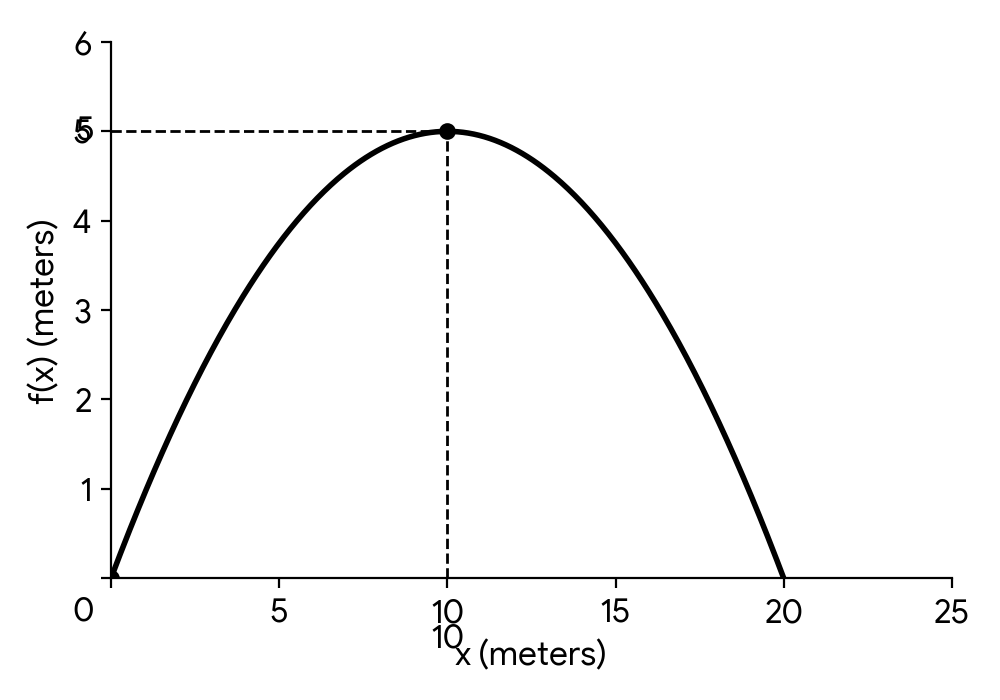
(a) Find the total horizontal span of the bridge, i.e., the x-coordinate where the arch meets the ground again.
(b) Determine the values of , , and .
(c) Write down the equation of the axis of symmetry of the parabolic arch.
Recall that a parabola is symmetrical about its axis of symmetry. The vertex lies on this axis.
You can use the vertex form of a quadratic function, , or the intercept form, . Substitute the known points to find , then expand to find and . Alternatively, set up a system of simultaneous equations using the points , , and .
The axis of symmetry of a parabola passes through its vertex.
Question 20
HardPaper 2 · calculator20 marksA large water wheel is used for irrigation. The lowest point a bucket on the wheel reaches is m above the water surface, and its highest point is m above the water surface.
(a) (i) Show that the radius of the water wheel is m.
(ii) Calculate the circumference of the water wheel.
(b) When the wheel rotates , find the distance that a bucket travels along the circumference.
The height in metres, above the water surface, of a particular bucket is modelled by the function:
, for ,
where is the time, measured in minutes.
The wheel takes minutes to complete revolution.
(c) (i) Find the value of .
(ii) Find the value of .
(iii) Hence, write down the equation of the sinusoidal model.
(d) Use the model to find the values of when the height of this bucket is m above the water surface for .
The water wheel operates for days, and each day it rotates nonstop for hours.
(e) Calculate the total number of rotations that the water wheel has made. Give your answer in the form where and is an integer.
The radius of a circular object can be found by taking half the difference between its highest and lowest points.
The formula for the circumference of a circle is , where is the radius.
The distance traveled along the circumference for a given angle is an arc length. The formula for arc length is when is in degrees.
The period of the sinusoidal function is the time it takes for one complete revolution. For a function , the period is given by if is in degrees, or if is in radians.
The value of represents the vertical shift or the midline of the sinusoidal function. It is the average of the maximum and minimum heights.
Recall that represents the amplitude, which is equal to the radius of the wheel.
Substitute into your equation from part (c)(iii) and solve for . Remember that the sine function has multiple solutions within a given period.
First, calculate the total operating time in minutes. Then, divide by the time it takes for one revolution.
No question on this page matches those filters. Try another difficulty or paper.
113 more Modelling (linear, quadratic, exponential growth/decay, cubic, sinusoidal) questions in the app
Every answer is marked mark by mark, IB-style, and the AI tutor helps when you are stuck.
Where marks are lost
- Using your own wrong value after failing a "show that." All follow through is withdrawn for the rest of that question.