Second derivative (+max/min distinguishing): notes and practice questions
- Second order derivative: or , obtained by differentiating the first derivative .
- Local minimum/maximum points: Stationary points where the gradient .
- Concave up: Curve forms a "U" shape, gradient is increasing, meaning .
- Concave down: Curve forms an "n" shape, gradient is decreasing, meaning .
- Point of Inflection: A point where the curve changes concavity.
- Second Derivative Test for Stationary Points:
- If , the stationary point is a local minimum.
- If , the stationary point is a local maximum.
- If , the test is inconclusive; further investigation (e.g., first derivative test or sign change of ) is required.
- Conditions for a Point of Inflection:
1. The second derivative is zero: .
2. The second derivative must change sign (concavity changes) as it passes through the point.
- To find and classify stationary points algebraically:
1. Find .
2. Set and solve for x-coordinates of stationary points.
3. Substitute x-values into the original function to find y-coordinates.
4. Find .
5. Substitute x-coordinates into : positive result indicates local minimum, negative result indicates local maximum, zero result is inconclusive.
- GDC can find turning points and visually classify them; use to check algebraic solutions.
- Second derivative, concavity, and points of inflection are HL only topics.
- "Classify turning points" means to determine their nature (local min/max).
- Exercise caution with negative and fractional powers during differentiation.
- For a point of inflection, is necessary but not sufficient; a change in concavity (sign change of ) must also occur.
How it is examined
The second derivative test is the HL-only shortcut: compute at the stationary point, positive means a minimum, negative means a maximum, zero means the test is inconclusive and the student has to fall back on the SL method (checking the sign of either side). A point of inflexion question wants the concavity language explicitly, "concave-up" or "concave-down", not just "the curve changes shape."
- Find the second derivative, in both notations and .
- Use the second derivative test to distinguish a maximum from a minimum point.
- Recognise that a point of inflexion is where concavity changes, and interpret this in context.
- Use "concave-up" for and "concave-down" for .
Linking questions
- Links to other subjects: simple harmonic motion (physics).
- TOK: music can be expressed using mathematics. Does that mean music is mathematical, or mathematics musical?
Practice questions
15 questions · 12 medium · 3 hardQuestion 1
MediumPaper 1 · calculator6 marksConsider the function .
(a) Find .
(b) Find how many points of inflection does this function contain.
To find the point of inflection you need to set the second derivative equal to zero and calculate at which value this happens.
Points of inflection are the points at which the second derivative of a function is equal to zero.
Question 2
HardPaper 1 · calculator10 marksA group of engineers is designing a new observation Ferris wheel. The height, , in metres, of a passenger capsule above the ground is modelled by the function , where is the time in seconds after the capsule begins its ascent from the highest point.
The lowest point a capsule reaches is 2 metres above the ground, and the highest point is 32 metres above the ground. The Ferris wheel completes one full rotation in 200 seconds.
Find the values of and .
Using your values from part (a), the function is .
(i) Find .
(ii) Find .
The engineers are particularly interested in the moment when the capsule's vertical speed is at its maximum, for the first time after . This occurs at time .
Calculate the value of .
Calculate the height of the capsule at this time .
The amplitude of a sinusoidal function is half the difference between its maximum and minimum values. The vertical shift (midline) is the average of the maximum and minimum values. Consider the starting point () to determine the sign of .
Remember the chain rule for differentiation. For , the derivative is . The derivative of is .
The vertical speed is given by . To find when the speed is maximum, you need to find the maximum value of . This occurs when or at the endpoints of the domain. Consider the range of the sine function.
Substitute the value of you found in part (c.i) into the original height function .
Question 3
MediumPaper 1 · calculator6 marksConsider the function .
Find .
Find how many points of inflection does this function contain.
To find the point of inflection you need to set the second derivative equal to zero and calculate at which value this happens.
Points of inflection are the points at which the second derivative of a function is equal to zero.
Question 4
HardPaper 2 · calculator15 marks(a) A pharmaceutical company is designing a new cylindrical container for a special liquid. The container has a fixed volume .
The radius of the container is and the height is .
Show that .
(b) Find an expression for the total surface area of the container.
(c) Substitute an expression for (from part (a) ) into your expression for (from part (b) ) and hence show that .
(d) Find .
(e) Find the minimum value of and the values of and when this occurs. Show that this value of is indeed a minimum.
Recall the formula for the volume of a cylinder. Substitute the given volume into this formula.
The total surface area of a cylinder consists of the area of the two circular bases and the area of the curved side.
From part (a), isolate . Then substitute this expression for into the formula for from part (b). Simplify the resulting expression.
Differentiate the expression for with respect to . Remember that can be written as .
To find the minimum value, set and solve for . Then use this value of to find and . To show it's a minimum, use the second derivative test.
Question 5
MediumPaper 1 · calculator5 marksThe diagram shows the slope field for the differential equation for and .
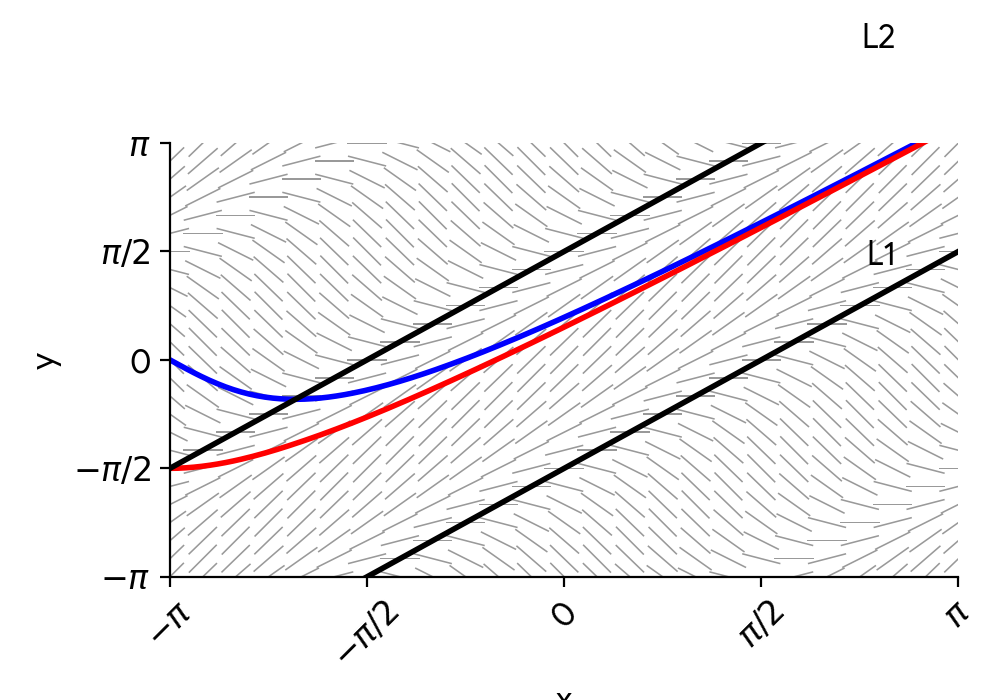
The local maximum points for solutions to the differential equation lie on the straight line .
Find the equation of , giving your answer in the form .
Find the equation of the straight line on which all local minimum points lie within the given domain, giving your answer in the form .
To find local maximum points, you need to find where and then use the second derivative test or analyze the sign change of . Remember to consider the domain for and .
Similar to part (a), but consider the condition for local minimum points. What must be the sign of the second derivative?
Question 6
HardPaper 2 · calculator20 marks(a) SweetTreats is designing new packaging for a line of artisanal chocolates. The initial design is a box in the shape of a cuboid with a square base of side length cm. Its height, cm, is twice the length of the base.
Write down an expression for in terms of .
(b) The box is designed to hold cm of chocolates.
Find the value of and .
(c) Calculate the total external surface area of the box.
(d) To minimize the amount of material needed, SweetTreats is considering changing the shape to a cylinder with radius cm and height cm. The cylindrical container must also hold cm of chocolates.
Find an expression for the height, , of the container in terms of .
(e) Let the total external surface area of the cylindrical container be cm.
Show that .
(f) Find .
(g.i) Hence or otherwise, find the value of that will minimize .
(g.ii) Find the minimum value of needed for the cylinder.
(h.i) Find .
(h.ii) Hence determine whether the graph of is concave-up or concave-down for . Justify your answer.
The question states a direct relationship between the height and the base length . Express this relationship mathematically.
The volume of a cuboid is given by base area multiplied by height. Use the expression from part (a) to relate the volume to only, then solve for . Once is found, calculate .
The total external surface area of a cuboid with a square base consists of two square bases and four rectangular sides. Use the dimensions found in part (b).
Recall the formula for the volume of a cylinder. Use the given volume to express in terms of .
The total surface area of a cylinder is the sum of the areas of the two circular bases and the curved surface area. Substitute the expression for from part (d) into the surface area formula.
Differentiate the expression for with respect to . Remember that can be written as .
To find the minimum value of , set its derivative to zero and solve for . You may need a GDC for the final calculation.
Substitute the value of found in part (g.i) back into the expression for from part (e).
Differentiate with respect to .
The sign of the second derivative determines concavity. If , the graph is concave-up. If , it's concave-down.
Question 7
MediumPaper 1 · calculator10 marksA company models the profit from a new product launch using the function , where is the profit in thousands of dollars and is the time in months since launch.
Find .
Find .
The company observes that the rate of change of profit growth begins to slow down after a certain point, indicating a point of inflexion. Find the time, , in months at which this point of inflexion occurs.
Remember to use the product rule for differentiation. Let and .
Differentiate the expression for obtained in part (a.i). You will need to apply the product rule again for the term involving .
A point of inflexion occurs where the second derivative is equal to zero. Set and solve for .
Question 8
MediumPaper 1 · calculator10 marks(a) A drone's displacement, metres, from a fixed charging station after minutes (where ) is given by the equation .
Calculate the distance travelled by the drone in the first 3 minutes.
(b) Find an expression for the velocity, , of the drone. Hence, determine if the drone ever becomes stationary for .
To find the distance travelled, first determine the displacement at the start and end of the interval. Then, consider if the drone changes direction within the interval by checking its velocity.
Recall the rules for differentiation, especially the quotient rule for rational functions and the chain rule for logarithmic functions. A drone is stationary when its velocity is zero.
Question 9
MediumPaper 1 · calculator14 marks(a) A company's profit, , in thousands of dollars, from selling units of a new product can be modelled by the function , for .
Calculate the coordinates of the stationary points of the profit function .
(b) Find the equation of the normal to the curve at the point where . Give your answer in the form , where .
(c) Determine the second derivative of the profit function, .
(d) Use the second derivative to classify the nature of the stationary points found in part (a).
To find stationary points, you need to find the first derivative of the function, set it to zero, and solve for . Then substitute the -values back into the original function to find the corresponding values.
First, find the -coordinate of the point when . Then, calculate the gradient of the tangent at that point using the first derivative. The gradient of the normal is the negative reciprocal of the tangent's gradient. Finally, use the point-slope form of a line to find the equation of the normal.
The second derivative is found by differentiating the first derivative, .
Substitute the -coordinates of the stationary points into the second derivative. If , it's a local minimum. If , it's a local maximum.
Question 10
MediumPaper 2 · calculator13 marks(a) A builder is designing a rectangular enclosure for a new community garden. The total length of fencing available for the enclosure is metres.
The builder wants to maximize the area of the garden. Calculate the maximum possible area of the enclosure.
(b) To ensure structural stability, the builder also needs to consider the sum of the squares of the lengths of the sides. Calculate the minimum possible value for the sum of the squares of the lengths of the sides of the enclosure.
(c) Justify that the value found in part (b) is indeed a minimum.
Let the length of the rectangle be and the width be . Form an equation for the perimeter and express the area in terms of a single variable. Then use calculus to find the maximum.
Using the relationship between length and width from part (a), express the sum of the squares of the sides as a function of a single variable. Then use calculus to find the minimum.
Consider the second derivative of the function you formed in part (b) or the properties of the quadratic function.
Question 11
MediumPaper 1 · calculator7 marks(a) The profit, , in thousands of dollars, for a company producing hundred units of a certain product is modelled by the function , for .
Find an expression for , the rate of change of profit with respect to the number of units produced.
(b) Hence, find the maximum profit the company can achieve.
(c) Justify that the profit you found in part (b) is a maximum point.
To find the rate of change of profit, you need to differentiate the profit function with respect to . Remember the power rule for differentiation: .
The maximum profit occurs when the rate of change of profit is zero. Set and solve for . Then substitute this value of back into the original profit function to find the maximum profit.
To justify that a critical point is a maximum, you can use the second derivative test. Find the second derivative and evaluate its sign at the critical point found in part (b). If , it indicates a maximum.
Question 12
MediumPaper 2 · calculator16 marksA civil engineer is designing a cross-section for a new pedestrian tunnel. The shape of the tunnel's ceiling can be modelled by the curve , where and are measured in metres. The tunnel's base is along the -axis, and it starts from the -axis, extending to where the ceiling meets the -axis.
(a) Sketch the curve, showing the region representing the cross-sectional area of the tunnel. Shade this region.
(b) Using the trapezium rule with five strips, determine an approximation for the cross-sectional area of the tunnel.
(c) Explain why your answer to part (b) will be an underestimate for the actual cross-sectional area.
(d) Using integration, determine the exact value of the cross-sectional area of the tunnel.
(e) Find the percentage error of your approximation from part (b) compared with the exact value found in part (d).
Identify the intercepts with the - and -axes to help sketch the curve accurately. The area described is in the first quadrant.
Remember the formula for the trapezium rule: . First, find the width of each strip, , and then calculate the -values at the endpoints of each strip.
Consider the second derivative of the function to determine its concavity.
Integrate the function from to the positive -intercept.
Percentage error . Use the unrounded values from parts (b) and (d) for accuracy.
Question 13
MediumPaper 1 · calculator10 marks(a) The height of a drone above the ground, in metres, can be modelled by the function , where is the time in seconds after launch.
Find .
(b) Find and and comment on the meaning of these values in the context of the drone's flight.
(c) Find the time when the drone reaches its minimum height and explain how you know that it is a minimum.
Recall the power rule for differentiation: if , then . The derivative of a constant is zero.
The derivative represents the instantaneous rate of change of the drone's height with respect to time, which is its vertical velocity. A positive value means increasing height, and a negative value means decreasing height.
To find the minimum or maximum point of a function, set its first derivative equal to zero. To confirm if it's a minimum, you can use the second derivative test ( for a minimum) or analyze the sign change of the first derivative.
Question 14
MediumPaper 1 · calculator18 marksThe diagram below shows a cross-section of a sculpted garden feature. The shaded area is bounded by the -axis, the vertical line , the line and the curve .
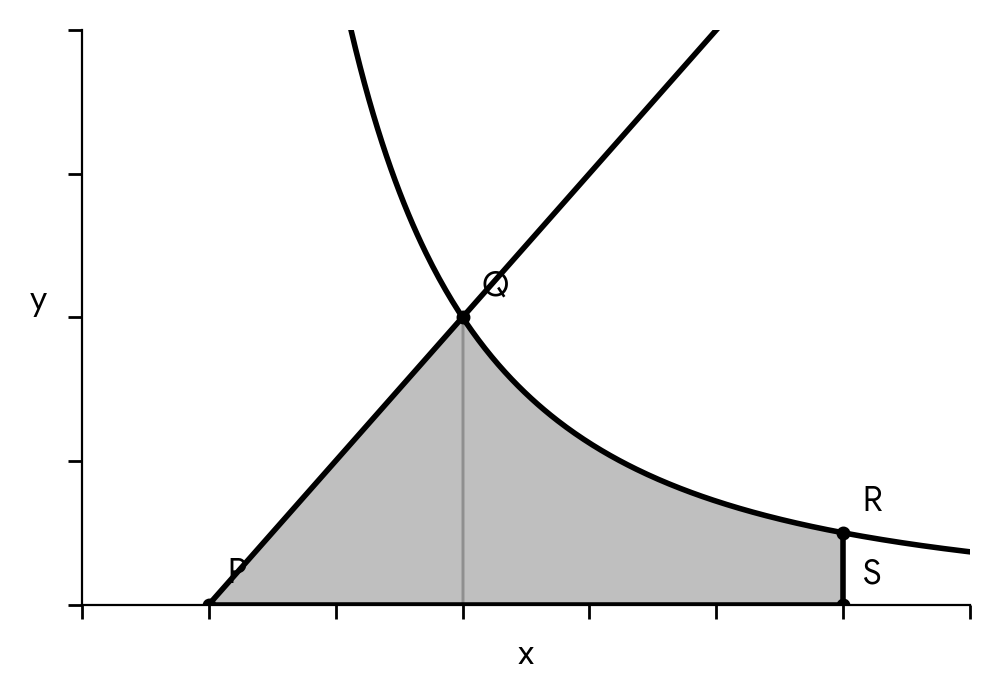
Using technology or otherwise, find the coordinates of points , , and .
Approximate the area of the cross-section using the trapezoidal rule with 5 strips of equal width over the interval .
Explain why the approximation in part (b) is an overestimate.
Determine the exact area of the cross-section using integration.
Find the percentage error of your approximation from part (b), compared with the exact value from part (d).
Points P and S lie on the -axis. Point Q is the intersection of the line and the curve. Point R is on the curve at . Remember to show your working for finding intersection points.
The width of each strip is . The trapezoidal rule formula is . Remember to use the correct function for each -value.
Consider the concavity of the curve over the interval where it is used in the approximation. How does the trapezoidal rule behave with concave up/down curves?
The area is split into two regions at the intersection point Q. Integrate each function over its respective interval and sum the results.
The formula for percentage error is .
Question 15
MediumPaper 1 · calculator5 marksThe rate of a chemical reaction, , in mol/s, at time seconds, is modelled by the function , for .
(a) Find an expression for .
(b) Hence or otherwise, find the values of at which the rate of reaction has points of inflexion. Give your answers correct to three significant figures.
To find the derivative of a rational function like , you can use the quotient rule or rewrite it as and use the product and chain rules.
Points of inflexion occur where the second derivative, , is equal to zero or undefined, and the concavity changes. You will need to differentiate and solve . Remember to consider the domain .
No question on this page matches those filters. Try another difficulty or paper.
Every Second derivative (+max/min distinguishing) question, marked for you
Every answer is marked mark by mark, IB-style, and the AI tutor helps when you are stuck.
Where marks are lost
- Using your own wrong value after failing a "show that." All follow through is withdrawn for the rest of that question.