Functions, domain, range: notes and practice questions
- A function maps each input to exactly one output (one-to-one or many-to-one).
- Vertical Line Test: If a vertical line intersects a graph more than once, it is not a function.
- Function notation: represents the output for input .
- Domain: Set of all valid input () values.
- Range: Set of all possible output ( or ) values.
- Standard Number Sets: (Real), (Rational), (Integers), (Natural).
- Largest Possible Domain exceptions:
- Square roots: Expression inside must be . E.g., for , domain is .
- Rational functions: Denominator cannot be zero. E.g., for , domain is .
- Piecewise functions: Defined by different formulas for different input intervals; evaluate by matching input to correct interval.
- Inverse functions ():
- Only one-to-one functions have inverses (or restricted domains).
- Horizontal Line Test: If a horizontal line intersects a graph more than once, it has no inverse (unless domain is restricted).
- Domain of becomes range of .
- Range of becomes domain of .
- Graph of is a reflection of across the line .
- GDC for Range: Graph function, observe min/max -values within the domain.
- GDC for Solving Equations (): Plot both functions, use intersection tool.
- GDC for Key Features: Use analysis tools for roots, intercepts, turning points.
- To find : Substitute into the function's expression.
- To find range for monotonic function over : Evaluate and . E.g., for on , range is .
How it is examined
Domain and range questions are usually asked in context, so the answer has to respect the situation as well as the algebra: a model of a population has domain because negative time is meaningless, not because the formula breaks. The inverse at SL is read off a graph or found by solving with technology, never by rearranging. Asking an SL student to "find an expression for " is an AHL 2.7 question.
- The concept of a function, its domain, its range and its graph.
- Function notation, for example , , .
- The concept of a function as a mathematical model.
- The informal idea that an inverse function reverses or undoes the effect of a function.
Linking questions
- Other contexts: temperature and currency conversions.
- Links to other subjects: currency conversions and cost functions (economics and business management); projectile motion (physics).
- Aim 8: what is the relationship between real-world problems and mathematical models?
- International-mindedness: functions were developed by Descartes (France), Leibniz (Germany) and Euler (Switzerland), and the notation was settled by many mathematicians across the 17th and 18th centuries. How did today's notation become internationally accepted?
- TOK: should mathematics or logic be classified as a language?
Practice questions
80 questions · 3 easy · 67 medium · 10 hardQuestion 1
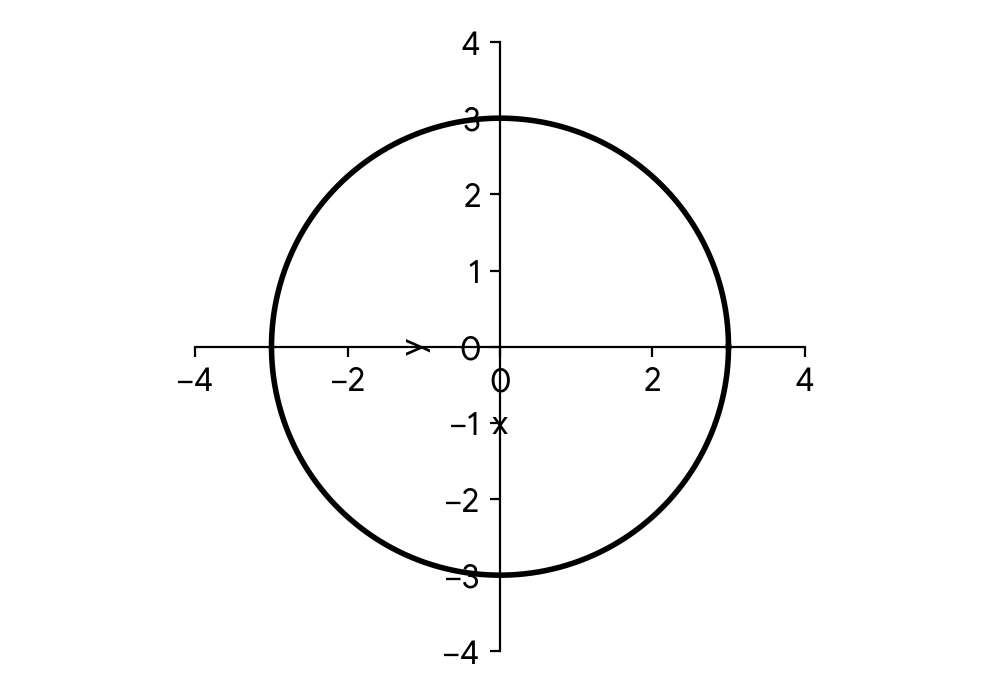
EasyPaper 1 · calculator8 marks(a) A scientist is observing the trajectory of a particle. The relationship between its horizontal position () and vertical position () is described by the equation .
Does this relationship represent as a function of ? Justify your answer.
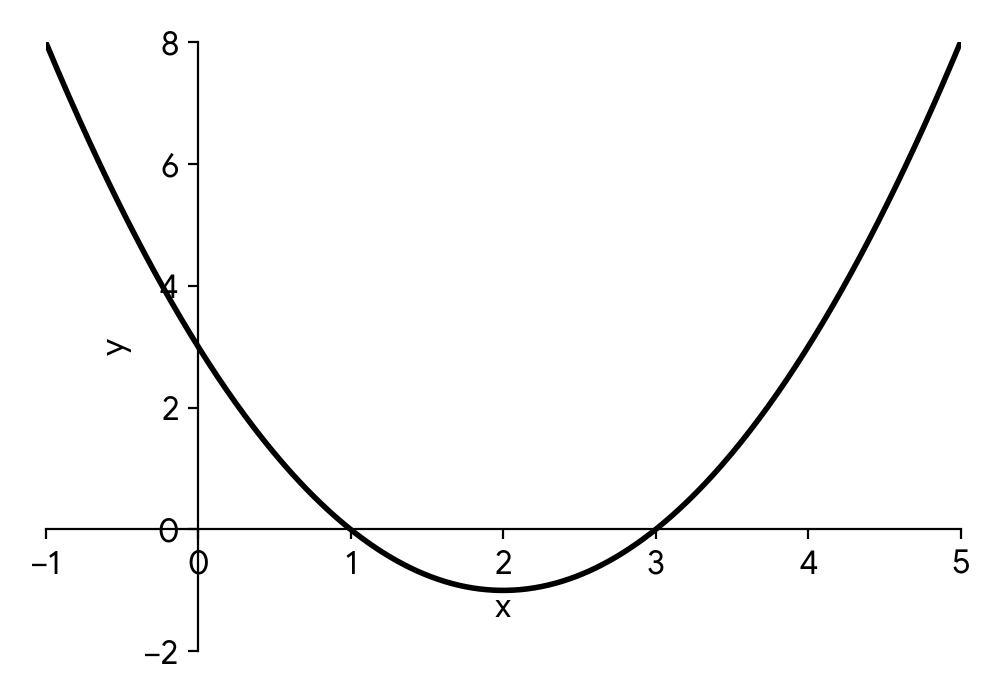
(b) Another experiment records the temperature () of a chemical reaction over time (). The relationship is modelled by the equation .
Does this relationship represent as a function of ? Justify your answer.
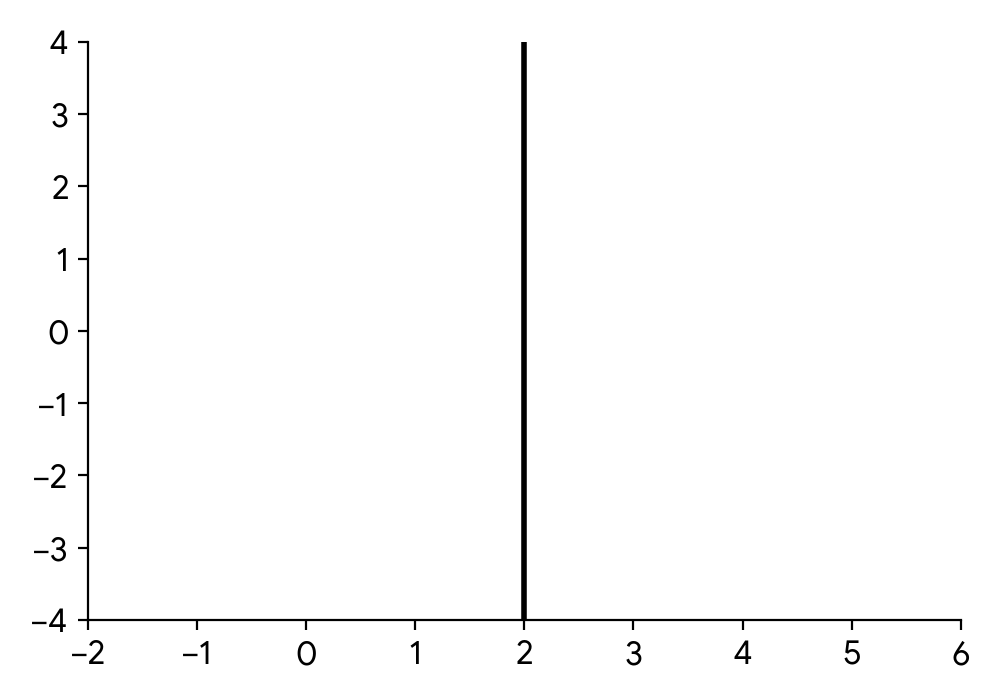
(c) A sensor measures a constant environmental factor, where its value () is always , regardless of any other variable (). The relationship is given by .
Does this relationship represent as a function of ? Justify your answer.
(d) A technician plots the oscillation of a spring, where its displacement () is related to time () by the equation .
Does this relationship represent as a function of ? Justify your answer.
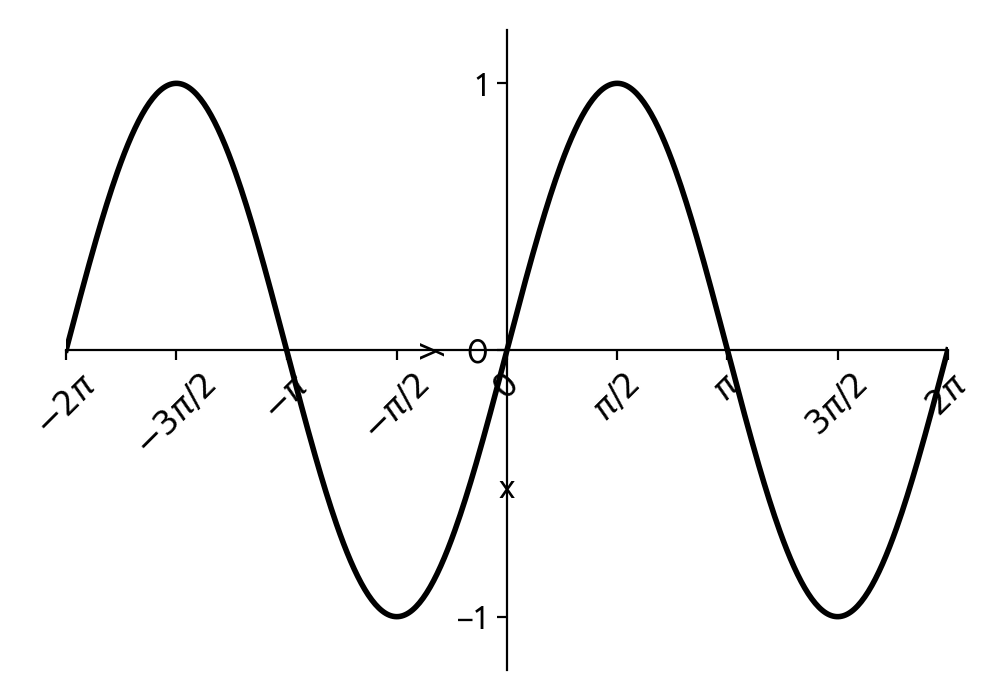
Recall the definition of a function and how to test it graphically. For a relationship to be a function, each input value () must correspond to exactly one output value ().
Apply the vertical line test. If any vertical line intersects the graph at more than one point, it is not a function.
Consider what happens when you draw a vertical line through the graph of . How many -values are associated with ?
Think about the behavior of the sine function. Does each input produce a unique output ?
Question 2
MediumPaper 1 · calculator7 marksA digital artist is designing a new fractal pattern. The initial curve for the pattern is defined by the function . To create a variation, the artist applies a transformation to , resulting in a new curve . This transformation involves a horizontal translation of units and a vertical translation of units.
The new curve is observed to pass through the points and .
Find the value of and the value of .
The transformed function will be of the form . Substitute the given points into this equation to form a system of two equations. Use logarithmic properties to simplify and solve for and .
Question 3
HardPaper 2 · calculator11 marksIn a controlled chemical experiment, the initial temperature, (in degrees Celsius), of a reactant mixture is adjusted before a reaction begins. The adjusted temperature, , is then used to determine the reaction rate, .
The adjustment function is given by , for .
State the range of .
The overall reaction rate, , as a function of the initial temperature , is modelled by , for .
State the range of .
The experiment is designed to achieve a specific 'target state' when the adjusted reaction rate equals 0. Solve the equation .
Determine the function .
Consider the type of function is and its domain. For a linear function with a domain of all real numbers, what is its range?
The function is a quadratic. Find the vertex of the parabola to determine its minimum value, which will define the lower bound of its range.
Recall that . Therefore, means substituting into the expression for . Once you have the expression for , set it to zero and solve the resulting quadratic equation.
You are given and . Let . Express in terms of . Then substitute this expression for into to find . Finally, replace with to get .
Question 4
EasyPaper 1 · calculator4 marks(a) Consider the graph of a relationship where the input is the length of a side of a square, , and the output is its area, . This graph is represented by for . State whether this graph represents as a function of , giving a reason.
(b) Consider the graph of a relationship between two variables, and , which forms a vertical line segment from to . State whether this graph represents as a function of , giving a reason.
Recall the definition of a function and how to use the vertical line test. For a relationship to be a function, each input value must correspond to exactly one output value.
Apply the vertical line test. If a vertical line intersects the graph at more than one point, then it is not a function.
Question 5
MediumPaper 1 · calculator7 marksThe "LearnFast" online learning platform charges a monthly subscription fee of and an additional per premium course. If a student enrolls in a minimum of premium courses in a month, a one-time discount of is applied to their total bill.
This can be modelled by the following function, , which gives the total cost when enrolling in a minimum of premium courses at LearnFast:
where is the number of premium courses a student enrolls in.
Find the total cost of enrolling in premium courses at LearnFast.
Find .
Another online learning platform, "SkillUp", charges a flat rate of per premium course, with no monthly subscription or discounts. A student must enroll in a minimum of premium courses for a direct comparison with LearnFast's discounted model.
The total cost at LearnFast is cheaper than SkillUp when .
Find the minimum integer value of .
Substitute the given number of courses into the function and calculate the result.
To find , set and solve for . Remember to check if the value of is within the domain .
First, write down the cost function for SkillUp, say . Then, set up an inequality where the cost of LearnFast is less than the cost of SkillUp, . Solve this inequality for and consider the domain .
Question 6
HardPaper 2 · calculator11 marks(a) An engineer is designing a section of a roller coaster track. To ensure a smooth ride, the track must follow a specific curve. Three sensor readings are taken at different horizontal positions along this section of the track, giving the following height coordinates: , , and .
Assuming the track follows a quadratic path of the form , find the equation of this quadratic curve.
(b) A fourth sensor reading is taken at a horizontal position of , recording a height of . Determine if this new point lies on the quadratic curve found in part (a).
(c) Due to the discrepancy, the engineer decides that a cubic function, , would be a better fit for the track. Find the equation of the cubic function that passes through all four points: , , , and .
Substitute each point into the general quadratic equation to form a system of three linear equations. Then, solve this system for the coefficients , , and . You can use your GDC's simultaneous equation solver.
Substitute the coordinates of the new point into the equation of the quadratic curve you found in part (a). If the equation holds true, the point lies on the curve.
Similar to part (a), substitute all four points into the general cubic equation . This will form a system of four linear equations with four unknowns (). Use your GDC to solve this system.
Question 7
EasyPaper 1 · calculator4 marks(a) The height of a drone above the ground, metres, seconds after launch, is modelled by a function whose graph is shown below. The drone is launched from a platform, reaches a maximum height, and then descends to the ground. The graph starts at , reaches a maximum point at , and touches the horizontal axis at .
State the domain and range for this function.
(b) A freshly brewed cup of coffee is left to cool. Its temperature, degrees Celsius, minutes after brewing, is modelled by a function whose graph is shown below. The graph starts at , and as time progresses, the temperature decreases, approaching an ambient temperature of degrees Celsius, but never quite reaching it.
State the domain and range for this function.
For the domain, consider the time interval from when the drone is launched until it lands. For the range, consider the minimum and maximum heights the drone reaches.
For the domain, consider that time starts from brewing and continues indefinitely. For the range, consider the initial temperature and the temperature it approaches.
Question 8
MediumPaper 1 · calculator7 marksA manufacturing company purchases a new specialized machine. The machine's value depreciates exponentially over time. The value of the machine, , in thousands of dollars, years after its purchase, is modelled by the function , for .
The initial value of the machine was 150 thousand dollars. After 3 years, its value had decreased by 40%.
(a) Find the value of .
(b) Calculate the value of the machine after 5 years and 6 months, giving your answer to two decimal places.
(c) The company believes that, according to this model, the machine will always have some residual value, however small.
State a mathematical reason why the company might believe this.
(d) Write down one possible limitation of the domain of the model.
The initial value of the machine corresponds to . If the value decreased by 40%, what percentage of the initial value remains after 3 years? Use this to set up an equation for .
Ensure the time is expressed in years for the model. Use the value of found in part (a).
Consider the behaviour of exponential functions as approaches infinity.
The domain is given as . Think about real-world scenarios that might make this model unrealistic for certain values of .
Question 9
HardPaper 2 · calculator22 marksThe concentration of a certain chemical, , in a solution over a period of time can be modelled using the function , where is the time in hours after the experiment begins.
Sketch the graph of for .
Find the concentration after hours.
Find the concentration after hours.
Find the maximum concentration and the time in hours at which this occurs.
Find the minimum concentration and the time in hours at which this occurs.
Find the times in hours when the concentration is mol/L.
Use your GDC to plot the function. Ensure your graph shows the correct domain and key features like intercepts and turning points.
Substitute into the given function .
Substitute into the given function .
To find the maximum concentration, you need to find the derivative of , set it to zero, and solve for . Then, evaluate at these critical points and the endpoints of the domain. Alternatively, use the 'maximum' function on your GDC.
Consider the values of at the critical points found in part (d) and at the endpoints of the domain ( and ). Alternatively, use the 'minimum' function on your GDC.
Set and solve the resulting cubic equation for . Use your GDC's solver or intersection feature.
Question 10
MediumPaper 1 · calculator7 marksAn architect is designing a parabolic arch for a new building. The shape of the arch can be modelled by the function , where and are measured in metres. The highest point of the arch (the vertex) is at . One end of the arch is at the origin , and the other end is at .
(a) Find the value of .
(b) Find the value of
(i) .
(ii) .
(iii) .
(c) Write down the equation of the axis of symmetry of the arch.
Recall that the x-coordinate of the vertex of a parabola is exactly halfway between its x-intercepts.
You can use the factored form or the vertex form , or set up a system of equations using the given points.
Once you have the value of , substitute it back into the general form of the quadratic or the expanded factored form.
Once you have the value of and , substitute them back into the general form of the quadratic or the expanded factored form.
The axis of symmetry for a parabola passes through its vertex.
Question 11
HardPaper 2 · calculator14 marksA drone launches a package, and its trajectory is modelled by the equation , where is the height of the package in metres and is the horizontal distance in metres from the launch point.
On paper, sketch the graph of the path that the package flies for . Clearly indicate the initial height, the maximum height, and the horizontal distance when it lands.
Find the height of the package when it has travelled a horizontal distance of metres.
Find the maximum height of the package.
Find the horizontal distance at which the package lands on the ground, and explain what this value represents in the context of the problem.
Identify the initial height (when ), the maximum height (vertex), and the point where the package lands (where ). Remember the general shape of a quadratic function with a negative leading coefficient.
Substitute the given horizontal distance into the function .
The maximum height of a quadratic function occurs at the vertex, where . Once you find this -value, substitute it back into the function to find the maximum height.
The package lands on the ground when its height is zero. Set and solve the quadratic equation for . Remember that horizontal distance must be positive.
Question 12
MediumPaper 1 · calculator5 marksA new fertilizer is being tested on a specific plant species. The concentration of a key nutrient, , in the plant (in mg/L) is modelled by the function , where is the amount of fertilizer added (in grams). The amount of fertilizer used is restricted to , where (due to experimental constraints).
Find the range of the nutrient concentration .
Determine the amount of fertilizer that results in a nutrient concentration of mg/L. Give your answer in the form .
To find the range of a rational function over a restricted domain, evaluate the function at the endpoints of the domain. Also, consider the behavior of the function around any vertical asymptotes that lie within the given domain.
To find , you need to solve the equation for . Alternatively, you could find the inverse function first and then substitute .
Question 13
HardPaper 2 · calculator15 marks(a) A pharmaceutical company is designing a new cylindrical container for a special liquid. The container has a fixed volume .
The radius of the container is and the height is .
Show that .
(b) Find an expression for the total surface area of the container.
(c) Substitute an expression for (from part (a) ) into your expression for (from part (b) ) and hence show that .
(d) Find .
(e) Find the minimum value of and the values of and when this occurs. Show that this value of is indeed a minimum.
Recall the formula for the volume of a cylinder. Substitute the given volume into this formula.
The total surface area of a cylinder consists of the area of the two circular bases and the area of the curved side.
From part (a), isolate . Then substitute this expression for into the formula for from part (b). Simplify the resulting expression.
Differentiate the expression for with respect to . Remember that can be written as .
To find the minimum value, set and solve for . Then use this value of to find and . To show it's a minimum, use the second derivative test.
Question 14
MediumPaper 1 · calculator7 marksLet the function represent the cost in dollars per display stand, where is the width of the stand in meters.
for .
Find the range of .
The function is the inverse function of .
Find .
In the context of the question, interpret your answer to part (b)(i).
Write down the range of .
To find the range of a function over a closed interval, evaluate the function at the endpoints of the interval. Consider whether the function is increasing or decreasing over that interval.
To find , you need to find the value of for which . Set up the equation and solve for .
Consider what the input and output of the original function represent. The inverse function reverses this relationship.
The range of an inverse function is the domain of the original function.
Question 15
HardPaper 2 · calculator21 marksThe "SkyGazer" is a new observation wheel in a city park. The wheel has a diameter of m. To begin the ride, a passenger enters a capsule at the lowest point on the wheel, which is m above the ground. A ride consists of multiple revolutions, and the wheel makes revolutions per minute.
The height of a capsule above the ground, , measured in metres, during a ride on the SkyGazer can be modelled by the function , where is the time, in seconds, since a passenger began their ride.
(a) Calculate the value of
(i) ;
(a)(ii) ;
(a)(iii) .
(b) A ride on the SkyGazer lasts for minutes in total.
Calculate the number of revolutions of the wheel per ride.
(c) For exactly one ride on the SkyGazer, suggest
(i) an appropriate domain for ;
(c)(ii) an appropriate range for .
(d) A metre-tall building stands on the horizontal ground next to the SkyGazer.
By considering the graph of , determine the length of time during one revolution of the wheel for which the capsule is higher than the building.
(e) There is a plan to relocate the SkyGazer onto a taller platform which will increase the maximum height of the wheel to m. This will change the value of one parameter, , or , found in part (a).
(i) Identify which parameter will change.
(e)(ii) Find the new value of the parameter identified in part (e)(i).
The parameter represents the amplitude of the sinusoidal function. For a Ferris wheel, the amplitude is half of its diameter.
The parameter is related to the period of the function. The period is the time it takes for one full revolution. Remember to convert revolutions per minute to seconds per revolution and use the formula for the period of a cosine function.
The parameter represents the vertical shift of the function, which is the central height of the wheel. This can be found by adding the amplitude to the lowest height.
Multiply the duration of the ride in minutes by the revolutions per minute.
The domain represents the possible values for time . The ride starts at and lasts for minutes. Remember to express time in seconds.
The range represents the possible values for the height . Consider the lowest and highest points a capsule can reach during the ride.
Set the height function equal to the building's height and solve for within one period. Use the symmetry of the cosine function to find the interval where the height is above the building.
Consider how raising the platform affects the dimensions and movement of the wheel. Does it change the diameter, the speed of rotation, or the overall vertical position?
The maximum height of the wheel is given by . Use the new maximum height and the value of (which remains unchanged) to find the new .
Question 16
MediumPaper 1 · calculator8 marksA biologist is studying the effect of a new toxin on a bacterial culture. The number of active bacterial cells, (in thousands), remaining after exposure to a toxin dose (in mg/L) follows the relationship:
, for some constant .
In an experiment, it was observed that when the toxin dose was 2 mg/L, there were 1000 thousand (i.e., 1,000,000) active cells remaining.
(a) Find the value of .
The relationship for this bacterial culture can also be written in the form .
(b) Find the value of .
(c) Given that the toxin dose is between 0.5 mg/L and 4.0 mg/L (i.e., ), find the range for .
The effectiveness score, , of a new antidote is inversely proportional to the number of active cells, , remaining after toxin exposure, such that .
(d) A new antidote was tested on a culture exposed to a dose of 4.5 mg/L. Calculate the effectiveness score, , for this antidote. Give your answer to 3 significant figures.
Substitute the given values of and into the equation and solve for . Remember that is in thousands.
Convert the logarithmic equation into an exponential form. Alternatively, substitute known values of and along with the value of found in part (a) into the given equation .
Calculate the values of at the boundary doses and using the equation . Remember to use the value of found in part (a).
First, calculate the number of active cells for a toxin dose of mg/L using the equation . Then, use the formula to find the effectiveness score.
Question 17
HardPaper 2 · calculator18 marksA tech company launches a new social media app. The number of active users, , can be modelled by the function
,
where is the number of hours since the app was launched, and is a positive constant.
Write down the value of .
Interpret what this value means in this context.
4 hours after the app was launched, the number of active users was 4050.
Find the value of .
Find the number of active users 2 hours and 15 minutes after the app was launched.
A competitor launches a similar app, whose user base, , can be modelled by the function
,
where is the number of hours since both apps were launched.
Find the value of when the number of users for both apps is equal.
It takes hours and minutes for the number of users of the first app to reach 15000.
Find the value of and , giving as an integer.
Each user of the first app requires MB of server storage. The total available server capacity is MB.
Determine how long it would take for the app's user base to exceed the server capacity.
The value of represents the number of users at time . Substitute into the given function.
Consider what signifies in the context of the app launch.
Substitute the given values of and into the function and solve for .
First, convert 2 hours and 15 minutes into a decimal number of hours. Then, use the value of found in part (b) and substitute this time into the model.
Set the two user base functions, and , equal to each other and solve for . You will need to use logarithms.
Set the function for the first app, , equal to 15000 and solve for . The integer part of will be . Convert the decimal part of into minutes and round to the nearest integer for .
Calculate the total storage required by users and set this equal to the total server capacity. Solve for .
Question 18
MediumPaper 1 · calculator8 marksA new experimental drug is administered to a patient. The concentration of the drug in the patient's bloodstream, , in mg/L, hours after administration, is modelled by the function , where and are positive constants.
Initially, the concentration of the drug is mg/L. After hours, the concentration drops to mg/L.
Determine the value of .
Using this model, calculate the concentration of the drug in the bloodstream hours after administration.
Based on this model, will the drug ever completely leave the patient's bloodstream? Justify your answer.
State one limitation of the domain of this model in a real-world context.
Substitute the given initial conditions and the concentration after 2 hours into the model equation. Remember to use the natural logarithm to solve for k.
Use the value of found in part (a) and substitute into the model equation.
Consider the behavior of the exponential function as approaches infinity.
Think about what values of might not make sense in the real world for drug concentration. The given domain is .
Question 19
HardPaper 2 · calculator23 marks(a) A confectionery company is designing a new wrapper for a chocolate bar. The wrapper is in the shape of a rectangular prism with a square base of side length cm. The height, cm, is twice the side length of the base.
Write down an expression for in terms of .
(b) The chocolate bar has a volume of cm.
Find the value of and .
(c) Calculate the total external surface area of this rectangular prism wrapper.
(d) The company also considers a cylindrical wrapper with radius cm and height cm. This wrapper must also hold cm of chocolate.
Find an expression for the height, , of the cylindrical wrapper in terms of .
(e) Let the total external surface area of the cylindrical wrapper be cm.
Show that .
(f) Find .
(g.i) Hence or otherwise, find the value of that will minimize .
(g.ii) Find the minimum value of for the cylindrical wrapper.
(h) To account for manufacturing waste and overlap, an additional of the calculated surface area is required for the rectangular prism wrapper, and for the cylindrical wrapper.
Determine which wrapper design the company should choose to minimize material usage. Justify your answer.
The question states a direct relationship between the height and the side length of the square base.
The volume of a rectangular prism is given by the area of the base multiplied by the height. Use the expression from part (a) to relate the height to the base side length.
The total surface area of a rectangular prism with a square base is the sum of the areas of the two square bases and the four rectangular sides. Use the values of and found in part (b).
The volume of a cylinder is given by . Use the given volume to express in terms of .
The total surface area of a cylinder is . Substitute the expression for from part (d) into this formula.
Differentiate the expression for with respect to . Remember that and .
To find the minimum value of , set the derivative to zero and solve for . Alternatively, you can use a GDC to find the minimum point of the function or the root of .
Substitute the value of found in part (g.i) into the surface area formula .
Calculate the total material needed for each wrapper type by adding the respective percentage increases to their surface areas. Then compare the two total amounts.
Question 20
MediumPaper 1 · calculator7 marksA scientist is modeling the concentration of a certain chemical in a solution over time. The concentration, , in mg/L, is given by the function , where is the time in hours. The model is valid for , but the chemical reaction causes a singularity at hours, so .
(a) Find the range of .
(b) Find an expression for the inverse function . The domain is not required.
(c) Write down the range of .
To find the range of a rational function over a restricted domain with a vertical asymptote, evaluate the function at the endpoints of the domain and consider the behavior of the function around the vertical asymptote.
To find the inverse function, replace with and with , then solve the new equation for .
The range of an inverse function is the domain of the original function.
No question on this page matches those filters. Try another difficulty or paper.
60 more Functions, domain, range questions in the app
Every answer is marked mark by mark, IB-style, and the AI tutor helps when you are stuck.
Where marks are lost
- Using your own wrong value after failing a "show that." All follow through is withdrawn for the rest of that question.