Non-right angle triangles (Sine, cosine rule, area of triangle): notes and practice questions
- Label triangles with capital letters for angles (A, B, C) and corresponding lowercase letters for opposite sides (a, b, c).
- Relabel triangle vertices as needed, maintaining consistent opposite side-angle pairs.
- Sine Rule: Use when any opposite pairs of sides and angles are known.
- To find a side:
- To find an angle:
- Ambiguous Case of Sine Rule: Occurs when given two sides and a non-included angle.
- Results in two possible angles: one acute (from GDC) and one obtuse.
- Obtuse angle:
- Check validity: Ensure the obtuse angle does not cause the sum of triangle angles to exceed .
- Cosine Rule: Use when given two sides and the included angle (SAS), or all three sides (SSS).
- To find a side:
- To find an angle:
- Ensure the angle (C) is opposite the side (c) in the formula.
- Area of a Triangle: Use when two sides and the included angle are known.
- Formula:
- Ensure C is the angle between sides a and b.
- GDC Tips:
- Always check GDC angle mode (Degrees/Radians).
- Use inverse trigonometric functions (, ) to find angles.
- Provide exact values (surd/fraction) if required, not rounded decimals.
How it is examined
Every SL paper has one. The decision the student has to make is which rule applies, and questions are built so that one of them is clearly right. Angles are in degrees at SL, so the calculator mode is a real source of lost marks. Because the ambiguous case is excluded, a question giving two sides and a non-included angle is out of syllabus at SL and legal at HL.
The sine rule, both forms of the cosine rule, and the area of a triangle. The right-angled ratios are expected knowledge.
- The sine, cosine and tangent ratios, to find the sides and angles of right-angled triangles.
- The sine rule, .
- The cosine rule, , and .
- The area of a triangle as .
Linking questions
- Other contexts: triangulation, map-making.
- Links to other subjects: vectors (physics).
- International-mindedness: diagrams of Pythagoras' theorem occur in early Chinese and Indian manuscripts. The earliest references to trigonometry are in Indian mathematics. Triangulation was used to find the curvature of the Earth to settle a dispute between England and France over Newton's gravity.
- TOK: is it ethical that Pythagoras gave his name to a theorem that may not have been his own creation? What criteria might we use to make such a judgment?
Practice questions
23 questions · 18 medium · 5 hardQuestion 1
MediumPaper 1 · calculator7 marksThe diagram below shows a hot air balloon hovering at point H, m vertically above a landing pad.
Point A is the point on the ground, directly below the hot air balloon.
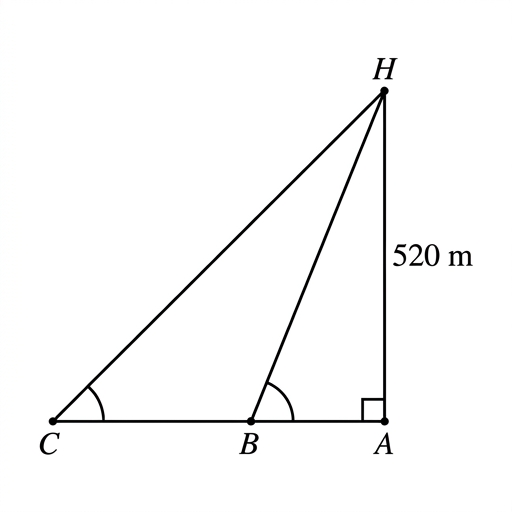
An observer starts walking at a constant speed from point C towards point A. From point C, the observer looks upward at the hot air balloon at an angle of elevation of . After minutes, the observer is at point B and observes the same hot air balloon at an angle of elevation of .
Write down the size of the angle of depression from H to C.
Find the horizontal distance from A to C.
Calculate the distance the observer walked from C to B.
Determine the observer's average speed, in metres per hour.
The angle of depression from H to C is equal to the angle of elevation from C to H due to alternate interior angles.
Consider the right-angled triangle formed by points H, A, and C. You know the height HA and the angle at C. Which trigonometric ratio relates these to AC?
First, find the distance from A to B using the new angle of elevation. Then, use the distance AC you found in part (b) to determine BC.
Speed is distance divided by time. Remember to convert the time from minutes to hours.
Question 2
HardPaper 1 · calculator12 marksA drone is used for aerial surveying. It starts at a central hub (H).
(a)(i) From H, it flies 15 km on a bearing of 040° to survey point S1. From S1, it flies 10 km on a bearing of 170° to survey point S2.
Determine the interior angle HS1S2.
(a)(ii) Determine the distance from S2 back to H.
(a)(iii) Determine the bearing the drone must use to travel directly from S2 to H.
(b) The drone's mission also includes a final delivery point D, such that S1S2DH forms a parallelogram. Write down the distance between point D and point H. Justify your answer.
Draw a diagram with North lines at H and S1. Use the given bearings and properties of parallel lines (North lines) to find the internal angle at S1.
You have two sides of triangle HS1S2 (HS1 = 15 km, S1S2 = 10 km) and the included angle (HS1S2 = 130°). Use the cosine rule to find the third side.
First, use the sine rule to find angle HS2S1 in triangle HS1S2. Then, consider the back bearing from S2 to S1 and use the calculated angle to find the bearing from S2 to H.
Recall the properties of a parallelogram, specifically regarding opposite sides.
Question 3
MediumPaper 1 · calculator5 marksThree remote research stations, Alpha (A), Beta (B), and Gamma (C), are located in a vast desert region. The distances between these stations are given below:
- Distance between Alpha and Beta (AB) = 250 km
- Distance between Beta and Gamma (BC) = 320 km
- Distance between Gamma and Alpha (CA) = 280 km
(a) Calculate the measure of angle ABC, in degrees, correct to one decimal place.
(b) Find the area of the triangular region formed by the three research stations, in , correct to three significant figures.
Use the Cosine Rule to find an angle when all three side lengths of a triangle are known. Remember the formula: .
Once you have an angle and the two sides adjacent to it, you can find the area of the triangle using the formula: . Make sure to use the unrounded angle from part (a) for better accuracy.
Question 4
HardPaper 2 · calculator10 marksA modern architectural marvel, 'The Apex Tower', is designed with a square base and a single peak directly above the centre of the base. The side length of the square base is , and the vertical height of the tower from the centre of the base to its peak is .
Let the base be represented by square ABCD and the peak by V. Let M be the midpoint of the side AB.
(a) Calculate all the side lengths and angles of the triangle , where O is the centre of the square base.
(b) Calculate all the side lengths and angles of the triangle .
First, identify the lengths of VO and OM. Remember that O is the center of the square base and M is the midpoint of a side. This forms a right-angled triangle.
First, find the length of the diagonal of the base, then half of it to get OA. Use this with VO to find the slant edge VA. Remember that is an isosceles triangle.
Question 5
MediumPaper 1 · calculator7 marksA graphic designer is creating a logo for a new technology company. The logo features a stylized 'C' shape, which is a circular arc. This arc is part of a circle with centre O and a radius of 8 cm. The arc subtends an angle of 120° at the centre O. The straight edge of the 'C' is a chord connecting the endpoints of the arc.
The logo component is shown as the curved boundary in the following diagram.
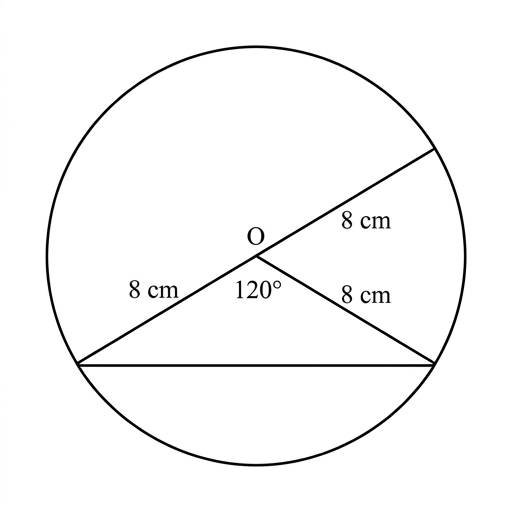
(a) Find the length of the curved boundary of this logo component.
(b) Find the area of the region enclosed by the arc and the straight edge (the segment of the circle).
Remember to convert the angle from degrees to radians when using the arc length formula , or use the proportion of the circle's circumference.
The area of the segment is the area of the sector minus the area of the triangle formed by the two radii and the chord.
Question 6
HardPaper 2 · calculator11 marksA rectangular prism with length 10 cm, width 8 cm, and height 6 cm is used as a base for a sculpture. One corner, vertex H, is cut off by a flat plane passing through points P, Q, and R. Point P is on edge HE such that HP = 3 cm. Point Q is on edge HG such that HQ = 4 cm. Point R is on edge HD such that HR = 3 cm.
(a) Calculate the volume of the remaining part of the prism.
(b) Calculate the total surface area of the remaining part of the prism.
First, find the volume of the original rectangular prism. Then, determine the dimensions of the pyramid that has been cut off from vertex H to calculate its volume. The remaining volume is the difference.
Start with the surface area of the original rectangular prism. Identify the three triangular areas that are removed from the faces meeting at H. Then, calculate the area of the new triangular face PQR. You will need to use the Pythagorean theorem to find the side lengths of triangle PQR and Heron's formula to find its area.
Question 7
MediumPaper 1 · calculator9 marksA triangular section of a modern architectural roof is being designed. The vertices of this section are represented by points P, Q, and R in a 3D coordinate system, where distances are measured in metres.
Point P is at .
Point Q is at .
Point R is at .
Calculate the vector product .
Hence, find the area of the triangular roof section.
A support beam is to be installed from point Q perpendicular to the edge PR. Find the length of this support beam.
The building's base lies on the horizontal plane (z=0). Find the acute angle that the roof section makes with the horizontal plane.
First, determine the component vectors and . Then, remember the formula for the cross product of two 3D vectors.
The magnitude of the cross product of two vectors forming two sides of a triangle is related to the area of the triangle. Specifically, the area is half the magnitude of the cross product.
The area of a triangle can also be calculated using the formula . You can use the area from part (b) and the length of as the base.
The angle between two planes can be found using the angle between their normal vectors. The normal vector to the horizontal plane (z=0) is . The normal vector to the roof section is the cross product you calculated in part (a).
Question 8
HardPaper 1 · calculator8 marksA specialized navigation chart uses complex numbers to represent locations. The central hub is at the origin . Two important landmarks, 'Anchor Point' () and 'Beacon Tower' (), are located at and respectively.
(a) (i) Find the modulus of .
(a) (ii) Find the argument of , giving your answer in radians.
(b) Find the area of the triangular region formed by the central hub, Anchor Point (), and Beacon Tower ().
The modulus of a complex number is given by .
The argument of a complex number is given by , ensuring the angle is in the correct quadrant.
The area of a triangle with vertices at the origin, , and can be found using the formula , where and .
Question 9
MediumPaper 1 · calculator8 marksA landscape architect is designing a triangular garden plot, named DEF. The side DE measures metres, and the side DF measures metres. The angle between these two sides, , is .
The area of the garden plot is m.
Calculate the perimeter of the garden plot.
Start by using the formula for the area of a triangle involving two sides and the included angle. This will allow you to find the value of . Once you have the side lengths DE and DF, you can use the cosine rule to find the length of the third side, EF, and then calculate the perimeter.
Question 10
HardPaper 2 · calculator16 marksThe matrices and are defined by and .
(a) Describe fully the single geometrical transformation represented by .
A quadrilateral is mapped onto quadrilateral by the composite transformation represented by the matrix product . The coordinates of the vertices of are (0, 0), (0, 2), (−1, 1) and (−1, 3).
(b) Find the coordinates of the vertices of .
(c) (i) Find the area of quadrilateral .
(c) (ii) Hence, find the area of quadrilateral .
The matrix represents a combination of transformations:
A rotation of 90° clockwise about the origin;
Followed by a horizontal stretch with scale factor 2, with the y-axis invariant;
Followed by a transformation represented by matrix .
(d) Find matrix .
What is the standard form of a rotation matrix? Alternatively, consider where the basis vectors (1,0) and (0,1) are mapped to by the matrix P.
To reverse a transformation, you need to use the inverse matrix. First, find the single matrix for the composite transformation T = PQ. Then, find its inverse and apply it to the vertices of L.
The vertices of K were found in part (b). Plot these points or recognize the shape they form. It's a common quadrilateral.
The area of a transformed shape is related to the area of the original shape by the determinant of the transformation matrix. What is this relationship?
Write the overall transformation M as a product of the individual transformation matrices in the correct order. Remember that 'followed by' means the new transformation matrix pre-multiplies the previous one. Then, use matrix algebra to isolate the unknown matrix F.
Question 11
MediumPaper 1 · calculator9 marksA surveyor is mapping a triangular plot of land, ABC. The length of side AB is 12.0 km, the length of side BC is 20.0 km, and angle A is 35 degrees.
(a) Find the length of side AC using one application of the cosine rule.
(b) Find the length of side AC using two applications of the sine rule.
Recall the cosine rule . You will need to solve a quadratic equation for the unknown side.
First, use the sine rule to find angle C. Then, use the angle sum property of a triangle to find angle B. Finally, use the sine rule again to find side AC.
Question 12
MediumPaper 1 · calculator6 marksA triangular sail for a yacht has side lengths of m, m, and m.
Find the size of the largest interior angle of the sail, correct to one decimal place.
Hence find the area of the sail, correct to three significant figures.
The largest angle in a triangle is always opposite the longest side. Use the Cosine Rule to find the angle.
Use the formula for the area of a triangle given two sides and the included angle: Area . Remember to use the unrounded value of the angle for accuracy.
Question 13
MediumPaper 1 · calculator6 marksA triangular sail, , is being designed for a yacht. The angle at vertex P, , measures . The side has a length of m and the side has a length of m.
Calculate the measure of angle .
Hence find the area of .
Use the Sine Rule to find the unknown angle. Remember to use the given angle and the side opposite to it, along with the other given side.
First, find the third angle of the triangle using the sum of angles in a triangle. Then, use the area formula .
Question 14
MediumPaper 2 · calculator10 marksA high-altitude drone takes off from a research station, point P. The drone flies due east at a constant speed of 50 km/h. It departs at 08:00. At 10:00, it reaches point Q and changes its course. It then flies for another 1.5 hours at the same speed, reaching point R. The course adjustment at Q is 40° southward from its original eastward direction.
(a) Determine the distance of the drone from the research station (PR) at 11:30. Write down your answer correct to the nearest integer.
(b) Determine the angle RQ. Give your answer correct to one decimal place.
First, calculate the lengths of the segments PQ and QR using the given speed and times. Then, determine the internal angle at Q. Finally, use the cosine rule to find the distance PR.
Use the sine rule with the distance PR calculated in part (a) and the angle PQR.
Question 15
MediumPaper 1 · calculator5 marksThree observation points in a 3D geological survey are located at points P, Q, and R. Their position vectors relative to an origin O are given by , and .
(a) Calculate .
(b) Hence find the area of triangle PQR.
First, find the displacement vectors and using the given position vectors. Then, apply the cross product formula for 3D vectors.
The magnitude of the cross product of two vectors forming two sides of a triangle is twice the area of the triangle.
Question 16
MediumPaper 1 · calculator7 marks(a) A landscape architect is designing a triangular garden bed. Two sides of the bed measure m and m, respectively. The angle between these two sides is radians.
Calculate the area of the garden bed.
(b) Calculate the length of the third side of the garden bed.
Recall the formula for the area of a triangle given two sides and the included angle. The formula is . Remember the value of .
Use the Cosine Rule to find the length of the third side. The Cosine Rule states . Remember the value of .
Question 17
MediumPaper 1 · calculator5 marksA surveyor is mapping a triangular plot of land. The lengths of the three sides of the plot are measured as m, m, and m.
(a) Calculate the measure of the largest interior angle of the plot. Give your answer in degrees, correct to one decimal place.
(b) Find the area of the triangular plot of land. Give your answer correct to three significant figures.
The largest angle in a triangle is opposite the longest side. Use the cosine rule to find the angle.
Use the formula for the area of a triangle given two sides and the included angle: Area . Use the full precision of the angle from part (a) for accuracy.
Question 18
MediumPaper 1 · calculator8 marksA designer is creating a decorative arch for a garden entrance. The cross-section of the arch can be modelled by the function , for , where and are measured in metres. The arch is supported by the ground (the -axis) and starts at the origin (the -axis).
(a) Write down an integral expression for the area of the cross-section of the arch.
(b) Find the area of the cross-section of the arch.
To stabilize the arch, a triangular support panel is to be fitted. The vertices of this triangular panel are at , , and . The area of this triangular panel must be equal to the area of the arch's cross-section calculated in part (b).
(c) Find the value of , the -coordinate of .
Identify the -intercepts of the function to determine the limits of integration for the area bounded by the curve and the -axis in the first quadrant.
Expand the integrand and then apply the power rule for integration. Remember to evaluate the definite integral using the limits found in part (a).
The area of a triangle with vertices , , and can be found using the formula . Alternatively, for a triangle with a base on the -axis, the area is .
Question 19
MediumPaper 2 · calculator15 marksA circular park has a central monument. A straight walking path cuts across the park. The radius of the park is m. The shortest distance from the center of the park to the path is m.
(a) (i) Calculate the angle in degrees.
(a) (ii) The region of the park bounded by the path and the arc is a flower bed. Calculate the area of this flower bed.
A square performance stage has a special effect light at its center. The stage has a side length of m. The light projects a circular pattern on the stage floor with a radius of m.
(b) (i) Calculate the total area of the circular light pattern if it were projected onto an infinite surface.
(b) (ii) Calculate the area of the stage floor that is lit by the special effect light.
Let be the brightness of the special effect light, measured in lumens, and be the time in minutes since the light was switched on.
The rate of change of brightness is given by .
(c) Find the value of at which the brightness of the light is increasing at the greatest rate.
Consider the right-angled triangle formed by the center of the park, the midpoint of the path, and one end of the path. Use trigonometry to find half of the angle .
The flower bed is a circular segment. Its area can be found by subtracting the area of the triangle from the area of the sector . Remember to use radians for the angle when calculating the area of the sector.
The area of a circle is given by the formula .
The light pattern extends beyond the square stage. The lit area is the area of the full circle minus the four segments that fall outside the square. The distance from the center to each side of the square is half the side length.
To find when the rate is greatest, you need to find the maximum of the function . This involves finding the derivative of and setting it to zero.
Question 20
MediumPaper 2 · calculator17 marksA drone is used for aerial surveillance of a research facility. Three key locations are the Launch Pad (L), a Data Collection Point (D), and a Scientist's observation post (S).
The distance between the Launch Pad (L) and the Data Collection Point (D) is m.
The Scientist (S) is observing such that . The distance from the Scientist to the Launch Pad is m. The angle is obtuse.
Calculate the size of .
Calculate the area of triangle .
An Automated Repair Station (R) is located such that it is m from the Launch Pad (L). The angle .
Calculate the distance between the Data Collection Point (D) and the Repair Station (R).
A new Target (T) is identified. The distance from the Repair Station (R) to the Target (T) is m. From the Scientist's observation post (S), the angle . From the Repair Station (R), the angle .
Determine whether the Scientist (S) or the Repair Station (R) is closer to the Target (T).
The drone needs to travel from the Repair Station (R) to the Target (T) along a semi-circular maintenance track. This track has its centre at the Launch Pad (L). The angle subtended by the arc at the centre L is .
Calculate the distance the drone travels along this track.
Use the Sine Rule to find the angle . Remember to consider the given condition that is obtuse, which will help confirm the correct value for .
To calculate the area of triangle , you can use the formula . You have two sides ( and ) and the included angle (which you can find using the sum of angles in a triangle from part (a) ).
You have two sides ( and ) and the included angle () of triangle . Use the Cosine Rule to find the unknown side .
First, find the third angle in triangle . Then, use the Sine Rule to calculate the distance from the Scientist (S) to the Target (T). Compare this distance with the given distance from the Repair Station (R) to the Target (T).
The distance the drone travels is the arc length of the sector . Use the arc length formula where is in radians, or . The radius is the distance from part (c).
No question on this page matches those filters. Try another difficulty or paper.
3 more Non-right angle triangles (Sine, cosine rule, area of triangle) questions in the app
Every answer is marked mark by mark, IB-style, and the AI tutor helps when you are stuck.
Where marks are lost
- Answering to the wrong accuracy. Two significant figures, or six, where the rule says exactly or three. Common wherever a GDC's full decimal display gets copied straight down.
- Rounding an intermediate value and then using it in a later part. Costs a mark every time, and AI's multi-part modelling questions give it more chances to happen than AA's shorter, more self-contained ones.
- Writing the answer and nothing else, where the mark scheme has an explicit M1 rather than an implied one. A bare answer cannot score full marks there.