Sum of infinite geometric sequences: notes and practice questions
- A geometric sequence is divergent if terms increase/decrease away from zero; sum approaches .
- A geometric sequence is convergent if terms get closer to zero; sum approaches a finite limit.
- Condition for convergence: The absolute value of the common ratio must be less than one: or .
- If , the series does not converge, and the sum to infinity cannot be calculated.
- Formula for the sum to infinity: If , the sum is .
- is the sum to infinity, is the first term, and is the common ratio.
- Always verify convergence () before applying the formula; explicitly state this for explanations.
- Use the GDC's numeric equation solver to find unknown or if is given.
- Input exact fractions into the GDC for or to prevent rounding errors.
- To find , calculate .
- To calculate , substitute and into the formula .
How it is examined
Short and formulaic on its own, so it usually arrives attached to something else. The convergence condition is the marking point worth watching: a student who applies the formula without checking can produce a negative "total distance" and still have written a fluent answer. It also underpins the self-similar length and area calculations in the fractal work at AHL 3.9.
, for .
Find the sum of infinite geometric sequences.
Linking questions
- Other contexts: the total distance travelled by a bouncing ball.
- TOK: is it possible to know about things of which we can have no experience, such as infinity?
Practice questions
9 questions · 8 medium · 1 hardQuestion 1
MediumPaper 1 · calculator6 marksA new type of eco-friendly battery is being tested for its long-term performance. In its first full charge cycle, the battery delivers a total capacity of 2500 mAh. Due to gradual degradation, the battery's maximum capacity for each subsequent charge cycle is only 92% of the capacity delivered in the previous cycle.
(a) Calculate the total cumulative charge capacity delivered by the battery over its first 8 full charge cycles.
(b) The manufacturer guarantees that the battery will deliver a total cumulative charge capacity of at least 31500 mAh over its entire lifespan. Determine if this battery meets the manufacturer's guarantee.
(c) Suggest a limitation of the given model for battery degradation.
Recall the formula for the sum of the first n terms of a geometric sequence. Identify the first term and the common ratio.
Consider the sum to infinity for a geometric sequence. This represents the maximum theoretical total charge capacity the battery can ever deliver.
Think about real-world factors that might affect battery degradation that are not accounted for by a simple geometric sequence model.
Question 2
HardPaper 3 · calculator26 marksA chemical spill has contaminated a section of a river. Environmental engineers are monitoring the concentration of a particular pollutant. Let , measured in milligrams per litre (mgL), be the concentration of the pollutant, days after a new batch of pollutant is introduced. The rate at which the pollutant naturally degrades or is flushed away is modelled as directly proportional to its concentration, leading to the differential equation
, where .
The initial concentration is mgL, .
By solving the differential equation, show that .
For the remainder of this question, you will consider this pollutant where it is known that . The first significant spill occurs at time and it is assumed that before this there is no pollutant present in the river.
Find the time, in days, for this pollutant to reach 10% of its initial concentration.
The pollutant is added to the river every days due to regular discharges, and in constant amounts, such that the concentration of the pollutant is increased by an amount mgL. To simplify the model, it is assumed that each time the pollutant is added, the concentration in the river increases instantaneously.
Show that the concentration of the pollutant is immediately after the third discharge is given.
Immediately after the discharge is given, the concentration of the pollutant is
.
Show that this concentration can be expressed as .
After the river has been subjected to these discharges for a long time, it is required to keep the pollutant concentration within a particular range to ensure ecological safety.
Let be the highest concentration of the pollutant in the river for the interval .
Let be the lowest concentration of the pollutant in the river for the interval .
This is shown in the following graph.
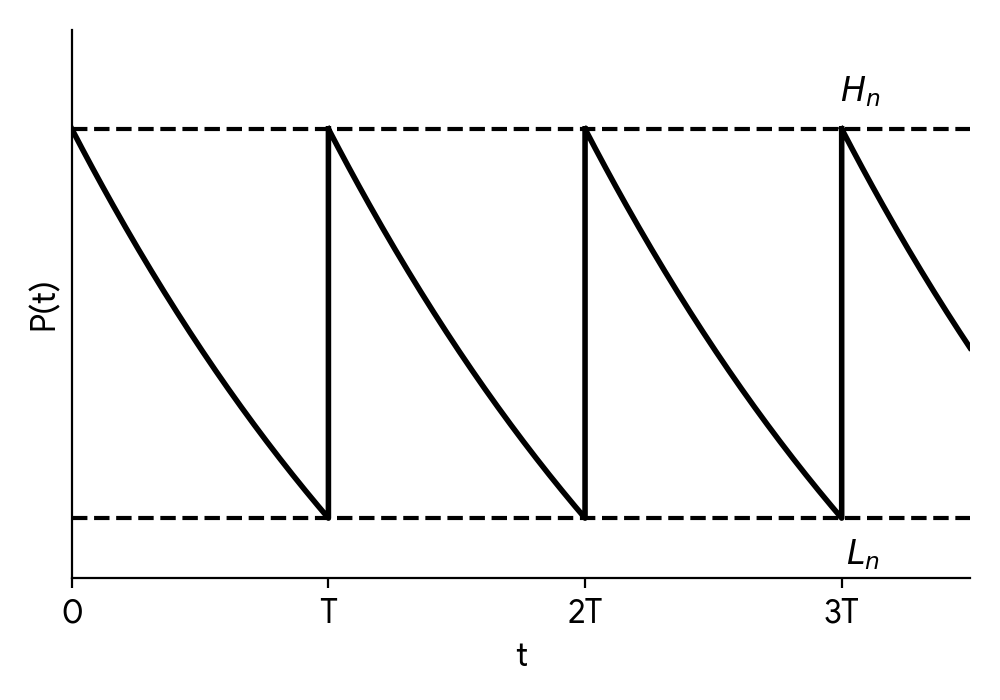
is defined as and is defined as .
Find, in terms of and , an expression for
.
.
Show that
.
.
It is known that this pollutant is considered safe if the long-term concentration never exceeds and ecologically effective if it never drops below .
Hence, for this pollutant, find a suitable value for
.
.
For the values of and found in part (g), find the proportion of time for which the concentration of the pollutant is at least between the first and second discharges.
Suggest a reason why the environmental regulations might specify a different value for to that found in part (g)(ii).
To solve the differential equation, separate the variables and . Integrate both sides and use the initial condition to find the constant of integration.
Set and solve for using the given value of .
Consider the contribution of each discharge to the total concentration immediately after the third discharge. The first discharge has decayed for hours, the second for hours, and the third has just been added.
Recognize the sum as a geometric series. Identify the first term, common ratio, and number of terms.
As , the term approaches 0. Use the formula from part (d) and consider the limit.
The lowest concentration in an interval occurs just before a new discharge. This is the highest concentration after it has decayed for one period .
Substitute the expressions for and found in part (e) and simplify.
Use the relationship or substitute the expressions for and directly into the logarithmic expression.
To satisfy both conditions, set and . Use the relationship .
Use the relationship with the values from part (g)(i) and .
The concentration starts at after the first discharge. Find the time when the concentration drops to within the interval . The proportion is .
Consider practical implications of the calculated value of for scheduling regular discharges or monitoring.
Question 3
MediumPaper 1 · calculator5 marksA specialized bouncy ball is dropped from a certain height. After the first bounce, it reaches a maximum height of meters. After each subsequent bounce, the maximum height it reaches is a constant fraction of the previous maximum height.
The first bounce reaches a height of 3 meters. The sum of all the maximum heights reached after each bounce (i.e., ) is 15 meters.
Find the common ratio, , for the sequence of maximum bounce heights.
Find the least value of such that the maximum height reached after the -th bounce, , is less than 0.1 meters.
Recall the formula for the sum of an infinite geometric sequence: .
Use the formula for the -th term of a geometric sequence, , and set up an inequality. Remember to use logarithms to solve for and be careful with the direction of the inequality when dividing by a negative logarithm.
Question 4
MediumPaper 1 · calculator5 marksA renowned architect designs a spiral staircase where the length of each step's outer edge forms a geometric sequence. The total theoretical length of all steps if the staircase were infinitely long is 12 meters. The first step's outer edge is 6 meters longer than the second step's outer edge.
Find the length of the third step's outer edge. Justify your answer.
Recall the formula for the sum of an infinite geometric sequence, , and the relationship between consecutive terms, . Set up a system of equations based on the given information and remember the condition for the sum to infinity to exist.
Question 5
MediumPaper 1 · calculator7 marksA specialized bouncy ball is dropped from a height of 16 meters. After the first bounce, it reaches a height of 8 meters. The height reached after each subsequent bounce is half of the height reached after the previous bounce.
(a) Calculate the height the ball reaches after its 4th bounce.
(b) Find the total vertical distance the ball has traveled upwards after 6 bounces.
(c) Determine the total vertical distance the ball travels from the moment it is dropped until it theoretically comes to rest.
Identify the first term and the common ratio of the geometric sequence representing the rebound heights. Then, use the formula for the n-th term of a geometric sequence, .
The total upward distance after 6 bounces is the sum of the first 6 terms of the geometric sequence of rebound heights. Use the formula for the sum of the first n terms of a geometric sequence, .
The total distance includes the initial drop height, plus the sum of all upward distances, and the sum of all downward distances after the initial drop. The sums of upward and downward distances (after the initial drop) are both infinite geometric series.
Question 6
MediumPaper 1 · calculator7 marks(a) A newly developed computational model processes information in a series of iterative steps. The amount of new information processed in each step forms a geometric sequence. If the total amount of information processed by the model over an infinite number of steps is three times the amount processed in the first step, calculate the common ratio of this sequence.
(b) In a different scenario for the same computational model, the total amount of information processed over an infinite number of steps is times the amount processed in the first step. Calculate the common ratio in this case.
(c) Determine whether it is possible for the total amount of information processed by the model over an infinite number of steps to be times the amount processed in the first step. Justify your answer.
Recall the formula for the sum to infinity of a geometric sequence, , where is the first term and is the common ratio. Set up an equation based on the given relationship between and .
Use the same sum to infinity formula as in part (a), but with the new relationship given. Remember that the common ratio can be negative as long as .
Calculate the common ratio that would result from this relationship. Then, consider the condition for the sum to infinity of a geometric sequence to exist.
Question 7
MediumPaper 2 · calculator11 marksA group of archaeologists is excavating an ancient site and finds a collection of eight inscribed clay tablets. Five of these tablets contain mythological tales (M) and three are historical records (H). Dr. Anya Sharma and Dr. Ben Carter decide to play a game: they take turns drawing a tablet from a bag, without replacement. The first person to draw a historical record tablet wins.
(a) Dr. Anya Sharma plays first. Find the probability that she wins.
The game is now changed so that the tablet chosen is replaced after each turn. Dr. Anya Sharma still plays first.
(b) Determine whether the probability of Dr. Anya Sharma winning has changed.
Consider all the possible turns on which Anya could win. Since tablets are not replaced, the probabilities change with each draw. List the sequence of draws for each winning scenario for Anya.
When tablets are replaced, the probability of drawing a historical record or mythological tale remains constant for each turn. This scenario can be modelled using an infinite geometric series.
Question 8
MediumPaper 1 · calculator10 marksA signal generator produces a sequence of complex voltage signals, , where is the signal number. The first signal is volts. Each subsequent signal is generated by multiplying the previous signal by a complex factor .
Write down the value of .
Write down the value of .
The engineering team claims that the sequence of signal magnitudes also forms a geometric sequence.
Show that this claim is correct, stating the exact value of the common ratio for this sequence.
Hence, find the sum of the infinite sequence of magnitudes .
To find the next term in a geometric sequence, multiply the current term by the common ratio. In this case, . Remember to perform complex number multiplication carefully.
Use the value of you found in part (a.i) and multiply it by the common ratio again to find . Remember .
Recall that for a geometric sequence , the modulus is . This implies that the sequence of moduli is also a geometric sequence with first term and common ratio . Calculate the modulus of the complex factor .
The sum of an infinite geometric sequence is given by the formula , where is the first term and is the common ratio. Ensure that the common ratio's magnitude is less than 1.
Question 9
MediumPaper 2 · calculator8 marksAn infinite geometric series has first term and second term , where is a real number and .
(a) Find the common ratio, , in terms of .
(b) Find the range of values of for which the sum to infinity of the series exists.
(c) Find the value of when .
The common ratio of a geometric series is found by dividing any term by its preceding term. In this case, calculate . Look for opportunities to simplify the algebraic expression.
The sum to infinity of a geometric series exists only if the absolute value of the common ratio is less than 1. Use your expression for from part (a) to set up an inequality, i.e., . Don't forget the initial condition given for .
Use the formula for the sum to infinity, . Substitute the given value for and the expressions for and in terms of . Then, solve the resulting equation for .
No question on this page matches those filters. Try another difficulty or paper.
Every Sum of infinite geometric sequences question, marked for you
Every answer is marked mark by mark, IB-style, and the AI tutor helps when you are stuck.
Where marks are lost
- Using your own wrong value after failing a "show that." All follow through is withdrawn for the rest of that question.