Power rule: notes and practice questions
- Differentiation is the process of finding the gradient function.
- The Power Rule applies to functions where is raised to any rational power.
- If , then .
- If , then .
- If (where is a constant), then .
- Differentiate expressions that are sums or differences of powers of term by term.
- Before differentiating: Rewrite all terms strictly as powers of .
- Rewrite roots as fractional powers (e.g., ).
- Rewrite terms with in the denominator as negative powers (e.g., ).
- Expand products and quotients into a sum or difference of powers before applying the rule.
- To differentiate a term: Multiply the front coefficient by the current power, then subtract 1 from the power.
- Simplify the resulting derivative, optionally rewriting negative exponents as fractions.
- Use a GDC to verify analytical derivatives by plotting the original function and its derivative (e.g., turning points of original align with x-intercepts of derivative).
- The power rule for all rational indices is standard for both IB SL and HL (Topic 5.1).
- Common Pitfall: Always expand products/quotients before differentiating; do not differentiate terms within unexpanded brackets separately.
- Common Pitfall: When subtracting 1 from a negative power, ensure correct arithmetic (e.g., ).
- Common Pitfall: Remember that standalone constant terms differentiate to 0.
How it is examined
The only differentiation rule an SL student has, which sharply limits what an SL calculus question can look like. Writing as before differentiating is the step students miss. Anything needing a chain rule, a product, a quotient, or a fractional power is HL.
The power rule.
- The derivative of , which is , .
- The derivative of functions of the form where all exponents are integers.
Linking questions
- TOK: the seemingly abstract concept of calculus allows us to create mathematical models that permit human feats such as getting a man on the Moon. What does that tell us about the links between mathematical models and reality?
Practice questions
51 questions · 1 easy · 42 medium · 8 hardQuestion 1
EasyPaper 1 · calculator2 marksFind the derivative of the function
You should use the power rule in the formula booklet
Question 2
MediumPaper 1 · calculator6 marksA company is designing a closed cylindrical container to hold a specific volume of liquid. The total surface area of the container, in cm, with a fixed volume of cm and a radius of cm, is given by the function , where .
Find .
Solve .
Interpret your answer to (b)(i) in context.
Recall the power rule for differentiation. You may find it helpful to rewrite the term using a negative exponent before differentiating.
Set the derivative you found in part (a) equal to zero and solve for . Remember that .
Consider what setting the derivative to zero tells you about the original function, and relate it back to the problem of designing the container.
Question 3
HardPaper 1 · calculator10 marksThe concentration of a reactant A, in mg/L, in a chemical reaction over time (in minutes) is modelled by the function:
, for .
(a) Find the coordinates of the local minimum point of the concentration.
(b) Find the coordinates of the local maximum point of the concentration.
(c) Find the set of values of for which the concentration of reactant A is above mg/L.
To find local minimum points, you need to find the first derivative of the function, set it to zero to find critical points, and then use the second derivative test or analyze the sign change of the first derivative to classify them.
Refer to the critical points found in part (a). Use the second derivative test to determine which critical point corresponds to a local maximum.
Set up an inequality . Simplify the inequality and factorize the resulting cubic expression. Then, consider the sign of the cubic function within the given domain.
Question 4
MediumPaper 1 · calculator7 marksThe height of a section of a roller coaster track, in metres, can be modelled by the function , where is the horizontal distance in metres from a central point.
(a) Find an expression for the gradient function of the track, .
(b) At a specific point on the track, where , a support beam L is tangent to the track. The coordinates of this point are .
Use your answer to part (a) to find the gradient of the support beam L.
(c) Determine the number of other points on the track where the tangent line is parallel to the support beam L. Justify your answer.
Remember the power rule for differentiation: . Apply it to each term of the function.
The gradient of the tangent line at a point is given by the value of the derivative at that point.
Parallel lines have the same gradient. Set your derivative equal to the gradient found in part (b) and solve for . Remember to exclude the original point.
Question 5
HardPaper 2 · calculator15 marks(a) A pharmaceutical company is designing a new cylindrical container for a special liquid. The container has a fixed volume .
The radius of the container is and the height is .
Show that .
(b) Find an expression for the total surface area of the container.
(c) Substitute an expression for (from part (a) ) into your expression for (from part (b) ) and hence show that .
(d) Find .
(e) Find the minimum value of and the values of and when this occurs. Show that this value of is indeed a minimum.
Recall the formula for the volume of a cylinder. Substitute the given volume into this formula.
The total surface area of a cylinder consists of the area of the two circular bases and the area of the curved side.
From part (a), isolate . Then substitute this expression for into the formula for from part (b). Simplify the resulting expression.
Differentiate the expression for with respect to . Remember that can be written as .
To find the minimum value, set and solve for . Then use this value of to find and . To show it's a minimum, use the second derivative test.
Question 6
MediumPaper 1 · calculator7 marksA designer is creating a decorative curve for a new architectural feature. The profile of the curve can be modelled by the function , for .
(a) Find .
(b) The designer wants to place a support beam perpendicular to the curve at the point where . Given that the point on the curve is , find the equation of the normal to the curve at this point, in the form , where .
Recall the power rule for differentiation. For a term like , rewrite it using a negative exponent before differentiating.
First, find the gradient of the tangent at using . Then, determine the gradient of the normal, which is the negative reciprocal of the tangent's gradient. Finally, use the point-slope form of a line.
Question 7
HardPaper 2 · calculator15 marksA drone is launched vertically upwards from a platform. Its vertical velocity, , at time seconds, is given by the function:
, for .
Find the times when the drone is momentarily at rest.
Find the magnitude of the drone's vertical acceleration at seconds.
Find the greatest speed of the drone in the interval .
The drone starts from an initial height of metres above the ground. Find an expression for the height of the drone, metres, above the ground at time seconds.
Find the total distance travelled by the drone in the interval .
The drone is momentarily at rest when its vertical velocity is zero. Set the velocity function equal to zero and solve for .
Acceleration is the derivative of velocity with respect to time, . Differentiate the given velocity function and then substitute . Remember to find the magnitude.
Speed is the magnitude of velocity, . The greatest speed can occur at the endpoints of the interval or at a critical point where acceleration is zero. Evaluate at these points and find the maximum absolute value.
Height is the integral of velocity with respect to time, . Use the initial condition to find the constant of integration.
Total distance travelled is the integral of the speed, . Remember that velocity can change sign, so you might need to split the integral at points where . The roots of are and .
Question 8
MediumPaper 1 · calculator7 marksThe power output , in watts (W), of a solar panel is modelled by the equation
where is the angle of inclination of the panel to the sun in degrees. Find an expression for .
At a particular moment, the solar panel is inclined at an angle of 30 degrees, and this angle is increasing at a rate of 2 degrees per minute.
Find the rate of change of the power output at this time.
Remember the power rule for differentiation: .
Use the chain rule: .
Question 9
HardPaper 2 · calculator19 marksA tech company, 'CaseCrafters', designs and sells custom phone cases. Their market research suggests that the average number of cases they will sell each month is modelled by the equation
where represents the number of cases sold and represents the selling price, in USD, of each case.
The marketing team proposes selling the cases for USD each.
Find the average number of phone cases that this model predicts CaseCrafters will sell at this price.
Calculate CaseCrafters' average monthly income, before any expenses, at this selling price.
Hence, write down the function that can be used to predict CaseCrafters' average monthly income, before expenses, at any selling price, .
CaseCrafters has USD of fixed monthly operational costs. Additionally, CaseCrafters must pay their supplier USD for each phone case.
Calculate CaseCrafters' average monthly profit if they sell each case at a price of USD.
Show that the average monthly profit for any selling price, , can be found using the function .
Find .
Show that the marketing team's selling price of USD does not maximize their average monthly profit.
CaseCrafters negotiates a new deal with their supplier. Under the new deal, the supplier agrees to discount the cost of each case based on the number of cases purchased by CaseCrafters. The cost charged by the supplier for each case can be found using the function
where represents the number of cases sold by CaseCrafters.
Find the function that can be used to find CaseCrafters' average monthly profit using the new deal from the supplier.
Hence, find the selling price, per case, that CaseCrafters should choose in order to maximize their average monthly profit under the new deal.
Substitute the given selling price into the demand function to find the number of cases sold.
Monthly income (revenue) is calculated by multiplying the selling price per case by the number of cases sold. Use your answer from part (a).
The revenue function is the product of the selling price and the number of cases sold . Substitute the expression for in terms of into .
Profit is Revenue minus Total Costs. Total Costs include fixed costs and variable costs. Variable costs are the cost per case multiplied by the number of cases sold. Use your answer from part (a) for the number of cases sold and part (b) for revenue.
Profit is Revenue minus Total Costs . Total Costs are fixed costs plus variable costs, where variable costs are the cost per case multiplied by the number of cases , and is expressed in terms of .
Differentiate the profit function with respect to . Remember the power rule for differentiation.
To maximize profit, should be equal to zero. You can either find the value that makes and compare it to , or evaluate and show it's not zero.
First, express the supplier cost per case, , in terms of by substituting . Then, the total variable cost will be . Finally, construct the new profit function .
To maximize profit, find the derivative of the new profit function from part (g), set it to zero, and solve for .
Question 10
MediumPaper 1 · calculator7 marksA company is designing a new cylindrical storage tank. The cost of manufacturing, in thousands of dollars, is modelled by the function , where is the radius of the tank in metres, and .
(a) Write down the equation of the vertical asymptote of .
(b) Find .
(c) Determine the interval in which is decreasing.
Consider the values of for which the function would become undefined or approach infinity.
Recall the power rule for differentiation. Rewrite as before differentiating.
To find where the function is decreasing, you need to find where its derivative, , is negative. Start by finding the critical points where .
Question 11
HardPaper 2 · calculator28 marks(a) (i) Consider the function . Find .
(ii) The first section of the stone wall's profile is given by for . A straight glass panel is to be installed tangent to this section of the wall at the point where . Find the equation of this tangent line.
The full profile of the stone wall, , is defined by:
A smaller, decorative stone insert is designed using a transformation of . The graph of is obtained from the graph of by:
- a stretch scale factor of in the direction,
- followed by a stretch scale factor of in the direction,
- followed by a translation of units to the right.
Point P lies on the graph of and has coordinates . Point Q is the image of P under the given transformations and has coordinates .
Find the value of and the value of .
The piecewise function is given by
(c) Find
(i) an expression for .
(ii) the value of .
(iii) the value of .
(d) (i) Calculate the total area of the profile of the stone wall, enclosed by , the -axis, and the line .
The decorative insert is placed within the main wall profile . The region of the main wall profile that is not covered by the insert is to be painted a contrasting colour. This region is bounded by , the -axis, and the lines and , excluding the area under from to . Find the area of this region.
Recall the power rule for differentiation: if , then .
First, find the y-coordinate of the point of tangency. Then, use the derivative from part (a)(i) to find the gradient of the tangent at that point. Finally, use the point-slope form of a linear equation, .
Apply each transformation step-by-step to the coordinates of point P. Remember that a stretch in the x-direction affects the x-coordinate, a stretch in the y-direction affects the y-coordinate, and a translation shifts the point.
To transform a function :
- Stretch by scale factor in -direction: replace with .
- Stretch by scale factor in -direction: replace with (or multiply by ).
- Translate units to the right: replace with .
Combine these transformations to find in terms of , then substitute the expression for the first part of .
The value is the new boundary point for the piecewise function . This corresponds to the original boundary point in after the x-transformations have been applied.
Substitute the second part of (the linear function) into the general transformation equation for derived in part (c)(i). Simplify the expression to find the constant term .
The function is piecewise. You will need to calculate two separate definite integrals and sum their results. The first integral will be for from to , and the second for from to .
The region to be painted consists of two parts: the area under from to , and the area between and from to . You have already calculated some of these areas in previous parts.
Question 12
MediumPaper 1 · calculator10 marksA company models the profit from a new product launch using the function , where is the profit in thousands of dollars and is the time in months since launch.
Find .
Find .
The company observes that the rate of change of profit growth begins to slow down after a certain point, indicating a point of inflexion. Find the time, , in months at which this point of inflexion occurs.
Remember to use the product rule for differentiation. Let and .
Differentiate the expression for obtained in part (a.i). You will need to apply the product rule again for the term involving .
A point of inflexion occurs where the second derivative is equal to zero. Set and solve for .
Question 13
HardPaper 2 · calculator24 marksA landscape architect is designing a new public park. The northern boundary of the park is modelled by the function , and other boundaries are straight lines. The plan view of the park is shown in the following diagram, where both axes represent distance and are measured in metres.
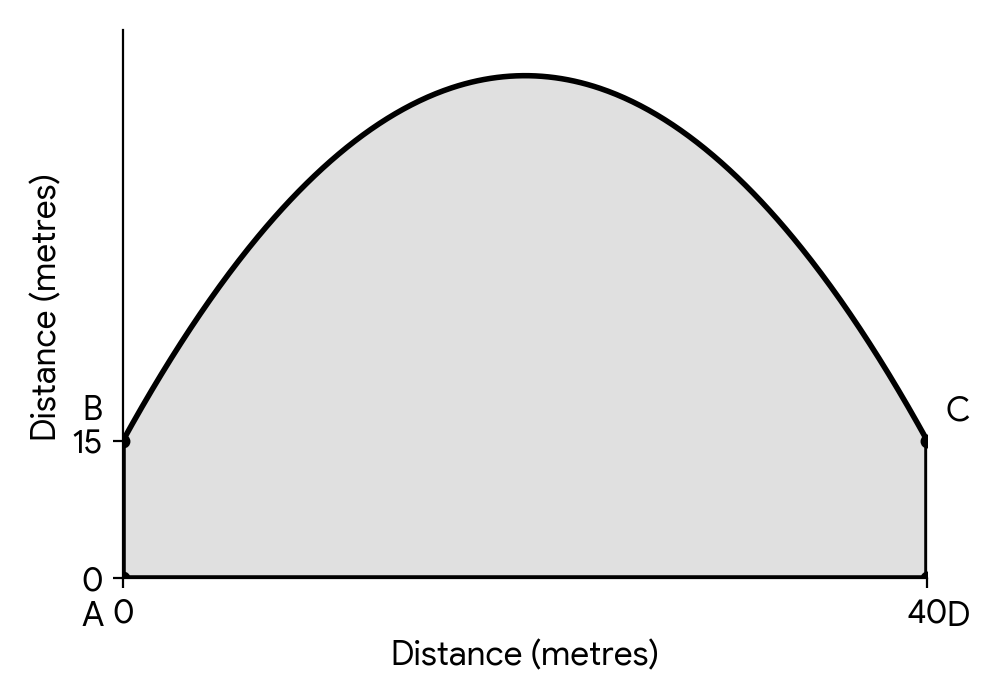
The function models the northern boundary of the park between points B and C and is given by
, for .
(i) Find .
(ii) Hence find the coordinates of the point on the park's northern boundary that is furthest north.
Point A has coordinates , point B has coordinates , point C has coordinates and point D has coordinates .
(i) Write down the integral which can be used to find the area of the shaded region representing the park.
(ii) Find the area of the park.
(i) A landscaper uses the trapezoidal rule with 4 intervals to estimate the area of the park. Calculate this estimate.
(ii) Calculate the percentage error in the landscaper's estimate.
(iii) Suggest how the landscaper might be able to reduce the error whilst still using the trapezoidal rule.
A square-shaped meditation garden, PQRS, is to be built within the park. The side [PS] lies on the southern boundary (x-axis), and the side [QR] lies on the eastern boundary of the park (). Point Q lies on the northern boundary curve .
(i) Find the x-coordinate of point P for the largest area of the meditation garden.
(ii) Find the largest area of the meditation garden.
Recall the power rule for differentiation: if , then . The derivative of a constant term is zero.
The point furthest north corresponds to the maximum value of . To find this, set the derivative to zero and solve for . Then substitute this -value back into to find the corresponding -coordinate.
The area under a curve from to is given by the definite integral . Identify the function and the limits of integration from the problem description.
Evaluate the definite integral you wrote down in part (b)(i). Use your GDC for calculation if allowed, or integrate term by term.
The trapezoidal rule formula is , where . For 4 intervals over , . Calculate at .
Percentage error is given by . Use the exact area from part (b)(ii) and the estimate from part (c)(i).
Consider how the number of intervals affects the accuracy of numerical integration methods like the trapezoidal rule.
Let the x-coordinate of P be . The side length of the square will be . Since Q lies on , its y-coordinate is . For a square, the side length must equal the height, so equate to and solve for . Remember that must be within the park's boundaries.
Once you have the x-coordinate of P, calculate the side length of the square using . Then square this side length to find the area.
Question 14
MediumPaper 1 · calculator6 marksA company's daily production cost, , in thousands of dollars, for producing units of a specialized component, is modelled by the function , for .
Write down the equation of the vertical asymptote of .
Find , the marginal cost function.
Determine the interval for where the production cost is increasing.
Consider the values of for which the function becomes undefined.
Recall the power rule for differentiation: . Remember that .
The function is increasing when its derivative is positive. Set and solve for . Remember the domain .
Question 15
HardPaper 2 · calculator23 marks(a) A confectionery company is designing a new wrapper for a chocolate bar. The wrapper is in the shape of a rectangular prism with a square base of side length cm. The height, cm, is twice the side length of the base.
Write down an expression for in terms of .
(b) The chocolate bar has a volume of cm.
Find the value of and .
(c) Calculate the total external surface area of this rectangular prism wrapper.
(d) The company also considers a cylindrical wrapper with radius cm and height cm. This wrapper must also hold cm of chocolate.
Find an expression for the height, , of the cylindrical wrapper in terms of .
(e) Let the total external surface area of the cylindrical wrapper be cm.
Show that .
(f) Find .
(g.i) Hence or otherwise, find the value of that will minimize .
(g.ii) Find the minimum value of for the cylindrical wrapper.
(h) To account for manufacturing waste and overlap, an additional of the calculated surface area is required for the rectangular prism wrapper, and for the cylindrical wrapper.
Determine which wrapper design the company should choose to minimize material usage. Justify your answer.
The question states a direct relationship between the height and the side length of the square base.
The volume of a rectangular prism is given by the area of the base multiplied by the height. Use the expression from part (a) to relate the height to the base side length.
The total surface area of a rectangular prism with a square base is the sum of the areas of the two square bases and the four rectangular sides. Use the values of and found in part (b).
The volume of a cylinder is given by . Use the given volume to express in terms of .
The total surface area of a cylinder is . Substitute the expression for from part (d) into this formula.
Differentiate the expression for with respect to . Remember that and .
To find the minimum value of , set the derivative to zero and solve for . Alternatively, you can use a GDC to find the minimum point of the function or the root of .
Substitute the value of found in part (g.i) into the surface area formula .
Calculate the total material needed for each wrapper type by adding the respective percentage increases to their surface areas. Then compare the two total amounts.
Question 16
MediumPaper 1 · calculator9 marksA spherical ice sculpture is melting in a gallery. Initially, the sculpture has a radius of 30 cm. This information is illustrated in the following diagram.
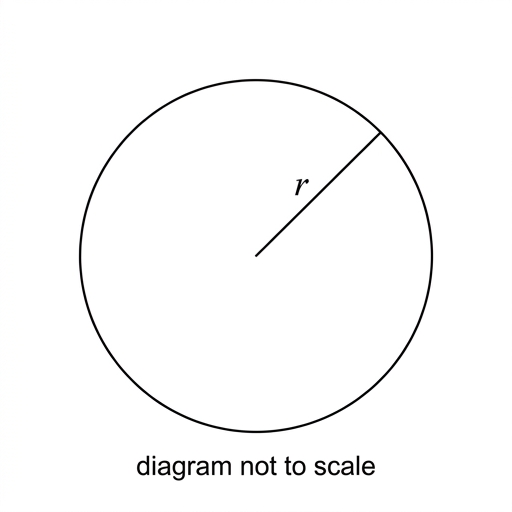
The gallery curator predicts that, as the ice sculpture melts, its radius will decrease at a constant rate of 0.5 cm per hour.
According to this model, find
(i) the radius of the ice sculpture, 10 hours after it begins melting.
(ii) the volume of the ice sculpture, 10 hours after it begins melting. Give your answer to one decimal place.
Let the function represent the volume of the ice sculpture, , hours after it begins melting. is given by
, for .
Find .
Find the rate of change of the volume of the ice sculpture at hours.
State one reason why the radius of the ice sculpture may not always decrease at a constant rate.
To find the new radius, subtract the total decrease in radius from the initial radius. The total decrease is the rate of decrease multiplied by the time elapsed.
Recall the formula for the volume of a sphere: . Use the radius calculated in part (a.i).
Apply the power rule for differentiation to each term of the polynomial function.
The rate of change of volume is given by the derivative . Substitute into your expression for from part (b).
Consider real-world factors that might influence the melting process of an ice sculpture, such as environmental conditions or the sculpture's changing shape.
Question 17
HardPaper 2 · calculator20 marks(a) SweetTreats is designing new packaging for a line of artisanal chocolates. The initial design is a box in the shape of a cuboid with a square base of side length cm. Its height, cm, is twice the length of the base.
Write down an expression for in terms of .
(b) The box is designed to hold cm of chocolates.
Find the value of and .
(c) Calculate the total external surface area of the box.
(d) To minimize the amount of material needed, SweetTreats is considering changing the shape to a cylinder with radius cm and height cm. The cylindrical container must also hold cm of chocolates.
Find an expression for the height, , of the container in terms of .
(e) Let the total external surface area of the cylindrical container be cm.
Show that .
(f) Find .
(g.i) Hence or otherwise, find the value of that will minimize .
(g.ii) Find the minimum value of needed for the cylinder.
(h.i) Find .
(h.ii) Hence determine whether the graph of is concave-up or concave-down for . Justify your answer.
The question states a direct relationship between the height and the base length . Express this relationship mathematically.
The volume of a cuboid is given by base area multiplied by height. Use the expression from part (a) to relate the volume to only, then solve for . Once is found, calculate .
The total external surface area of a cuboid with a square base consists of two square bases and four rectangular sides. Use the dimensions found in part (b).
Recall the formula for the volume of a cylinder. Use the given volume to express in terms of .
The total surface area of a cylinder is the sum of the areas of the two circular bases and the curved surface area. Substitute the expression for from part (d) into the surface area formula.
Differentiate the expression for with respect to . Remember that can be written as .
To find the minimum value of , set its derivative to zero and solve for . You may need a GDC for the final calculation.
Substitute the value of found in part (g.i) back into the expression for from part (e).
Differentiate with respect to .
The sign of the second derivative determines concavity. If , the graph is concave-up. If , it's concave-down.
Question 18
MediumPaper 1 · calculator9 marksA landscape architect is designing a walking path in a new park. The path consists of three segments. The first segment is a straight path connecting point A(0, 0) to point B(2, 4).
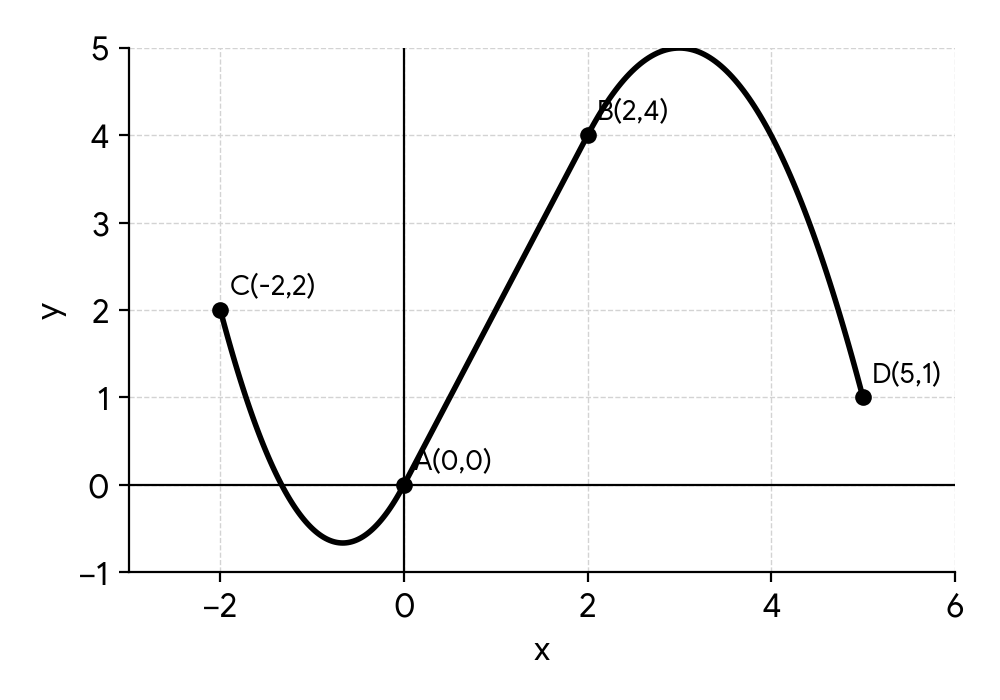
Write down the equation of the line segment for .
A curved section of the path, modeled by a quadratic function, connects point C(-2, 2) to point A(0, 0). At point A(0, 0), the curve has the same gradient as the straight path segment AB.
Find the equation of the curve between (-2, 2) and (0, 0).
The second curved section of the path, also modeled by a quadratic function, connects point B(2, 4) to point D(5, 1). At point B(2, 4), the curve has the same gradient as the straight path segment AB.
Find the equation of this curve.
Write down the equation of the entire walking path as a piecewise function, .
Recall the formula for the equation of a straight line given two points. The gradient can be found using the coordinates of points A and B.
Assume the quadratic equation is of the form . Use the given points and the gradient condition at (0,0) to set up and solve a system of equations for a, b, and c.
Similar to part (b), use the general quadratic form . You have two points and one gradient condition, which will lead to a system of three linear equations in a, b, and c.
Combine the equations from parts (a), (b), and (c), specifying the correct domain for each segment.
Question 19
MediumPaper 1 · calculator7 marksA civil engineer is designing a parabolic arch for a new bridge. The cross-section of the arch can be modelled by the curve . The arch passes through the point P(1, -2). At this point, the gradient of the normal to the curve is .
Calculate the value of and the value of .
First, find the gradient of the tangent at point P. Then, use the point and the original equation to form one linear equation, and use the point and the derivative to form a second linear equation. Solve these two equations simultaneously.
Question 20
MediumPaper 1 · calculator7 marks12. [Maximum mark: 7]
The path of a small drone flying over a landscape can be modelled by the curve with equation , where is the horizontal distance in meters from a reference point and is the altitude in meters.
(a) Find .
(b) Write down the gradient of the path when the drone is at a horizontal distance of meters.
(c) Hence, find the equation of the normal to the drone's path at .
Remember to rewrite as before differentiating using the power rule.
Substitute the given value into your derivative from part (a).
The normal line is perpendicular to the tangent line. If the gradient of the tangent is , the gradient of the normal is . You'll also need the -coordinate of the point on the curve.
No question on this page matches those filters. Try another difficulty or paper.
31 more Power rule questions in the app
Every answer is marked mark by mark, IB-style, and the AI tutor helps when you are stuck.
Where marks are lost
- Using your own wrong value after failing a "show that." All follow through is withdrawn for the rest of that question.
- Leaving an answer in calculator notation. Never accepted in a final answer, and AI's constant calculator use makes this the easiest slip in the whole subject.