Max / min points and solving f’(x)=0: notes and practice questions
- Stationary points: points on a curve where the gradient is zero ( or ).
- Turning points: stationary points where the curve changes direction.
- Local maximum: a turning point where the gradient changes from positive to negative.
- Local minimum: a turning point where the gradient changes from negative to positive.
- Point of inflection: a stationary point where the gradient is zero but the curve does not change direction.
- Modelling: use differentiation to find maximum or minimum values of real-world quantities.
- Steps to find and classify stationary points algebraically:
- Differentiate the function to find .
- Set and solve for the x-coordinate(s).
- Substitute x-values into the original function to find the y-coordinate(s).
- Determine the nature (max/min) using a GDC, the first derivative test, or the second derivative test (HL).
- Second derivative test (HL only) for determining the nature of a stationary point:
- If , the point is a local minimum.
- If , the point is a local maximum.
- GDC usage:
- Use the equation solver to find roots of .
- Use the built-in max/min feature on the graph of .
- Always use GDC to check work, unless an algebraic method is explicitly required.
- SL/HL distinctions:
- Finding max/min using is covered in both SL and HL.
- The second derivative test () and formal identification of points of inflection are HL only.
- Exam tips:
- "Classify turning points" means to state whether they are local maximums or local minimums.
- Substitute x-coordinates into the original function (not ) to find y-coordinates.
- For "show that" modelling questions, clearly show all algebraic substitution steps.
How it is examined
The local against global distinction is a stated understanding, so a question can give a restricted domain and ask for the greatest value, where the answer is at an endpoint rather than at the stationary point. At SL the nature of the point is justified from the graph or from the sign of either side, never from .
- Values of where the gradient of a curve is zero.
- The solution of .
- Local maximum and minimum points.
Linking questions
- Other contexts: profit, area, volume, cost.
- Links to other subjects: displacement-time and velocity-time graphs, and simple harmonic motion graphs (physics).
- TOK: is it possible for an area of knowledge to describe the world without transforming it?
Practice questions
60 questions · 38 medium · 22 hardQuestion 1
MediumPaper 1 · calculator5 marksThe diagram shows the slope field for the differential equation for and .
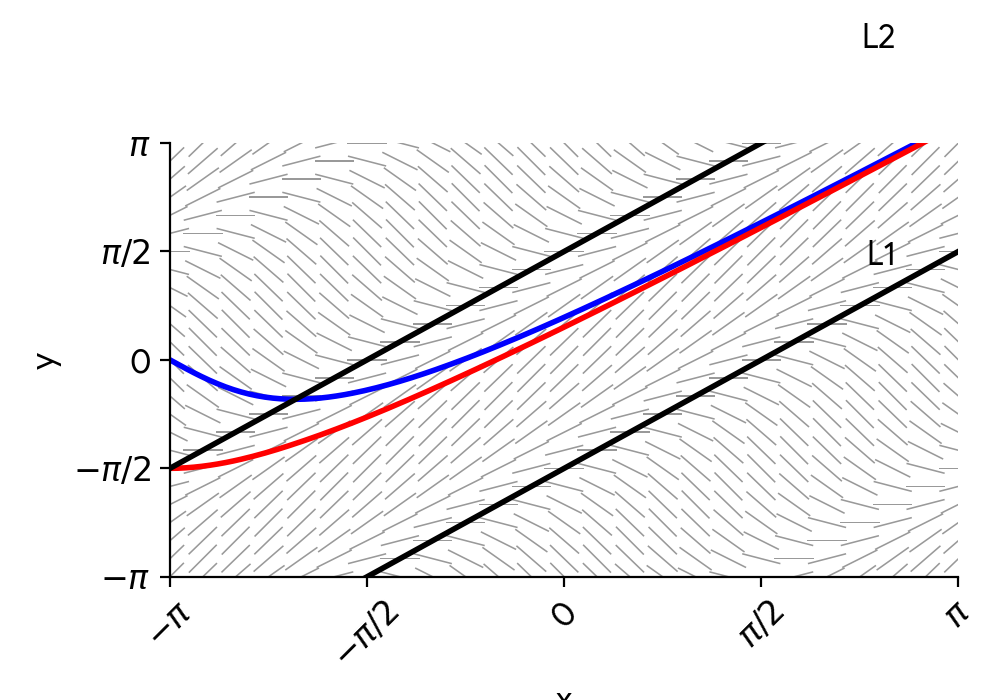
The local maximum points for solutions to the differential equation lie on the straight line .
Find the equation of , giving your answer in the form .
Find the equation of the straight line on which all local minimum points lie within the given domain, giving your answer in the form .
To find local maximum points, you need to find where and then use the second derivative test or analyze the sign change of . Remember to consider the domain for and .
Similar to part (a), but consider the condition for local minimum points. What must be the sign of the second derivative?
Question 2
HardPaper 1 · calculator10 marksA group of engineers is designing a new observation Ferris wheel. The height, , in metres, of a passenger capsule above the ground is modelled by the function , where is the time in seconds after the capsule begins its ascent from the highest point.
The lowest point a capsule reaches is 2 metres above the ground, and the highest point is 32 metres above the ground. The Ferris wheel completes one full rotation in 200 seconds.
Find the values of and .
Using your values from part (a), the function is .
(i) Find .
(ii) Find .
The engineers are particularly interested in the moment when the capsule's vertical speed is at its maximum, for the first time after . This occurs at time .
Calculate the value of .
Calculate the height of the capsule at this time .
The amplitude of a sinusoidal function is half the difference between its maximum and minimum values. The vertical shift (midline) is the average of the maximum and minimum values. Consider the starting point () to determine the sign of .
Remember the chain rule for differentiation. For , the derivative is . The derivative of is .
The vertical speed is given by . To find when the speed is maximum, you need to find the maximum value of . This occurs when or at the endpoints of the domain. Consider the range of the sine function.
Substitute the value of you found in part (c.i) into the original height function .
Question 3
MediumPaper 1 · calculator6 marksA company is designing a closed cylindrical container to hold a specific volume of liquid. The total surface area of the container, in cm, with a fixed volume of cm and a radius of cm, is given by the function , where .
Find .
Solve .
Interpret your answer to (b)(i) in context.
Recall the power rule for differentiation. You may find it helpful to rewrite the term using a negative exponent before differentiating.
Set the derivative you found in part (a) equal to zero and solve for . Remember that .
Consider what setting the derivative to zero tells you about the original function, and relate it back to the problem of designing the container.
Question 4
HardPaper 2 · calculator13 marks(a) The position of a reconnaissance drone, relative to a control tower, is given by the vector equation , where is the position vector in metres and is the time in minutes.
Write down the position vector of the drone when and when .
(b) Calculate the speed of the drone.
(c) Find an expression for the distance of the drone from the origin at time .
(d) Hence find the minimum distance of the drone from the origin and the time at which it occurs.
Substitute the given values of into the vector equation to find the corresponding position vectors.
The velocity vector is the direction vector in the position equation. The speed is the magnitude of the velocity vector.
First, write the position vector in terms of its components at time . Then, use the distance formula from the origin, which is the magnitude of the position vector.
To minimize the distance, you can minimize the square of the distance. This will result in a quadratic function. You can find the minimum of a quadratic function by taking its derivative and setting it to zero, or by using the formula for the vertex of a parabola.
Question 5
MediumPaper 1 · calculator9 marksA landscape architect is designing a modular planter box for a new urban garden. The planter box has a base and top that are identical sectors of a circle, each with radius cm and angle radians. The height of the planter box is cm. The total length of metal frame used for all edges of the planter box is cm. This includes two circular arcs, four radial edges for the top and bottom sectors, and three vertical connecting edges.
(a) Show that .
(b) The planter box is designed to hold soil, enclosing a volume, .
(i) Find an expression for in terms of .
(ii) Find the expression for .
(iii) Solve algebraically to find the value of that will maximize the volume, .
Carefully identify all the edges that contribute to the total length of the metal frame. Remember the formula for the arc length of a sector.
Recall the formula for the area of a circular sector and how it relates to the volume of a prism.
Remember to use the quotient rule for differentiation, or rewrite the expression using a negative exponent and apply the product rule.
To maximize a function, you typically find where its derivative is equal to zero.
Question 6
HardPaper 1 · calculator10 marksThe concentration of a reactant A, in mg/L, in a chemical reaction over time (in minutes) is modelled by the function:
, for .
(a) Find the coordinates of the local minimum point of the concentration.
(b) Find the coordinates of the local maximum point of the concentration.
(c) Find the set of values of for which the concentration of reactant A is above mg/L.
To find local minimum points, you need to find the first derivative of the function, set it to zero to find critical points, and then use the second derivative test or analyze the sign change of the first derivative to classify them.
Refer to the critical points found in part (a). Use the second derivative test to determine which critical point corresponds to a local maximum.
Set up an inequality . Simplify the inequality and factorize the resulting cubic expression. Then, consider the sign of the cubic function within the given domain.
Question 7
MediumPaper 1 · calculator7 marksA company is designing a new cylindrical storage tank. The cost of manufacturing, in thousands of dollars, is modelled by the function , where is the radius of the tank in metres, and .
(a) Write down the equation of the vertical asymptote of .
(b) Find .
(c) Determine the interval in which is decreasing.
Consider the values of for which the function would become undefined or approach infinity.
Recall the power rule for differentiation. Rewrite as before differentiating.
To find where the function is decreasing, you need to find where its derivative, , is negative. Start by finding the critical points where .
Question 8
HardPaper 2 · calculator22 marksThe concentration of a certain chemical, , in a solution over a period of time can be modelled using the function , where is the time in hours after the experiment begins.
Sketch the graph of for .
Find the concentration after hours.
Find the concentration after hours.
Find the maximum concentration and the time in hours at which this occurs.
Find the minimum concentration and the time in hours at which this occurs.
Find the times in hours when the concentration is mol/L.
Use your GDC to plot the function. Ensure your graph shows the correct domain and key features like intercepts and turning points.
Substitute into the given function .
Substitute into the given function .
To find the maximum concentration, you need to find the derivative of , set it to zero, and solve for . Then, evaluate at these critical points and the endpoints of the domain. Alternatively, use the 'maximum' function on your GDC.
Consider the values of at the critical points found in part (d) and at the endpoints of the domain ( and ). Alternatively, use the 'minimum' function on your GDC.
Set and solve the resulting cubic equation for . Use your GDC's solver or intersection feature.
Question 9
MediumPaper 1 · calculator5 marksA slope field for the differential equation is shown.
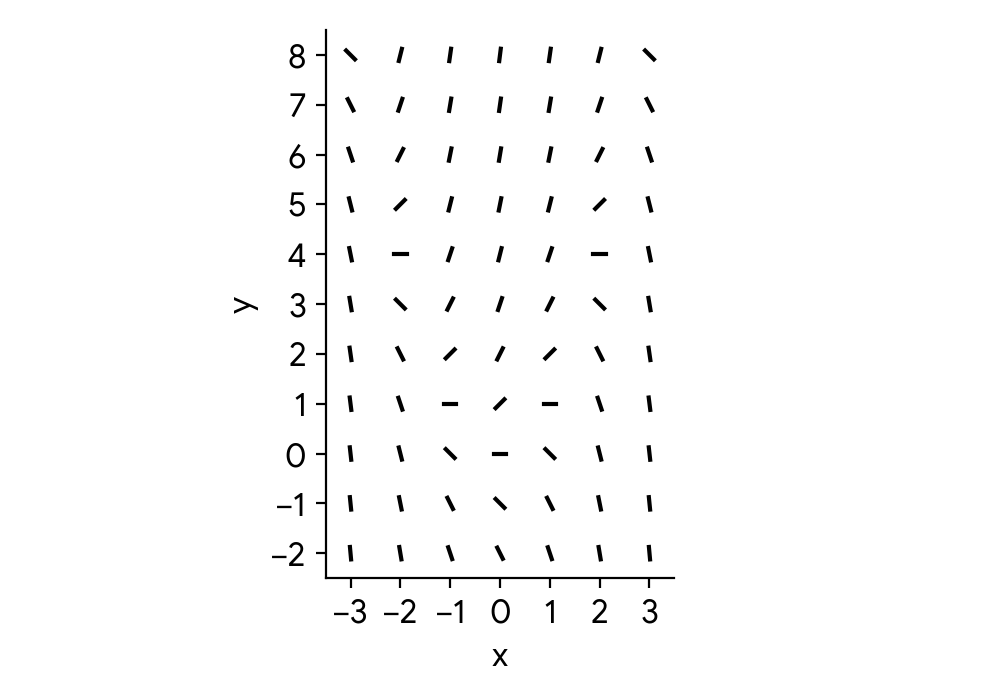
Some of the solutions to the differential equation have a local maximum point and a local minimum point.
Write down the equation of the curve on which all these maximum and minimum points lie.
Sketch this curve on the slope field.
The solution to the differential equation that passes through the point (0, 1) has both a local maximum point and a local minimum point.
On the slope field, sketch the solution to the differential equation that passes through (0, 1).
Recall that local maximum or minimum points occur where the derivative is equal to zero. Set the given differential equation to zero and solve for y in terms of x.
Plot a few points for the curve , such as (0,0), (1,1), (-1,1), (2,4), (-2,4), and then draw a smooth parabola through them on the provided slope field.
Start at the point (0, 1) and follow the direction of the slope lines. Remember that local maximum and minimum points must lie on the curve that you sketched in part (a.ii).
Question 10
HardPaper 2 · calculator14 marksA drone launches a package, and its trajectory is modelled by the equation , where is the height of the package in metres and is the horizontal distance in metres from the launch point.
On paper, sketch the graph of the path that the package flies for . Clearly indicate the initial height, the maximum height, and the horizontal distance when it lands.
Find the height of the package when it has travelled a horizontal distance of metres.
Find the maximum height of the package.
Find the horizontal distance at which the package lands on the ground, and explain what this value represents in the context of the problem.
Identify the initial height (when ), the maximum height (vertex), and the point where the package lands (where ). Remember the general shape of a quadratic function with a negative leading coefficient.
Substitute the given horizontal distance into the function .
The maximum height of a quadratic function occurs at the vertex, where . Once you find this -value, substitute it back into the function to find the maximum height.
The package lands on the ground when its height is zero. Set and solve the quadratic equation for . Remember that horizontal distance must be positive.
Question 11
MediumPaper 1 · calculator6 marksA company's daily production cost, , in thousands of dollars, for producing units of a specialized component, is modelled by the function , for .
Write down the equation of the vertical asymptote of .
Find , the marginal cost function.
Determine the interval for where the production cost is increasing.
Consider the values of for which the function becomes undefined.
Recall the power rule for differentiation: . Remember that .
The function is increasing when its derivative is positive. Set and solve for . Remember the domain .
Question 12
HardPaper 1 · calculator9 marksThe number of visitors (in hundreds) to a new eco-tourism resort months after its opening is modelled by the function .
Sketch the graph of against for the first months, clearly indicating any intercepts and local extrema within this domain.
Find the maximum number of visitors (to the nearest whole number) during the first months.
Find the time(s) when the number of visitors is above . Give your answer in months, correct to two decimal places.
To sketch the graph, identify the -intercept by evaluating . Find any local maximum or minimum points by calculating the derivative and setting it to zero. Evaluate at the endpoints of the domain ( and ) and at any critical points. Remember to label your axes.
The maximum number of visitors corresponds to the local maximum of the function within the given time frame. You can find this by setting the first derivative to zero and solving for , or by using the GDC's maximum-finding feature. Remember that is in hundreds of visitors.
First, convert visitors into hundreds to match the units of . Then, set up an inequality or an equation and solve for . You will likely need a GDC to find the roots of the resulting cubic equation. Remember to consider the domain and interpret the inequality correctly.
Question 13
MediumPaper 1 · calculator6 marksThe relationship between the sound intensity, S, of a speaker and the distance, d, from the speaker can be modelled by .
A sound engineer measures the sound intensity at different distances. The data collected is shown in the table.
| d (m) | S (W/m) |
|---|---|
| 1 | 98 |
| 2 | 26 |
| 5 | 4.5 |
| d (m) | S (W/m) |
|---|---|
| 1 | 98 |
| 2 | 26 |
| 5 | 4.5 |
The engineer finds the sum of square residuals in the form .
Find the exact value of c.
Hence find the least squares regression curve of the form .
Recall that the sum of square residuals is the sum of the squares of the differences between the observed values and the values predicted by the model. Expand the squared terms to identify the constant 'c'.
The least squares regression curve corresponds to the value of 'k' that minimizes the sum of square residuals. For a quadratic expression , the minimum occurs at .
Question 14
HardPaper 2 · calculator13 marksA company is designing an open-top storage container with a square base. The side length of the base is cm and the height is cm. The container needs to have a volume of cm.
Explain why .
Rearrange the equation in part (a) to make the subject.
Write down an expression for the surface area, , of the open-top container.
Show that this can be written as
Plot the graph of for .
Find the minimum surface area and the value of when this occurs.
Recall the formula for the volume of a rectangular prism (or cuboid). The base is a square.
Isolate the variable on one side of the equation.
The container has a square base and four rectangular sides. Remember it is open-top.
Substitute the expression for from part (b) into the surface area formula from part (c).
Use your GDC to plot the function. Ensure you choose an appropriate window to see the minimum point.
You can use the GDC's 'minimum' function or calculus by finding the derivative and setting it to zero.
Question 15
MediumPaper 1 · calculator9 marks(a) A drone's vertical velocity, metres per second, at time seconds, is given by .
Find an expression for the vertical acceleration of the drone.
(b) Hence, or otherwise, find its greatest vertical acceleration for seconds.
(c) The drone starts at ground level (displacement is 0). Find an expression for the vertical displacement of the drone.
(d) Hence show that the drone never descends below ground level.
Recall the product rule for differentiation: if , then . Also, remember the chain rule for differentiating composite functions like .
You will need to use your GDC to find the maximum value of the acceleration function over the given interval. Plot the acceleration function and use the maximum-finding feature.
Displacement is the integral of velocity with respect to time. You will need to use a substitution method for integration. Remember to use the initial condition to find the constant of integration.
Consider the range of the cosine function. How does this affect the range of your displacement function? Ground level corresponds to a displacement of zero.
Question 16
HardPaper 2 · calculator15 marks(a) A pharmaceutical company is designing a new cylindrical container for a special liquid. The container has a fixed volume .
The radius of the container is and the height is .
Show that .
(b) Find an expression for the total surface area of the container.
(c) Substitute an expression for (from part (a) ) into your expression for (from part (b) ) and hence show that .
(d) Find .
(e) Find the minimum value of and the values of and when this occurs. Show that this value of is indeed a minimum.
Recall the formula for the volume of a cylinder. Substitute the given volume into this formula.
The total surface area of a cylinder consists of the area of the two circular bases and the area of the curved side.
From part (a), isolate . Then substitute this expression for into the formula for from part (b). Simplify the resulting expression.
Differentiate the expression for with respect to . Remember that can be written as .
To find the minimum value, set and solve for . Then use this value of to find and . To show it's a minimum, use the second derivative test.
Question 17
MediumPaper 1 · calculator10 marksA landscape architect is designing a series of modular planter boxes for an urban garden project. The volume, cm, of a particular planter box is modelled by the function , where is the depth of the planter in cm.
(a) Use your graphic display calculator to find the value of that will produce the maximum volume.
(b) Show that the maximum volume of the planter box is cm.
The width of the planter is cm, and the length is cm.
(c) The architect is interested in the total linear dimension , which is defined as the sum of the depth, width, and length of the planter. Hence find the value of when the volume is maximized.
To find the maximum volume, you need to find the value of where the rate of change of volume with respect to is zero. You can use your GDC to find the maximum point of or the root of .
Integrate the derivative to find the volume function . Remember that the volume is 0 when the depth is 0. Then substitute the value of found in part (a) into .
First, write an expression for in terms of . Then, use the value of that maximizes the volume from part (a).
Question 18
HardPaper 1 · calculator7 marks(a) When the profit is zero, find the possible number of units produced, .
(b) Determine the positive values of profit, , for which there is only one positive value of (units produced).
To find the values of when the profit is zero, you need to solve the equation . You can factor out first.
Consider the graph of the profit function . To find where there is only one positive value of for a given , you need to analyze the local maximum and minimum points of the function. First, find the derivative and set it to zero to find the critical points.
Question 19
MediumPaper 1 · calculator7 marksA sculptor is designing a curved art installation whose height above the ground, in meters, can be modelled by the function , where is the horizontal distance in meters from a reference point. The installation is planned for a section from to meters.
(a) Draw the graph of the function , for , clearly indicating any local maximum or minimum points and the endpoints of the curve. Hence, determine the range of the function for this domain.
To determine the range of the function over a closed interval, you need to evaluate the function at its critical points within the interval and at the endpoints of the interval. The range will be from the absolute minimum to the absolute maximum of these values. Remember to show these points clearly on your graph.
Question 20
HardPaper 2 · calculator15 marksA drone is launched vertically upwards from a platform. Its vertical velocity, , at time seconds, is given by the function:
, for .
Find the times when the drone is momentarily at rest.
Find the magnitude of the drone's vertical acceleration at seconds.
Find the greatest speed of the drone in the interval .
The drone starts from an initial height of metres above the ground. Find an expression for the height of the drone, metres, above the ground at time seconds.
Find the total distance travelled by the drone in the interval .
The drone is momentarily at rest when its vertical velocity is zero. Set the velocity function equal to zero and solve for .
Acceleration is the derivative of velocity with respect to time, . Differentiate the given velocity function and then substitute . Remember to find the magnitude.
Speed is the magnitude of velocity, . The greatest speed can occur at the endpoints of the interval or at a critical point where acceleration is zero. Evaluate at these points and find the maximum absolute value.
Height is the integral of velocity with respect to time, . Use the initial condition to find the constant of integration.
Total distance travelled is the integral of the speed, . Remember that velocity can change sign, so you might need to split the integral at points where . The roots of are and .
No question on this page matches those filters. Try another difficulty or paper.
40 more Max / min points and solving f’(x)=0 questions in the app
Every answer is marked mark by mark, IB-style, and the AI tutor helps when you are stuck.
Where marks are lost
- Using your own wrong value after failing a "show that." All follow through is withdrawn for the rest of that question.