Transformations of graphs (translation, reflections, stretches): notes and practice questions
- Transformations alter position, orientation, or size; use "stretch" with a scale factor.
- Horizontal translation by vector : , , VA: .
- Vertical translation by vector : , , HA: .
- Reflection in x-axis: , , HA: .
- Reflection in y-axis: , , VA: .
- Vertical stretch (parallel to y-axis) by scale factor : , , HA: .
- Horizontal stretch (parallel to x-axis) by scale factor : , , VA: .
- Composite Vertical Transformations ():
- First: Vertical stretch by scale factor (reflect in x-axis if ).
- Then: Vertical translation by vector .
- Composite Horizontal Transformations ():
- First: Horizontal translation by vector .
- Then: Horizontal stretch by scale factor (reflect in y-axis if ).
How it is examined
Note the horizontal stretch convention: scale factor for , so is a stretch of scale factor , not 2. Getting the reciprocal the wrong way round is the single most common error here. Order matters when a stretch and a translation act in the same direction, and questions do exploit that. Matrix transformations of points are a separate subtopic (AHL 3.9) and use different machinery, so keep the two apart.
- Translations: and .
- Reflections: in the -axis, , and in the -axis, .
- Vertical stretch with scale factor : .
- Horizontal stretch with scale factor : .
Linking questions
- Other contexts: translating curves to reduce rounding errors for large values.
- Links to other subjects: shifting supply and demand curves (economics), electromagnetic induction (physics).
- TOK: is mathematics independent of culture? To what extent are we aware of the impact of culture on what we believe or know?
Practice questions
22 questions · 1 easy · 14 medium · 7 hardQuestion 1
EasyPaper 1 · calculator7 marksLet which is translated by such that it can pass through the points A(4,1) and B(5,2).
Find the value of and .
First find the new transformed function then substitute the coordinates of A and B to find and .
Question 2
MediumPaper 1 · calculator7 marksA digital artist is designing a new fractal pattern. The initial curve for the pattern is defined by the function . To create a variation, the artist applies a transformation to , resulting in a new curve . This transformation involves a horizontal translation of units and a vertical translation of units.
The new curve is observed to pass through the points and .
Find the value of and the value of .
The transformed function will be of the form . Substitute the given points into this equation to form a system of two equations. Use logarithmic properties to simplify and solve for and .
Question 3
HardPaper 1 · calculator9 marksA landscape architect is designing a decorative water channel. The cross-section of the channel is modelled by the function , for . The shaded region, , represents the cross-sectional area of the channel, bounded by the graph of and the -axis.
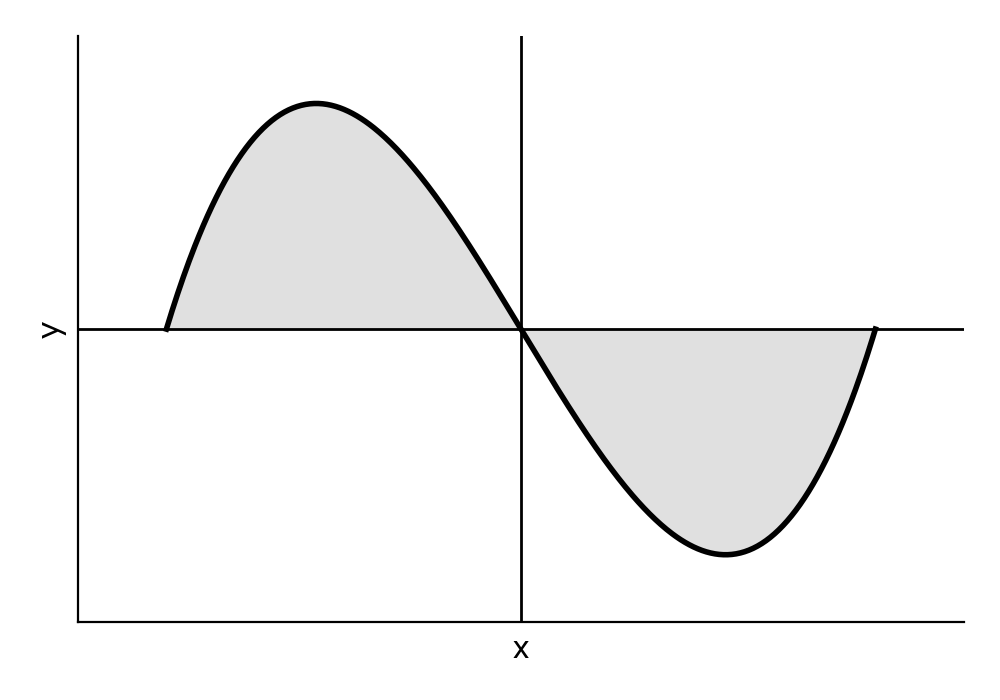 and below for x in [0,2].]
Write down an integral that represents the area of .
Find the area of .
The architect considers a modified design, where the cross-section is given by .
On the following set of axes, the graph of has been drawn. On the same set of axes, sketch the graph of .
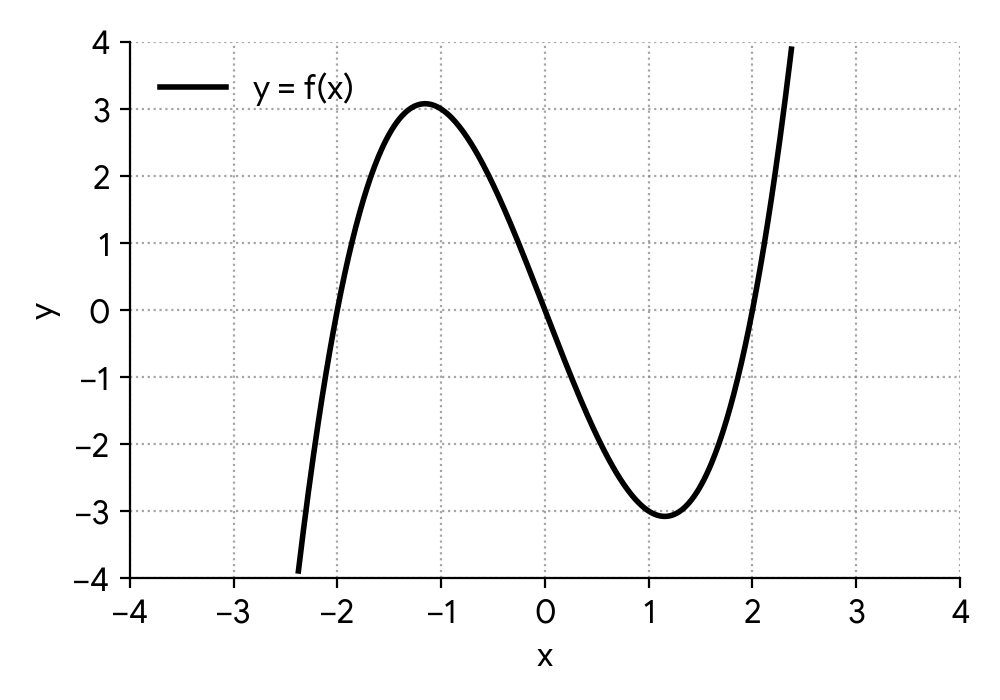
The region (the original cross-section) is rotated through radians about the -axis to form a three-dimensional decorative element. Find the volume of this element.
Remember that area is always positive. Consider how the function behaves on different parts of the interval, or use the absolute value function.
Use your GDC to evaluate the definite integral you wrote in part (a)(i).
Recall the rules for transformations . How does the factor 'a' affect the graph, and how does the term 'b' affect it?
The formula for the volume of revolution about the x-axis is . Remember to square the function before integrating.
Question 4
MediumPaper 1 · calculator4 marksThe graph of represents the concentration of a certain chemical in a solution (in mol/L) at time (in hours). The graph passes through the points and , and has a horizontal asymptote at .
Let represent the concentration in a different experiment.
Find .
On a new set of axes, sketch the graph of , clearly indicating its horizontal asymptote and the -intercept. You do not need to show the graph of .
Recall how transformations affect the input and output values of a function. For , evaluate at the required value, then apply the vertical stretch and vertical shift .
Consider how each transformation (, , ) affects the horizontal asymptote and the points on the original graph. The horizontal asymptote transforms to . The point on transforms to on .
Question 5
HardPaper 1 · calculator11 marks(a) A designer is creating a prototype for a decorative vase. The cross-section of the vase can be modelled by the function , for .
Sketch the graph of on the following pair of axes.
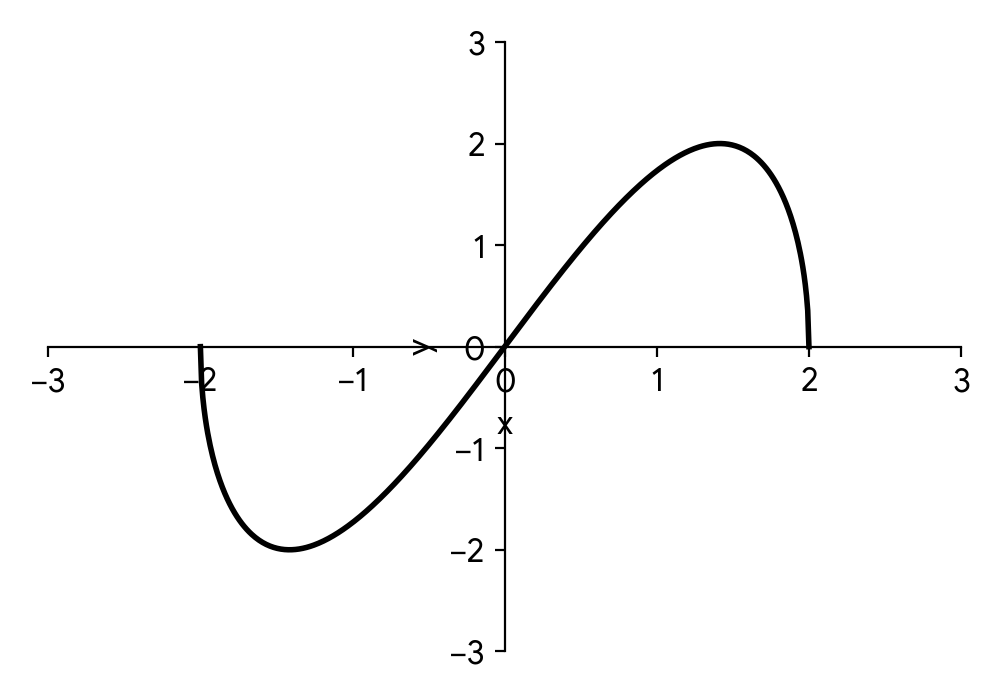
(b) The region enclosed by the graph of and the x-axis is rotated about the x-axis to form the body of the vase.
(i) Write down an integral that represents the volume of this vase.
(ii) Calculate the value of this integral.
(c) The designer decides to create a new, larger version of the vase, , by applying the following transformations to the original cross-section :
- A horizontal stretch by a scale factor of 3, parallel to the x-axis.
- A vertical stretch by a scale factor of 0.75, parallel to the y-axis.
Find the volume of this new vase.
To sketch the graph, identify key features such as x-intercepts, y-intercepts, and local maximum/minimum points. The domain is given as . Consider the symmetry of the function.
The formula for the volume of revolution about the x-axis is . Remember to use the given function and its domain as the limits of integration.
First, simplify the integrand . Then, integrate the resulting polynomial term by term. Remember to evaluate the definite integral using the limits and multiply by .
Consider how transformations affect the integral for the volume of revolution. If , how does the new integral relate to the original integral? Alternatively, express explicitly and then set up and evaluate the new integral.
Question 6
MediumPaper 1 · calculator7 marksA civil engineer is designing a new road. A preliminary section of the road is modelled by a straight line with equation .
Find the vectors and such that the equation of the line can be expressed in vector form in terms of and/or .
Before construction, a ground transformation is applied to the design. This transformation is described by the matrix .
Calculate the value of .
The preliminary road section (where ) undergoes the transformation described by matrix .
Show that the equation of the resulting transformed path does not depend on or .
Recall that is a position vector to a point on the line, and is a direction vector of the line. Consider simple points on the line .
The determinant of a 2x2 matrix is given by .
Apply the transformation matrix to a general point on the line . Let the new coordinates be . Then find a relationship between and that eliminates , , and .
Question 7
HardPaper 1 · calculator8 marksA landscape architect is designing a large decorative fountain for a new public park. The outer structure of the fountain consists of a cylindrical base topped by a conical section. The inner part of the fountain, which holds the water, is a hollow space created by rotating a specific curve around the vertical axis.
The shape of the inner hollow is based on a transformation of the graph . The curve that defines the profile of the inner hollow is given by . This transformation involves a vertical translation of units and a stretch parallel to the x-axis with a scale factor of .
(a.i) Write down the value of .
(a.ii) Find the value of .
The cylindrical base of the fountain has a radius of m and a height of m. The conical section on top has the same base radius of m and a height of m. The inner hollow, described by the curve , extends from the base of the fountain () up to the total height of the outer structure.
Find the volume of the solid material that makes up the fountain (i.e., the volume of the outer structure minus the volume of the inner hollow).
A vertical translation shifts the entire graph up or down. For a function , a vertical translation by units results in . Compare the constant term in the transformed equation to the original form.
A stretch parallel to the x-axis by a scale factor means replacing with in the original function. So, . Compare this to the given transformed equation after accounting for the vertical translation.
First, calculate the total volume of the outer structure (cylinder + cone). Then, calculate the volume of the inner hollow using integration. Remember to express in terms of for the volume of revolution about the y-axis, and integrate from to the total height of the outer structure. The total height is the sum of the cylinder and cone heights.
Question 8
MediumPaper 1 · calculator5 marksA civil engineer is designing a section of a new roller coaster track. She collects data points from a preliminary design sketch to model a specific curved section.
Here are the coordinates of five points on the track's profile:
| 2 | 9.70 |
| 4 | 10.77 |
| 6 | 11.33 |
| 8 | 8.70 |
| 10 | -0.05 |
The engineer thinks a cubic curve will be a good model for this section of the track.
Find the equation of the cubic regression curve for this data.
For another section of the roller coaster, the engineer first creates a small-scale model. The equation for the profile of this model section is given by .
The full-size roller coaster track will be an enlargement of this model, with a scale factor of 5, centered at the origin (0,0).
Determine the equation of the cubic curve that models the full-size roller coaster track.
Use your GDC's regression feature (cubic regression) to find the equation. Make sure to input the x and y values correctly.
If a function is enlarged by a scale factor centered at the origin, the new function is . Substitute with and multiply the entire function by .
Question 9
HardPaper 2 · calculator21 marksThe "SkyGazer" is a new observation wheel in a city park. The wheel has a diameter of m. To begin the ride, a passenger enters a capsule at the lowest point on the wheel, which is m above the ground. A ride consists of multiple revolutions, and the wheel makes revolutions per minute.
The height of a capsule above the ground, , measured in metres, during a ride on the SkyGazer can be modelled by the function , where is the time, in seconds, since a passenger began their ride.
(a) Calculate the value of
(i) ;
(a)(ii) ;
(a)(iii) .
(b) A ride on the SkyGazer lasts for minutes in total.
Calculate the number of revolutions of the wheel per ride.
(c) For exactly one ride on the SkyGazer, suggest
(i) an appropriate domain for ;
(c)(ii) an appropriate range for .
(d) A metre-tall building stands on the horizontal ground next to the SkyGazer.
By considering the graph of , determine the length of time during one revolution of the wheel for which the capsule is higher than the building.
(e) There is a plan to relocate the SkyGazer onto a taller platform which will increase the maximum height of the wheel to m. This will change the value of one parameter, , or , found in part (a).
(i) Identify which parameter will change.
(e)(ii) Find the new value of the parameter identified in part (e)(i).
The parameter represents the amplitude of the sinusoidal function. For a Ferris wheel, the amplitude is half of its diameter.
The parameter is related to the period of the function. The period is the time it takes for one full revolution. Remember to convert revolutions per minute to seconds per revolution and use the formula for the period of a cosine function.
The parameter represents the vertical shift of the function, which is the central height of the wheel. This can be found by adding the amplitude to the lowest height.
Multiply the duration of the ride in minutes by the revolutions per minute.
The domain represents the possible values for time . The ride starts at and lasts for minutes. Remember to express time in seconds.
The range represents the possible values for the height . Consider the lowest and highest points a capsule can reach during the ride.
Set the height function equal to the building's height and solve for within one period. Use the symmetry of the cosine function to find the interval where the height is above the building.
Consider how raising the platform affects the dimensions and movement of the wheel. Does it change the diameter, the speed of rotation, or the overall vertical position?
The maximum height of the wheel is given by . Use the new maximum height and the value of (which remains unchanged) to find the new .
Question 10
MediumPaper 1 · calculator10 marksA drone is launched vertically upwards from a platform. Its height, metres above the ground, seconds after launch, is given by the formula , where is the initial height of the platform and is the initial upward velocity.
The drone is launched from a platform m above the ground with an initial upward velocity of ms.
Calculate the time taken for the drone to return to the height of the launch platform.
Find the time it takes for the drone to reach its maximum height.
Calculate the maximum height of the drone.
Another drone operator, Liam, launches an identical drone with the same initial upward velocity, but from a platform m above the ground.
By considering the difference in the two height-time graphs for the drones, write down the answers to parts (a), (b), and (c) for Liam's drone.
Consider what the height is equal to when the drone returns to the launch platform's height. Then solve the resulting equation for .
The maximum height occurs at the vertex of the parabolic path. Recall the formula for the time at the vertex of a quadratic function .
Substitute the time found in part (b) into the height equation.
Think about how changing the constant term 'c' in the equation affects the graph. Does it shift the graph horizontally, vertically, or change its shape?
Question 11
HardPaper 2 · calculator28 marks(a) (i) Consider the function . Find .
(ii) The first section of the stone wall's profile is given by for . A straight glass panel is to be installed tangent to this section of the wall at the point where . Find the equation of this tangent line.
The full profile of the stone wall, , is defined by:
A smaller, decorative stone insert is designed using a transformation of . The graph of is obtained from the graph of by:
- a stretch scale factor of in the direction,
- followed by a stretch scale factor of in the direction,
- followed by a translation of units to the right.
Point P lies on the graph of and has coordinates . Point Q is the image of P under the given transformations and has coordinates .
Find the value of and the value of .
The piecewise function is given by
(c) Find
(i) an expression for .
(ii) the value of .
(iii) the value of .
(d) (i) Calculate the total area of the profile of the stone wall, enclosed by , the -axis, and the line .
The decorative insert is placed within the main wall profile . The region of the main wall profile that is not covered by the insert is to be painted a contrasting colour. This region is bounded by , the -axis, and the lines and , excluding the area under from to . Find the area of this region.
Recall the power rule for differentiation: if , then .
First, find the y-coordinate of the point of tangency. Then, use the derivative from part (a)(i) to find the gradient of the tangent at that point. Finally, use the point-slope form of a linear equation, .
Apply each transformation step-by-step to the coordinates of point P. Remember that a stretch in the x-direction affects the x-coordinate, a stretch in the y-direction affects the y-coordinate, and a translation shifts the point.
To transform a function :
- Stretch by scale factor in -direction: replace with .
- Stretch by scale factor in -direction: replace with (or multiply by ).
- Translate units to the right: replace with .
Combine these transformations to find in terms of , then substitute the expression for the first part of .
The value is the new boundary point for the piecewise function . This corresponds to the original boundary point in after the x-transformations have been applied.
Substitute the second part of (the linear function) into the general transformation equation for derived in part (c)(i). Simplify the expression to find the constant term .
The function is piecewise. You will need to calculate two separate definite integrals and sum their results. The first integral will be for from to , and the second for from to .
The region to be painted consists of two parts: the area under from to , and the area between and from to . You have already calculated some of these areas in previous parts.
Question 12
MediumPaper 2 · calculator12 marksConsider the function .
(a) The graph of the function is translated vertically to define a new function . Find the value of such that the graph of passes through the point .
(b) The graph of the function is translated horizontally to define a new function . Find the values of such that the graph of passes through the point .
(c) The graph of the function is translated to define a new function . Find the values of and such that the minimum point of is .
(d) The graph of the function is transformed to define a new function . Find the values of and such that the maximum point of is and the graph passes through the point .
Substitute the coordinates of the given point into the equation for and solve for . Remember that .
Substitute the coordinates of the given point into the equation for . Remember that the absolute value function can result in two possible values for .
For the function , the minimum point is at . A translation shifts the minimum point to .
For , the vertex is at . If it's a maximum point, must be negative. Use the given points to find , , and then .
Question 13
HardPaper 1 · calculator13 marksA design studio is manufacturing a decorative wall sconce. The cross-sectional profile of the sconce is defined by two mathematical curves. The sconce is formed by rotating the region between these curves through radians about the -axis, creating a flat rear surface that mounts flush against a wall. All linear dimensions are in centimetres.
The curve of the outer profile is given by , for .
The curve of the inner profile, , is formed by translating the graph of by units to the left and units down.
(a) Write down an expression for .
(b) The curve intersects the -axis at , where defines the inner boundary of the sconce.
Find the value of . Give your answer to three significant figures.
(c.i) Write down an expression for the volume of the solid formed.
(c.ii) Hence find the volume of material used in the sconce. Give your answer to three significant figures.
Recall that translating a function to the left by units gives , and translating it downwards by units gives .
Set and isolate the cosine term, then use the inverse cosine function to solve for .
A full revolution around the -axis gives . A rotation through radians is half of a complete revolution. Subtract the volume generated by the inner curve from that of the outer curve.
Evaluate both definite integrals on your GDC, find their difference, and multiply by . Include the appropriate units.
Question 14
MediumPaper 1 · calculator9 marksThe depth of water, metres, at the entrance to a harbour can be modelled by the function , where is the time in hours after midnight and is a constant in radians per hour. The graph below shows the depth of water over a 24-hour period.
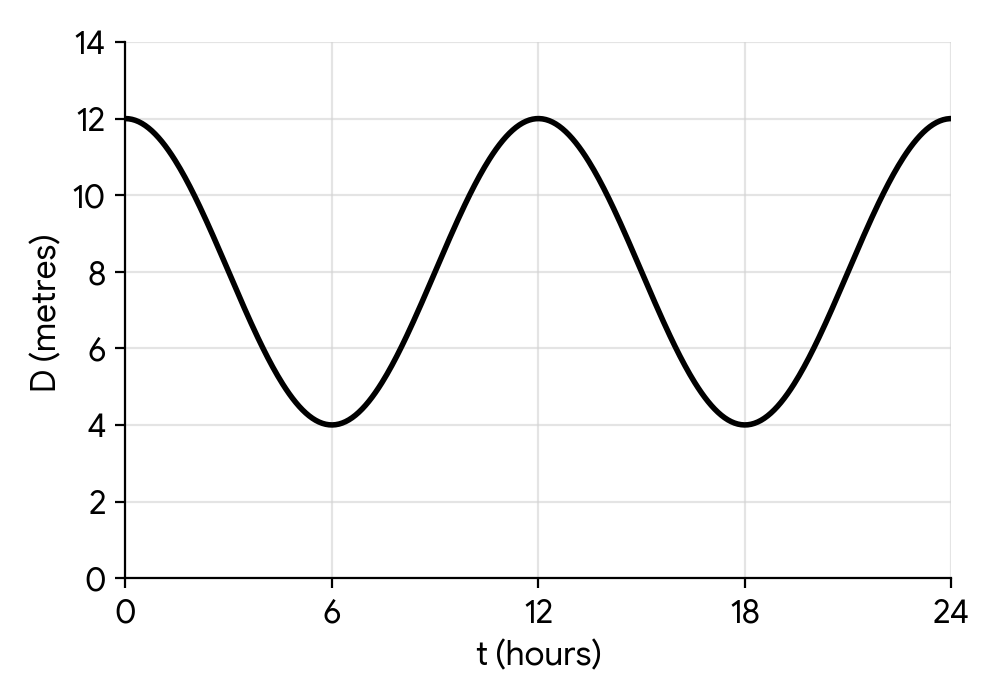
(a) On the same axes, sketch the graph of the function .
(b) Determine the values of the constants , , and .
First, determine the values of and from the original graph. Then, substitute these values into the new function to find its midline and amplitude. Remember that the period remains the same.
The constant represents the vertical shift (midline), represents the amplitude, and is related to the period of the oscillation. Use the maximum and minimum values and the period from the graph.
Question 15
HardPaper 1 · calculator13 marksA design studio is developing a wall-mounted decorative bracket. The bracket is designed to mount flush against a flat vertical wall. The cross-sectional profile of the bracket in the -plane is defined by two mathematical curves, where all linear dimensions are measured in centimetres.
The curve of the outer profile is given by , for .
The curve of the inner profile, , is formed by translating the graph of by units to the left and units downwards.
(a) Write down an expression for .
The inner profile curve intersects the -axis at the point . The relevant portion of the inner profile is restricted to .
(b) Find the value of . Give your answer to three significant figures.
The bracket is modelled by the solid formed when the region between the profiles is rotated through radians about the -axis. This region is bounded by from to , the line , the -axis, and from to .
(c.i) Write down an expression for the volume of the solid formed.
(c.ii) Hence find the volume of material used in the bracket. Give your answer to three significant figures.
Recall how horizontal and vertical translations affect the equation of a function . A translation to the left replaces with , and a downward translation subtracts a constant from the function.
Set and solve for , either analytically using the inverse cosine function or directly on your GDC.
Remember that rotating through radians is half of a full rotation ( radians). The volume is the outer volume of revolution minus the inner volume of revolution.
Evaluate each integral on your GDC and calculate the net volume.
Question 16
MediumPaper 2 · calculator5 marks(a) The population of a rare species of orchid in a botanical garden, years after its introduction, is modelled by the logistic function .
Determine the time (in years) at which the rate of population growth of the orchid species is at its maximum.
(b) Hence, find the coordinates of the point of inflexion for a modified model , which represents the population if the initial conditions were set 3 years earlier.
The maximum rate of growth for a logistic function occurs at its point of inflexion. For a function of the form , the point of inflexion occurs when the exponent is zero, i.e., .
A transformation of the form represents a horizontal translation of units to the right. The y-coordinate of the point of inflexion for a logistic function is .
Question 17
MediumPaper 1 · calculator7 marks(a) A Ferris wheel has a radius of metres, and its centre is metres above the ground. A passenger boards the wheel at its highest point at minutes. The height, metres, of the passenger above the ground at time minutes is modelled by the function .
Write down the amplitude of the Ferris wheel's motion.
(b) Calculate the minimum height above the ground a passenger reaches. Determine the first positive time, in minutes, this height occurs.
(c) Find the period of the Ferris wheel's rotation.
The amplitude of a sinusoidal function in the form or is given by . This represents the maximum displacement from the central axis.
The minimum value of a cosine function, , is . Substitute this into the height function to find the minimum height. Then, solve for when for the smallest positive value of .
For a function of the form , the period is given by the formula .
Question 18
MediumPaper 1 · calculator10 marksA company monitors the daily temperature fluctuations in a specialized industrial oven. The temperature , in degrees Celsius, at time hours after midnight, is modelled by the function , where , , are positive constants. The graph below shows the temperature fluctuations over a 24-hour period.
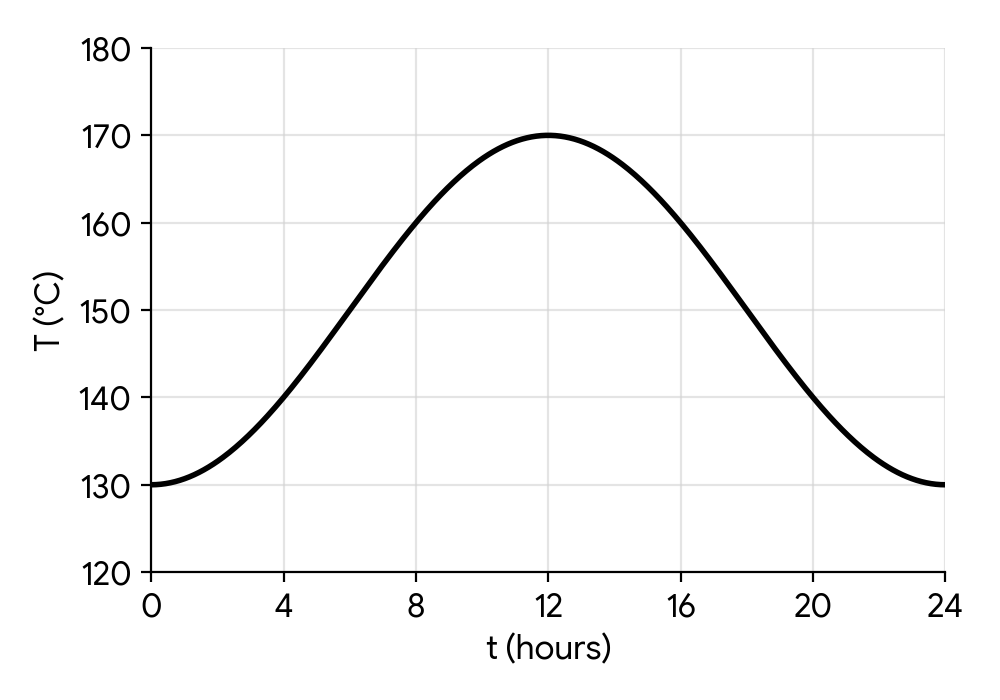
On the same axes, sketch the graph of .
Determine the values of the constants , and .
Identify the midline, amplitude, and period from the original function. For the new function, consider how the amplitude changes and how the sign of the cosine term affects the starting point and general shape relative to the midline.
The constant represents the vertical shift or midline of the oscillation. The constant relates to the amplitude. The constant is related to the period of the function.
Question 19
MediumPaper 2 · calculator10 marksThe temperature, in degrees Celsius, in a controlled environment can be modelled by a sinusoidal function of time, hours after monitoring began. At hours, the temperature reaches its maximum of . At hours, the temperature drops to its minimum of . The monitoring takes place over hours.
(a) Find the equation of the function in the form , for .
During the monitoring period, the temperature is recorded exactly five times. Find the value of .
Recall the properties of a sinusoidal function. The amplitude is half the difference between maximum and minimum values, and the vertical shift is the average of these values. The period can be found from the time between a maximum and a minimum, and the phase shift for a cosine function is typically the x-value of a maximum.
Consider the values of the function at the boundaries of the domain and how many times a horizontal line would intersect the curve within the given domain. Sketching the graph or evaluating the function at key points might help.
Question 20
MediumPaper 1 · calculator13 marksA company is designing a decorative stand for a new line of luxury smart speakers. The profile of the stand's base is defined by two mathematical curves. The stand itself is formed by rotating the region between these curves through radians about the -axis. All dimensions are in centimetres.
The curve of the outer profile is given by , for .
The curve of the inner profile, , is formed by translating the graph of by units to the left and units down.
(a) Write down an expression for .
The inner profile curve intersects the -axis at . The relevant portion of for the stand is restricted to .
(b) Find the value of . Give your answer to three significant figures.
The decorative stand is modelled by the solid formed when the region is rotated through radians about the -axis. The region is defined by the area under from to , excluding the area under from to .
(c.i) Write down an expression for the volume of the solid formed.
(c.ii) Hence find the volume of material used in the stand. Give your answer to three significant figures.
Recall the rules for horizontal and vertical translations of a function. A translation of units to the left means replacing with , and a translation of units down means subtracting from the function.
To find the -intercept, set and solve for . Remember to use the inverse cosine function and consider the domain.
The volume of a solid of revolution formed by rotating a curve about the -axis through radians is given by . The problem asks for the difference in volumes generated by and over their respective domains.
Evaluate the definite integrals from part (c.i). The first integral can be solved analytically, while the second may require numerical integration using a GDC or appropriate software.
No question on this page matches those filters. Try another difficulty or paper.
2 more Transformations of graphs (translation, reflections, stretches) questions in the app
Every answer is marked mark by mark, IB-style, and the AI tutor helps when you are stuck.
Where marks are lost
- Using your own wrong value after failing a "show that." All follow through is withdrawn for the rest of that question.