Right angle triangles (SOH CAH TOA): notes and practice questions
- Hypotenuse (H): Longest side, opposite .
- Opposite (O): Side directly across from reference angle .
- Adjacent (A): Side next to reference angle , not H.
- Pythagoras' Theorem (2D): For right-angled triangles, (c = hypotenuse).
- Pythagoras' Theorem (3D): For a 3D diagonal, (d = 3D diagonal, x, y, z = dimensions).
- Sine (SOH):
- Cosine (CAH):
- Tangent (TOA):
- Finding missing sides: Label H, O, A; choose correct ratio; substitute values and rearrange.
- Finding missing angles: Use inverse trigonometric functions:
- Solving 3D problems: Break down into multiple 2D right-angled triangles; often find a base diagonal first.
- Angle between line and plane: Form a right-angled triangle by drawing a perpendicular from a point on the line to the plane.
- GDC Tip: Always check calculator is in correct angle mode (Degrees/Radians).
- GDC Tip: Calculate exact values (e.g., square roots) by hand if required, avoid rounded decimals.
How it is examined
Every SL paper has one. The decision the student has to make is which rule applies, and questions are built so that one of them is clearly right. Angles are in degrees at SL, so the calculator mode is a real source of lost marks. Because the ambiguous case is excluded, a question giving two sides and a non-included angle is out of syllabus at SL and legal at HL.
The sine rule, both forms of the cosine rule, and the area of a triangle. The right-angled ratios are expected knowledge.
- The sine, cosine and tangent ratios, to find the sides and angles of right-angled triangles.
- The sine rule, .
- The cosine rule, , and .
- The area of a triangle as .
Linking questions
- Other contexts: triangulation, map-making.
- Links to other subjects: vectors (physics).
- International-mindedness: diagrams of Pythagoras' theorem occur in early Chinese and Indian manuscripts. The earliest references to trigonometry are in Indian mathematics. Triangulation was used to find the curvature of the Earth to settle a dispute between England and France over Newton's gravity.
- TOK: is it ethical that Pythagoras gave his name to a theorem that may not have been his own creation? What criteria might we use to make such a judgment?
Practice questions
15 questions · 9 medium · 6 hardQuestion 1
MediumPaper 1 · calculator7 marksThe diagram below shows a hot air balloon hovering at point H, m vertically above a landing pad.
Point A is the point on the ground, directly below the hot air balloon.
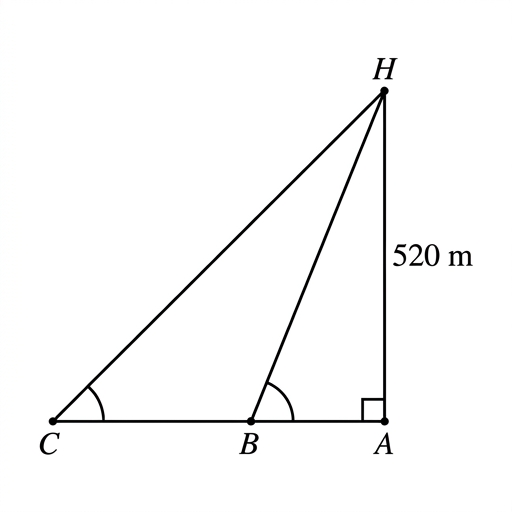
An observer starts walking at a constant speed from point C towards point A. From point C, the observer looks upward at the hot air balloon at an angle of elevation of . After minutes, the observer is at point B and observes the same hot air balloon at an angle of elevation of .
Write down the size of the angle of depression from H to C.
Find the horizontal distance from A to C.
Calculate the distance the observer walked from C to B.
Determine the observer's average speed, in metres per hour.
The angle of depression from H to C is equal to the angle of elevation from C to H due to alternate interior angles.
Consider the right-angled triangle formed by points H, A, and C. You know the height HA and the angle at C. Which trigonometric ratio relates these to AC?
First, find the distance from A to B using the new angle of elevation. Then, use the distance AC you found in part (b) to determine BC.
Speed is distance divided by time. Remember to convert the time from minutes to hours.
Question 2
HardPaper 2 · calculator10 marksA modern architectural marvel, 'The Apex Tower', is designed with a square base and a single peak directly above the centre of the base. The side length of the square base is , and the vertical height of the tower from the centre of the base to its peak is .
Let the base be represented by square ABCD and the peak by V. Let M be the midpoint of the side AB.
(a) Calculate all the side lengths and angles of the triangle , where O is the centre of the square base.
(b) Calculate all the side lengths and angles of the triangle .
First, identify the lengths of VO and OM. Remember that O is the center of the square base and M is the midpoint of a side. This forms a right-angled triangle.
First, find the length of the diagonal of the base, then half of it to get OA. Use this with VO to find the slant edge VA. Remember that is an isosceles triangle.
Question 3
MediumPaper 1 · calculator4 marksA drone takes off from a launch pad located at the origin O(0, 0, 0) of a coordinate system. It flies in a straight line to a target destination T with coordinates (5.0, 3.0, 7.0). All units are in metres.
(a) Calculate the total distance the drone travels from the launch pad to the target.
(b) Determine the angle of elevation of the drone's flight path from the horizontal ground.
Recall the distance formula in three dimensions, or consider the magnitude of the displacement vector from O to T.
Consider the right-angled triangle formed by the drone's height, its horizontal displacement, and its flight path. The horizontal displacement is the distance from the origin to the point (5.0, 3.0, 0).
Question 4
HardPaper 2 · calculator11 marksA rectangular prism with length 10 cm, width 8 cm, and height 6 cm is used as a base for a sculpture. One corner, vertex H, is cut off by a flat plane passing through points P, Q, and R. Point P is on edge HE such that HP = 3 cm. Point Q is on edge HG such that HQ = 4 cm. Point R is on edge HD such that HR = 3 cm.
(a) Calculate the volume of the remaining part of the prism.
(b) Calculate the total surface area of the remaining part of the prism.
First, find the volume of the original rectangular prism. Then, determine the dimensions of the pyramid that has been cut off from vertex H to calculate its volume. The remaining volume is the difference.
Start with the surface area of the original rectangular prism. Identify the three triangular areas that are removed from the faces meeting at H. Then, calculate the area of the new triangular face PQR. You will need to use the Pythagorean theorem to find the side lengths of triangle PQR and Heron's formula to find its area.
Question 5
MediumPaper 1 · calculator7 marksA monument features a prominent pyramidal cap. The length of the slant edge from the apex, A, to any corner of its square base is measured as 2.8 m, accurate to the nearest tenth of a meter. The side length of the square base is exactly 3.2 m. Let C be a corner of the base.
Write down the upper bound and lower bound for the possible lengths of edge AC.
Let H be the midpoint of one of the base edges. Determine the upper bound and lower bound for AH, the slant height of the pyramid's triangular faces.
For structural stability, the angle between the slant height (AH) and the base of the pyramid must be less than 35°. Show whether this monument's pyramidal cap meets this stability requirement. Justify your answer.
Remember how to determine the upper and lower bounds for a measurement given to a certain degree of accuracy. Consider the smallest and largest values that would round to the given measurement.
Consider the right-angled triangle formed by the apex (A), a corner of the base (C), and the midpoint of the base edge (H). Use the Pythagorean theorem. Remember to use the appropriate bounds for AC to find the bounds for AH.
Identify the right-angled triangle relevant to the angle in question. To determine if the requirement is met, calculate the maximum possible angle between the slant height and the base. This will involve using the upper bound of AH found in part (b) and the half-side length of the base.
Question 6
HardPaper 2 · calculator14 marksA botanical garden is constructing a large planter box for exotic plants. The planter is shaped like an inverted frustum of a right pyramid, with a horizontal square top opening of side length metres and a smaller horizontal square base of side length metres.
The depth of the planter is metres.
Find the angle of inclination of the side walls of the planter to the horizontal.
(b) The point V is the theoretical vertex of the full pyramid from which the frustum is cut, and C is the centre of the square top opening.
(i) Find the total height of the pyramid from its theoretical vertex V to the centre of the top opening C.
(ii) Hence or otherwise, show that the volume of the planter is .
The botanical garden orders bags of a special soil mix, with each bag containing of soil. Determine whether the ordered soil is sufficient to fill the planter.
To prevent soil erosion and water leakage, the entire interior surface of the planter (including the bottom base and the four side walls) needs to be lined with a waterproof membrane. Calculate the total area that needs to be lined.
Consider a vertical cross-section of the planter. Identify a right-angled triangle formed by the depth, half the difference in side lengths, and the inclined wall. Use trigonometry to find the angle.
Use similar triangles or the angle found in part (a) to relate the height of the full pyramid to its base dimensions.
The volume of a frustum can be found by subtracting the volume of the smaller pyramid (that was cut off) from the volume of the larger, complete pyramid. The formula for the volume of a pyramid is .
Calculate the total volume of soil delivered and compare it to the volume of the planter found in part (b.ii).
The area to be lined consists of the area of the bottom square base and the lateral surface area of the frustum (four trapezoidal sides). You will need to calculate the slant height of the trapezoidal side walls using Pythagoras' theorem.
Question 7
MediumPaper 1 · calculator5 marksTwo lighthouses, Lighthouse A and Lighthouse B, are located along a coastline. Lighthouse A has a height of 60 m and Lighthouse B has a height of 45 m. A ship is positioned at sea such that its horizontal distance from the base of Lighthouse B is 1200 m.
Calculate the angle of elevation from the ship to the top of Lighthouse B.
The horizontal distance between the bases of Lighthouse A and Lighthouse B is 800 m.
Calculate the angle of depression from the top of Lighthouse A to the top of Lighthouse B.
Draw a right-angled triangle. The height of Lighthouse B is the opposite side, and the horizontal distance from the ship to Lighthouse B is the adjacent side. Use the appropriate trigonometric ratio.
Consider the horizontal line from the top of Lighthouse A. The vertical distance between the tops of the lighthouses forms the opposite side of a right-angled triangle, and the horizontal distance between them forms the adjacent side.
Question 8
HardPaper 2 · calculator15 marksA geological survey team is setting up sensors in a remote area. A map of the area is represented on the following coordinate axes.
Three sensor locations are positioned at , and .
All measurements are in kilometres.
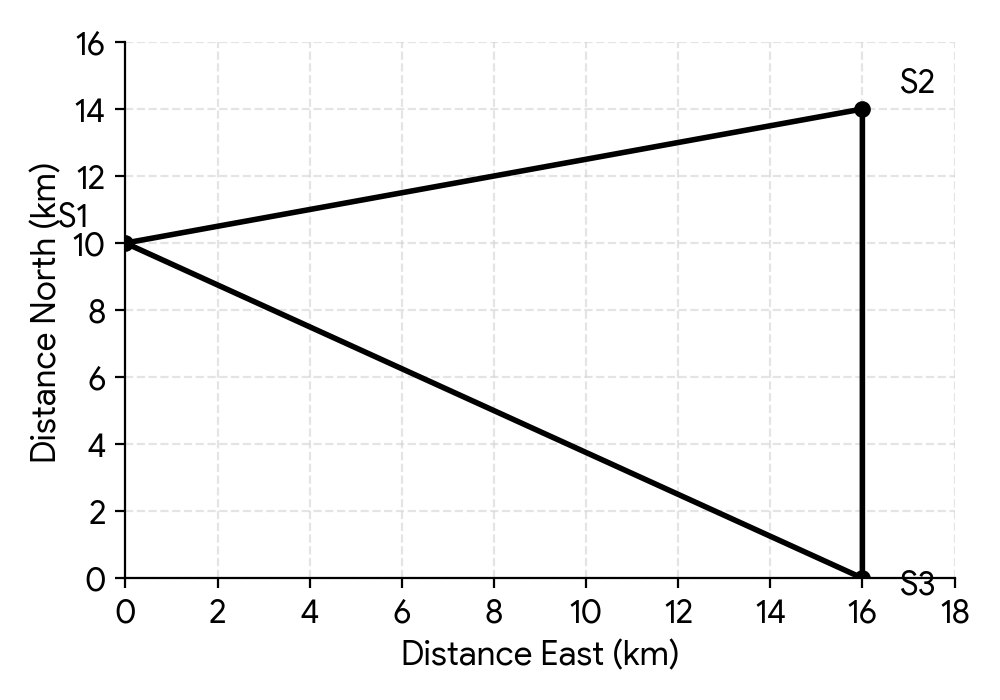
(a) Write down the distance between and .
(b) Calculate the distance between and .
(c) A geological team member is at sensor and needs to walk directly to sensor . Calculate the bearing of from .
A communication relay station is to be installed at a point that is an equal distance from each of the sensors at , , and .
(i) Write down the gradient of the line segment .
(ii) Write down the coordinates of the midpoint of the line segment .
(iii) Hence, calculate the coordinates of the communication relay station.
The distance between two points and can be found using the distance formula . For points on a vertical or horizontal line, this simplifies to the absolute difference in the changing coordinate.
Use the distance formula for the points and . Remember to take the square root of the sum of the squared differences in coordinates.
Bearings are measured clockwise from North. First, determine the change in easting and northing from to . Then, use trigonometry to find the angle relative to the North-South line and convert it to a bearing.
The gradient of a line segment connecting and is given by .
The midpoint of a line segment connecting and is given by .
The communication relay station is equidistant from , , and . This means it is the circumcenter of the triangle formed by these points. The circumcenter is the intersection of the perpendicular bisectors of the sides of the triangle. You already have the gradient and midpoint for . Find the perpendicular bisector for another side, for example , and solve the system of equations.
Question 9
MediumPaper 2 · calculator19 marks(a) Two drones, P and Q, are launched simultaneously. Drone P is launched from the origin of a coordinate system, while Drone Q is launched from a point units along the positive horizontal axis. The velocity equations for the two drones are given by and where:
and
Write down vector equations for the displacement, and , of the two drones at time .
(b) Find an expression for the vector joining the centre of Drone P to the centre of Drone Q.
(c) Hence find the shortest distance between the two drones.
(d) The pilot of Drone P adjusts its initial velocity vector to . The velocity equation for Drone P is now .
Find the values of and if the two drones collide when seconds.
(e) Using the values of and found in part (d), find the angle to the horizontal at which Drone P was initially launched.
To find the displacement vector from the velocity vector, integrate each component with respect to time. Remember to include the initial position as the constant of integration.
The vector joining Drone P to Drone Q is given by . Subtract the corresponding components of the displacement vectors found in part (a).
The shortest distance occurs when the magnitude of the relative position vector is minimized. This is equivalent to minimizing the square of the magnitude. Find the derivative of the squared magnitude with respect to and set it to zero.
For a collision to occur, the position vectors of the two drones must be equal at the specified time. First, find the new displacement vector for Drone P using the adjusted velocity. Then, set the components of and equal to each other at to solve for and .
The initial velocity vector for Drone P is . The angle to the horizontal can be found using the components of this initial velocity vector and trigonometry (e.g., tangent function).
Question 10
HardPaper 2 · calculator19 marksA large decorative water wheel, with a diameter of metres, has its lowest point metres above the water surface. There are eight evenly spaced buckets on the wheel. The wheel rotates in an anticlockwise direction.
Bucket A is initially located at the lowest point of the water wheel when it starts rotating. At the same time, Bucket B is located two positions ahead of Bucket A in the anticlockwise direction.
Let be the length of time, in minutes, after the water wheel started rotating.
(a) Calculate the height of Bucket B above the water surface when .
The water wheel completes one revolution every minutes.
(b) Calculate the height of Bucket A above the water surface when minutes.
(c) Determine the values of when Bucket A and Bucket B have the same height above the water surface, for .
The height of Bucket A above the water surface can be modelled by the function , for .
(d) State the amplitude of .
(e) Find the value of
(i) , given that ;
(ii) .
A new attraction, 'Hydro-Spin', features a modified water wheel. A main beam, PQ, rotates in an anticlockwise direction about its midpoint O. The length of the beam is metres. The midpoint O is fixed at a height of metres above the water surface. At the end of the beam, point Q, there is a smaller circular wheel with a radius of metres, which also rotates anticlockwise.
A passenger, Clara, is in a bucket labelled K on the smaller wheel. The height of the end of the beam Q above the water surface, seconds after 'Hydro-Spin' starts moving, is modelled by the function . The height of bucket K above point Q, after seconds, is modelled by the function .
(f) Find the furthest distance from Clara's bucket K to the midpoint O of the main beam.
(g) Calculate Clara's height above the water surface after seconds.
First, determine the radius of the wheel and the height of its centre (midline). Then, calculate the angular position of Bucket B relative to the lowest point. Use a sinusoidal model, remembering that the lowest point is usually associated with a cosine value of or an angle of (if measured from the lowest point).
Determine what fraction of a revolution occurs in minutes. Then, calculate the total angle of rotation from the starting point (lowest point). Use the sinusoidal height function for Bucket A.
Write down the height functions for both Bucket A and Bucket B. Remember that Bucket A starts at the lowest point, and Bucket B is ahead. Set the two height functions equal to each other and solve for . Consider the period of the function when finding all solutions within the given interval.
Recall the definition of amplitude in a sinusoidal function or . It is the absolute value of the coefficient of the sine or cosine term.
The period of the function is given as minutes. For a sinusoidal function where is in minutes and the angle is in degrees, the period is related to by the formula .
The value represents the vertical shift or the midline of the sinusoidal function. This corresponds to the height of the centre of the water wheel.
The maximum displacement from the midpoint O to point Q is the amplitude of . The maximum displacement from point Q to bucket K is the amplitude of . The furthest distance from K to O occurs when K, Q, and O are all aligned.
Clara's total height above the water surface is the sum of the height of point Q above the water surface and the height of bucket K above point Q. Substitute into both given functions and then add the results. Ensure your calculator is in degree mode for the trigonometric functions.
Question 11
MediumPaper 1 · calculator5 marks(a) A circular stained-glass window has its center at the origin O. A rectangular decorative panel, ODEF, is fitted inside the window. Vertex D lies on the positive x-axis, vertex F lies on the positive y-axis, and vertex E lies on the circumference of the window. The length OD is cm and the length OF is cm.
Calculate the length of the arc from point E to the point where the window intersects the positive x-axis. Give your answer to three significant figures.
To find the radius of the circular window, consider the coordinates of point E and its distance from the origin. Remember that the arc length formula requires the angle to be in radians. You can find the angle using trigonometric ratios in the right-angled triangle formed by O, D, and E.
Question 12
HardPaper 2 · calculator15 marksA drone delivery service operates from three main hubs, P, Q, and R, whose locations are represented on a coordinate plane. All measurements are in kilometres.
Hub P is at , Hub Q is at , and Hub R is at .
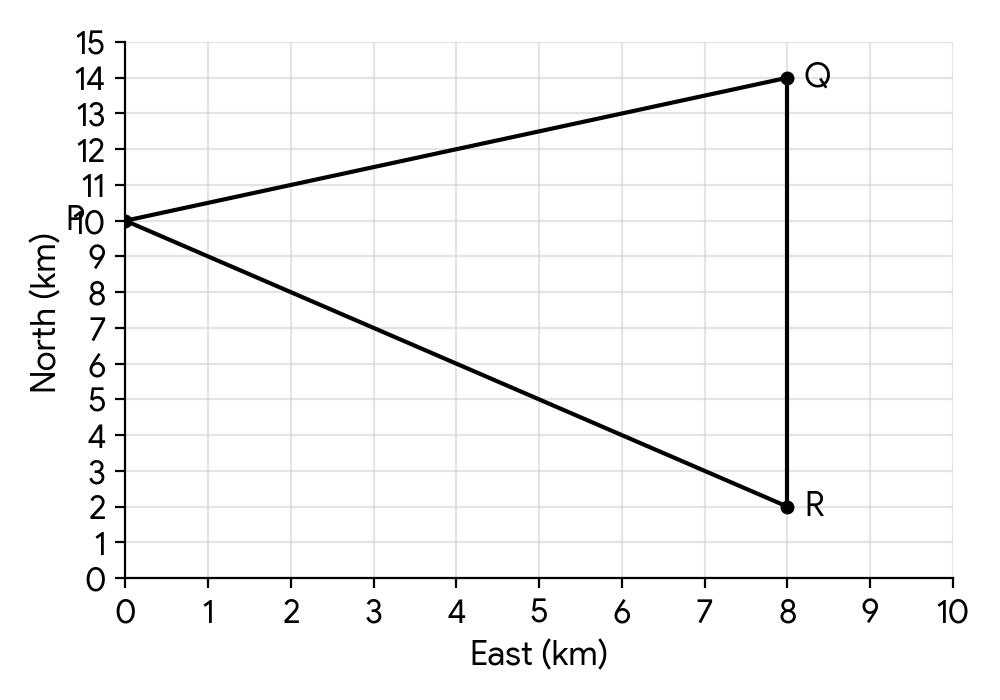
Write down the distance between Hub Q and Hub R.
Calculate the distance between Hub P and Hub Q.
A drone is at Hub Q and needs to fly directly to Hub P. Calculate the bearing of P from Q.
A central charging station is to be built at a location equidistant from Hubs P, Q, and R.
Write down the gradient of the line segment [PR].
Find the coordinates of the midpoint of [PR].
Hence calculate the coordinates of the central charging station.
The hubs Q and R share the same x-coordinate. What does this mean about the line segment connecting them?
Use the distance formula, which is derived from the Pythagorean theorem. Consider the change in x-coordinates and y-coordinates.
First, determine the change in x and y coordinates from Q to P. Then, use trigonometry to find the angle with respect to the North line. Remember bearings are measured clockwise from North and are typically given as three figures.
The gradient of a line segment between two points and is given by .
The midpoint of a line segment between two points and is given by .
The central charging station is the circumcenter of the triangle formed by P, Q, and R. It is the intersection point of the perpendicular bisectors of the sides of the triangle. You'll need the gradient and midpoint of at least two sides to find their perpendicular bisectors.
Question 13
MediumPaper 1 · calculator8 marksA team of architects is designing a new domed stadium. The cross-section of the dome's roof can be modelled by the function , where . The -axis represents the ground level and the -axis represents the height above the ground, with units in metres.
A support beam is to be anchored to the dome's roof at a point, P, where the roof's height is m above the ground. The coordinates of P are , where .
Calculate the value of .
Find an expression for .
The support beam is designed to be perpendicular to the dome's roof at point P. Find the angle, , that this support beam makes with the horizontal ground.
To find the value of , you need to set the function equal to the given height and solve for . Remember to use logarithms to solve for when it's in the exponent.
Use the chain rule for differentiation. Remember that the derivative of is .
First, find the gradient of the tangent to the curve at point P by evaluating . Then, find the gradient of the normal (the support beam) using the negative reciprocal. Finally, use the relationship between the gradient and the tangent of the angle to find .
Question 14
MediumPaper 2 · calculator15 marksA circular park has a central monument. A straight walking path cuts across the park. The radius of the park is m. The shortest distance from the center of the park to the path is m.
(a) (i) Calculate the angle in degrees.
(a) (ii) The region of the park bounded by the path and the arc is a flower bed. Calculate the area of this flower bed.
A square performance stage has a special effect light at its center. The stage has a side length of m. The light projects a circular pattern on the stage floor with a radius of m.
(b) (i) Calculate the total area of the circular light pattern if it were projected onto an infinite surface.
(b) (ii) Calculate the area of the stage floor that is lit by the special effect light.
Let be the brightness of the special effect light, measured in lumens, and be the time in minutes since the light was switched on.
The rate of change of brightness is given by .
(c) Find the value of at which the brightness of the light is increasing at the greatest rate.
Consider the right-angled triangle formed by the center of the park, the midpoint of the path, and one end of the path. Use trigonometry to find half of the angle .
The flower bed is a circular segment. Its area can be found by subtracting the area of the triangle from the area of the sector . Remember to use radians for the angle when calculating the area of the sector.
The area of a circle is given by the formula .
The light pattern extends beyond the square stage. The lit area is the area of the full circle minus the four segments that fall outside the square. The distance from the center to each side of the square is half the side length.
To find when the rate is greatest, you need to find the maximum of the function . This involves finding the derivative of and setting it to zero.
Question 15
MediumPaper 2 · calculator7 marksA circular stained-glass window has a radius of . A horizontal decorative metal bar acts as a chord, dividing the window into two segments. The length of this metal bar is .
Find the area of the smaller segment of the stained-glass window.
Recall the formula for the area of a circular segment, which involves the area of a sector and the area of a triangle. You will first need to determine the central angle subtended by the chord. Ensure your calculator is in radian mode for area calculations involving angles.
No question on this page matches those filters. Try another difficulty or paper.
Every Right angle triangles (SOH CAH TOA) question, marked for you
Every answer is marked mark by mark, IB-style, and the AI tutor helps when you are stuck.
Where marks are lost
- Using your own wrong value after failing a "show that." All follow through is withdrawn for the rest of that question.