Volume & surface area of 3D objects: notes and practice questions
- Volume: Measure of 3D space a shape occupies.
- Surface Area: Total area of all outer faces and curved surfaces of a 3D object.
- Prism: 3D shape with two identical base shapes and a uniform cross-section.
- Right-Pyramid/Cone: Apex is vertically above the exact center of the base; vertical height (h) is perpendicular to the base.
- Volume of Prism: (A = area of uniform cross-section, h = length/height).
- Volume of Cuboid: .
- Volume of Cylinder: .
- Volume of Right-Pyramid: (A = area of the base).
- Volume of Right-Cone: .
- Volume of Sphere: .
- Surface Area (General): Sum of areas of all 2D net faces.
- Surface Area of Sphere: .
- Curved Surface Area of Right-Cone: (l = slant height).
- Total Surface Area of Right-Cone: .
- Cone relationship: Slant height (l), radius (r), and vertical height (h) form a right-angled triangle: .
- Formulas are in the IB formula booklet: "Prior Learning" (cuboids, cylinders, prisms) and "Topic 3: Geometry" (pyramids, cones, spheres).
- Keep intermediate values exact in GDC; round only final answers to 3 significant figures.
How it is examined
A reliable early question on both SL papers, usually a composite solid where the student finds a volume, then a surface area, then an angle. Because the formulas are in the booklet, the marks are for picking the right solid, decomposing the shape, and identifying the right-angled triangle inside it. The restriction to right-angled trigonometry in 3D at SL is the line to hold when writing questions.
The distance between two points in three dimensions, the coordinates of the midpoint, and the volume and surface area formulas for the right-pyramid, right cone, sphere and hemisphere. This is a real difference from AA, where students recall more of these.
- The distance between two points in three-dimensional space, and their midpoint.
- The volume and surface area of three-dimensional solids including the right-pyramid, right cone, sphere, hemisphere, and combinations of these solids.
- The size of an angle between two intersecting lines, or between a line and a plane.
Linking questions
- Other contexts: architecture and design.
- Links to other subjects: design technology; volumes of stars and the inverse square law (physics).
- TOK: what is an axiomatic system? Are axioms self evident to everybody?
Practice questions
29 questions · 17 medium · 12 hardQuestion 1
MediumPaper 1 · calculator6 marksA company manufactures decorative glass paperweights in the shape of a solid hemisphere. The radius of each paperweight is 8 cm.
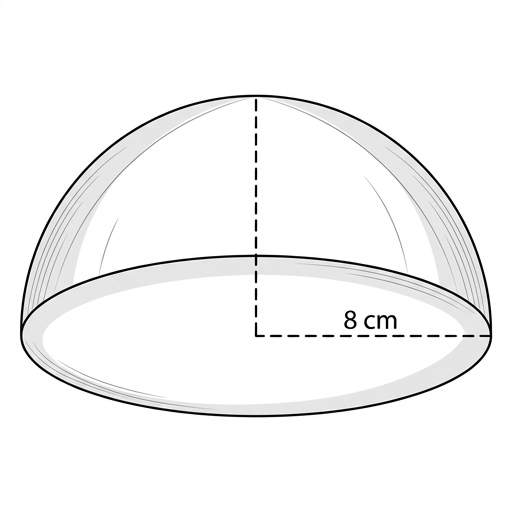
(a) Calculate the total surface area of one such paperweight.
Each paperweight is coated with a protective sealant. It is known that 1 mL of the sealant covers an area of 150 cm.
(b) Calculate the volume of sealant required to coat one paperweight.
Remember that a solid hemisphere has both a curved surface and a flat circular base. Consider the formulas for the surface area of a sphere and the area of a circle.
You will need the total surface area calculated in part (a) for this calculation. Think about how the given coverage rate relates to the total area.
Question 2
HardPaper 1 · calculator8 marksA scientist is preparing a cylindrical container for an experiment. She measures the radius of the base, , to be 5.0 cm and the height, , to be 12 cm.
Calculate the volume of the cylindrical container using these measurements. Give your answer to three significant figures.
It is known that the measurements are accurate to the number of significant figures given.
Find the lower bound and upper bound of the volume of the cylindrical container. Give your answers to three significant figures.
Find, with justification, the largest possible percentage error if the answer to part (a) is recorded as the volume of the cylindrical container.
Recall the formula for the volume of a cylinder. Pay attention to the required number of significant figures for the final answer.
For a measurement given to 'n' significant figures, the lower bound is the value minus half of the place value of the last significant digit, and the upper bound is the value plus half of the place value of the last significant digit. For example, 5.0 (2 sf) means the actual value is between 4.95 and 5.05. For 12 (2 sf), it means the actual value is between 11.5 and 12.5.
Percentage error is calculated as . To find the largest possible percentage error, you should compare the calculated value from part (a) with both the upper and lower bounds found in part (b). The 'true value' in this context refers to the bound that maximizes the error.
Question 3
MediumPaper 1 · calculator10 marks(a) A satellite dish is supported by three anchor points A, B, and C on a mast. The coordinates of these points, relative to a fixed origin, are A(1, 2, 0), B(7, 2, 0), and C(4, 6, 1), where distances are measured in metres.
(i) Find the vector .
(ii) Find the vector .
(b) Calculate .
(c) Hence, determine the area of the triangular support surface formed by points A, B, and C.
Remember that .
Remember that .
Use the formula for the cross product: if and , then .
The area of a triangle formed by vectors and originating from the same vertex is given by .
Question 4
HardPaper 2 · calculator11 marksA rectangular prism with length 10 cm, width 8 cm, and height 6 cm is used as a base for a sculpture. One corner, vertex H, is cut off by a flat plane passing through points P, Q, and R. Point P is on edge HE such that HP = 3 cm. Point Q is on edge HG such that HQ = 4 cm. Point R is on edge HD such that HR = 3 cm.
(a) Calculate the volume of the remaining part of the prism.
(b) Calculate the total surface area of the remaining part of the prism.
First, find the volume of the original rectangular prism. Then, determine the dimensions of the pyramid that has been cut off from vertex H to calculate its volume. The remaining volume is the difference.
Start with the surface area of the original rectangular prism. Identify the three triangular areas that are removed from the faces meeting at H. Then, calculate the area of the new triangular face PQR. You will need to use the Pythagorean theorem to find the side lengths of triangle PQR and Heron's formula to find its area.
Question 5
MediumPaper 1 · calculator10 marksA landscape architect is designing a section of a park. The boundary of a planned pathway can be modelled by the line and a decorative flower bed by the curve . These two features intersect at points and , as shown in the following diagrams.
In diagram 1, the region enclosed by the line , , and the -axis has been shaded.
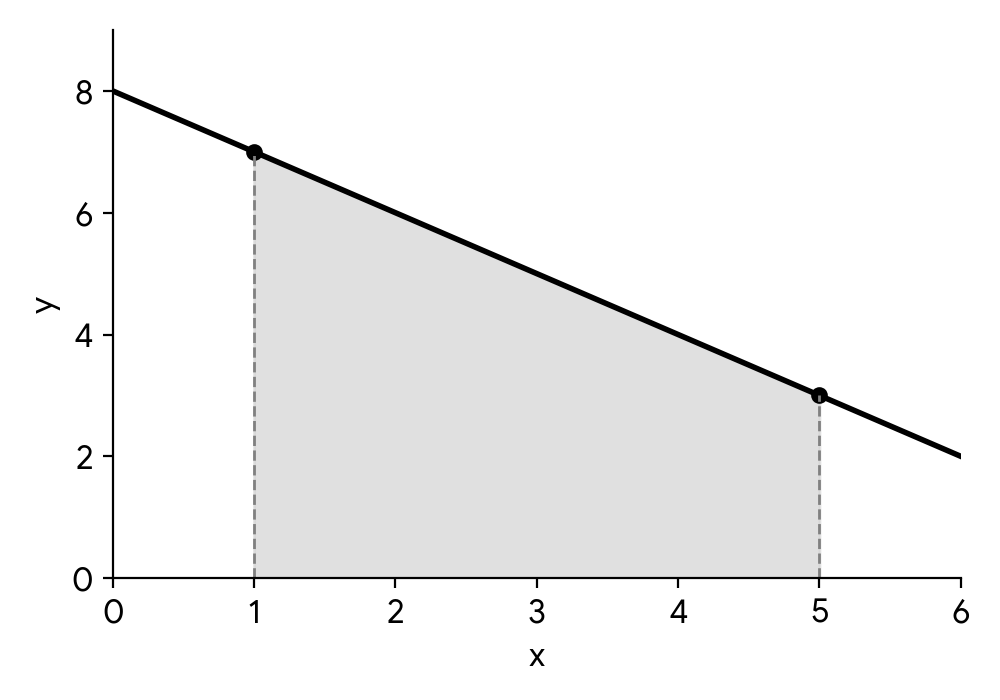
Calculate the area of the shaded region in diagram 1.
In diagram 2, the region enclosed by the curve , and the lines , and the -axis has been shaded.
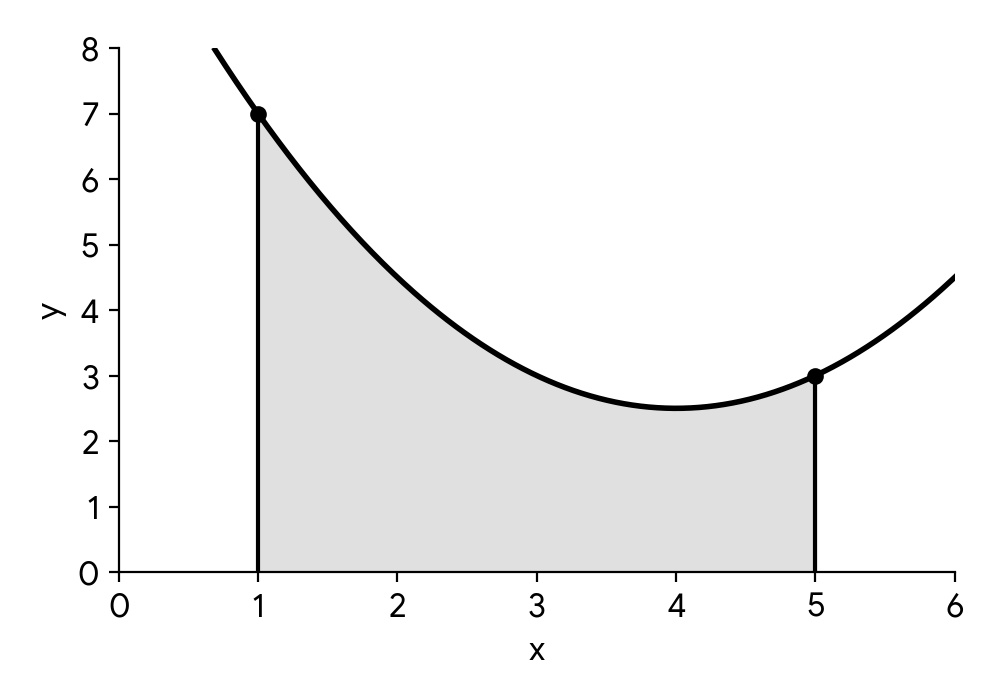
Write down an integral for the area of the shaded region in diagram 2.
Calculate the area of this region.
Hence, determine the area enclosed between the line and the curve .
The shaded region is a trapezoid. You can use the formula for the area of a trapezoid or a definite integral to find its area. Remember the limits of integration are the x-coordinates of the intersection points.
Remember to include the correct limits of integration, the function itself, and the differential 'dx'.
Use your GDC to evaluate the definite integral you wrote down in part (b.i).
The area enclosed between two curves can be found by subtracting the area under the lower curve from the area under the upper curve over the given interval.
Question 6
HardPaper 2 · calculator12 marks(a) A cylindrical grain silo with a radius of m and an initial grain height of m is being emptied. The rate at which the grain is removed from the silo is proportional to the square root of the height of the grain.
Using for the volume of grain in the silo and for the height of the grain, write down a differential equation relating these variables.
(b) Apply the chain rule and the formula for the volume of a cylinder to show that . Hence, write your answer to part (a) in terms of and .
(c) After minutes, the height of the grain has dropped to m. Predict how long it will take for the silo to be completely empty from the initial height of m.
Recall that 'proportional to' means there is a constant of proportionality. Since the silo is emptying, the rate of change of volume with respect to time should be negative.
The volume of a cylinder is . Use the given radius to find , then apply the chain rule .
Solve the differential equation from part (b) by separating variables and integrating. Use the given initial conditions to find the constant of integration and the constant of proportionality.
Question 7
MediumPaper 1 · calculator6 marksThe ancient civilization of Eldoria constructed monumental structures using a unit of measurement called the Ancient Eldorian Rod (AER).
Historians have determined that 1 AER is equivalent to 0.74 metres, rounded to two decimal places.
Write down the upper and lower bounds of 1 AER in metres.
The grand 'Tower of Eldoria' is modelled as a square-based pyramid with a base side length of 380 AER and a height of 250 AER. Assume these measurements are exact.
Find the minimum possible volume of the pyramid in cubic metres.
Remember that rounding to two decimal places means the actual value could be anywhere from 0.005 below the rounded value to just under 0.005 above it.
To find the minimum possible volume, you should use the lower bound of the conversion factor from part (a). The formula for the volume of a square-based pyramid is .
Question 8
HardPaper 2 · calculator13 marksA company is designing an open-top storage container with a square base. The side length of the base is cm and the height is cm. The container needs to have a volume of cm.
Explain why .
Rearrange the equation in part (a) to make the subject.
Write down an expression for the surface area, , of the open-top container.
Show that this can be written as
Plot the graph of for .
Find the minimum surface area and the value of when this occurs.
Recall the formula for the volume of a rectangular prism (or cuboid). The base is a square.
Isolate the variable on one side of the equation.
The container has a square base and four rectangular sides. Remember it is open-top.
Substitute the expression for from part (b) into the surface area formula from part (c).
Use your GDC to plot the function. Ensure you choose an appropriate window to see the minimum point.
You can use the GDC's 'minimum' function or calculus by finding the derivative and setting it to zero.
Question 9
MediumPaper 1 · calculator9 marksA spherical ice sculpture is melting in a gallery. Initially, the sculpture has a radius of 30 cm. This information is illustrated in the following diagram.
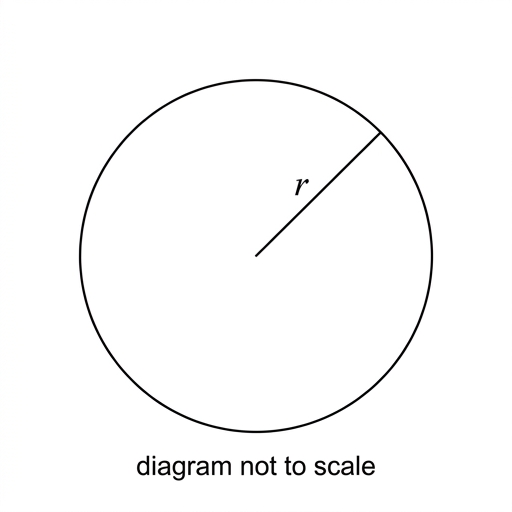
The gallery curator predicts that, as the ice sculpture melts, its radius will decrease at a constant rate of 0.5 cm per hour.
According to this model, find
(i) the radius of the ice sculpture, 10 hours after it begins melting.
(ii) the volume of the ice sculpture, 10 hours after it begins melting. Give your answer to one decimal place.
Let the function represent the volume of the ice sculpture, , hours after it begins melting. is given by
, for .
Find .
Find the rate of change of the volume of the ice sculpture at hours.
State one reason why the radius of the ice sculpture may not always decrease at a constant rate.
To find the new radius, subtract the total decrease in radius from the initial radius. The total decrease is the rate of decrease multiplied by the time elapsed.
Recall the formula for the volume of a sphere: . Use the radius calculated in part (a.i).
Apply the power rule for differentiation to each term of the polynomial function.
The rate of change of volume is given by the derivative . Substitute into your expression for from part (b).
Consider real-world factors that might influence the melting process of an ice sculpture, such as environmental conditions or the sculpture's changing shape.
Question 10
HardPaper 2 · calculator15 marks(a) A pharmaceutical company is designing a new cylindrical container for a special liquid. The container has a fixed volume .
The radius of the container is and the height is .
Show that .
(b) Find an expression for the total surface area of the container.
(c) Substitute an expression for (from part (a) ) into your expression for (from part (b) ) and hence show that .
(d) Find .
(e) Find the minimum value of and the values of and when this occurs. Show that this value of is indeed a minimum.
Recall the formula for the volume of a cylinder. Substitute the given volume into this formula.
The total surface area of a cylinder consists of the area of the two circular bases and the area of the curved side.
From part (a), isolate . Then substitute this expression for into the formula for from part (b). Simplify the resulting expression.
Differentiate the expression for with respect to . Remember that can be written as .
To find the minimum value, set and solve for . Then use this value of to find and . To show it's a minimum, use the second derivative test.
Question 11
MediumPaper 1 · calculator5 marks(a) A spherical decorative orb has a radius of 4.5 cm. A craftsman plans to cover of its surface with intricate filigree work.
Calculate the volume of the orb that will NOT be covered by the filigree work.
(b) A conical party hat has a slant height of 15 cm and a base radius of 6 cm. The outside of the hat (excluding the base) is to be decorated with glitter.
Calculate the surface area of the hat that will be covered with glitter. Give your answer correct to the nearest cm.
First, find the total volume of the sphere. Then, determine the fraction of the volume that will not be covered.
Recall the formula for the lateral surface area of a cone. Remember to round your final answer to the nearest whole number.
Question 12
HardPaper 1 · calculator8 marksA landscape architect is designing a large decorative fountain for a new public park. The outer structure of the fountain consists of a cylindrical base topped by a conical section. The inner part of the fountain, which holds the water, is a hollow space created by rotating a specific curve around the vertical axis.
The shape of the inner hollow is based on a transformation of the graph . The curve that defines the profile of the inner hollow is given by . This transformation involves a vertical translation of units and a stretch parallel to the x-axis with a scale factor of .
(a.i) Write down the value of .
(a.ii) Find the value of .
The cylindrical base of the fountain has a radius of m and a height of m. The conical section on top has the same base radius of m and a height of m. The inner hollow, described by the curve , extends from the base of the fountain () up to the total height of the outer structure.
Find the volume of the solid material that makes up the fountain (i.e., the volume of the outer structure minus the volume of the inner hollow).
A vertical translation shifts the entire graph up or down. For a function , a vertical translation by units results in . Compare the constant term in the transformed equation to the original form.
A stretch parallel to the x-axis by a scale factor means replacing with in the original function. So, . Compare this to the given transformed equation after accounting for the vertical translation.
First, calculate the total volume of the outer structure (cylinder + cone). Then, calculate the volume of the inner hollow using integration. Remember to express in terms of for the volume of revolution about the y-axis, and integrate from to the total height of the outer structure. The total height is the sum of the cylinder and cone heights.
Question 13
MediumPaper 1 · calculator5 marksA conical tank is being filled with water. The tank has a height of 12 cm and a radius of 4 cm at its top. Water is poured into the tank such that the volume of water is increasing at a rate of 10 cms.
(a) Find the height of the water in the tank when its volume is 8 cm.
(b) Hence or otherwise, find the rate of change of the height of the water at this instant.
Recall the formula for the volume of a cone, . Use similar triangles to establish a relationship between the radius () and height () of the water in the conical tank.
You have the volume in terms of height . Differentiate with respect to to find . Then, use the chain rule, , to find .
Question 14
HardPaper 2 · calculator14 marksA botanical garden is constructing a large planter box for exotic plants. The planter is shaped like an inverted frustum of a right pyramid, with a horizontal square top opening of side length metres and a smaller horizontal square base of side length metres.
The depth of the planter is metres.
Find the angle of inclination of the side walls of the planter to the horizontal.
(b) The point V is the theoretical vertex of the full pyramid from which the frustum is cut, and C is the centre of the square top opening.
(i) Find the total height of the pyramid from its theoretical vertex V to the centre of the top opening C.
(ii) Hence or otherwise, show that the volume of the planter is .
The botanical garden orders bags of a special soil mix, with each bag containing of soil. Determine whether the ordered soil is sufficient to fill the planter.
To prevent soil erosion and water leakage, the entire interior surface of the planter (including the bottom base and the four side walls) needs to be lined with a waterproof membrane. Calculate the total area that needs to be lined.
Consider a vertical cross-section of the planter. Identify a right-angled triangle formed by the depth, half the difference in side lengths, and the inclined wall. Use trigonometry to find the angle.
Use similar triangles or the angle found in part (a) to relate the height of the full pyramid to its base dimensions.
The volume of a frustum can be found by subtracting the volume of the smaller pyramid (that was cut off) from the volume of the larger, complete pyramid. The formula for the volume of a pyramid is .
Calculate the total volume of soil delivered and compare it to the volume of the planter found in part (b.ii).
The area to be lined consists of the area of the bottom square base and the lateral surface area of the frustum (four trapezoidal sides). You will need to calculate the slant height of the trapezoidal side walls using Pythagoras' theorem.
Question 15
MediumPaper 2 · calculator13 marks(a) A sculptor is creating a metal art piece from a solid cylindrical block. The block has a radius of cm and a height of cm. A conical section is drilled out from the top center of the block. The conical hole has the same radius as the cylinder and a height of cm.
Calculate the remaining volume of the metal sculpture.
(b) Determine the total surface area of the finished sculpture.
Remember the formulas for the volume of a cylinder and a cone. The remaining volume is the difference between the volume of the original cylinder and the volume of the removed conical section.
Consider all exposed surfaces: the top circular face of the cylinder, the curved surface of the cylinder, and the newly exposed curved surface of the conical hole. You will need to calculate the slant height of the cone.
Question 16
HardPaper 2 · calculator18 marks(a) An architect is designing a modular facade for a building. Each module is based on a fundamental rectangular panel, . The vertices of panel are , , , and .
Show that the area of the panel is square units.
(b) The design incorporates 30 elements, each obtained by transforming the panel . These elements form a symmetric pattern, with the y-axis acting as a line of symmetry.
The transformation that produces each of the elements on the right side of the design can be represented by a matrix of the form
where .
(i) Find the matrix . Give your answer in the form where .
(ii) Hence find the coordinates of the image of the vertex after it is transformed by the matrix .
(c) The matrix can be expressed as the product of a rotation matrix and an enlargement matrix.
(i) Write down, in terms of , the rotation matrix.
(ii) Write down, in terms of , the enlargement matrix.
(iii) Write down, in terms of , the angle of the rotation.
(iv) Write down, in terms of , the scale factor of the enlargement.
(d) Using your answer to part (c)(iv), or otherwise, find the determinant of the matrix in terms of .
(e) Hence, or otherwise, find the total area of the elements in the whole design. Give your answer to three significant figures.
(f) Each element on the left side of the design can be obtained through a transformation of the panel by applying the matrix , where .
Write down the matrix as a product of two matrices.
Recall the formula for the area of a rectangle. The vertices define the width and height of the rectangle.
Substitute into the given matrix formula and simplify the trigonometric functions for .
Multiply the matrix by the column vector representing the vertex .
Identify the standard form of a rotation matrix and extract the relevant parts from .
Identify the standard form of an enlargement matrix and extract the relevant parts from .
The angle of rotation is directly given by the argument of the trigonometric functions in the rotation matrix.
The scale factor is the value in the enlargement matrix.
The determinant of a transformation matrix represents the scale factor of area. For a combined rotation and enlargement, the determinant is the square of the enlargement scale factor.
The area of a transformed shape is the original area multiplied by the absolute value of the determinant of the transformation matrix. Remember there are 15 elements on the right side and 15 on the left, making a total of 30 elements. Sum the areas for to and then multiply by 2.
A reflection across the y-axis can be represented by a specific transformation matrix. The elements on the left side are reflections of the elements on the right side.
Question 17
MediumPaper 2 · calculator13 marksA company is designing heat sinks for a new line of high-performance microchips. They want to maximize the heat dissipation efficiency, which is directly related to the surface area to volume ratio () of the heat sink material. A higher ratio allows for faster heat transfer away from the chip.
(a) Calculate the surface area, volume, and surface area to volume ratio () for each of the heat sink designs below. Give your answers to three significant figures where appropriate.
(i) Square Prisms
| Base side () Height () | cm cm | cm cm | cm cm |
|---|---|---|---|
| Surface area () (cm) | |||
| Volume () (cm) | |||
| Surface area to volume ratio, (cm) |
(ii) Cylinders
| Radius () Height () | cm cm | cm cm | cm cm |
|---|---|---|---|
| Surface area () (cm) | |||
| Volume () (cm) | |||
| Surface area to volume ratio, (cm) |
(b) Based on your calculations, state what conclusions can be drawn about the design principles for heat sinks to achieve a higher surface area to volume ratio ().
Recall the formulas for the surface area and volume of a square prism. For a square prism with base side and height , the surface area is and the volume is . Calculate the ratio by dividing the surface area by the volume.
Recall the formulas for the surface area and volume of a cylinder. For a cylinder with radius and height , the surface area is and the volume is . Calculate the ratio by dividing the surface area by the volume.
Analyze the calculated ratios. What happens to the SA:V ratio as the overall size of the object changes? What happens when the shape becomes more elongated or flattened versus more compact?
Question 18
HardPaper 2 · calculator23 marks(a) A confectionery company is designing a new wrapper for a chocolate bar. The wrapper is in the shape of a rectangular prism with a square base of side length cm. The height, cm, is twice the side length of the base.
Write down an expression for in terms of .
(b) The chocolate bar has a volume of cm.
Find the value of and .
(c) Calculate the total external surface area of this rectangular prism wrapper.
(d) The company also considers a cylindrical wrapper with radius cm and height cm. This wrapper must also hold cm of chocolate.
Find an expression for the height, , of the cylindrical wrapper in terms of .
(e) Let the total external surface area of the cylindrical wrapper be cm.
Show that .
(f) Find .
(g.i) Hence or otherwise, find the value of that will minimize .
(g.ii) Find the minimum value of for the cylindrical wrapper.
(h) To account for manufacturing waste and overlap, an additional of the calculated surface area is required for the rectangular prism wrapper, and for the cylindrical wrapper.
Determine which wrapper design the company should choose to minimize material usage. Justify your answer.
The question states a direct relationship between the height and the side length of the square base.
The volume of a rectangular prism is given by the area of the base multiplied by the height. Use the expression from part (a) to relate the height to the base side length.
The total surface area of a rectangular prism with a square base is the sum of the areas of the two square bases and the four rectangular sides. Use the values of and found in part (b).
The volume of a cylinder is given by . Use the given volume to express in terms of .
The total surface area of a cylinder is . Substitute the expression for from part (d) into this formula.
Differentiate the expression for with respect to . Remember that and .
To find the minimum value of , set the derivative to zero and solve for . Alternatively, you can use a GDC to find the minimum point of the function or the root of .
Substitute the value of found in part (g.i) into the surface area formula .
Calculate the total material needed for each wrapper type by adding the respective percentage increases to their surface areas. Then compare the two total amounts.
Question 19
MediumPaper 2 · calculator12 marksA rectangular prism (cuboid) is used as a building block. It has one vertex at the origin O(0,0,0). Its dimensions are 6 units along the x-axis, 4 units along the y-axis, and 3 units along the z-axis. The vertices are given by O(0,0,0), A(6,0,0), B(6,4,0), C(0,4,0), D(0,0,3), E(6,0,3), F(6,4,3), and G(0,4,3).
Find the surface area of the cuboid.
Find the length of the space diagonal [OF].
The space diagonals [OF] and [CE] intersect at the point M.
Find the coordinates of M.
Find the acute angle between the diagonals [OF] and [CE] at their intersection point M.
Recall the formula for the surface area of a cuboid given its length, width, and height.
The space diagonal [OF] connects the origin O(0,0,0) to the vertex F(6,4,3). Use the 3D distance formula.
Write vector equations for both lines OF and CE. Set the corresponding components equal to find the parameters, then substitute back to find the intersection point.
Use the dot product formula for the angle between two vectors. The direction vectors of the diagonals are needed.
Question 20
HardPaper 2 · calculator20 marks(a) SweetTreats is designing new packaging for a line of artisanal chocolates. The initial design is a box in the shape of a cuboid with a square base of side length cm. Its height, cm, is twice the length of the base.
Write down an expression for in terms of .
(b) The box is designed to hold cm of chocolates.
Find the value of and .
(c) Calculate the total external surface area of the box.
(d) To minimize the amount of material needed, SweetTreats is considering changing the shape to a cylinder with radius cm and height cm. The cylindrical container must also hold cm of chocolates.
Find an expression for the height, , of the container in terms of .
(e) Let the total external surface area of the cylindrical container be cm.
Show that .
(f) Find .
(g.i) Hence or otherwise, find the value of that will minimize .
(g.ii) Find the minimum value of needed for the cylinder.
(h.i) Find .
(h.ii) Hence determine whether the graph of is concave-up or concave-down for . Justify your answer.
The question states a direct relationship between the height and the base length . Express this relationship mathematically.
The volume of a cuboid is given by base area multiplied by height. Use the expression from part (a) to relate the volume to only, then solve for . Once is found, calculate .
The total external surface area of a cuboid with a square base consists of two square bases and four rectangular sides. Use the dimensions found in part (b).
Recall the formula for the volume of a cylinder. Use the given volume to express in terms of .
The total surface area of a cylinder is the sum of the areas of the two circular bases and the curved surface area. Substitute the expression for from part (d) into the surface area formula.
Differentiate the expression for with respect to . Remember that can be written as .
To find the minimum value of , set its derivative to zero and solve for . You may need a GDC for the final calculation.
Substitute the value of found in part (g.i) back into the expression for from part (e).
Differentiate with respect to .
The sign of the second derivative determines concavity. If , the graph is concave-up. If , it's concave-down.
No question on this page matches those filters. Try another difficulty or paper.
9 more Volume & surface area of 3D objects questions in the app
Every answer is marked mark by mark, IB-style, and the AI tutor helps when you are stuck.
Where marks are lost
- Using your own wrong value after failing a "show that." All follow through is withdrawn for the rest of that question.