Slope fields: notes and practice questions
- Differential equation: An equation involving derivatives, typically in the form .
- Slope field: Graphical representation of differential equation solutions using short tangent line segments, where each segment's gradient is at that point.
- Solution curves: Flow smoothly through the slope field, staying parallel to tangent lines.
- Family of solutions: The solution to a differential equation is a family of curves.
- Initial/boundary conditions: Required to determine a specific curve from the family of solutions.
- Slope fields can be generated for differential equations even if they cannot be solved analytically.
- To find a specific solution:
- Plot the given initial condition .
- Trace a continuous curve through that point, following the directional flow of the tangent lines.
- Advanced GDCs can plot slope fields (consult manual).
- This topic (Differential Equations, Topic 5.6) is Higher Level (HL) content only.
- A specific solution curve must pass precisely through its given initial condition, not just follow the general flow.
- Slope fields are generated by substituting coordinates into to find the gradient at each point.
How it is examined
A slope field question is usually a sketch mark: given the field and a starting point, draw the solution curve that passes through it, following the direction indicated at each point. It rewards a student who reads gradients qualitatively rather than one who only knows the algebraic method of AHL 5.14, and it is the one place in the course where "solving" a differential equation means drawing rather than calculating.
Interpret and use slope fields and their diagrams.
Linking questions
- TOK: in what ways do values affect our representations of the world, for example in statistics, maps, visual images or diagrams?
Practice questions
3 questions · 3 mediumQuestion 1
MediumPaper 1 · calculator5 marksA slope field for the differential equation is shown.
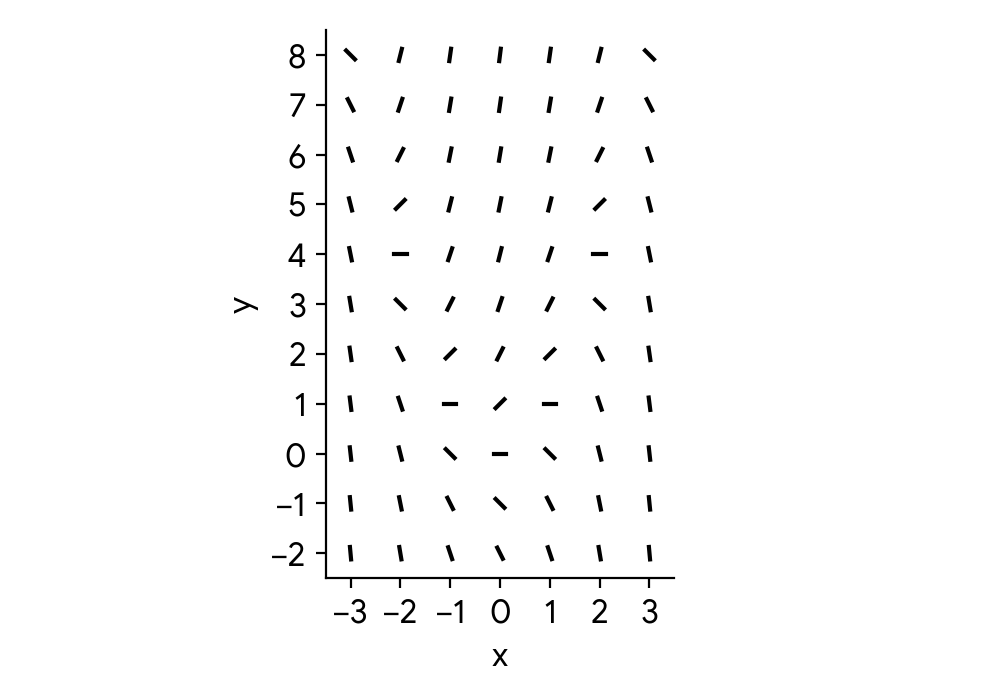
Some of the solutions to the differential equation have a local maximum point and a local minimum point.
Write down the equation of the curve on which all these maximum and minimum points lie.
Sketch this curve on the slope field.
The solution to the differential equation that passes through the point (0, 1) has both a local maximum point and a local minimum point.
On the slope field, sketch the solution to the differential equation that passes through (0, 1).
Recall that local maximum or minimum points occur where the derivative is equal to zero. Set the given differential equation to zero and solve for y in terms of x.
Plot a few points for the curve , such as (0,0), (1,1), (-1,1), (2,4), (-2,4), and then draw a smooth parabola through them on the provided slope field.
Start at the point (0, 1) and follow the direction of the slope lines. Remember that local maximum and minimum points must lie on the curve that you sketched in part (a.ii).
Question 2
MediumPaper 2 · calculator13 marksA biologist is modeling the population growth rate of two interacting species, and , in a confined ecosystem. The rate of change of species with respect to species is described by the differential equation , where and represent the populations of species and respectively, and .
In a slope field, an isocline is defined as a curve on which the gradient is constant. In other words, an isocline is a curve where , with a constant.
(a) State which of the following equations are isoclines of the above differential equation.
(i)
(ii)
(iii)
(iv)
(v)
(b) Determine whether the solution to the differential equation , has any turning points. Justify your answer.
Substitute the given equation for into the differential equation and simplify. If the result is a constant, it is an isocline.
Substitute the given equation for into the differential equation and simplify. If the result is a constant, it is an isocline.
Substitute the given equation for into the differential equation and simplify. If the result is a constant, it is an isocline.
Rearrange the given equation to isolate a term that appears in the differential equation, then substitute.
Substitute the given equation for into the differential equation and simplify. If the result is a constant, it is an isocline.
Turning points occur where the gradient is zero. Set and solve for in terms of . Remember the constraints .
Question 3
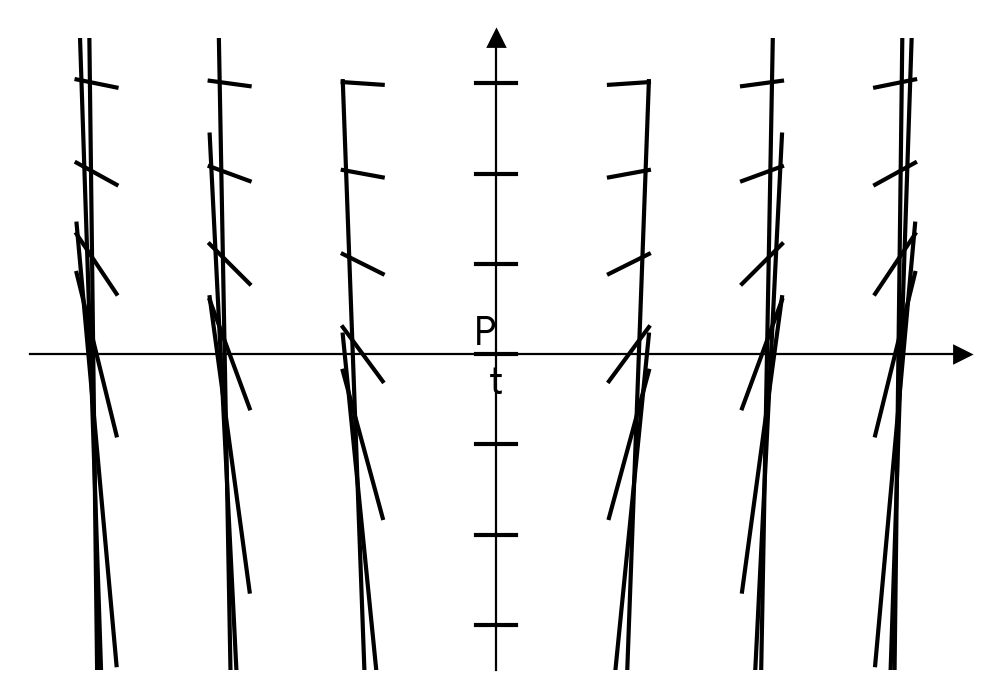
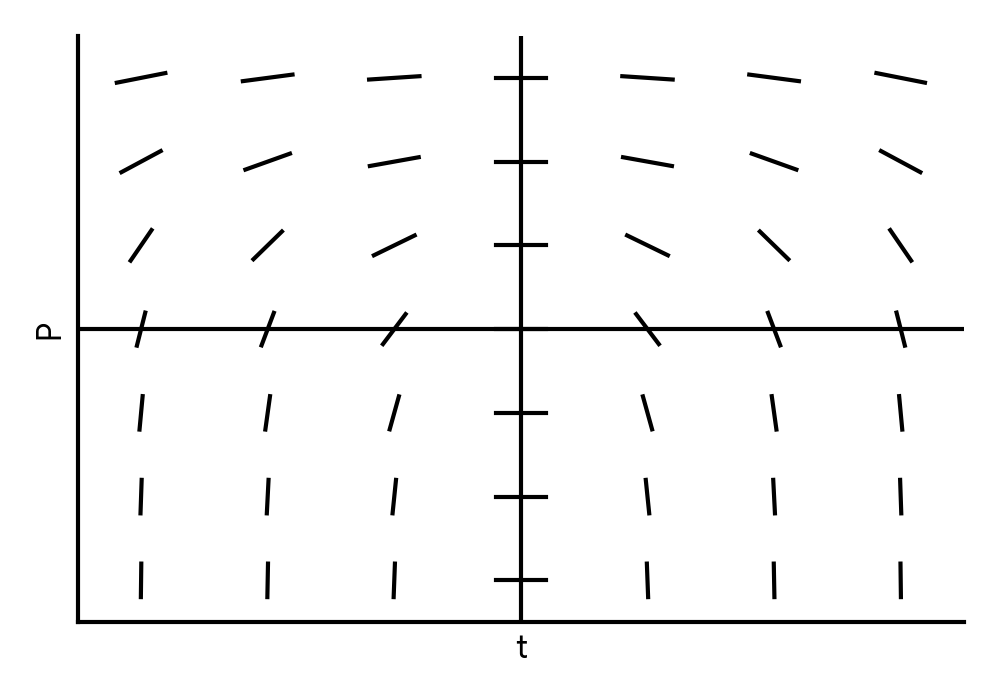
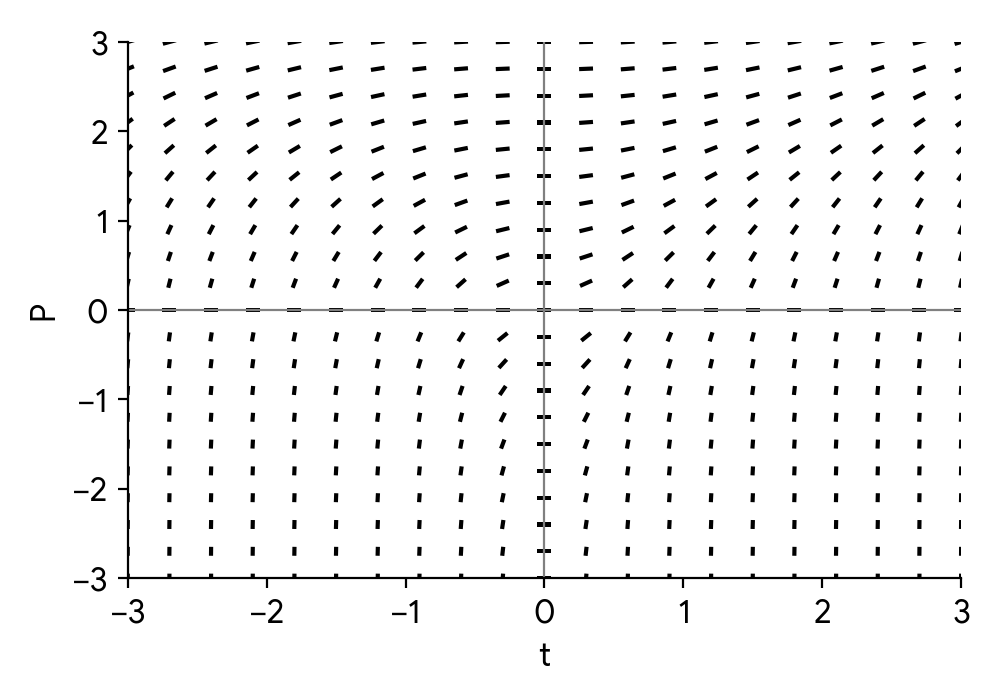
MediumPaper 2 · calculator13 marksA biologist is studying the growth of a new bacterial colony in a controlled environment. The rate of change of the population with respect to time is modelled by the differential equation , where is the population size (in thousands) and is the time in hours.
(a) Identify which of the following diagrams, A, B or C, represents the slope field for the differential equation. Give a reason for your answer.
(b) It is given that, at time hours, the initial population is (in thousands). Find an expression for , in terms of , for this solution.
(c) Find , in terms of , by differentiating your answer from part (b).
(d) Hence verify that your answer to part (b) is a solution to .
Consider the sign of for different values of and . What happens when ? How does the slope change as increases?
Separate the variables and to integrate both sides. Remember to include the constant of integration and use the initial condition to find its value.
Use the chain rule to differentiate . Remember that the derivative of is .
Substitute the expression for from part (b) into the original differential equation's right-hand side, and compare it with the you found in part (c).
No question on this page matches those filters. Try another difficulty or paper.
Every Slope fields question, marked for you
Every answer is marked mark by mark, IB-style, and the AI tutor helps when you are stuck.
Where marks are lost
- Answering to the wrong accuracy. Two significant figures, or six, where the rule says exactly or three. Common wherever a GDC's full decimal display gets copied straight down.
- Rounding an intermediate value and then using it in a later part. Costs a mark every time, and AI's multi-part modelling questions give it more chances to happen than AA's shorter, more self-contained ones.
- Writing the answer and nothing else, where the mark scheme has an explicit M1 rather than an implied one. A bare answer cannot score full marks there.