Kinematics: notes and practice questions
- Kinematics: mathematical modeling and analysis of object motion.
- Displacement ( or ): vector, position relative to start.
- Distance: scalar, total length travelled, always positive.
- Velocity (): vector, rate of change of displacement.
- Speed: scalar, magnitude of velocity.
- Acceleration (): vector, rate of change of velocity, gradient on velocity-time graph.
- Time (): scalar, for initial conditions.
- Units: (m), (m/s), (m/s), (s).
- Velocity (HL):
- Acceleration (HL):
- Acceleration (HL, if is function of ):
- Displacement (HL):
- Velocity (HL):
- Dot notation for time derivatives (HL): (velocity), (acceleration).
- Constant velocity: Use linear vector models, e.g., .
- Variable velocity (HL): Use calculus (differentiation/integration).
- Find integration constant () (HL): Use boundary/initial conditions ().
- GDC for distance (HL): Use definite integral for area between velocity-time graph and axis (all sections positive).
- Vector components (HL): Integrate/differentiate each component individually.
- Calculus-based kinematics (differentiation, integration, , vector kinematics) is HL only.
- Distance vs. Displacement (HL trap): Displacement = direct integral; Distance = account for direction changes (), sum positive areas.
- Contextual clues: "Constant speed" linear vectors; "accelerating" calculus.
- Phase portraits (HL): If is displacement, is velocity.
- For (HL): and .
- For (HL): .
How it is examined
A multi-part question that moves between the three quantities via differentiation and integration, usually finishing by asking for total distance over an interval where the object changes direction, which forces the split-and-absolute-value step from AHL 5.12. Reporting displacement when the question asks for total distance, or the reverse, is the most reliable way to lose the final marks on an otherwise complete answer.
, , displacement and total distance as the definite integrals above, and the dot notation.
- Displacement , velocity and acceleration , where and .
- Displacement .
- Total distance travelled .
- Speed as the magnitude of velocity.
Linking questions
- Links to other subjects: kinematics (physics).
- International-mindedness: does including kinematics as core mathematics reflect a particular cultural heritage? Who decides what counts as mathematics?
- TOK: what is the role of convention in mathematics, and is it similar to or different from the role of convention in other areas of knowledge?
Practice questions
24 questions · 1 easy · 18 medium · 5 hardQuestion 1
EasyPaper 1 · calculator7 marksIf the velocity, , of a particle, starting from the origin, at time, seconds, is .
Find the displacement equation.
Find acceleration after 1 second.
Remember that displacement is the integral of velocity.
Remember that acceleration is the derivative of velocity with respect to time
Question 2
MediumPaper 1 · calculator8 marksA high-speed drone is being tested, and its acceleration, , is modelled by the function , where is the speed of the drone in m/s and is the time in seconds, for seconds.
Determine whether the speed of the drone is increasing or decreasing at seconds.
It is observed that when seconds, the speed of the drone is m/s.
Find an expression for the function .
Recall that the sign of the derivative tells you whether the original function is increasing or decreasing. If , the speed is increasing. If , the speed is decreasing.
To find the original function from its derivative , you need to integrate. Remember to include the constant of integration, and use the given initial condition to find its value.
Question 3
HardPaper 1 · calculator7 marksA water jet is launched from a fountain with an initial speed of m/s. After seconds, the jet is descending at an angle of to the horizontal.
Find the possible angles of projection of the water jet, giving your answers in degrees to one decimal place, for . Assume the acceleration due to gravity is m/s.
Recall the kinematic equations for projectile motion, specifically how to express the horizontal and vertical components of velocity at any given time. The angle of descent relates the magnitude of these velocity components. Remember that for descending motion, the vertical velocity component will be negative.
Question 4
MediumPaper 1 · calculator9 marks(a) A drone's vertical velocity, metres per second, at time seconds, is given by .
Find an expression for the vertical acceleration of the drone.
(b) Hence, or otherwise, find its greatest vertical acceleration for seconds.
(c) The drone starts at ground level (displacement is 0). Find an expression for the vertical displacement of the drone.
(d) Hence show that the drone never descends below ground level.
Recall the product rule for differentiation: if , then . Also, remember the chain rule for differentiating composite functions like .
You will need to use your GDC to find the maximum value of the acceleration function over the given interval. Plot the acceleration function and use the maximum-finding feature.
Displacement is the integral of velocity with respect to time. You will need to use a substitution method for integration. Remember to use the initial condition to find the constant of integration.
Consider the range of the cosine function. How does this affect the range of your displacement function? Ground level corresponds to a displacement of zero.
Question 5
HardPaper 2 · calculator15 marksA drone is launched vertically upwards from a platform. Its vertical velocity, , at time seconds, is given by the function:
, for .
Find the times when the drone is momentarily at rest.
Find the magnitude of the drone's vertical acceleration at seconds.
Find the greatest speed of the drone in the interval .
The drone starts from an initial height of metres above the ground. Find an expression for the height of the drone, metres, above the ground at time seconds.
Find the total distance travelled by the drone in the interval .
The drone is momentarily at rest when its vertical velocity is zero. Set the velocity function equal to zero and solve for .
Acceleration is the derivative of velocity with respect to time, . Differentiate the given velocity function and then substitute . Remember to find the magnitude.
Speed is the magnitude of velocity, . The greatest speed can occur at the endpoints of the interval or at a critical point where acceleration is zero. Evaluate at these points and find the maximum absolute value.
Height is the integral of velocity with respect to time, . Use the initial condition to find the constant of integration.
Total distance travelled is the integral of the speed, . Remember that velocity can change sign, so you might need to split the integral at points where . The roots of are and .
Question 6
MediumPaper 1 · calculator4 marksTwo autonomous exploration robots, Alpha and Beta, are navigating a straight linear path starting from a central hub, point H. Robot Alpha leaves H at seconds, and its displacement ( metres) from H at time seconds is given by the equation
, for .
Robot Beta, a newer model, leaves H at seconds.
After starting its motion, Robot Beta covers any given distance in one-third of the time Robot Alpha would take to cover the same distance.
(a) Write down the equation for the displacement of Beta, , in terms of .
(b) Find the value of at which Robot Beta catches up with Robot Alpha.
Consider how the time taken by Robot Beta to cover a distance relates to the time Robot Alpha would take, and account for Robot Beta's delayed start.
To find when Robot Beta catches up with Robot Alpha, set their displacement equations equal to each other and solve for . Remember to check the domain of your solution.
Question 7
HardPaper 2 · calculator35 marks(a) The position vector of Drone A at time seconds is given by , where displacement is measured in metres.
(i) Find an expression for the velocity of Drone A at time .
(ii) Hence, find the speed of Drone A when seconds.
(b) (i) Find an expression for the acceleration of Drone A at time .
(ii) Show that the acceleration of Drone A is always directed towards the origin.
(c) The position vector of a second drone, Drone B, is given by .
For , find the time when the two drones are closest to each other.
(d) At time , where , Drone B is moving parallel to Drone A.
(i) Find the value of .
(ii) At time , show that the two drones are moving in the opposite direction.
To find the velocity vector from the position vector, differentiate each component with respect to time. Remember to apply the chain rule for functions like and .
Speed is the magnitude of the velocity vector. Substitute the given time into your velocity expression and then calculate its magnitude using the Pythagorean theorem.
Acceleration is the derivative of the velocity vector with respect to time. Differentiate each component of the velocity vector you found in part (a.i).
To show that acceleration is directed towards the origin, demonstrate that the acceleration vector is a negative scalar multiple of the position vector, i.e., where .
First, find the relative position vector . Then, find the magnitude of this vector, , which represents the distance between the drones. Use your GDC to find the minimum value of this distance function within the given time interval.
Two vectors are parallel if one is a scalar multiple of the other, or if their slopes are equal. First, find the velocity vector for Drone B. Then, set up an equation using the condition for parallel vectors and solve for using your GDC.
Substitute the value of found in part (d.i) into both velocity vectors. If the drones are moving in opposite directions, one velocity vector should be a negative scalar multiple of the other.
Question 8
MediumPaper 1 · calculator11 marks(a) The profile of a section of a mountain trail can be modelled by the function , where is the altitude in hundreds of metres and is the horizontal distance in hundreds of metres. Find the gradient of the trail at the point where the horizontal distance is (and the altitude is ).
(b) A company's profit, , in thousands of dollars, from selling units of a new product is modelled by the function . Find the number of units at which the profit's rate of change is zero. State the corresponding profit for each of these values of .
(c) The concentration of a certain chemical in a solution, , measured in milligrams per litre, is modelled by the function , where is the time in minutes after the chemical is added. Find the rate of change of the concentration with respect to time at the instant when minutes.
To find the gradient of the curve, you need to differentiate the function with respect to and then substitute the given -value into the derivative.
The rate of change of profit is given by the derivative of the profit function, . Set to find the values of where the rate of change is zero. Then substitute these -values back into the original profit function to find the corresponding profit.
The rate of change of concentration with respect to time is given by the derivative of with respect to . Differentiate the function and then substitute into the derivative.
Question 9
HardPaper 2 · calculator14 marks(a) A drone launches a rescue package from an initial position of metres, relative to an origin on the ground. The package is launched with an initial speed of at an angle to the horizontal ground, where .
The velocity components of the package, seconds after it is launched, are given by and .
Find an expression for , the horizontal displacement from the origin, in terms of and .
(b) It is given that the vertical displacement of the package from the ground is . When the package hits the ground, show that .
(c) Let be the value of when the package hits the ground.
Find an expression for in terms of only.
(d) Hence, find the value of which maximizes the value of .
(e) The model is adapted to account for a horizontal wind with speed acting in the opposite direction to the initial horizontal motion.
(i) In this new model, the horizontal velocity component is . The time taken for the package to hit the ground remains .
Find an expression for , the value of when the package hits the ground, in terms of only.
(ii) Hence, find the value of which maximizes the value of .
To find the position from the velocity component , you need to integrate with respect to . Remember to include the initial horizontal position as the constant of integration.
The package hits the ground when its vertical displacement is equal to zero. Solve the equation for . Remember that represents the launch time.
Substitute the expression for (from part (b) ) into your expression for (from part (a) ).
Recall the trigonometric identity . This can simplify the expression for . The maximum value of is . Consider what value of makes within the given domain for .
First, integrate the new horizontal velocity component to find the new expression for , including the initial position. Then, substitute the time when the package hits the ground into this new expression.
To maximize , you need to find the derivative of with respect to and set it to zero. Remember to use the chain rule for or product rule for . You will likely end up with a quadratic equation in terms of . Alternatively, use your GDC to graph the function and find the maximum.
Question 10
MediumPaper 1 · calculator10 marks(a) A drone's displacement, metres, from a fixed charging station after minutes (where ) is given by the equation .
Calculate the distance travelled by the drone in the first 3 minutes.
(b) Find an expression for the velocity, , of the drone. Hence, determine if the drone ever becomes stationary for .
To find the distance travelled, first determine the displacement at the start and end of the interval. Then, consider if the drone changes direction within the interval by checking its velocity.
Recall the rules for differentiation, especially the quotient rule for rational functions and the chain rule for logarithmic functions. A drone is stationary when its velocity is zero.
Question 11
HardPaper 3 · calculator29 marksA robotic system is designed to launch small spherical 'seed pods' into a series of elevated collection bins. The robot is positioned at the origin, O, of a coordinate system on a horizontal platform. In this system, and represent the horizontal and vertical displacement from O, measured in metres.
Bin is the closest collection bin to the robot. The coordinates of the centre of bin are .
Each subsequent bin is m further from O horizontally and m higher than the bin in the row below it. Let bin be the bin in row .
Write down the coordinates of the centre of bin .
Find, in terms of , the coordinates for the centre of bin .
While in motion, a seed pod can be treated as a projectile.
Let be the time, in seconds, after a seed pod is launched.
At any time , the acceleration of the seed pod, in m s, is given by the vector
The initial velocity, in m s, of the seed pod is given as , where is the angle to the horizontal at which the seed pod is launched and .
Find an expression for the velocity, , at time .
Hence show that when the seed pod is launched vertically, the time for it to reach its maximum height is seconds.
The displacement of the seed pod, seconds after it is launched, is given by the vector equation
Using the given answer to part (b)(ii) or otherwise, find the maximum height reached by a seed pod when it is launched vertically.
If there were no bins to block its path, and the seed pod was launched at an angle , show that the value of when it would hit the ground is given by the expression
.
Hence find the maximum possible value for if there were no bins to block the path of the seed pod.
In order to calculate which bins can be reached by a seed pod, it is required to find the equation of the curve that forms the boundary of all the points that can be reached. This boundary is represented by a parabolic curve , with its vertex on the -axis.
Using your answers to parts (c) and (d)(ii), or otherwise, find the value of .
Find the value of .
Find the value of .
A technician is considering placing a special sensor in bin .
Show that it is not possible for a seed pod to ever reach bin .
Identify the initial coordinates and the constant horizontal and vertical increments. Apply these increments for the specified number of rows.
Recognize that the horizontal and vertical coordinates form arithmetic sequences. Use the formula for the -th term of an arithmetic sequence, .
Integrate the acceleration vector with respect to time to find the velocity vector. Use the initial velocity components as constants of integration.
For vertical launch, . The maximum height is reached when the vertical component of velocity is zero.
Substitute the time to reach maximum height (from part b.ii) and into the vertical displacement equation.
The seed pod hits the ground when its vertical displacement is zero. Solve for when and substitute this time into the horizontal displacement equation.
Recall the trigonometric identity . The maximum value of is .
The vertex of the boundary parabola on the -axis corresponds to the maximum height achieved when launched vertically.
If the vertex of a parabola is on the -axis, what does this imply about the axis of symmetry and the value of ?
The maximum horizontal range (from part d.ii) corresponds to an -intercept of the boundary parabola when . Use this point and the values of and to solve for .
First, find the coordinates of bin using your expression from part (a.ii). Then, substitute the -coordinate of into the equation of the boundary parabola (from part e) to find the maximum possible height at that horizontal distance. Compare this maximum height with the actual height of bin .
Question 12
MediumPaper 2 · calculator20 marksThe graph below represents the vertical velocity , in metres per second, of a drone over the time interval to seconds. Positive velocity indicates upward motion.
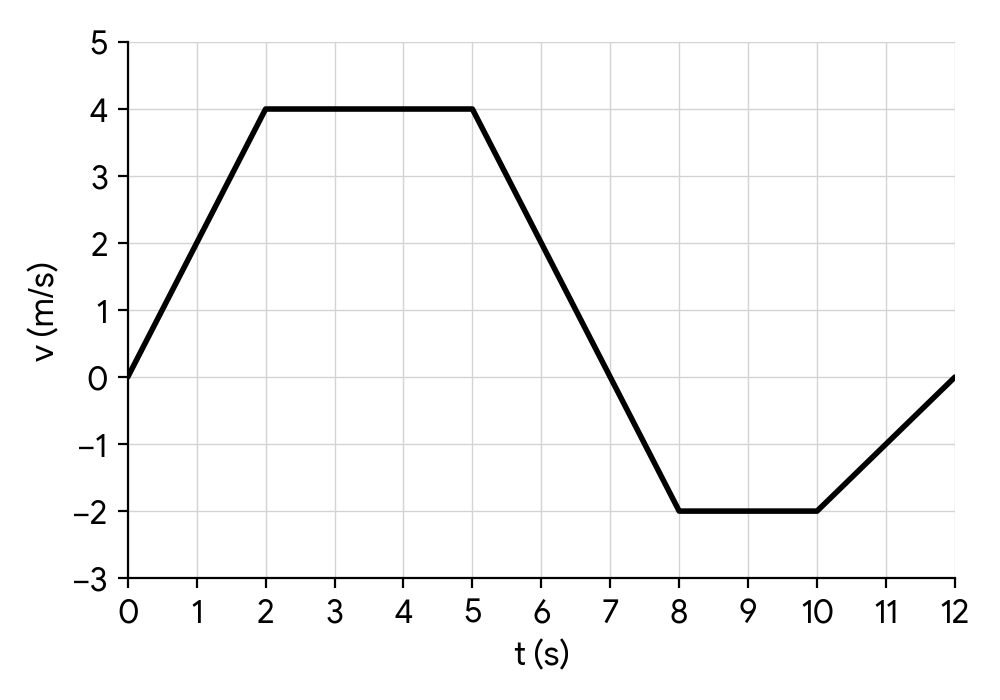
At , determine whether the drone is moving upwards or downwards.
Find the interval(s) in which the drone is moving i upwards ii downwards.
Explain your answer.
At , determine whether the drone's acceleration is positive or negative.
Describe the motion of the drone in each of the intervals , , , and in terms of its vertical direction, velocity, and acceleration.
Determine the time in the given interval when the drone reaches its maximum height.
The direction of motion is determined by the sign of the velocity. Positive velocity means upwards, negative velocity means downwards.
The drone moves upwards when its vertical velocity is positive () and downwards when its vertical velocity is negative ().
Acceleration is the gradient of the velocity-time graph. A positive gradient means positive acceleration, and a negative gradient means negative acceleration.
For each interval, consider the sign of the velocity (direction), whether the speed is increasing or decreasing (magnitude of velocity), and the sign of the acceleration (gradient of the graph).
The maximum height (maximum displacement from the starting point) occurs when the velocity changes from positive to negative. Calculate the area under the velocity-time graph up to this point.
Question 13
MediumPaper 1 · calculator6 marksA high-altitude drone is flying along a path described by the curve , where and are measured in metres. As the drone passes through the point , its horizontal position (-coordinate) is increasing at a rate of .
Determine the rate of change of the distance between the origin and the drone at this point.
Start by defining the distance between the origin and the drone's position . Then, use implicit differentiation with respect to time and the chain rule to find . Remember to find first.
Question 14
MediumPaper 2 · calculator12 marksA particle is moving through a viscous fluid. Its acceleration, , at time is given by .
(a) Find an expression for the velocity of the particle, , as a function of time , given that the particle started from rest.
(b) Find an expression for the displacement of the particle, , as a function of time , given that the particle started from the origin.
(c) Write down the limiting velocity of the particle as gets very large.
(d) Find the particle's displacement 30 seconds after it begins to move.
Recall that velocity is the integral of acceleration with respect to time. Use the initial condition to find the constant of integration.
Recall that displacement is the integral of velocity with respect to time. Use the initial condition to find the constant of integration.
Consider the behaviour of the exponential term as .
Substitute into your displacement expression from part (b).
Question 15
MediumPaper 2 · calculator14 marksA drone's acceleration is given by the vector , where is the time in seconds.
Initially, at , the drone is hovering at a position metres and has an initial velocity of m/s.
In terms of , find an expression for the drone's velocity .
In terms of , find an expression for the drone's displacement .
When seconds, find the drone's velocity.
When seconds, find the drone's displacement.
Remember that velocity is the integral of acceleration with respect to time. Don't forget to use the initial velocity to find the constant of integration.
Displacement is the integral of velocity with respect to time. Use the initial position to determine the constants of integration.
Substitute into your expression for from part (a.i).
Substitute into your expression for from part (a.ii).
Question 16
MediumPaper 2 · calculator13 marks(a) A weather satellite is in a circular orbit around a planet. Its velocity vector, relative to a fixed ground station, is given by
m/s
where is the time in seconds. Distances are measured in metres.
Find its acceleration vector .
(b) At time seconds, the satellite is at the position m. Find its displacement vector .
(c) When the vertical acceleration of the satellite is zero, find the possible positions for the satellite.
(d) State how many complete orbits the satellite makes in one minute.
To find the acceleration vector from the velocity vector, you need to differentiate each component of the velocity vector with respect to time . Remember the chain rule for differentiating trigonometric functions.
To find the displacement vector from the velocity vector, you need to integrate each component with respect to time . Don't forget the constants of integration, which can be found using the given initial position.
Set the vertical component of the acceleration vector (from part a) to zero and solve for . Then substitute these values of back into the displacement vector (from part b) to find the corresponding positions.
The angular frequency is related to the period by . The number of orbits in a given time is the total time divided by the period of one orbit.
Question 17
MediumPaper 1 · calculator7 marksA deep-sea exploration probe is launched from a research vessel. Its velocity vector, , at time seconds after launch, is given by
m/s.
At the moment of launch (), the probe's initial position relative to a fixed origin is m. Find the position vector, , of the probe at time .
Find the distance of the probe from the origin when seconds.
To find the position vector from the velocity vector, you need to integrate each component of the velocity vector with respect to time. Remember to include constants of integration for each component and use the initial position to find their values.
Substitute into the position vector found in part (a) to get the probe's position at that time. Then, calculate the magnitude of this position vector to find its distance from the origin.
Question 18
MediumPaper 1 · calculator8 marksA small drone takes off vertically from a launch pad. Its vertical velocity, , in metres per second, at time seconds, is given by , for . The drone next comes to instantaneous rest when .
(a) Determine the value of .
(b) Find the maximum vertical velocity of the drone during the interval .
(c) Calculate the total vertical distance travelled by the drone during the interval , and hence find its average speed during this interval.
For a particle to be at instantaneous rest, its velocity must be zero. Set the given velocity function equal to zero and solve for . Remember to find the first positive value of that satisfies this condition.
To find the maximum velocity, you need to find the critical points by setting the derivative of the velocity function (acceleration) to zero. Evaluate the velocity at these critical points and at the endpoints of the interval to find the maximum. Alternatively, use a GDC to find the maximum of the velocity function within the given interval.
The total distance travelled is the integral of the speed (absolute value of velocity) over the given time interval. Since velocity is non-negative in the interval , you can directly integrate . Average speed is calculated by dividing the total distance travelled by the total time taken.
Question 19
MediumPaper 1 · calculator18 marksA particle's position, metres, at time seconds, is given by the function . For each of the following position functions, determine the velocity function, , and find the instantaneous velocity of the particle at seconds.
(a)
(b)
(c)
(d)
(e)
(f)
Recall that velocity is the derivative of position with respect to time. For a constant function, the derivative is zero.
Remember the power rule for differentiation: . The derivative of a constant is zero.
Apply the power rule to each term in the polynomial. Then substitute into the velocity function.
Differentiate each term using the power rule. Be careful with the signs and coefficients.
Rewrite the term as before differentiating. Then apply the power rule.
Remember to rewrite terms like using negative exponents before differentiating.
Question 20
MediumPaper 1 · calculator5 marks(a) A drone is ascending vertically. Its velocity, , in m/s, at time seconds, is given by for .
Given that the drone starts from the ground (origin), find an expression for its displacement from the ground after seconds.
(b) Hence, find the distance travelled by the drone during the fifth second of its ascent.
To find the displacement function from the velocity function, you need to integrate the velocity function with respect to time. Remember to consider the initial condition that the drone starts from the ground.
The 'fifth second' refers to the time interval from seconds to seconds. Use the displacement function found in part (a) to calculate the displacement at these two times and then find the difference.
No question on this page matches those filters. Try another difficulty or paper.
4 more Kinematics questions in the app
Every answer is marked mark by mark, IB-style, and the AI tutor helps when you are stuck.
Where marks are lost
- Using your own wrong value after failing a "show that." All follow through is withdrawn for the rest of that question.