Developing, fitting, validating and interpreting mathematical models: notes and practice questions
- Mathematical Model: Simplifies real-world situations for mathematical description and prediction.
- Assumptions: Simplify mathematics (e.g., ignoring air resistance).
- Extrapolation: Making predictions outside the range of given data, generally inaccurate and unreliable.
- Refining Models: Improve by incorporating new information or adjusting to better fit real-world data.
- Initial Value: The value of the function when the independent variable (usually or ) is 0.
- Linear Models: , where is the constant rate of change and is the initial value.
- Quadratic Models: , where is the initial value. Axis of symmetry/x-coordinate of min/max: .
- Cubic Models: , where is the initial value and has the biggest impact on the rate of change.
- Exponential Models: , where the initial value is and is the horizontal asymptote.
- Sinusoidal Models: , where is the amplitude, is the principal axis, and the period is .
- Logarithmic Models (HL): , valid only for .
- Logistic Models (HL): , where is the limiting capacity (horizontal asymptote as ).
- Inverse Variation: Model as .
- Developing Models: Form equations by substituting given data points into the model's equation to find parameters.
- Solving Parameters: Solve systems of simultaneous equations (up to 3 unknowns with GDC) to find unknown parameters.
- Regression: Fit linear or non-linear models (quadratic, cubic, exponential, sinusoidal) to bivariate data using GDC regression functions.
- Model Validation: Check if answers are appropriate for the given situation (e.g., population cannot be negative).
- Domain Restrictions: Pay attention to context-based restrictions (e.g., time ).
- Evaluating Fit: Visually assess model fit by plotting a scatter diagram of raw data and overlaying the regression model graph on GDC.
- GDC Sketching: Use GDC to plot functions, adjusting zoom/axes to see relevant parts of the graph.
- GDC Exact Values: Store or use full display values of regression parameters to avoid compounding rounding errors.
- GDC Solver: Use the built-in simultaneous equation solver for finding parameters from multiple equations.
How it is examined
This is where AI's marks-per-minute problem lives. The questions are wordy, the answers are short, and a lot of the marks are for judgement rather than calculation: choosing the model, saying whether the domain makes sense, saying whether a prediction is trustworthy. "Justify the choice of model" and "comment on the reasonableness" are worth one or two marks each and need a sentence that refers to the data or the context, not a generic statement. The extrapolation warning is a recurring one-mark answer.
- Develop and fit the model. Given a context, recognise and choose an appropriate model and possible parameters. Determine a reasonable domain for a model.
- Find the parameters of a model.
- Test and reflect upon the model. Comment on the appropriateness and reasonableness of a model. Justify the choice of a particular model, based on the shape of the data, the properties of the curve, and the context of the situation.
- Use the model. Read, interpret and make predictions based on the model.
At SL, students will not be expected to perform non-linear regressions, but will be expected to set up and solve up to three linear equations in three variables using technology. Non-linear regression is AHL 4.13.
Linking questions
- Links to other subjects: opportunities to model as part of experimental work (science).
- TOK: what makes a mathematical model effective? Is simplicity a desirable characteristic in models?
Practice questions
85 questions · 1 easy · 69 medium · 15 hardQuestion 1
EasyPaper 1 · calculator4 marksThe population of a certain species of fish in a lake is decreasing due to pollution, and the population at any time (in years) after the pollution started is given by the function:
Where is the population of fish in the lake at time .
Find:
The initial population of fish in the lake.
The percentage decrease in the fish population each year.
Calculate the population of fish in the lake after 4 years.
Set and evaluate the function.
Find the population at and calculate the percentage decrease from the initial population.
Substitute into the function
Question 2
MediumPaper 1 · calculator8 marksA chemical compound is dissolving in a solvent. Initially, there are 225 grams of the compound. After 15 minutes, 144 grams of the compound remain undissolved.
The mass of the undissolved compound, M grams, remaining after t minutes, can be modelled by the differential equation , where k is a positive constant.
(a) Show that .
(b) Calculate the time it takes for the entire compound to dissolve.
Separate the variables and integrate. Remember to use the initial conditions to find the constant of integration and then the value of k. The process is similar to solving an initial value problem for a differential equation.
The compound is entirely dissolved when its mass M becomes zero. Use the equation derived in part (a).
Question 3
HardPaper 2 · calculator22 marksThe concentration of a certain chemical, , in a solution over a period of time can be modelled using the function , where is the time in hours after the experiment begins.
Sketch the graph of for .
Find the concentration after hours.
Find the concentration after hours.
Find the maximum concentration and the time in hours at which this occurs.
Find the minimum concentration and the time in hours at which this occurs.
Find the times in hours when the concentration is mol/L.
Use your GDC to plot the function. Ensure your graph shows the correct domain and key features like intercepts and turning points.
Substitute into the given function .
Substitute into the given function .
To find the maximum concentration, you need to find the derivative of , set it to zero, and solve for . Then, evaluate at these critical points and the endpoints of the domain. Alternatively, use the 'maximum' function on your GDC.
Consider the values of at the critical points found in part (d) and at the endpoints of the domain ( and ). Alternatively, use the 'minimum' function on your GDC.
Set and solve the resulting cubic equation for . Use your GDC's solver or intersection feature.
Question 4
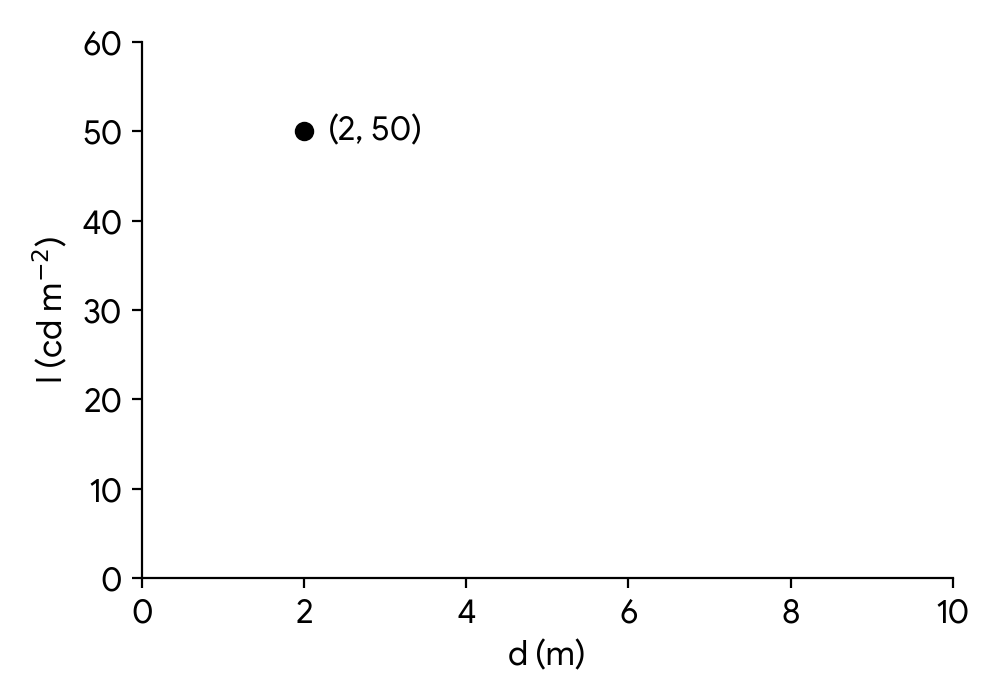
MediumPaper 1 · calculator7 marks(a) The intensity of light, I, from a lighthouse varies inversely with the square of the distance, d, from the lighthouse, where .
It is known that at a distance of 2 metres from the lighthouse, the light intensity is 50 candelas per square metre (cd m).
Show that .
(b) Sketch the curve of I on the axes below, showing clearly the point (2, 50).
(c) A small boat needs a light intensity greater than to navigate safely.
Find the values of d where the boat cannot navigate safely.
Recall the definition of inverse variation. Set up the general formula and use the given point to find the constant of proportionality.
Consider the general shape of an inverse square function. What happens to I as d gets very large? What about as d approaches 0? Make sure to label the given point.
Set up an inequality where the light intensity is less than or equal to the minimum required intensity. Remember that distance d must be positive.
Question 5
HardPaper 2 · calculator14 marksA drone launches a package, and its trajectory is modelled by the equation , where is the height of the package in metres and is the horizontal distance in metres from the launch point.
On paper, sketch the graph of the path that the package flies for . Clearly indicate the initial height, the maximum height, and the horizontal distance when it lands.
Find the height of the package when it has travelled a horizontal distance of metres.
Find the maximum height of the package.
Find the horizontal distance at which the package lands on the ground, and explain what this value represents in the context of the problem.
Identify the initial height (when ), the maximum height (vertex), and the point where the package lands (where ). Remember the general shape of a quadratic function with a negative leading coefficient.
Substitute the given horizontal distance into the function .
The maximum height of a quadratic function occurs at the vertex, where . Once you find this -value, substitute it back into the function to find the maximum height.
The package lands on the ground when its height is zero. Set and solve the quadratic equation for . Remember that horizontal distance must be positive.
Question 6
MediumPaper 1 · calculator7 marksA manufacturing company purchases a new specialized machine. The machine's value depreciates exponentially over time. The value of the machine, , in thousands of dollars, years after its purchase, is modelled by the function , for .
The initial value of the machine was 150 thousand dollars. After 3 years, its value had decreased by 40%.
(a) Find the value of .
(b) Calculate the value of the machine after 5 years and 6 months, giving your answer to two decimal places.
(c) The company believes that, according to this model, the machine will always have some residual value, however small.
State a mathematical reason why the company might believe this.
(d) Write down one possible limitation of the domain of the model.
The initial value of the machine corresponds to . If the value decreased by 40%, what percentage of the initial value remains after 3 years? Use this to set up an equation for .
Ensure the time is expressed in years for the model. Use the value of found in part (a).
Consider the behaviour of exponential functions as approaches infinity.
The domain is given as . Think about real-world scenarios that might make this model unrealistic for certain values of .
Question 7
HardPaper 2 · calculator16 marks(a) TechCraft Innovations starts with an annual production of drones. Due to market demand and efficiency improvements, the production increases by each year on the previous year's output.
Justify that the annual drone production over the years forms a geometric sequence, and state its common ratio.
(b) Determine TechCraft Innovations' annual drone production during the third year of operation.
(c) Find the total number of drones produced by TechCraft Innovations during the first years of operation, correct to the nearest whole number.
(d) After the initial offer, TechCraft Innovations considers an alternative production plan. They want to start with the same annual production of drones, but with a fixed annual increase of drones. The company's financial manager agrees to this new plan if the total production over the years remains the same as it was in the original geometric plan.
Determine the value of , correct to two decimal places, that satisfies the financial manager's conditions.
(e) Hence, determine the number of years for which the second plan (arithmetic) gives TechCraft Innovations a higher annual production than the first plan (geometric).
A geometric sequence is formed when each term is found by multiplying the previous term by a constant value. Consider how a percentage increase on the previous value translates into a multiplicative factor.
Use the formula for the -th term of a geometric sequence: . Remember that is the starting production.
Use the formula for the sum of the first terms of a geometric sequence: . Remember to round your final answer to the nearest whole number.
The total production for the arithmetic plan must equal the total production from the geometric plan (found in part c). Use the formula for the sum of an arithmetic series: . Solve for .
You need to compare the general term for both sequences: and . Test values of (from to ) to see when the arithmetic production exceeds the geometric production.
Question 8
MediumPaper 1 · calculator7 marksAn architect is designing a parabolic arch for a new building. The shape of the arch can be modelled by the function , where and are measured in metres. The highest point of the arch (the vertex) is at . One end of the arch is at the origin , and the other end is at .
(a) Find the value of .
(b) Find the value of
(i) .
(ii) .
(iii) .
(c) Write down the equation of the axis of symmetry of the arch.
Recall that the x-coordinate of the vertex of a parabola is exactly halfway between its x-intercepts.
You can use the factored form or the vertex form , or set up a system of equations using the given points.
Once you have the value of , substitute it back into the general form of the quadratic or the expanded factored form.
Once you have the value of and , substitute them back into the general form of the quadratic or the expanded factored form.
The axis of symmetry for a parabola passes through its vertex.
Question 9
HardPaper 2 · calculator16 marksA chemical engineer is studying the concentration of an intermediate product, , in a reaction vessel. The change in concentration over time (in minutes) is modelled by the second order differential equation:
where . It is known that when , the initial concentration is and the rate of change of concentration is .
Show that the system of coupled first order equations:
can be written as the given second order differential equation.
Find the eigenvalues of the system of coupled first order equations given in part (a).
Hence find the exact solution of the second order differential equation, given the initial conditions and .
Sketch the graph of against for , labelling the maximum point of the graph with its coordinates.
If the concentration of the intermediate product exceeds arbitrary units, the reaction needs to be monitored closely. Use the model to calculate the total amount of time (in minutes) during which the reaction needs to be monitored closely.
The chemical engineer decides to monitor the reaction for 15% longer than the time found from the model in part (e).
Write down one reason, with reference to the context, to support this decision.
Differentiate the first equation with respect to and then substitute the expression for into the resulting equation. Remember that is defined as .
Form the coefficient matrix for the system of first-order differential equations. Then, find the eigenvalues by solving the characteristic equation, .
For distinct real eigenvalues and , the general solution for is of the form . Use the initial conditions to find the values of and .
To find the maximum point, set the first derivative to zero and solve for . Then substitute this value of back into the equation for to find the maximum concentration.
You need to find the values of for which . Since this equation is transcendental, you will likely need to use a GDC to find the intersection points. Then, calculate the difference between these two time values.
Consider potential uncertainties or risks in a real-world chemical process that might not be fully captured by a simplified mathematical model.
Question 10
MediumPaper 1 · calculator7 marksThe diagram below shows a hot air balloon hovering at point H, m vertically above a landing pad.
Point A is the point on the ground, directly below the hot air balloon.
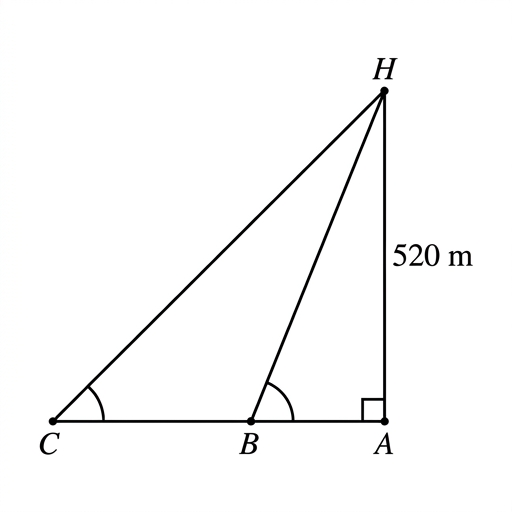
An observer starts walking at a constant speed from point C towards point A. From point C, the observer looks upward at the hot air balloon at an angle of elevation of . After minutes, the observer is at point B and observes the same hot air balloon at an angle of elevation of .
Write down the size of the angle of depression from H to C.
Find the horizontal distance from A to C.
Calculate the distance the observer walked from C to B.
Determine the observer's average speed, in metres per hour.
The angle of depression from H to C is equal to the angle of elevation from C to H due to alternate interior angles.
Consider the right-angled triangle formed by points H, A, and C. You know the height HA and the angle at C. Which trigonometric ratio relates these to AC?
First, find the distance from A to B using the new angle of elevation. Then, use the distance AC you found in part (b) to determine BC.
Speed is distance divided by time. Remember to convert the time from minutes to hours.
Question 11
HardPaper 2 · calculator24 marksA landscape architect is designing a new public park. The northern boundary of the park is modelled by the function , and other boundaries are straight lines. The plan view of the park is shown in the following diagram, where both axes represent distance and are measured in metres.
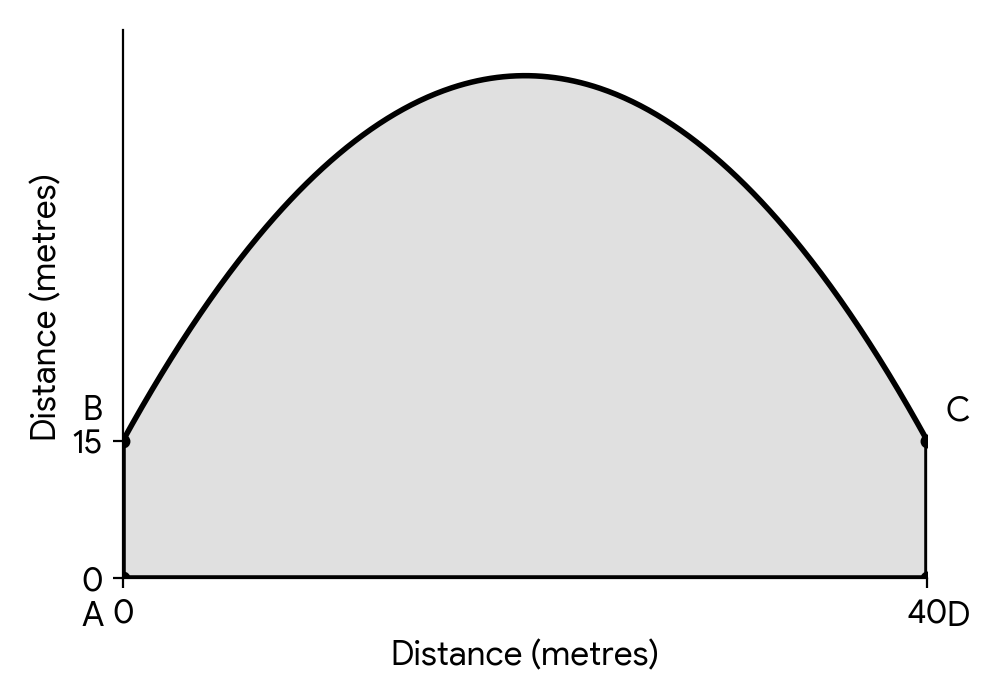
The function models the northern boundary of the park between points B and C and is given by
, for .
(i) Find .
(ii) Hence find the coordinates of the point on the park's northern boundary that is furthest north.
Point A has coordinates , point B has coordinates , point C has coordinates and point D has coordinates .
(i) Write down the integral which can be used to find the area of the shaded region representing the park.
(ii) Find the area of the park.
(i) A landscaper uses the trapezoidal rule with 4 intervals to estimate the area of the park. Calculate this estimate.
(ii) Calculate the percentage error in the landscaper's estimate.
(iii) Suggest how the landscaper might be able to reduce the error whilst still using the trapezoidal rule.
A square-shaped meditation garden, PQRS, is to be built within the park. The side [PS] lies on the southern boundary (x-axis), and the side [QR] lies on the eastern boundary of the park (). Point Q lies on the northern boundary curve .
(i) Find the x-coordinate of point P for the largest area of the meditation garden.
(ii) Find the largest area of the meditation garden.
Recall the power rule for differentiation: if , then . The derivative of a constant term is zero.
The point furthest north corresponds to the maximum value of . To find this, set the derivative to zero and solve for . Then substitute this -value back into to find the corresponding -coordinate.
The area under a curve from to is given by the definite integral . Identify the function and the limits of integration from the problem description.
Evaluate the definite integral you wrote down in part (b)(i). Use your GDC for calculation if allowed, or integrate term by term.
The trapezoidal rule formula is , where . For 4 intervals over , . Calculate at .
Percentage error is given by . Use the exact area from part (b)(ii) and the estimate from part (c)(i).
Consider how the number of intervals affects the accuracy of numerical integration methods like the trapezoidal rule.
Let the x-coordinate of P be . The side length of the square will be . Since Q lies on , its y-coordinate is . For a square, the side length must equal the height, so equate to and solve for . Remember that must be within the park's boundaries.
Once you have the x-coordinate of P, calculate the side length of the square using . Then square this side length to find the area.
Question 12
MediumPaper 1 · calculator7 marksLet the function represent the cost in dollars per display stand, where is the width of the stand in meters.
for .
Find the range of .
The function is the inverse function of .
Find .
In the context of the question, interpret your answer to part (b)(i).
Write down the range of .
To find the range of a function over a closed interval, evaluate the function at the endpoints of the interval. Consider whether the function is increasing or decreasing over that interval.
To find , you need to find the value of for which . Set up the equation and solve for .
Consider what the input and output of the original function represent. The inverse function reverses this relationship.
The range of an inverse function is the domain of the original function.
Question 13
HardPaper 2 · calculator17 marksEmily and Liam are researching the adoption of smart home devices in a specific region to create a model predicting future usage. They collect the following data:
| Year | Years after 2000 () | Number of devices (in thousands) () |
|---|---|---|
| 2000 | 0 | 10 |
| 2005 | 5 | 150 |
| 2010 | 10 | 400 |
| 2015 | 15 | 750 |
| 2020 | 20 | 1000 |
| 2025 | 25 | 1100 |
Emily proposes the number of devices can be modelled using quadratic regression to find a function of the form , where is the number of years after 2000.
Find the equation of Emily's model.
Emily finds the coefficient of determination for her model is to five significant figures.
State whether the coefficient of determination supports Emily's proposal. Justify your answer.
Comment on the validity of Emily's model with reference to one of the parameters in the equation.
(i) Find the value of and interpret this value in context.
(ii) By considering the changes in device adoption in the table, use the value found in part (d)(i) to comment on the validity of Emily's model.
Liam proposes that the device adoption instead follows a logistic model of the form
where is the number of years after 2000 and is the number of devices in thousands.
State a reason why it may be valid to use Liam's proposal to predict future device adoption.
(i) Find .
(ii) Hence find the year, according to Liam's model, during which the greatest device adoption growth rate occurred.
Use your GDC's regression features (e.g., QuadraticReg) to find the coefficients , , and . Ensure you input the 'Years after 2000' as your -values and 'Number of devices (in thousands)' as your -values.
Recall what a coefficient of determination () value close to 1 indicates about the model's fit to the data.
Consider the real-world implications of the values of or in the context of device adoption. Can the number of devices be negative, or can it decrease indefinitely?
For (i), differentiate with respect to to find , then substitute . The derivative represents the rate of change. For (ii), compare the model's predicted rate of change with the actual data in the table, especially for the period around .
Think about the long-term behaviour of logistic models, especially in the context of growth phenomena like technology adoption.
For (i), use the chain rule or quotient rule to differentiate . Remember that . For (ii), the maximum growth rate for a logistic function occurs when , where is the coefficient of in the denominator.
Question 14
MediumPaper 1 · calculator5 marksThe height of a diver above the water surface after jumping from a diving board is modelled by the function
where is the height in metres and is the time in seconds after the diver leaves the board.
(a) Write down the height of the diving board above the water surface.
(b) Find the value of when the diver enters the water. Give your answer to three significant figures.
(c) State an appropriate domain for in this model.
Consider the value of at the instant the diver leaves the board.
The diver enters the water when the height is zero. You will need to solve a quadratic equation.
The model starts when the diver leaves the board and ends when they enter the water.
Question 15
HardPaper 2 · calculator14 marksOn a particular day, the temperature, , in degrees Celsius, in the city of Solara can be modelled by the function
, where ,
and represents the number of hours after midnight.
The minimum temperature recorded is at () and the maximum temperature is at ().
Show that the value of is .
Find the temperature at ().
Write down
the amplitude of .
the equation of the principal axis.
An outdoor event can only proceed if the temperature is between and (inclusive). The event organizer uses a temperature sensor that has a possible error of .
The organizer wants to start setting up the event as soon as possible after ().
Determine the earliest time that it could be possible for the organizer to start setting up the event, ensuring that the actual temperature is certainly at or above . Give your answer to the nearest minute.
The event takes minutes for setup and minutes for pack-down. The organizer wants to maximize the actual operating time of the event, ensuring that the temperature remains within the safe range ( to ) throughout its entire duration (from the start of setup to the end of pack-down).
Determine the maximum possible length of time the event can actually operate, in hours, starting from the earliest setup time found in part (d).
The period of a cosine function in the form is when the angle is in degrees. Determine the period of the temperature cycle from the given information.
Substitute the value of into the given temperature model. Remember to use the value of found in part (a).
The amplitude of a sinusoidal function is .
The principal axis (or vertical shift) of a sinusoidal function is given by .
To be certain the actual temperature is at or above , the modelled temperature must be sufficiently higher to account for the sensor's possible error. Set up an inequality or equation and solve for . Remember to consider the phase shift and the desired time interval.
The entire period, from the start of setup to the end of pack-down, must satisfy both temperature conditions ( and ). Calculate the times when the temperature reaches these critical values. The total time for setup and pack-down must be subtracted from the continuous safe interval.
Question 16
MediumPaper 1 · calculator8 marksA new experimental drug is administered to a patient. The concentration of the drug in the patient's bloodstream, , in mg/L, hours after administration, is modelled by the function , where and are positive constants.
Initially, the concentration of the drug is mg/L. After hours, the concentration drops to mg/L.
Determine the value of .
Using this model, calculate the concentration of the drug in the bloodstream hours after administration.
Based on this model, will the drug ever completely leave the patient's bloodstream? Justify your answer.
State one limitation of the domain of this model in a real-world context.
Substitute the given initial conditions and the concentration after 2 hours into the model equation. Remember to use the natural logarithm to solve for k.
Use the value of found in part (a) and substitute into the model equation.
Consider the behavior of the exponential function as approaches infinity.
Think about what values of might not make sense in the real world for drug concentration. The given domain is .
Question 17
HardPaper 2 · calculator18 marksThe rate of change of pollution, (in tonnes per day), in a protected lake is modelled by , where is the time in days since monitoring began, for .
(i) Find the value of at days.
(ii) Interpret the meaning of your answer to part (a) (i) in context.
Use to find the value of when the pollution in the lake reaches its maximum level.
Two days after monitoring began, the pollution in the lake was tonnes.
Find an expression for in terms of , for .
Hence, find the maximum pollution level in the lake.
A second source of pollution, from a nearby factory, is modelled by , where is the pollution in tonnes and is the time in days, for .
Write down the initial pollution from this factory.
Each day, the pollution from the factory increases by %.
Find the value of .
Find the value of when the pollution from the initial lake source and the factory are the same.
Substitute the given value of into the expression for .
Consider what represents and what the positive value signifies.
The maximum level of pollution occurs when its rate of change is zero.
Integrate the expression for to find . Use the given condition to find the constant of integration.
Substitute the value of found in part (b) into the expression for found in part (c).
The initial pollution occurs at .
For an exponential growth model , the growth factor is . The percentage increase is .
Set the expressions for and equal to each other and solve using your GDC.
Question 18
MediumPaper 1 · calculator6 marksA car enthusiast, Mr. Henderson, purchases two classic cars for his collection. The first is a popular sedan, initially costing 75000, and is expected to depreciate at a rate of 15% per year.
(a) Estimate the value of the popular sedan after 4 years.
(b) Find the number of years, , after which both cars will have the same estimated value. Give your answer to three significant figures.
(c) Comment on the validity of your answer to part (b).
Recall the formula for compound depreciation: , where is the future value, is the principal amount, is the annual depreciation rate, and is the number of years.
Set up an equation where the future values of both cars are equal. You will need to use logarithms to solve for .
Consider real-world factors that might influence car values over a long period, beyond a simple depreciation model.
Question 19
HardPaper 2 · calculator14 marks(a) A manufacturing company uses a specialized machine to produce custom parts. The number of units produced, , in one day is modelled by
, for
where is the time the machine operates, in hours, on that day.
Find the time, in hours, it takes for the machine to produce 80 units in one day.
(b) The daily profit, , in thousands of dollars, from producing units is given by
, for .
Find the profit, in thousands of dollars, the company earns for producing 80 units.
(c) Find an expression for as a function of , giving your answer in the form
where is a number to be determined.
(d) Hence or otherwise, find the profit, in thousands of dollars, the company earns by operating the machine for 4 hours.
(e) Find the greatest profit, in thousands of dollars, the company can earn in one day.
(f) The company introduces a weekly bonus profit, , in thousands of dollars, for the total units produced in one week, , using
The company decides to operate the machine for the same length of time, hours, each day for 5 days a week.
They want to achieve a total weekly profit of 580 thousand dollars.
Find the value of .
To find the time for a given number of units , set the equation for equal to the given value and solve for . Remember to use the properties of logarithms and exponentials.
Substitute the given number of units into the profit function. Ensure your calculator is in the correct mode for exponential calculations.
Substitute the expression for in terms of into the profit function . Then, use logarithm properties, specifically and , to simplify the expression into the required form.
Use the composite function found in part (c) and substitute .
Consider the maximum operating time for the machine as stated in the problem's domain for .
The total weekly profit is the sum of the daily profits for 5 days plus the weekly bonus profit. Express in terms of , and then set up an equation for the total weekly profit. This equation will likely require a GDC to solve for .
Question 20
MediumPaper 1 · calculator7 marksA civil engineer is designing a parabolic arch for a pedestrian bridge. The arch starts at ground level at the origin (0,0) and reaches its maximum height of 5 meters at a horizontal distance of 10 meters from the start. The shape of the arch can be modelled by the function , where is the height of the arch above the ground in meters and is the horizontal distance in meters from the start of the arch.
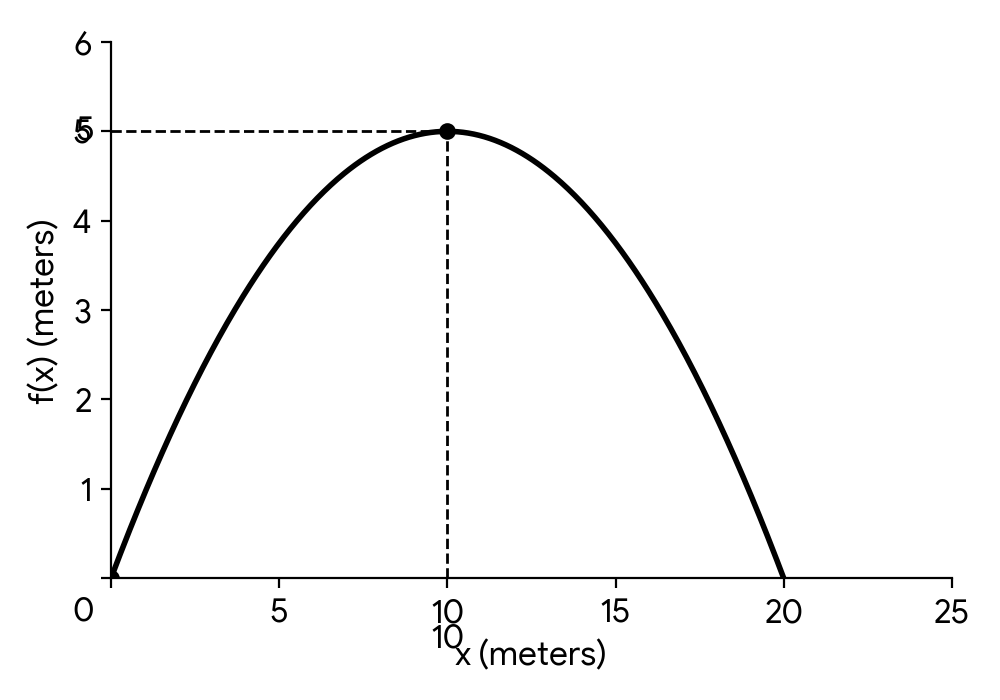
(a) Find the total horizontal span of the bridge, i.e., the x-coordinate where the arch meets the ground again.
(b) Determine the values of , , and .
(c) Write down the equation of the axis of symmetry of the parabolic arch.
Recall that a parabola is symmetrical about its axis of symmetry. The vertex lies on this axis.
You can use the vertex form of a quadratic function, , or the intercept form, . Substitute the known points to find , then expand to find and . Alternatively, set up a system of simultaneous equations using the points , , and .
The axis of symmetry of a parabola passes through its vertex.
No question on this page matches those filters. Try another difficulty or paper.
65 more Developing, fitting, validating and interpreting mathematical models questions in the app
Every answer is marked mark by mark, IB-style, and the AI tutor helps when you are stuck.
Where marks are lost
- Using your own wrong value after failing a "show that." All follow through is withdrawn for the rest of that question.
- Leaving an answer in calculator notation. Never accepted in a final answer, and AI's constant calculator use makes this the easiest slip in the whole subject.