Composite & inverse functions: notes and practice questions
- A composite function or applies one function to the output of another; the function closest to is applied first.
- For to be valid, the range of must be within the domain of .
- An inverse function reverses the effect of ; .
- Only one-to-one functions (pass the horizontal line test) have inverses.
- The identity property: and .
- The domain of is the range of , and the range of is the domain of .
- The graph of is a reflection of across the line .
- To find intersections of and , solve .
- To find algebraically:
1. Replace with .
2. Swap and .
3. Rearrange to make the new the subject.
4. Replace the new with .
5. For restricted domains, choose the correct root (e.g., positive or negative).
- GDC can evaluate composites directly (e.g., ) and graph them (e.g., ).
- Use GDC to check inverses by plotting , , and to verify reflection.
- Example: For and , .
- Example: For and , .
- Example: For with domain , with domain .
How it is examined
The phrase "in context" is doing work: an AI composite function question is normally two real processes chained, a conversion followed by a cost, rather than an abstract . Finding an inverse means rearranging, which is one of the few places this course asks for algebra. Domain restriction is the marking point that separates a full answer from a partial one, and students routinely give the inverse without saying which branch they kept.
- Composite functions in context.
- The notation .
- The inverse function , including domain restriction.
- Finding an inverse function.
Linking questions
- The guide lists no connections for AHL 2.7.
Practice questions
25 questions · 22 medium · 3 hardQuestion 1
MediumPaper 1 · calculator5 marksA new fertilizer is being tested on a specific plant species. The concentration of a key nutrient, , in the plant (in mg/L) is modelled by the function , where is the amount of fertilizer added (in grams). The amount of fertilizer used is restricted to , where (due to experimental constraints).
Find the range of the nutrient concentration .
Determine the amount of fertilizer that results in a nutrient concentration of mg/L. Give your answer in the form .
To find the range of a rational function over a restricted domain, evaluate the function at the endpoints of the domain. Also, consider the behavior of the function around any vertical asymptotes that lie within the given domain.
To find , you need to solve the equation for . Alternatively, you could find the inverse function first and then substitute .
Question 2
HardPaper 2 · calculator11 marksIn a controlled chemical experiment, the initial temperature, (in degrees Celsius), of a reactant mixture is adjusted before a reaction begins. The adjusted temperature, , is then used to determine the reaction rate, .
The adjustment function is given by , for .
State the range of .
The overall reaction rate, , as a function of the initial temperature , is modelled by , for .
State the range of .
The experiment is designed to achieve a specific 'target state' when the adjusted reaction rate equals 0. Solve the equation .
Determine the function .
Consider the type of function is and its domain. For a linear function with a domain of all real numbers, what is its range?
The function is a quadratic. Find the vertex of the parabola to determine its minimum value, which will define the lower bound of its range.
Recall that . Therefore, means substituting into the expression for . Once you have the expression for , set it to zero and solve the resulting quadratic equation.
You are given and . Let . Express in terms of . Then substitute this expression for into to find . Finally, replace with to get .
Question 3
MediumPaper 1 · calculator7 marksLet the function represent the cost in dollars per display stand, where is the width of the stand in meters.
for .
Find the range of .
The function is the inverse function of .
Find .
In the context of the question, interpret your answer to part (b)(i).
Write down the range of .
To find the range of a function over a closed interval, evaluate the function at the endpoints of the interval. Consider whether the function is increasing or decreasing over that interval.
To find , you need to find the value of for which . Set up the equation and solve for .
Consider what the input and output of the original function represent. The inverse function reverses this relationship.
The range of an inverse function is the domain of the original function.
Question 4
HardPaper 2 · calculator14 marks(a) A manufacturing company uses a specialized machine to produce custom parts. The number of units produced, , in one day is modelled by
, for
where is the time the machine operates, in hours, on that day.
Find the time, in hours, it takes for the machine to produce 80 units in one day.
(b) The daily profit, , in thousands of dollars, from producing units is given by
, for .
Find the profit, in thousands of dollars, the company earns for producing 80 units.
(c) Find an expression for as a function of , giving your answer in the form
where is a number to be determined.
(d) Hence or otherwise, find the profit, in thousands of dollars, the company earns by operating the machine for 4 hours.
(e) Find the greatest profit, in thousands of dollars, the company can earn in one day.
(f) The company introduces a weekly bonus profit, , in thousands of dollars, for the total units produced in one week, , using
The company decides to operate the machine for the same length of time, hours, each day for 5 days a week.
They want to achieve a total weekly profit of 580 thousand dollars.
Find the value of .
To find the time for a given number of units , set the equation for equal to the given value and solve for . Remember to use the properties of logarithms and exponentials.
Substitute the given number of units into the profit function. Ensure your calculator is in the correct mode for exponential calculations.
Substitute the expression for in terms of into the profit function . Then, use logarithm properties, specifically and , to simplify the expression into the required form.
Use the composite function found in part (c) and substitute .
Consider the maximum operating time for the machine as stated in the problem's domain for .
The total weekly profit is the sum of the daily profits for 5 days plus the weekly bonus profit. Express in terms of , and then set up an equation for the total weekly profit. This equation will likely require a GDC to solve for .
Question 5
MediumPaper 1 · calculator7 marksA scientist is modeling the concentration of a certain chemical in a solution over time. The concentration, , in mg/L, is given by the function , where is the time in hours. The model is valid for , but the chemical reaction causes a singularity at hours, so .
(a) Find the range of .
(b) Find an expression for the inverse function . The domain is not required.
(c) Write down the range of .
To find the range of a rational function over a restricted domain with a vertical asymptote, evaluate the function at the endpoints of the domain and consider the behavior of the function around the vertical asymptote.
To find the inverse function, replace with and with , then solve the new equation for .
The range of an inverse function is the domain of the original function.
Question 6
HardPaper 3 · calculator9 marksTwo geometric transformations, H and K, are defined on points in a Cartesian plane. The transformations are given by the functions defined by:
(a) (i) Find the composite transformation .
(ii) Find the composite transformation .
(b) The order in which transformations are applied can be important. Determine, with a reason, whether the transformations H and K are commutative.
(c) Find the inverse transformation .
To find the composite function , you first need to apply the inner function to . Then, take the result of and use it as the input for the outer function .
Similar to the previous part, find by first evaluating the inner function and then using that result as the input for the outer function .
Two functions (or transformations) and are commutative if . Compare your results from part (a).
To find the inverse of , set . This will give you a system of two linear equations. Solve this system for and in terms of and . The resulting expressions for and will define the inverse function .
Question 7
MediumPaper 1 · calculator7 marksA company produces custom-sized square display screens. The production cost, , in dollars, for a screen with side length cm is modelled by the function:
, for .
Find the range of .
The function is the inverse function of .
Find .
In the context of the question, interpret your answer to part (b)(i).
Write down the range of .
To find the range of a decreasing function over a given interval, evaluate the function at the endpoints of the interval. The maximum value will occur at the lower bound of the domain, and the minimum value will occur at the upper bound.
To find , set and solve for . Alternatively, find the algebraic expression for and then substitute .
Remember what the input and output of the original function represent. The inverse function swaps these roles.
The range of an inverse function is the domain of the original function.
Question 8
MediumPaper 1 · calculator5 marksA new automated packaging machine's efficiency, , is modelled by a function of the number of hours, , it has been operating since its last maintenance. The efficiency score is given by , where is in hours and .
(a) Calculate the number of hours, , for which the machine's efficiency score is 3.
(b) Determine the domain of the inverse function .
To find the number of hours when the efficiency score is 3, set the function equal to 3 and solve for . This is equivalent to finding .
The domain of the inverse function is the range of the original function. Consider the behaviour of as approaches its boundary values (e.g., and ).
Question 9
MediumPaper 1 · calculator5 marksA biologist is studying the population growth of a certain species of algae in a pond. The population, , in thousands of cells per millilitre, days after the start of the study, is modelled by the function , for .
Find an expression for the inverse function, . You are not required to state a domain.
The biologist is interested in the specific time(s) when the numerical value of the population (in thousands of cells per millilitre) is equal to the numerical value of the time (in days).
Solve .
To find the inverse function, swap the variables (P and t), and then rearrange the equation to make the new 't' the subject. Remember the relationship between exponential and logarithmic functions.
The condition is equivalent to solving when the function is monotonic. Use your GDC to find the intersection points of and , or the roots of . Remember the domain restriction for .
Question 10
MediumPaper 1 · calculator4 marksA chemical reaction's rate, , in mol/L per minute, depends on the time, , in minutes since the reaction started. The relationship is modelled by the function:
Calculate the time (in minutes) when the reaction rate is .
Determine the range of possible reaction rates for this model, and hence state the domain of .
To find the time when the reaction rate is a specific value, set the function equal to that value and solve for . Remember to isolate the square root term first.
The domain of the inverse function is the range of the original function. Consider the behavior of as approaches its minimum value () and as approaches infinity.
Question 11
MediumPaper 1 · calculator6 marks(a) The formula for converting daily steps, , to a fitness score, , is given by .
(i) Find a formula for converting a fitness score, , back to daily steps, .
(ii) A user achieved a fitness score of 75. Calculate the number of daily steps they took.
(b) Over a month, the mean daily steps recorded by a group of users was 8500 steps with a standard deviation of 1200 steps.
For the same group, find
(i) the mean daily fitness score.
(ii) the standard deviation of the daily fitness scores.
To find the inverse formula, you need to rearrange the given equation to make the subject.
Substitute the given fitness score into the formula you found in part (a)(i).
When a dataset is transformed by , the new mean is .
When a dataset is transformed by , the new standard deviation is . The constant does not affect the standard deviation.
Question 12
MediumPaper 1 · calculator5 marksA patient is administered a dose of a certain medication. The concentration of the drug in their bloodstream, , measured in mg/L, hours after administration, can be modelled by the function:
,
Find the concentration of the drug in the bloodstream 8 hours after administration.
State the long-term concentration of the drug in the bloodstream.
The drug is considered effective as long as its concentration is at least 30 mg/L. Determine the time, in hours, when the drug concentration first drops to 30 mg/L.
Substitute the given time value into the function and calculate the concentration.
Consider what happens to the exponential term as time approaches infinity.
Set the function equal to the target concentration and solve for 't'. You will need to use logarithms.
Question 13
MediumPaper 1 · calculator7 marksThe total cost, , in US dollars (USD), to subscribe to 'StreamVerse Premium' for months is given by the function , where and .
The total cost includes a one-time activation fee.
State, in context, what the values 18 and 25 represent.
Calculate the cost of subscribing to StreamVerse Premium for 7 months.
A user wants to subscribe to StreamVerse Premium.
Write down the minimum number of months they can subscribe for.
Given that , find the value of .
Consider the structure of a linear function and what 'm' and 'c' typically represent in real-world scenarios.
Substitute the given number of months into the cost function .
Pay close attention to the domain specified for the function .
The expression means that the total cost is 385 USD for months. Set up an equation using the given cost function.
Question 14
MediumPaper 1 · calculator8 marksThe graph of the function is shown in the following diagram, representing the concentration of a certain chemical in a solution over time (in minutes).
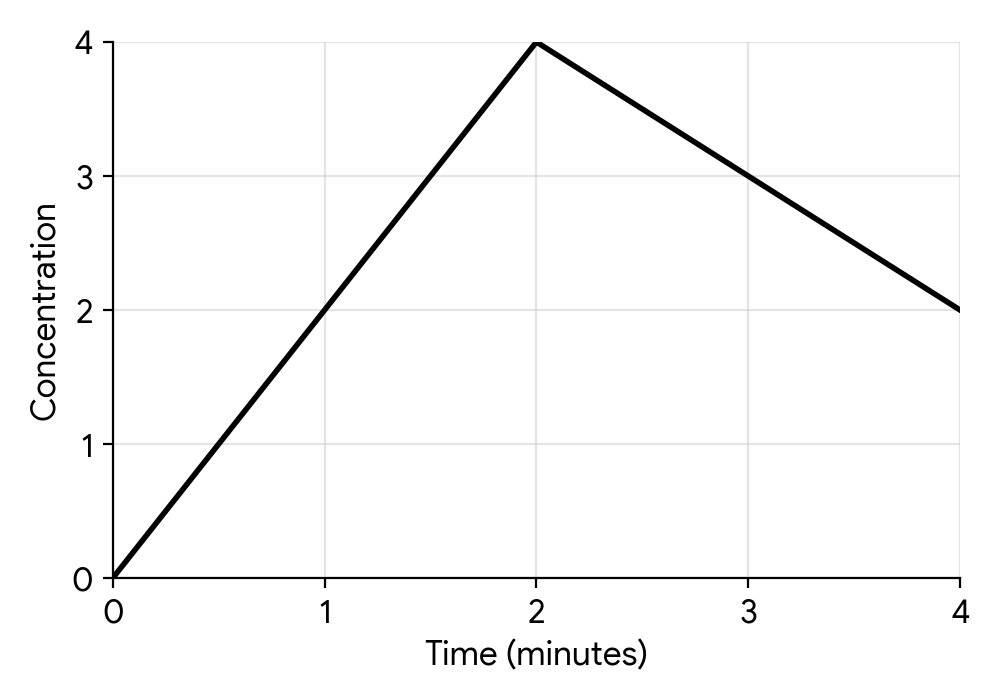
(a) Write down the concentration of the chemical at time minute.
(b) On the same axes, sketch the graph of , representing the time required to reach a certain concentration.
A different chemical's concentration, , is modeled by the function , where is time in minutes.
(c) Find an expression for .
(d) Find a value of where .
Locate on the horizontal axis and find the corresponding value on the vertical axis from the graph.
Remember that the graph of an inverse function is a reflection of the original function across the line . Identify key points on and reflect them.
To find the inverse function, replace with , swap and , and then solve for .
You can either sketch on the graph from part (b) and find the intersection, or use the algebraic expressions for and and solve the equation. Remember is piecewise, so will also be piecewise.
Question 15
MediumPaper 1 · calculator11 marksA company's monthly revenue, (in thousands of dollars), is modelled by a linear function of the number of units, (in hundreds), sold. The function is given by .
When 200 units are sold, the revenue is 7000.
(a) Determine the value of and the value of .
(b) Find an expression for .
(c) Solve the equation , giving your answer in an exact form.
(d) Explain why, for any function , the equation will have the same solution(s) as the equation .
Remember that the input is in hundreds of units and the output is in thousands of dollars. Form two coordinate pairs (x, R(x) ) and use them to find the slope and y-intercept of the linear function.
To find the inverse function, start by setting , then swap and , and finally solve for .
Set the expression for equal to the expression for and solve the resulting linear equation for .
Consider the geometric relationship between the graph of a function, its inverse, and the line .
Question 16
MediumPaper 2 · calculator12 marksThe two graphs illustrate relationships within a specialized coffee roasting company.
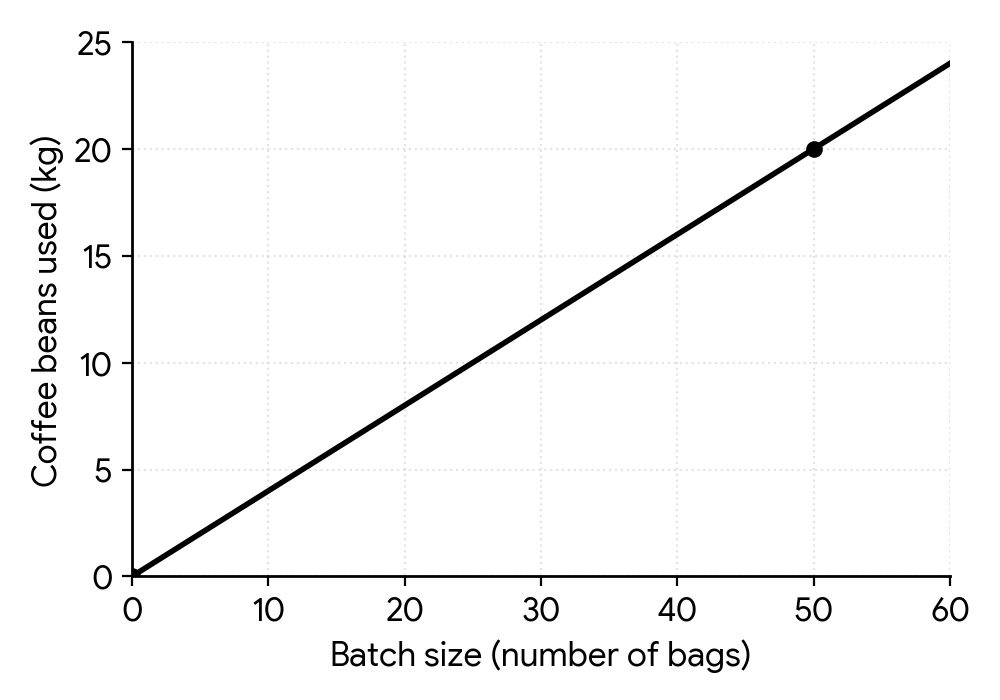
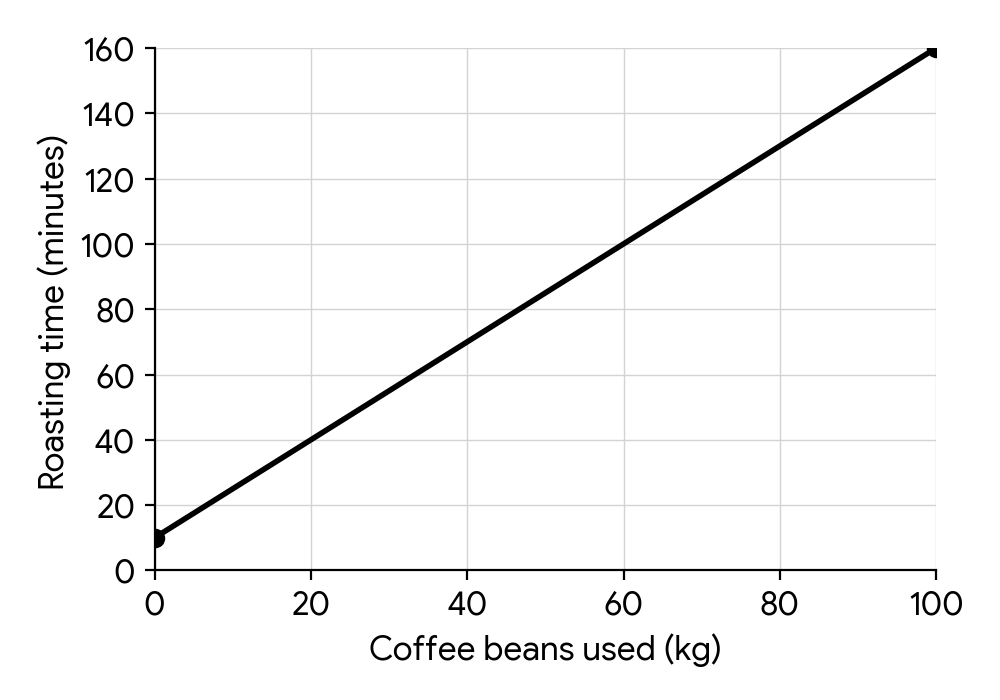
Write down which graph represents direct variation, with a reason.
(b) Find and interpret the gradient of each graph in context.
(c) Find an equation for the roasting time (in minutes) as a function of the batch size, (in number of bags), and use it to predict how long the roasting process will be for a batch of bags.
Recall the definition of direct variation and how it appears on a graph.
The gradient represents the rate of change of the y-variable with respect to the x-variable. Remember to include units in your interpretation.
You will need to combine the relationships from both graphs. First, express coffee beans used in terms of batch size, then substitute this into the equation for roasting time.
Question 17
MediumPaper 1 · calculator10 marksA local delivery service charges for deliveries based on the distance, km, from the origin. The cost, in dollars, is modelled by the piecewise function:
(a) Find the inverse function, , and state its domain and range.
A different data plan charges users based on the amount of data, GB, consumed. The cost, in dollars, is given by:
(b) Show that the function is not invertible.
To find the inverse of a piecewise function, find the inverse for each piece separately. Remember to swap and and solve for . The domain of the inverse function is the range of the original function, and the range of the inverse function is the domain of the original function.
For a function to be invertible, it must be one-to-one (pass the horizontal line test). This means that for any two distinct inputs, the outputs must also be distinct. Try to find two different -values that produce the same value.
Question 18
MediumPaper 1 · calculator8 marksA company's daily profit, (in thousands of dollars), depends on the number of units, (in hundreds), it sells. The profit function is given by .
On a particular day, the company's profit was between thousand dollars and thousand dollars (exclusive). Find the possible range for the number of units sold, .
Determine the inverse function, .
State the range of the inverse function .
To find the domain given the range, set up an inequality with the function between the given range values and solve for .
To find the inverse function, replace with , then swap and , and solve for .
The range of an inverse function is the domain of the original function.
Question 19
MediumPaper 2 · calculator12 marksA function is defined by . Let be the inverse function of .
(a) (i) State the -intercept of the graph of .
(ii) State the coordinates of the point where the graph of cuts the -axis.
(b) Determine an equation for in the form .
(c) (i) Write down the equation of the horizontal asymptote to the graph of .
(ii) Write down the equation of the vertical asymptote to the graph of .
(d) Hence state the domain of .
(e) Solve the equation .
To find the -intercept of a function, substitute into the function's equation.
The -intercept of an inverse function corresponds to the -intercept of the original function .
To find the inverse function, swap and in the equation for and then solve for . Remember that the inverse of is .
For an exponential function , the horizontal asymptote is . Consider the behaviour of as .
The vertical asymptote of an inverse function is the reflection of the horizontal asymptote of the original function across the line . For a logarithmic function , the vertical asymptote is .
The domain of an inverse function is the range of the original function. Alternatively, for , the argument of the logarithm must be positive.
Substitute the expressions for and into the equation. This is a transcendental equation, so you will need to use a GDC to find the solution graphically or numerically.
Question 20
MediumPaper 1 · calculator10 marks(a) A travel agency, GlobalVoyages, offers various package deals. For flight packages priced over $1000, they apply a 15% discount.
Another travel agency, WorldExplorer, offers a fixed reduction of 1000.
Given that is the original price of a travel package and ,
(i) write down a function that models the final price of a flight package at GlobalVoyages, after the discount is applied.
(ii) write down a function that models the final price of a hotel package at WorldExplorer, after the reduction is applied.
(b) A third agency, GrandTour, decides to offer both a 15% discount and a 1000.
Describe the meaning of , in context.
(c) State, with justification, whether or is better for the customer when they buy a travel package with an original price of $1800.
To calculate a percentage discount, you subtract the discounted amount from the original price. If there's a 15% discount, the customer pays 85% of the original price.
A fixed reduction means a constant amount is subtracted from the original price.
Remember that in composite functions like , the inner function is applied first, followed by the outer function .
Calculate the final price for both composite functions, and , and compare the results. The lower price is better for the customer.
No question on this page matches those filters. Try another difficulty or paper.
5 more Composite & inverse functions questions in the app
Every answer is marked mark by mark, IB-style, and the AI tutor helps when you are stuck.
Where marks are lost
- Using your own wrong value after failing a "show that." All follow through is withdrawn for the rest of that question.