Polar, exponential form of Complex numbers (conversions, arithmetics), combining phase shifts, drawing on argand diagram: notes and practice questions
- Modulus of is , representing distance from origin.
- Argument of is , the angle with the positive real axis (counter-clockwise, radians, usually or ).
- Calculate argument using ratio and a sketch to determine the correct quadrant.
- Cartesian form: (best for addition/subtraction).
- Polar (Modulus-Argument) form: or .
- Complex conjugate of is .
- Exponential (Euler's) form: , where .
- Euler's Identity: .
- Cartesian to Polar/Exponential: Find and (with sketch); use exact values.
- Polar/Exponential to Cartesian: Use and ; evaluate exact trigonometric ratios.
- Multiplication: Multiply moduli, add arguments.
- Polar:
- Exponential:
- Adjust argument by if outside the specified range.
- Division: Divide moduli, subtract arguments.
- Polar:
- Exponential:
- Powers: .
- Argand diagram: Real part on horizontal (Re), imaginary on vertical (Im); complex numbers are vectors from origin to .
- Combining sinusoidal functions (same frequency):
- Method:
1. Represent functions as complex numbers and .
2. Factor out from : .
3. Convert the constant complex sum to (use GDC).
4. Combine: .
5. The combined function is (for sine) or (for cosine).
- GDC Tips: Use built-in conversions, ensure radians mode, use for combining complex constants in phase shift applications.
How it is examined
The conversion step is the one worth drilling, because a student who lands in Cartesian form when the question asks for exponential form loses marks even with correct arithmetic. The "no roots" restriction is the guardrail for question writers: anything that needs th roots of a complex number belongs to a different course. The AC-circuit phrasing of the phase-shift addition is distinctive to AI and worth recognising as a routine application, not a new technique.
and .
- Write a complex number in modulus-argument (polar) form, .
- Write a complex number in exponential (Euler) form, .
- Convert between Cartesian, polar and exponential forms, by hand and with technology.
- Calculate products, quotients and integer powers in polar or exponential form.
Students will not be required to find the roots of complex numbers in examinations. Integer powers are in, roots are out.
Linking questions
- Links to other subjects: phase shift and voltage as complex quantities (physics, electronics).
- TOK: why might it be said that is beautiful? What is the place of beauty and elegance in mathematics?
- Enrichment, not examinable: separation of variables (AHL 5.14) applied to gives both the polar and exponential forms as solutions.
Practice questions
17 questions · 13 medium · 4 hardQuestion 1
MediumPaper 1 · calculator13 marksIn a complex signal processing system, an input signal is transformed into an output signal using the relationship , where .
(a.i) Calculate when .
(a.ii) Calculate when .
(b) Describe the two geometric transformations that map point to point on the Argand diagram, stating the order in which they are applied.
(c) Find the complex number such that the output signal .
Substitute the value of into the given equation and perform the complex number arithmetic. Remember that .
Substitute the real value of into the equation and simplify.
Consider the effect of multiplying by and then adding . Remember that multiplication by a complex number corresponds to a rotation and dilation, and addition corresponds to a translation.
Rearrange the equation to solve for . Remember that dividing by is equivalent to multiplying by .
Question 2
HardPaper 2 · calculator13 marks(a) A complex number represents a displacement on the complex plane, given by . Determine the magnitude and direction (argument) of this displacement.
(b) Another complex number represents a scaling and rotation, given in polar form as . A combined transformation is defined by . Find in its simplest polar form.
Recall that for a complex number , the magnitude (modulus) is and the direction (argument) is , adjusted for the correct quadrant.
Use De Moivre's theorem to find and . Remember that for multiplication of complex numbers in polar form, you multiply the moduli and add the arguments. Ensure the final argument is in the range or .
Question 3
MediumPaper 1 · calculator10 marksLet be a complex number representing a rotation and scaling transformation, given by .
(a) In parts (a)(i) and (a)(ii), give your answers in the form .
(i) Calculate .
Another transformation is given by , where .
(ii) For , calculate .
(b) Find the least positive integer value of such that the combined transformation results in a purely positive scaling (i.e., ).
Recall De Moivre's theorem for powers of complex numbers: . Remember to adjust the argument to be within the range .
First, substitute the value of into . Then, perform the division of complex numbers: . Finally, apply De Moivre's theorem for the power.
For a complex number to be a purely positive real number, its argument must be an integer multiple of . Use the property that .
Question 4
HardPaper 1 · calculator8 marksA specialized navigation chart uses complex numbers to represent locations. The central hub is at the origin . Two important landmarks, 'Anchor Point' () and 'Beacon Tower' (), are located at and respectively.
(a) (i) Find the modulus of .
(a) (ii) Find the argument of , giving your answer in radians.
(b) Find the area of the triangular region formed by the central hub, Anchor Point (), and Beacon Tower ().
The modulus of a complex number is given by .
The argument of a complex number is given by , ensuring the angle is in the correct quadrant.
The area of a triangle with vertices at the origin, , and can be found using the formula , where and .
Question 5
MediumPaper 1 · calculator7 marks(a) The trajectory of a probe in a simulated complex plane is given by the complex number , where is a parameter representing time. An Argand diagram is provided showing a circular boundary with radius 5 units.
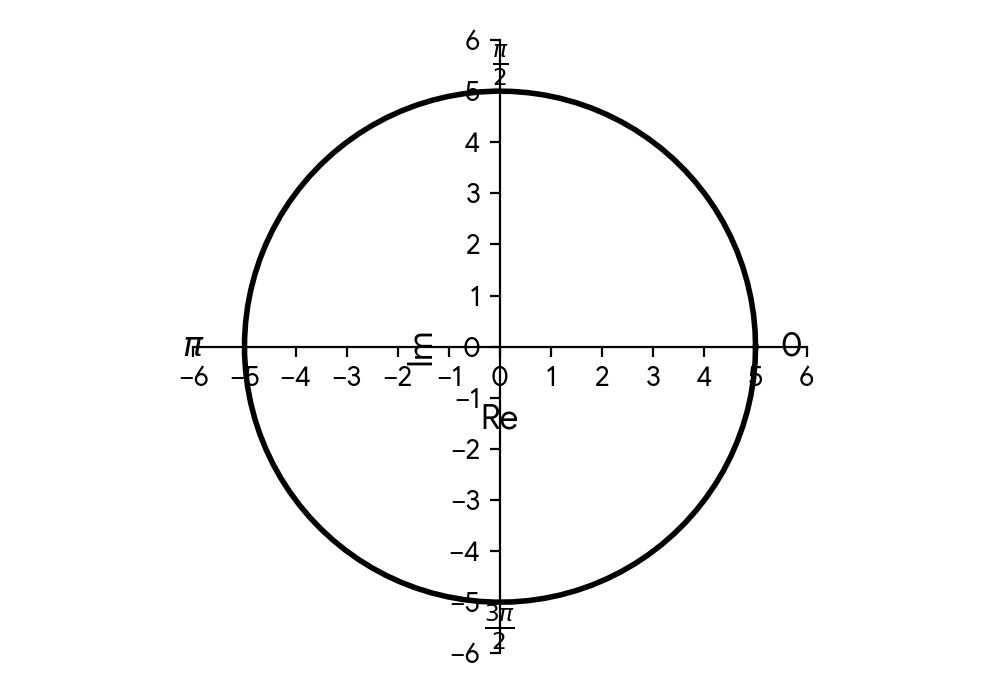
(a.i) Plot on the Argand diagram the point corresponding to .
(a.ii) Plot on the Argand diagram the point corresponding to .
(a.iii) Plot on the Argand diagram the point corresponding to .
(b) The probe exits a stable orbital region when its distance from the origin, , reaches 5 units.
(b.i) Calculate the value of when the probe exits the stable orbital region.
(b.ii) For this value of , plot the approximate position of on the Argand diagram.
Recall that a complex number in polar form has modulus and argument . Calculate these values for the given and then plot the point.
Calculate the modulus and argument for and plot the corresponding complex number.
Calculate the modulus and argument for and plot the corresponding complex number.
The modulus of is . Remember that for any real .
Use the value of found in part (b.i) to calculate the argument of . Remember to consider the principal argument or its equivalent within radians for plotting accuracy.
Question 6
HardPaper 1 · calculator9 marksIn a system analyzing oscillating signals, the initial state of a signal is given by the complex number .
(a) Express in the form , where .
After a certain operation, the signal's state changes from to .
(b) (i) Describe fully the single transformation (a composition of an enlargement and a rotation about the origin) that maps the point representing to the point representing on the Argand diagram. State the scale factor of the enlargement and the angle of rotation.
(b) (ii) This transformation can be represented by a matrix. Find and simplify the matrix that represents this transformation.
The signal is considered stable when its state is real and positive.
(c) Find the smallest positive integer, , for which is real and positive.
To express a complex number in exponential form , you need to find its modulus and its argument . Remember that and . Pay attention to the quadrant of the complex number to determine the correct argument within the specified range.
Calculate in exponential form. Compare the modulus and argument of with those of to find the scale factor and angle of rotation. Remember that multiplication by corresponds to an enlargement by factor and rotation by angle .
A transformation consisting of an enlargement by scale factor and a rotation by angle about the origin can be represented by the matrix . Use the values for and found in part (b)(i).
For to be real and positive, its argument must be a multiple of . Use the exponential form of and consider the argument of .
Question 7
MediumPaper 1 · calculator5 marksTwo sound waves propagate through a medium. The pressure variation, , from the first wave at a specific point, at time , is modelled by
.
The pressure variation, , from the second wave at the same point is modelled by
.
The total pressure variation at the point, , is given by
.
Find an expression for in the form , where and are real constants.
Hence write down the maximum pressure variation in the medium.
Recall Euler's formula, . The real part of a sum of complex numbers is the sum of their real parts. Consider combining the complex numbers before taking the real part.
Consider the range of the cosine function. What is the maximum value that can take?
Question 8
HardPaper 1 · calculator22 marksA complex number is defined by for .
(a) Solve for .
(b) Show that .
(c) Find the modulus and argument of in terms of . Express each answer in its simplest form.
(d) Hence find the fourth roots of in modulus-argument form.
Start by expanding both sides of the equation using the compound angle formulas for sine and cosine.
You can express 15 degrees as a difference of two standard angles, like 45 and 30 degrees. Alternatively, consider squaring the entire expression.
Use the double angle identities for and . Try to factor out a common term to get the complex number into the form .
Recall De Moivre's theorem for finding the n-th roots of a complex number in polar form. Remember that there will be four distinct roots.
Question 9
MediumPaper 1 · calculator8 marksThe depth of water at high tide, meters, in Port Azure can be modelled by
,
where is the day of the year 2024 (for example, represents 1 January 2024).
The depth of water at low tide, meters, in Port Azure can be modelled by
.
The tidal range, (the difference between high and low tide depths), in Port Azure during 2024 can be modelled by
.
Find the value of , of and of .
Hence, or otherwise, find the largest tidal range in Port Azure during 2024
and the day of the year on which this occurs.
The tidal range is given by . Combine the two sinusoidal functions using either trigonometric identities, complex numbers, or by analyzing the graph of using your GDC to find the amplitude, phase shift, and vertical shift.
The maximum value of a sinusoidal function is . To find the day, consider when the cosine term reaches its maximum value (i.e., 1).
Question 10
MediumPaper 1 · calculator6 marksTwo loudspeakers are emitting sound waves of equal frequencies in a room. The pressure variation from the first loudspeaker is modelled by the equation , where is in Pascals (Pa) and is in seconds.
The pressure variation from the second loudspeaker is modelled by the equation .
Determine the maximum pressure variation of the combined sound waves.
Using your graphic display calculator, find a suitable equation for the combined pressure variations, giving your answer in the form , where , and are constants, and .
Consider the superposition of the two waves. You can find the maximum value by graphing the sum of the two functions on your GDC.
The frequency of the combined wave remains the same as the individual waves. Use the maximum value from part (a) as the amplitude . To find the phase shift , you can look for an x-intercept (where ) on your graph and relate it to the standard sine function's intercept at .
Question 11
MediumPaper 1 · calculator6 marksIn an AC circuit, the impedance of a component is given by the complex number ohms.
Write in the exponential form , where and .
Two current phasors in a parallel circuit are given by and . The total instantaneous reactive current is given by the imaginary part of their sum, .
Find in the form , where , and .
Recall how to calculate the modulus and argument of a complex number from its Cartesian form. The modulus and the argument , making sure to adjust for the correct quadrant.
Consider expressing each complex number in its Cartesian form first, then sum the imaginary parts. Alternatively, factor out and find the modulus and argument of the remaining complex constant, then convert the product to the desired sinusoidal form.
Question 12
MediumPaper 2 · calculator11 marksIn an alternating current (AC) circuit analysis, complex numbers are often used to represent impedances. Consider two impedances, and , given in polar form as:
Find an expression for . Give your answer in the form , where .
Find an expression for . Give your answer in the form , where .
Find an expression for . Give your answer in the form , where .
Recall that for complex numbers and , their product is . Then convert the result to Cartesian form using .
Recall that for complex numbers and , their quotient is . Then convert the result to Cartesian form.
Use De Moivre's Theorem, which states that for a complex number , . Then convert the result to Cartesian form.
Question 13
MediumPaper 1 · calculator13 marksA company models the position of two drones, 'Alpha' and 'Bravo', on a complex plane relative to a central control tower located at the origin. The position of Drone Alpha is given by and the position of Drone Bravo is given by .
(a) Express and in modulus-argument (polar) form.
(b) Determine the complex number representing the combined effect of their positions, given by , in polar form.
(c) Determine the complex number representing the relative position of Drone Alpha with respect to Drone Bravo, given by , in polar form.
(d) Predict the position of Drone Alpha after a specific command that scales its argument by a factor of 4 and raises its modulus to the power of 4. This new position is given by . Express this in polar form and then in Cartesian form.
To convert a complex number to polar form , calculate the modulus and the argument , ensuring is in the correct quadrant. Remember to use the principal argument, typically in the range .
When multiplying two complex numbers in polar form, and , their product is .
When dividing two complex numbers in polar form, and , their quotient is . Remember to adjust the argument to be within the principal range if necessary.
Use De Moivre's Theorem for powers of complex numbers in polar form: If , then . After finding the polar form, convert it back to Cartesian form using and .
Question 14
MediumPaper 2 · calculator8 marksThe complex numbers and have arguments between and radians. Given that and , find the modulus and argument of and of .
Start by finding the modulus and argument of the given complex numbers and . Remember the properties of moduli and arguments for products and quotients of complex numbers, and pay close attention to the specified range for the arguments of and .
Question 15
MediumPaper 1 · calculator6 marksConsider two alternating current (AC) voltage sources connected in series. The instantaneous voltages, and , are given by the functions:
where is time in seconds and voltages are in volts.
(a) Write down both functions in the form .
(b) The total instantaneous voltage across the series combination is , which can be expressed in the form , where .
Use your answer to part (a) to find the value of and of . Give your answers to three significant figures.
Recall Euler's formula, which relates sinusoidal functions to complex exponentials. Specifically, . Apply this to the given voltage functions, identifying the amplitude , angular frequency , and phase angle .
To sum the two functions, first express them in their complex exponential form from part (a). Factor out the common exponential term . Then, sum the remaining complex numbers (phasors) in rectangular form, and finally convert the resulting complex number back into polar form to find (magnitude) and (argument). Remember to ensure is in the specified range.
Question 16
MediumPaper 1 · calculator11 marksLet , where .
For ,
(i) find the values of , and ;
(ii) draw and on the following Argand diagram.
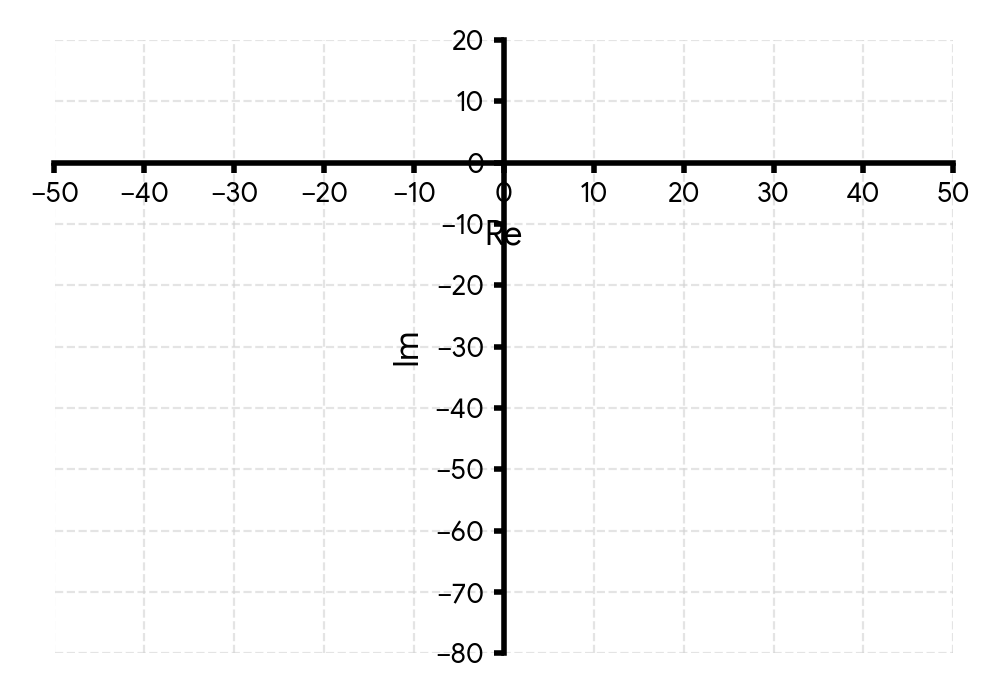 .
.Let .
Find the value of for which successive powers of lie on a circle.
Recall De Moivre's theorem for powers of complex numbers in exponential form: . Remember to simplify the argument where possible.
Plot the points based on their modulus (distance from origin) and argument (angle from the positive real axis). Remember to consider the scale of the Argand diagram given the moduli values.
For successive powers of a complex number to lie on a circle, its modulus must be 1. Use the property that .
Question 17
MediumPaper 1 · calculator6 marksIn an alternating current (AC) circuit, two impedances are given by the complex numbers and . The total impedance is given by .
(a) (i) By expressing and in modulus-argument form, write down the modulus of .
(a) (ii) Write down the argument of .
(b) The circuit is said to be purely resistive when is a real number. Find the smallest positive integer value of for which this occurs.
First, convert each complex number from Cartesian form () to modulus-argument form (). Remember that and you can find using trigonometry, paying attention to the quadrant. Then, use the rule for the modulus of a quotient of complex numbers, .
Use the rule for the argument of a quotient of complex numbers: . Be careful when subtracting negative angles.
For a complex number to be real, its argument must be an integer multiple of . Use De Moivre's theorem to find the argument of and set it equal to , where is an integer. Then solve for the smallest positive integer .
No question on this page matches those filters. Try another difficulty or paper.
Every Polar, exponential form of Complex numbers (conversions, arithmetics), combining phase shifts, drawing on argand diagram question, marked for you
Every answer is marked mark by mark, IB-style, and the AI tutor helps when you are stuck.
Where marks are lost
- Using your own wrong value after failing a "show that." All follow through is withdrawn for the rest of that question.