Indefinite integrals (direct/u-substitution): notes and practice questions
- Integration is the reverse of differentiation.
- An indefinite integral finds a general antiderivative and always includes a constant of integration ().
- The general rule for integration is to raise the power by one and divide by the new power.
- Standard integrals apply to powers, exponentials, logarithms, and trigonometric functions.
- For HL, the Reverse Chain Rule integrates functions of the form .
- HL students also use U-Substitution to simplify complex integrals by replacing an inner function with .
- A special HL case is .
- To find the constant of integration (), integrate and substitute a given point.
- Always include for indefinite integrals.
How it is examined
Spotting the substitution is the skill being tested, not the mechanics of carrying it out: the giveaway is a factor in the integrand that is (up to a constant) the derivative of another part of it. giving is the one exclusion from SL that HL removes, and it is a common place to drop the modulus sign or the constant of integration.
The extended list of standard integrals, (), , , , and .
- Find definite and indefinite integrals of for , including , , , and .
- Integrate by inspection, or by substitution of the form .
Linking questions
- International-mindedness: ancient Egyptian calculation of the volume of a pyramidal frustum (the Egyptian Moscow mathematical papyrus).
Practice questions
40 questions · 1 easy · 30 medium · 9 hardQuestion 1
EasyPaper 1 · calculator7 marksIf the velocity, , of a particle, starting from the origin, at time, seconds, is .
Find the displacement equation.
Find acceleration after 1 second.
Remember that displacement is the integral of velocity.
Remember that acceleration is the derivative of velocity with respect to time
Question 2
MediumPaper 1 · calculator8 marksA high-speed drone is being tested, and its acceleration, , is modelled by the function , where is the speed of the drone in m/s and is the time in seconds, for seconds.
Determine whether the speed of the drone is increasing or decreasing at seconds.
It is observed that when seconds, the speed of the drone is m/s.
Find an expression for the function .
Recall that the sign of the derivative tells you whether the original function is increasing or decreasing. If , the speed is increasing. If , the speed is decreasing.
To find the original function from its derivative , you need to integrate. Remember to include the constant of integration, and use the given initial condition to find its value.
Question 3
HardPaper 1 · calculator10 marksA mathematical model for a physical phenomenon involves the expression .
(a) Expand .
The rate of change of a certain quantity is given by .
(b) Find the indefinite integral .
A designer is creating a custom-shaped container. The cross-sectional profile of the container is defined by the curve for . The container is formed by rotating this region about the x-axis.
(c) Calculate the volume of the solid formed. Give your answer in the form , where .
Remember the formula for .
Integrate each term separately. Remember that for , and . Don't forget the constant of integration.
The volume of revolution about the x-axis is given by . Use your result from part (b) for the integral of and apply the given limits of integration.
Question 4
MediumPaper 1 · calculator7 marksA chemical reaction is monitored in a laboratory. The concentration of a specific compound, C, in milligrams per litre (mg/L), changes over time, t, in minutes.
The rate of change of the compound's concentration is modelled by
At 8 minutes, the concentration of the compound is 70 mg/L.
Find an expression for C in terms of t.
The experiment continues for an extended period.
Describe how the compound's concentration changes if the time elapsed is between 25 minutes and 35 minutes. Justify your answer.
To find the expression for C(t) from its rate of change, you need to integrate the given derivative. Remember to include a constant of integration and use the provided initial condition to find its value.
Consider the sign of the rate of change of concentration, , in the given time interval. If the rate is negative, the concentration is decreasing.
Question 5
HardPaper 1 · calculator7 marks(a) A designer is creating a unique component for a specialized optical instrument. The cross-section of the component's profile can be modelled by the curve for . The component is formed by rotating this curve about the -axis.
Calculate the exact volume of this solid of revolution. Give your answer in the form or a similar exact form, and then to three significant figures.
Recall the formula for the volume of a solid of revolution about the -axis: . You will need to use integration by parts to evaluate the definite integral.
Question 6
MediumPaper 1 · calculator6 marksThe rate of change of the volume of water in a reservoir, in thousands of cubic meters per year, is given by the equation:
where is the volume of water in thousands of cubic meters and is the time in years since the start of monitoring.
(a) Determine whether the volume of water in the reservoir is increasing or decreasing when years.
(b) One year after the start of monitoring, the volume of water in the reservoir was 5 thousand cubic meters. Find an expression for , the volume of water in the reservoir at time , for .
To determine if the volume is increasing or decreasing, you need to evaluate the sign of the rate of change at the given time.
To find the expression for , you need to integrate the given rate function. Remember to include the constant of integration and use the given condition to find its value.
Question 7
HardPaper 1 · calculator10 marksAlex is preparing for a calculus exam and encounters a series of integrals. For each integral, identify whether it can be evaluated analytically using standard techniques (and if so, state the appropriate analytical method) or if it requires numerical approximation using technology (e.g., a GDC).
(a)
(b)
(c)
(d)
(e)
(f)
Consider if a simple substitution can transform the integral into a basic trigonometric integral.
Look for a function and its derivative within the integrand. Think about u-substitution.
This integral involves a product of two different types of functions (polynomial and trigonometric). Consider integration by parts.
Try to think of any standard integration techniques. If none seem to work, it might be a non-elementary integral.
The numerator is related to the derivative of the denominator. Consider u-substitution for a logarithmic result.
Similar to part (d), consider if this definite integral can be found using elementary functions or if it's a non-elementary form.
Question 8
MediumPaper 1 · calculator8 marksA colony of bacteria is growing in a nutrient solution. The rate of change of the population, , with respect to time, (in hours), is modelled by the differential equation . At time , the population is .
(a) By using Euler's method with a step length of 0.1, find an approximate value for the population when . Give your answer to three significant figures.
(b) By solving the differential equation, find the percentage error in your approximation for the population when . Give your answer to three significant figures.
Remember the formula for Euler's method: . You will need to apply this formula iteratively for and .
This is a separable differential equation. Integrate both sides after separating variables. Remember to use the initial condition to find the constant of integration. The percentage error is calculated as .
Question 9
HardPaper 2 · calculator9 marksThe cross-section of a decorative garden bed is modelled by the curve , where and are measured in metres. The garden bed is built on flat ground, represented by the -axis.
(a) Write down the -intercepts of this curve.
(b) Write down a definite integral that represents the area of the cross-section of the garden bed.
(c) Find the value of this area.
The -intercepts occur when . Consider the factored form of the equation.
The area between a curve and the -axis from to is given by . Determine if the curve is above or below the -axis in the relevant interval.
First, expand the expression . Then, integrate the resulting polynomial term by term and evaluate the definite integral using the limits found in part (a).
Question 10
MediumPaper 1 · calculator9 marks(a) A drone's vertical velocity, metres per second, at time seconds, is given by .
Find an expression for the vertical acceleration of the drone.
(b) Hence, or otherwise, find its greatest vertical acceleration for seconds.
(c) The drone starts at ground level (displacement is 0). Find an expression for the vertical displacement of the drone.
(d) Hence show that the drone never descends below ground level.
Recall the product rule for differentiation: if , then . Also, remember the chain rule for differentiating composite functions like .
You will need to use your GDC to find the maximum value of the acceleration function over the given interval. Plot the acceleration function and use the maximum-finding feature.
Displacement is the integral of velocity with respect to time. You will need to use a substitution method for integration. Remember to use the initial condition to find the constant of integration.
Consider the range of the cosine function. How does this affect the range of your displacement function? Ground level corresponds to a displacement of zero.
Question 11
HardPaper 2 · calculator15 marksA drone is launched vertically upwards from a platform. Its vertical velocity, , at time seconds, is given by the function:
, for .
Find the times when the drone is momentarily at rest.
Find the magnitude of the drone's vertical acceleration at seconds.
Find the greatest speed of the drone in the interval .
The drone starts from an initial height of metres above the ground. Find an expression for the height of the drone, metres, above the ground at time seconds.
Find the total distance travelled by the drone in the interval .
The drone is momentarily at rest when its vertical velocity is zero. Set the velocity function equal to zero and solve for .
Acceleration is the derivative of velocity with respect to time, . Differentiate the given velocity function and then substitute . Remember to find the magnitude.
Speed is the magnitude of velocity, . The greatest speed can occur at the endpoints of the interval or at a critical point where acceleration is zero. Evaluate at these points and find the maximum absolute value.
Height is the integral of velocity with respect to time, . Use the initial condition to find the constant of integration.
Total distance travelled is the integral of the speed, . Remember that velocity can change sign, so you might need to split the integral at points where . The roots of are and .
Question 12
MediumPaper 1 · calculator8 marksThe rate of profit, , in thousands of dollars per month, for a new product is modelled by the piecewise function
where and . For a smooth transition in the profit rate, it is required that .
Find the value of .
Show that .
The total profit from the product at time is zero.
Find the time when the total profit returns to its initial position.
To find the value of T where the two functions meet, set equal to and solve for T.
First, find the derivatives of and . Then, substitute the value of found in part (a) into both derivatives to show they are equal.
The total profit is the integral of the profit rate. Set the sum of the definite integrals over the two phases (from 0 to T, and from T to k) equal to zero, where k is the time when the total profit returns to zero.
Question 13
HardPaper 2 · calculator18 marksThe rate of change of pollution, (in tonnes per day), in a protected lake is modelled by , where is the time in days since monitoring began, for .
(i) Find the value of at days.
(ii) Interpret the meaning of your answer to part (a) (i) in context.
Use to find the value of when the pollution in the lake reaches its maximum level.
Two days after monitoring began, the pollution in the lake was tonnes.
Find an expression for in terms of , for .
Hence, find the maximum pollution level in the lake.
A second source of pollution, from a nearby factory, is modelled by , where is the pollution in tonnes and is the time in days, for .
Write down the initial pollution from this factory.
Each day, the pollution from the factory increases by %.
Find the value of .
Find the value of when the pollution from the initial lake source and the factory are the same.
Substitute the given value of into the expression for .
Consider what represents and what the positive value signifies.
The maximum level of pollution occurs when its rate of change is zero.
Integrate the expression for to find . Use the given condition to find the constant of integration.
Substitute the value of found in part (b) into the expression for found in part (c).
The initial pollution occurs at .
For an exponential growth model , the growth factor is . The percentage increase is .
Set the expressions for and equal to each other and solve using your GDC.
Question 14
MediumPaper 1 · calculator10 marksA landscape architect is designing a series of modular planter boxes for an urban garden project. The volume, cm, of a particular planter box is modelled by the function , where is the depth of the planter in cm.
(a) Use your graphic display calculator to find the value of that will produce the maximum volume.
(b) Show that the maximum volume of the planter box is cm.
The width of the planter is cm, and the length is cm.
(c) The architect is interested in the total linear dimension , which is defined as the sum of the depth, width, and length of the planter. Hence find the value of when the volume is maximized.
To find the maximum volume, you need to find the value of where the rate of change of volume with respect to is zero. You can use your GDC to find the maximum point of or the root of .
Integrate the derivative to find the volume function . Remember that the volume is 0 when the depth is 0. Then substitute the value of found in part (a) into .
First, write an expression for in terms of . Then, use the value of that maximizes the volume from part (a).
Question 15
HardPaper 2 · calculator15 marksThe 'EcoPack' company designs sustainable packaging. They produce a standard closed rectangular storage container with a length of cm, a width of cm, and a height of cm. The information is shown in the diagram.
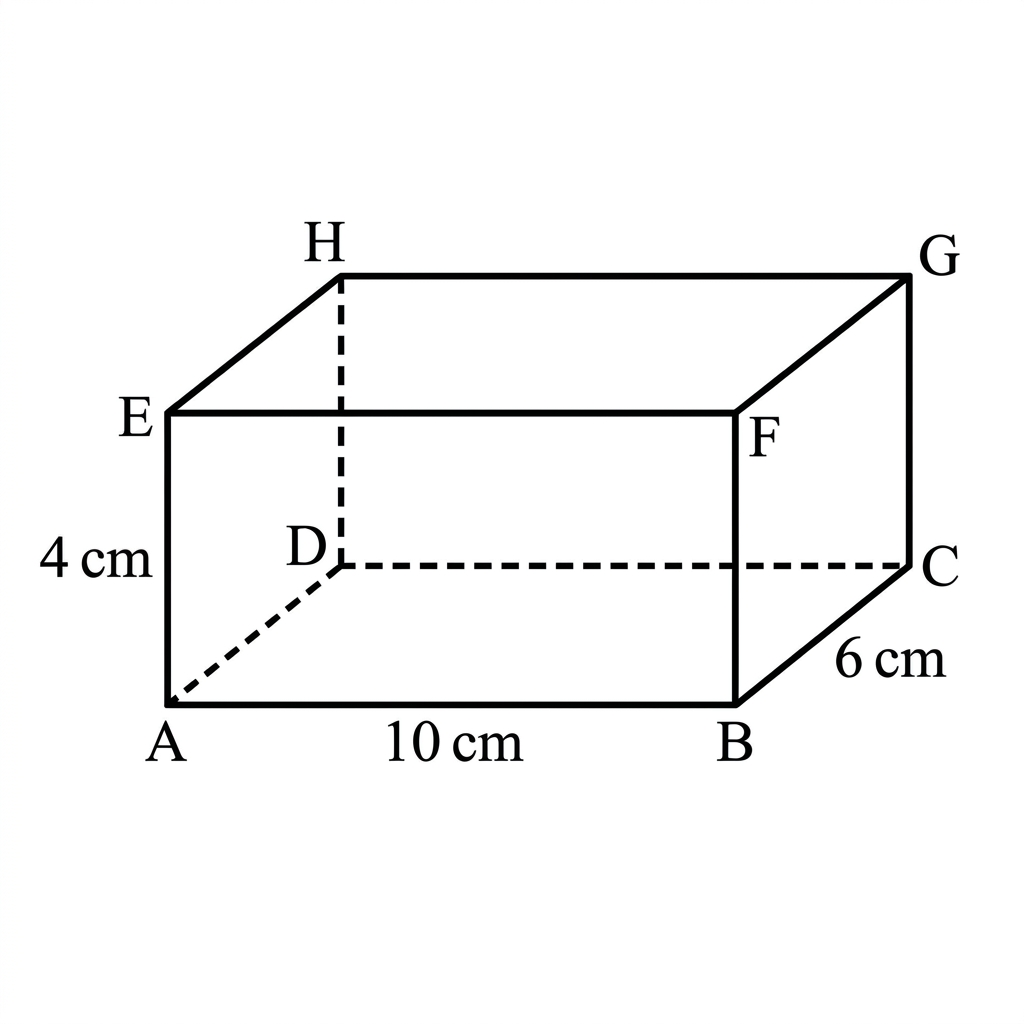
Calculate the surface area of the container in cm.
(b) Calculate the length of the longest internal diagonal of the container.
(c) Each week, EcoPack sells thousand containers. It is known that , for , where is the weekly profit, in dollars, from the sale of thousand containers.
Find the number of containers that should be sold each week to maximize the profit.
(d) The profit from the sale of containers is $2500.
Find .
(e) Find the least number of containers which must be sold each week in order to make a profit.
The surface area of a rectangular prism is given by the formula , where is length, is width, and is height.
The longest internal diagonal of a rectangular prism can be found using the 3D Pythagorean theorem: .
To maximize profit, set the derivative of the profit function, , equal to zero and solve for . Remember that is in thousands of containers.
Integrate the derivative to find . Use the given profit information to find the constant of integration.
To make a profit, must be greater than zero. Find the values of for which and choose the smallest integer value of that results in a profit.
Question 16
MediumPaper 1 · calculator7 marksThe rate of change of a certain quantity, , with respect to time, (in minutes), is modelled by the function .
(a) Find an expression for in terms of , assuming an arbitrary constant of integration.
(b) Given that the model is valid for , find the exact total change in the quantity from minute to minutes. Give your answer in the form , where .
Recall the integration rule for functions of the form . Consider using a substitution or recognizing the pattern for the derivative of a logarithmic function.
Use the result from part (a) and apply the Fundamental Theorem of Calculus. Remember to use the properties of logarithms to simplify the expression into the required form.
Question 17
HardPaper 2 · calculator14 marks(a) A drone launches a rescue package from an initial position of metres, relative to an origin on the ground. The package is launched with an initial speed of at an angle to the horizontal ground, where .
The velocity components of the package, seconds after it is launched, are given by and .
Find an expression for , the horizontal displacement from the origin, in terms of and .
(b) It is given that the vertical displacement of the package from the ground is . When the package hits the ground, show that .
(c) Let be the value of when the package hits the ground.
Find an expression for in terms of only.
(d) Hence, find the value of which maximizes the value of .
(e) The model is adapted to account for a horizontal wind with speed acting in the opposite direction to the initial horizontal motion.
(i) In this new model, the horizontal velocity component is . The time taken for the package to hit the ground remains .
Find an expression for , the value of when the package hits the ground, in terms of only.
(ii) Hence, find the value of which maximizes the value of .
To find the position from the velocity component , you need to integrate with respect to . Remember to include the initial horizontal position as the constant of integration.
The package hits the ground when its vertical displacement is equal to zero. Solve the equation for . Remember that represents the launch time.
Substitute the expression for (from part (b) ) into your expression for (from part (a) ).
Recall the trigonometric identity . This can simplify the expression for . The maximum value of is . Consider what value of makes within the given domain for .
First, integrate the new horizontal velocity component to find the new expression for , including the initial position. Then, substitute the time when the package hits the ground into this new expression.
To maximize , you need to find the derivative of with respect to and set it to zero. Remember to use the chain rule for or product rule for . You will likely end up with a quadratic equation in terms of . Alternatively, use your GDC to graph the function and find the maximum.
Question 18
MediumPaper 1 · calculator8 marksThe rate of change of the concentration of a certain chemical in a reaction vessel, in mol/L per minute, is given by , where is the time in minutes.
(a) Use a GDC to find the total change in concentration of the chemical from minutes to minutes, giving your answer correct to significant figures.
(b) Find the general expression for the concentration of the chemical, , if the initial concentration at is not considered. That is, find the indefinite integral .
(c) Hence, using your answer from part (b), find the exact total change in concentration of the chemical from minutes to minutes.
To find the total change in concentration, you need to evaluate the definite integral of the rate of change function over the given time interval. Use your GDC's integral function for this calculation and remember to round your final answer to significant figures.
Consider using a u-substitution. Let be the denominator of the integrand. Then find and rewrite the integral in terms of . Remember to add the constant of integration.
Use the Fundamental Theorem of Calculus. Evaluate the indefinite integral at the upper and lower limits of integration and subtract the results. Express your answer in exact logarithmic form.
Question 19
HardPaper 3 · calculator28 marksA small scientific probe is launched into a dense liquid to collect data. Its descent is affected by gravity, buoyancy, and liquid resistance. The direction downwards is taken to be positive.
Initially, a simple model for the probe's velocity, ms, at time seconds, assumes constant effective acceleration due to gravity and buoyancy, ms, given by:
When the probe enters the liquid at m, its initial velocity is ms. The displacement from its initial position is metres.
(i) Use the chain rule to show that .
(ii) Assuming that is a constant, solve the differential equation to find as a function of .
(iii) Using ms, determine whether the model predicts that the probe will reach a velocity of ms at some point before it reaches a depth of m. Justify your answer.
To test the model , the probe conducted a trial descent, and data for against was recorded.
(i) If the model is correct, describe the shape of the graph of against .
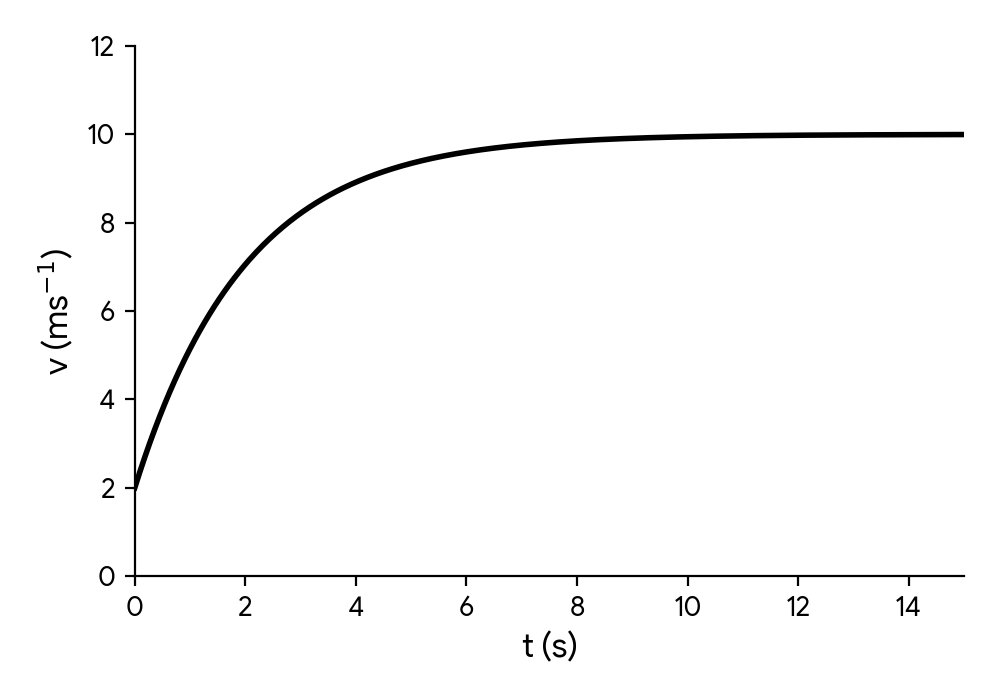
(ii) The observed data showed a graph where the velocity increased rapidly at first, then its rate of increase slowed down, eventually approaching a constant value. Use this observation to comment on the validity of the model in part (a).
An improved model considers liquid resistance, using
where is a positive constant. You are reminded that initially and . You may assume that .
(i) By using , solve the differential equation to find in terms of , and .
The probe's engineers use the graph of against from the trial descent to estimate the value of .
(ii) The gradient is estimated to be ms when ms. Taking to be ms, use this information to show that the engineers found that .
(iii) Hence, find the value of predicted by this model, as tends to infinity.
(iv) Find the upper bound for the velocity according to this model, given that . Give your answer to four significant figures.
(d) A more refined model for the probe's descent suggests that the rate of change of velocity with respect to displacement is given by . Use Euler's method with a step length of m to estimate the value of when m. Take the initial velocity ms at m.
(i) Suggest one improvement to the use of Euler's method which might increase the accuracy of the prediction of the model.
(ii) Suggest one factor not explicitly considered by the model in part (d) which might lead to a difference between the model's prediction and the data collected.
Recall the chain rule for derivatives involving an intermediate variable. In this case, is a function of , and is also a function of . You also know the relationship between velocity and displacement.
Separate the variables and , then integrate both sides. Remember to use the initial conditions () to find the constant of integration.
Substitute and into your equation from part (a)(ii) to find the displacement at which this velocity is reached. Then compare this value with m.
Consider what kind of function would result from integrating .
Compare the observed behavior (rate of increase slowing down) with the prediction of the simple model (constant rate of increase).
Substitute into the given differential equation. Then, separate variables and integrate using a substitution method (e.g., ). Finally, apply the initial conditions to solve for the constant of integration.
Substitute the given values for , , and into the improved model's differential equation and solve for .
Consider what happens to the exponential term as . Alternatively, recall that terminal velocity occurs when .
Since velocity is an increasing function of depth, the upper bound will occur at the maximum depth, m. Substitute this value into your equation from part (c)(i).
Euler's method for is . Perform the calculations step-by-step until reaches m.
Consider factors that affect the accuracy of numerical methods for solving differential equations.
Think about real-world conditions that could affect a probe's descent in liquid that are not included in the mathematical model.
Question 20
MediumPaper 1 · calculator15 marksA researcher is modeling various rates of change in a system. For each given rate of change function, find the original function by determining the indefinite integral.
(a)
(b)
(c)
(d)
(e)
Recall the power rule for integration: , for . Apply this rule to each term of the polynomial.
Remember the integrals of trigonometric functions: and .
Recall the integral of exponential functions: . Be careful with the sign in the exponent for the second term.
Use a substitution method or reverse chain rule. If , then .
Simplify the integrand algebraically before performing the integration. Divide each term in the numerator by the denominator.
No question on this page matches those filters. Try another difficulty or paper.
20 more Indefinite integrals (direct/u-substitution) questions in the app
Every answer is marked mark by mark, IB-style, and the AI tutor helps when you are stuck.
Where marks are lost
- Using your own wrong value after failing a "show that." All follow through is withdrawn for the rest of that question.
- Leaving an answer in calculator notation. Never accepted in a final answer, and AI's constant calculator use makes this the easiest slip in the whole subject.