Scientific notation: notes and practice questions
- A method to express very large or small numbers in the form:
where and is an integer.
- Operations:
- Multiplication:
- Division:
- Addition/Subtraction: Adjust exponents to match before performing operations.
How it is examined
Rarely a question on its own. It shows up as the required form of an answer somewhere else, which is where the marks go missing: an answer copied off the GDC screen as `5.2E30` is not in acceptable notation. Command terms are `Write down` and `Calculate`, 1 to 2 marks. Both papers.
Operations with numbers in the form where and is an integer.
Linking questions
- Other contexts: astronomical distances, sub-atomic particles, global financial figures.
- Links to other subjects: chemistry (Avogadro's number), physics (order of magnitude), biology (microscopic measurements).
Practice questions
11 questions · 1 easy · 9 medium · 1 hardQuestion 1
EasyPaper 1 · no calculator6 marks(a) A newly proposed particle accelerator, the "Cosmic Collider", is designed with a perfectly circular beam path. The engineers have specified its diameter as 15 000 metres.
Calculate the circumference of the Cosmic Collider's beam path in kilometres. Give your full calculator display.
(b) Give your answer to part (a) correct to three significant figures.
(c) Write your answer to part (b) in the form , where , .
Remember the formula for the circumference of a circle. Pay close attention to the units required for the final answer.
Identify the first three non-zero digits in your answer from part (a) and round accordingly.
To write a number in scientific notation, adjust the decimal point so that there is only one non-zero digit before it, and then determine the appropriate power of 10.
Question 2
MediumPaper 1 · no calculator6 marksA high-performance computing cluster transfers data at a constant rate of 250 megabytes per second (MB/s). A large scientific dataset, with a total size of 1200 gigabytes (GB), needs to be transferred.
(a) Calculate the time, in minutes, it takes for the computing cluster to transfer the entire dataset. Assume 1 GB = 1000 MB.
A research facility stores experimental data. Each experiment generates 3.5 terabytes (TB) of data. The facility plans to conduct 8500 such experiments over the next few years.
(b) Find the total storage capacity, in megabytes (MB), required for all these experiments. Give your answer in the form with and . Assume 1 TB = 1000 GB and 1 GB = 1000 MB.
First, convert the total dataset size from gigabytes to megabytes. Then, use the transfer rate to find the time in seconds, and finally convert that time to minutes.
First, calculate the total data in terabytes. Then, convert this total to megabytes using the given conversion factors. Finally, express your answer in scientific notation.
Question 3
HardPaper 3 · calculator30 marksA pharmaceutical company is formulating a new drug. They are testing two active ingredients, and , such that their total concentration is mg/mL. The drug's efficacy is modelled by the product of the concentrations of the two ingredients.
Find the efficacy, , as a function of only.
Determine the concentration of that maximizes the drug's efficacy.
Hence, show that the maximum efficacy for two ingredients with a total concentration of mg/mL is .
Let represent the maximum efficacy for a drug with active ingredients and a total concentration of mg/mL. For , the maximum efficacy can be expressed as .
Verify that is true for .
The relationship between the geometric mean and arithmetic mean states that for positive real numbers , their geometric mean is always less than or equal to their arithmetic mean .
Show that the geometric mean and arithmetic mean are equal when .
Use this result to prove that .
Using the formula for , determine the value of:
;
;
.
For a fixed total concentration of mg/mL, the company wants to find the optimal number of active ingredients, , to maximize the drug's efficacy. Let denote this maximum efficacy.
Write down the value of and the value of at which it occurs.
Determine the value of and the value of at which it occurs.
Consider the continuous function , defined by , where . A sketch of the graph of is shown in the following diagram. Point A is the maximum point on this graph.
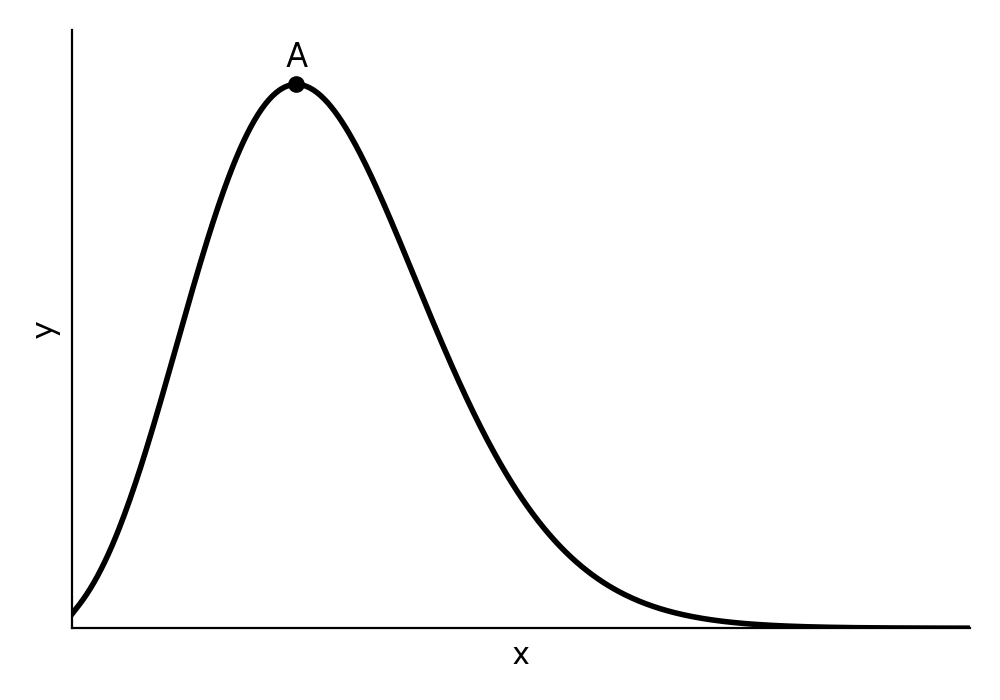
Find, in terms of , the -coordinate of point A.
Verify that , when .
The company has a total concentration of mg/mL available. Use your answer to part (h) to find the largest possible efficacy. Give your answer in the form , where and .
Express in terms of using the given total concentration. Then substitute this into the product expression.
The function is a quadratic. You can find its maximum by finding the vertex or by using calculus (setting the first derivative to zero).
Substitute the value of found in part (b.i) into the efficacy function .
Substitute into the given formula for and compare the result with your answer from part (b.ii).
Assume all are equal to a single variable, say . Substitute this into both sides of the inequality and simplify.
Start with the AM-GM inequality. Use the fact that the sum of the is . The maximum product occurs when the equality holds.
Substitute and into the formula .
Substitute and into the formula .
Substitute and into the formula .
Calculate for integer values of around the expected maximum (which can be estimated using ). Compare these values to find the largest.
Similar to part (f), calculate for integer values of around .
To find the maximum point, differentiate with respect to and set the derivative to zero. Remember to use the product rule and chain rule.
Use the properties of logarithms to rewrite the expression for and then convert it back to .
The optimal number of ingredients must be an integer. Use the result from part (h) to find the continuous maximum, then test the integer values of immediately surrounding this continuous maximum.
Question 4
MediumPaper 1 · no calculator4 marksA scientist is studying a spherical microbe. The radius of the microbe is measured to be cm.
(a) Write down the diameter of the microbe.
(b) The volume of the microbe can be expressed in the form where and .
Find the value of and the value of .
The diameter of a sphere is twice its radius. How can you apply this to the given radius in scientific notation?
The formula for the volume of a sphere is . Substitute the radius and use the laws of exponents to simplify. Remember to adjust the final answer to match the required scientific notation format.
Question 5
MediumPaper 1 · no calculator6 marksConsider a geometric sequence, , with common ratio , where each term in the sequence is positive.
It is given that and .
(a) Find the value of .
(b) Find the value of , giving your answer in the form , where and .
Think about how many times you need to multiply by the common ratio to get from to .
Use the value of you found in part (a) and work backwards from to find the first term . Remember to format your final answer in scientific notation.
Question 6
MediumPaper 2 · calculator14 marksThe following table shows the average annual temperature, in degrees Celsius, and the average annual sunshine hours, , for seven different cities.
| City | Average annual temperature, (°C) | Average annual sunshine hours, |
|---|---|---|
| A | 5 | 1600 |
| B | 8 | 1800 |
| C | 12 | 2100 |
| D | 15 | 2500 |
| E | 20 | 2900 |
| F | 24 | 3100 |
| G | 27 | 3300 |
The city of Sunville has an average annual temperature of 18 °C.
In fact, Sunville has an average of 2650 annual sunshine hours.
The city of Frostburg has an average annual temperature of -2 °C.
(a) Find the range of the average annual temperatures for these seven cities.
(b) (i) For the data from these seven cities, calculate , the Pearson’s product–moment correlation coefficient.
(ii) Describe the correlation between the average annual temperature and the average annual sunshine hours.
(c) Write down the equation of the regression line on , in the form .
(d) Use your regression line to estimate the average annual sunshine hours for Sunville.
(e) Find the percentage error in your estimate in part (d).
(f) State whether it is valid to use the regression line to estimate the average annual sunshine hours for Frostburg. Give a reason for your answer.
The range is the difference between the maximum and minimum values in a dataset. Look at the column for average annual temperature.
You will need to use the statistics function on your GDC. Enter the temperature data as one list and the sunshine hours data as another list, then perform a linear regression calculation.
Your description should include two aspects: the strength and the direction of the correlation. Use your value of from the previous part to help you.
Your GDC will provide the values for and when you calculate the linear regression. Make sure to write the answer as a full equation.
Substitute the given temperature for Sunville (18 °C) into the regression equation you found in part (c).
The formula for percentage error is . Use your answer from part (d) as the estimated value and 2650 as the actual value.
Consider whether the temperature of Frostburg (-2 °C) falls within the range of temperatures given in the original data table. What is the term for making a prediction outside the data range?
Question 7
MediumPaper 1 · no calculator6 marksA large, rare pearl is discovered, and its value is estimated to be 250 million US dollars ().
(a) Write down this value in the form , where and
The pearl is assumed to be a perfect sphere with a radius of 3 cm.
(b) Calculate an estimate for the volume of the pearl, giving your answer in terms of .
The actual volume of the pearl is later determined to be .
(c) Calculate the percentage error in the estimated volume.
A million is equal to . How can you express 250 in scientific notation and combine it with the power of ten for 'million'?
The formula for the volume of a sphere is . Substitute the given radius into this formula.
The formula for percentage error is , where is the actual value and is the estimated value. Use your answer from part (b).
Question 8
MediumPaper 1 · no calculator5 marksA large conical sand dune has a height of m and a base radius of m.
(a) Find the area of the base of the sand dune, giving your answer in terms of .
The volume of the sand dune can be expressed in the form m, where and .
(b) Find the value of and the value of .
The base of a cone is a circle. What is the formula for the area of a circle? Remember to apply the exponent rules correctly when squaring the radius.
The formula for the volume of a cone is . You have already calculated the base area, , in part (a). Use this result and the given height to find the volume. Make sure your final answer is in the correct scientific notation format.
Question 9
MediumPaper 1 · no calculator6 marksA space probe is sent to a dwarf planet. The total distance of the journey is kilometres. The probe travels at an average speed of 50 000 kilometres per hour.
(a) Calculate the time, in years, it takes for the probe to complete its journey. Assume 1 year = 9000 hours.
The probe is designed to collect interstellar dust particles. The average mass of one dust particle is 0.4 nanograms (ng). During its journey, the probe collects 50 million particles.
(b) Find the total mass of the dust particles collected, in kilograms (kg). Give your answer in the form where and . Assume 1 gram = nanograms and 1 kilogram = 1000 grams.
First, find the total travel time in hours by using the formula time = distance / speed. Then, convert this time from hours to years using the given conversion factor.
First, calculate the total mass in nanograms by multiplying the mass of one particle by the total number of particles. Then, convert this mass from nanograms to kilograms using the two conversion factors provided. Remember to express your final answer in scientific notation.
Question 10
MediumPaper 1 · no calculator6 marksA space probe is sent on a mission to a distant exoplanet. The distance to the exoplanet is 1.2 billion kilometres. The probe travels at a constant speed of 50,000 kilometres per hour.
(a) Calculate the time, in days, it will take for the probe to reach the exoplanet.
The probe is designed to collect interstellar dust particles. On its journey, it collects an average of particles for every kilometre it travels.
(b) Find the total number of interstellar dust particles the probe will collect on its journey to the exoplanet. Give your answer in the form where and .
First, find the total travel time in hours using the formula time = distance / speed. Then, convert the time from hours to days.
To find the total number of particles, you need to multiply the number of particles collected per kilometre by the total distance in kilometres. Remember the rules for multiplying numbers in scientific notation.
Question 11
MediumPaper 1 · no calculator7 marks(a) The efficiency of a new solar panel design, , is modeled by the formula:
where and are angles in degrees, is a resistance value, and is a reactance value.
Given , , ohms, and ohms, calculate the value of . Write down your full calculator display.
(b) Write your answer to part (a):
(i) correct to three decimal places
(ii) correct to four significant figures.
(c) Write your answer to part (b)(ii) in the form , where , .
Substitute the given values into the formula carefully. Ensure your calculator is in degree mode for the trigonometric functions. Perform the operations in the correct order (PEMDAS/BODMAS).
For decimal places, count digits after the decimal point.
For significant figures, count all non-zero digits, and zeros between non-zero digits or trailing zeros in a decimal number.
Move the decimal point until there is only one non-zero digit before it. The number of places you move it, and the direction, determines the power of 10.
No question on this page matches those filters. Try another difficulty or paper.
Every Scientific notation question, marked for you
Every answer is marked mark by mark, IB-style, and the AI tutor helps when you are stuck.
Where marks are lost
- Using your own wrong value after failing a "show that".