Arithmetic Sequences & Series (+Sigma notation): notes and practice questions
### Arithmetic Sequences
- An arithmetic sequence has a common difference between consecutive terms.
- The first term is .
- The term formula is .
- Problems can require solving simultaneous linear equations to find and .
### Arithmetic Series
- An arithmetic series is the sum of terms in an arithmetic sequence.
- The sum of the first terms, , can be found using:
### Sigma Notation
- Used to show the sum of a certain number of terms in a sequence.
- The symbol stands for 'sum'.
- The expression to the right of the is what is being summed, with the limits above and below indicating the start and end term numbers.
How it is examined
A staple of Paper 1 section A at 5 to 7 marks, usually as simultaneous equations in and from two given terms, then a sum. `Find`, `Show that`, `Determine`. On Paper 2 the same content appears with a "how many terms until the total exceeds " turn, which is a GDC table or solver question.
and .
- Arithmetic sequences and series.
- Use of the formulae for the term and the sum of the first terms of the sequence.
- Use of sigma notation for sums of arithmetic sequences.
- Applications.
Linking questions
- International-mindedness: Aryabhatta as the "father of algebra", compared with alKhawarizmi; the use of several alphabets in mathematical notation.
Practice questions
44 questions · 2 easy · 31 medium · 11 hardQuestion 1
EasyPaper 1 · no calculator3 marksThe population of a species of insect in a controlled environment is modelled by a recurrence relation. The population at the start of the first week, , is 200. The population at the start of the -th week, , is given by the relation for .
(a) Find the population of the insects at the start of each of the first four weeks.
You are given the population for the first week, . Use the recurrence relation to calculate the population for the second week, . Then use to find , and so on, up to .
Question 2
MediumPaper 2 · calculator3 marksA startup company's quarterly profit follows an arithmetic sequence. In the 5th quarter of operation, the profit was 78,000.
Determine the number of quarters for which the company's profit remained positive.
First, use the given information to find the common difference and the initial profit (first term) of the arithmetic sequence. Then, set up an inequality to determine when the profit is greater than zero.
Question 3
HardPaper 1 · no calculator5 marks(a) A financial analyst observes the annual profit (in millions of dollars) of a startup company. The profits for the first few years form an arithmetic sequence. The profit in the 2nd year, the 5th year, and the 11th year are observed to form a geometric sequence.
Given that the profit in the 1st year was 2 million dollars and the common difference of the arithmetic sequence is non-zero, find the common difference, , of the arithmetic sequence.
(b) Find the common ratio, , of the geometric sequence.
Start by expressing the 2nd, 5th, and 11th terms of the arithmetic sequence in terms of the first term and the common difference . Then, use the property of a geometric sequence that the ratio of consecutive terms is constant.
Once you have the value of , substitute it into the expression for the common ratio using any two consecutive terms of the geometric sequence.
Question 4
EasyPaper 1 · no calculator5 marksAn outdoor amphitheater is being designed. The first row of seating has 25 seats. Each subsequent row has 3 more seats than the row in front of it. The last row has 91 seats.
(a) Find the number of rows of seats in the amphitheater.
(b) Find the total seating capacity of the amphitheater.
This scenario describes an arithmetic sequence. Identify the first term, the common difference, and the last term. Then use the formula for the n-th term of an arithmetic sequence to find the number of terms (rows).
Use the formula for the sum of an arithmetic series. You can use the first term, the last term, and the number of terms you found in part (a).
Question 5
MediumPaper 2 · calculator6 marks(a) A research team, 'Team Alpha', is monitoring a specific environmental parameter. On the first day, they collected 50 GB of data. Due to increasing efficiency, they manage to collect an additional 8 GB of data each subsequent day.
Calculate the total amount of data collected by Team Alpha during the first 15 days of their research.
(b) Another research team, 'Team Beta', is monitoring a different environmental parameter. On their first day, they collected 40 GB of data. Due to the nature of their data collection method, the amount of data they collect increases by 5% each subsequent day.
Calculate the total amount of data collected by Team Beta during the first 15 days of their research.
Recall the formula for the sum of an arithmetic series. Identify the first term, common difference, and number of terms.
Recall the formula for the sum of a geometric series. Pay attention to the common ratio when there is a percentage increase.
Question 6
HardPaper 1 · no calculator15 marksConsider the series , where and .
Consider the case where the series is geometric.
(a) (i) Show that .
(a) (ii) Given that and the sum to infinity is , find the value of .
Now consider the case where the series is arithmetic with common difference .
(b) (i) Show that .
(b) (ii) Write down in the form , where .
(b) (iii) The sum of the first terms of the series is .
Find the value of .
For a sequence to be geometric, the ratio of any term to its preceding term must be constant. Set up an equation by equating the ratio of the second term to the first term, and the third term to the second term.
Use the formula for the sum to infinity of a geometric series, . You can determine and from the question.
For a sequence to be arithmetic, the difference between consecutive terms is constant. Set up an equation by equating the difference between the second and first terms, and the third and second terms.
The common difference 'd' is the second term minus the first term. Use the value of k you just found.
Use the formula for the sum of an arithmetic series, . Substitute the given sum and the values for and . This will lead to a quadratic equation in terms of .
Question 7
MediumPaper 2 · calculator5 marksA specialized superball is dropped from a height of 5 meters. After each bounce, it reaches a height that is a constant fraction of the previous height. After the third bounce, the ball reaches a height of 1.08 meters.
(a) Calculate the common ratio of the heights reached by the ball after each bounce.
(b) Determine the total vertical distance the ball travels downwards from the moment it is dropped until it theoretically comes to rest.
Recall the formula for the n-th term of a geometric sequence, where the initial drop height can be considered the first term.
Consider that the total vertical distance downwards is the sum of the initial drop and all subsequent downward movements. This forms an infinite geometric series.
Question 8
HardPaper 1 · no calculator19 marksConsider the series , where and .
(a) Consider the case where the series is geometric.
(i) Show that .
(ii) Hence or otherwise, show that the series is convergent.
(iii) Given that and , find the value of .
(b) Now consider the case where the series is arithmetic with common difference .
(i) Show that .
(ii) Write down in the form , where .
(iii) The sum of the first terms of the series is .
Find the value of .
For a geometric series, the ratio of consecutive terms is constant. Set up an equation using the first three terms to find p.
What is the condition for a geometric series to be convergent? Does the common ratio r satisfy this condition?
Use the formula for the sum to infinity of a geometric series. You will need to determine the value of p first.
For an arithmetic series, the difference between consecutive terms is constant. Set up an equation using the first three terms to find p.
Use the value of p you just found to calculate the common difference, .
Use the formula for the sum of the first n terms of an arithmetic series. Set this equal to the given sum and solve for n. Remember that n must be a positive integer.
Question 9
MediumPaper 2 · calculator5 marksA new company makes a profit of $50000 in its first month of operation. The profit is found to decrease by $1250 each subsequent month, forming an arithmetic sequence.
(a) Find the first month in which the company makes a loss (a negative profit).
(b) Calculate the maximum total profit the company could make.
The profit in month can be represented by the -th term of an arithmetic sequence, . You are looking for the smallest integer for which . You could start by finding when the profit is zero.
The total profit is the sum of the monthly profits, . This sum will be at its maximum just before the company starts making a monthly loss. Use your answer from part (a) to determine which term to sum up to.
Question 10
HardPaper 1 · no calculator17 marksBy using an appropriate substitution, show that .
The following diagram shows part of the curve for .
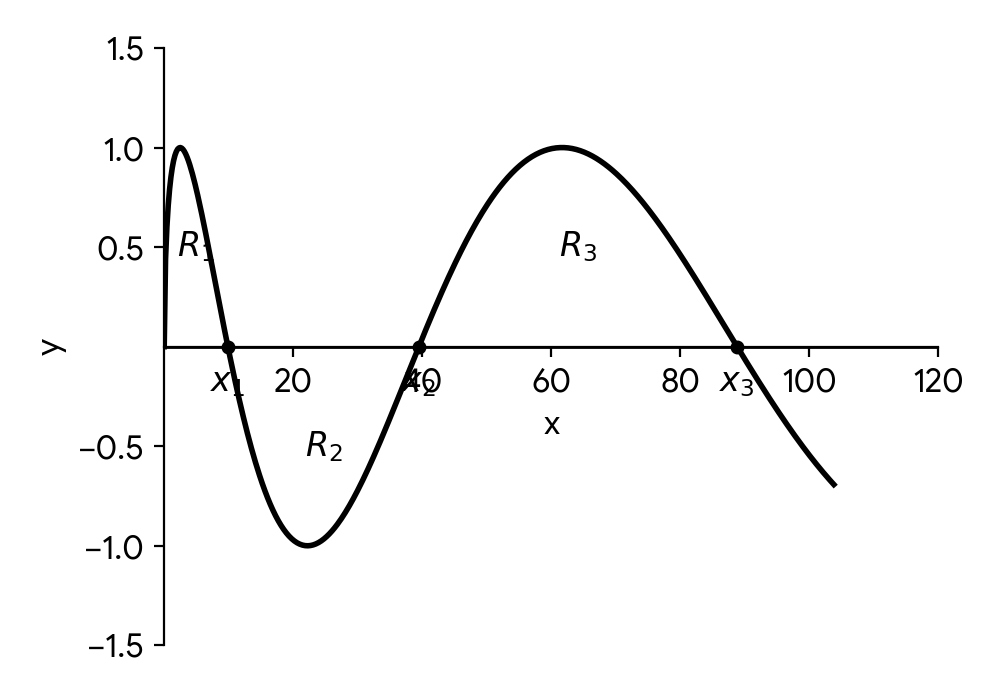
The curve intersects the x-axis at .
The nth x-intercept of the curve, , is given by , where .
Write down an expression for .
The regions bounded by the curve and the x-axis are denoted by as shown on the diagram.
Calculate the area of region .
Give your answer in the form , where .
Hence, show that the areas of the regions form an arithmetic sequence.
Try substituting . After substituting, you will need to use integration by parts.
Simply replace with in the given formula for .
The area of is given by the absolute value of the definite integral from to . Use the result from part (a) and the expressions for the intercepts from part (b).
An arithmetic sequence has a constant common difference. Calculate Area() - Area() and show that it is a constant.
Question 11
MediumPaper 1 · no calculator5 marksThe sum of the first four terms of an arithmetic sequence is 26. The sum of the first six terms of the same sequence is 57.
Find the first term, , and the common difference, .
You will need to use the formula for the sum of an arithmetic sequence, . Set up two equations using the information given for and , and then solve them simultaneously for and .
Question 12
HardPaper 1 · no calculator11 marksA function is defined by , where . The equation has three real roots, and .
(a) Write down the value of .
A polynomial is defined by , where . The roots of are also roots of the equation . It is given that is a root of .
(b) Find the other non-real root of , giving a reason for your answer.
(c) Find the value of .
(d) It is given that the roots form an arithmetic progression. Find the values of and .
Recall Vieta's formulas, which relate the coefficients of a polynomial to the sums and products of its roots. For a cubic polynomial , what is the sum of the roots?
Consider the properties of polynomials with real coefficients. What does this imply about any non-real roots?
Use Vieta's formulas for the quintic polynomial . You know all five roots in terms of . Relate their product to the coefficients of .
Represent the three roots that form an arithmetic progression as . Use the sum of the roots to find the value of , which is one of the roots. Then use the product of the roots to find the common difference .
Question 13
MediumPaper 1 · no calculator14 marksA company's profit in the -th month after it was founded is given by the -th term, , of an arithmetic sequence. The total profit after months is given by , in thousands of dollars.
(a) (i) Find the total profit after the first 3 months.
(a) (ii) Find the profit made in the 3rd month.
(b) Find the profit made in the first month.
(c) Find an expression for the profit in the -th month, , in terms of .
(d) A second company's profit in the -th month is given by the -th term, , of a geometric sequence. The profit in the second month, , is equal to the first company's profit in the first month, . The profit in the fourth month, , is equal to the first company's profit in the fifth month, .
Find the possible values of the common ratio, .
(e) Given that the second company's profit is always positive, find the profit made in its third month, .
The question gives you the formula for the total profit after months, . You need to find the total profit after 3 months. What value should you substitute for ?
The profit in the 3rd month () is the difference between the total profit after 3 months () and the total profit after 2 months ().
The profit in the first month () is the same as the total profit after one month ().
To find the general term of an arithmetic sequence, you need the first term and the common difference . You can find by calculating . Alternatively, remember the relationship .
First, find the values of and from the arithmetic sequence. These will be your values for and . Then use the formula for the general term of a geometric sequence, , to relate and .
The condition 'profit is always positive' tells you something about the common ratio, . If the terms of a geometric sequence are all positive, what must be true about the sign of ? Once you've determined the correct value of , you can find using and .
Question 14
HardPaper 1 · no calculator14 marksConsider the function where and . The graph of contains the point .
(a) Show that .
(b) Write down an expression for .
(c) Find the value of .
Consider the arithmetic sequence , where and .
(i) Show that and are four consecutive terms in a geometric sequence.
Consider the arithmetic sequence , where and .
(ii) Find the value of and the value of .
Substitute the given coordinates into the function's equation and solve for the base 'a'. You will need to use the rules of exponents.
The inverse of an exponential function is a logarithmic function. Recall the relationship between the base of the exponential and the base of the logarithm.
Substitute into the expression for the inverse function you found in part (b). Then, use the properties of logarithms to evaluate the result. Ask yourself: '9 to what power equals 1/81?'
An arithmetic sequence has a common difference. Set up equations by equating the differences between consecutive terms. Then, use the laws of logarithms to simplify these equations and show that the arguments of the logarithms have a common ratio.
You can use the properties of the geometric sequence from part (d)(i) or the properties of the original arithmetic sequence. Using the geometric sequence, find the common ratio 'r' first. Using the arithmetic sequence, find the common difference 'd' first.
Question 15
MediumPaper 1 · no calculator7 marksA graphic designer creates a sequence of patterns. The total number of dots in the first patterns is given by the formula , where and are constants.
It is known that the total number of dots in the first 3 patterns is 33, and the total number of dots in the first 5 patterns is 75.
(a) Find the value of and the value of .
(b) Find the number of dots in the fifth pattern.
Use the given information to set up a system of two linear equations with two variables, and . Then, solve this system.
The number of dots in the fifth pattern is the difference between the total number of dots in the first five patterns and the total number of dots in the first four patterns.
Question 16
HardPaper 1 · no calculator9 marksThe dimensions of a rectangular prism, its length, width and height, are denoted by and respectively.
The dimensions, in the order , form a geometric sequence.
The numbers , in that order, form an arithmetic sequence.
Given that the sum of the dimensions is 42, find the dimensions of the rectangular prism.
Start by writing down three equations based on the information given: one for the geometric sequence, one for the arithmetic sequence, and one for the sum of the dimensions. Try to combine these equations to solve for one of the variables first.
Question 17
MediumPaper 1 · no calculator7 marksA new theatre is being designed. The number of seats in each row forms an arithmetic sequence. The total number of seats in the first rows, denoted by , is given by the formula , where and are constants.
It is known that the total number of seats in the first 4 rows is 70, and the total number of seats in the first 6 rows is 135.
(a) Find the value of and the value of .
(b) Find the number of seats in the 6th row.
Use the given information to set up a system of two linear equations with variables and . For example, substitute and into the formula to get one equation.
The number of seats in the -th row, , can be found by calculating the difference between the total number of seats in the first rows and the first rows, i.e., .
Question 18
HardPaper 3 · calculator25 marksA chemical engineer is studying the concentration of a certain byproduct in a reaction mixture over time. The concentration is modelled by the function , where represents time in hours.
(a) Sketch the graph of , stating the coordinates of the maximum concentration.
(b) The total amount of byproduct accumulated in the first hours is given by the integral .
Show that .
(c.i) The total amount of byproduct accumulated indefinitely, , is given by .
Use l'Hôpital's rule to find . You may assume that the condition for applying l'Hôpital's rule has been met.
(c.ii) Hence write down the value of .
(d) The total amount of byproduct accumulated indefinitely for a general function is denoted by .
You are given that and .
(i) Use your graphic display calculator, and an appropriate value for the upper limit, to determine the value of .
(ii) Determine the value of .
(e) Suggest an expression for in terms of , where .
(f) Use mathematical induction to prove your conjecture from part (e). You may assume that, for any value of , .
Remember to find the derivative of and set it to zero to locate critical points. Consider the function's behavior at and as to help with the sketch.
Use integration by parts. Let and . Recall the formula .
The expression can be written as . Focus on the limit of the second term, which is an indeterminate form .
The value of is the limit you just calculated.
When using the GDC for an integral with an infinite upper limit, choose a sufficiently large number (e.g., 10 or 20) for the upper limit, as decays quickly.
Continue using your GDC with the appropriate function and limits.
Look for a pattern in the values of . Consider factorials and powers of 2.
For the inductive step, you will need to use integration by parts. Remember to clearly state the base case, the inductive hypothesis, and the inductive step, and conclude your proof.
Question 19
MediumPaper 1 · no calculator5 marksConsider an arithmetic sequence where the fifth term is 10 and the sum of the first ten terms is 125. Find the value of the first term, , and the value of the common difference, .
Recall the formulas for the nth term and the sum of the first n terms of an arithmetic sequence. Use the given information to set up a system of two simultaneous equations with two variables, and .
Question 20
HardPaper 3 · calculator29 marksThis question asks you to examine linear and quadratic functions constructed in systematic ways using geometric sequences.
Consider the function for where and .
Let be the root of .
If and , in that order, are in geometric sequence, then is said to be a GS-linear function.
Show that is a GS-linear function.
Consider .
Show that .
Given that is a GS-linear function, show that .
State any further restrictions on the value of , assuming the common ratio .
There are only two integer values of (excluding ) for which is a GS-linear function with a common ratio . One of these gives .
Use part (b) to determine the other GS-linear function with integer values of and that satisfies the condition.
Consider the function for where and .
Let be the roots of .
Write down an expression for
(i) the sum of roots, , in terms of and .
(ii) the product of roots, , in terms of and .
If are in arithmetic sequence, AND are in geometric sequence, then is said to be a GS-Quadratic function.
Given that is a GS-Quadratic function, show that , where .
Hence or otherwise, show that or .
Consider the case where .
Determine the two GS-Quadratic functions that satisfy this condition, given that . Give your answers in the form .
Consider the case where .
Determine the two GS-Quadratic functions that satisfy this condition, given that .
First, find the root of the given linear function. Then, check if the sequence forms a geometric sequence by calculating the ratio between consecutive terms.
The root of a function is the value of for which . Set to zero and solve for in terms of and .
Use the definition of a geometric sequence () and the expression for the root from part (b)(i). Express in terms of .
Recall the relationship between and derived in part (b)(ii). Apply the given restriction on to find the restriction on .
From part (b)(ii), . For to be integers, must be an integer. Consider integer values for other than (from part b.iii).
Recall Vieta's formulas for the sum of roots of a quadratic equation.
Recall Vieta's formulas for the product of roots of a quadratic equation.
Use the definitions of arithmetic and geometric sequences. Express and in terms of , , and . Then substitute these into the arithmetic sequence condition for .
Consider the equation . What happens if ? What happens if ? Also, think about specific cases for the coefficients or roots that might simplify the equation.
If , then . Use the equation to find the possible values for . Then use and the expressions for and in terms of to find the quadratic functions.
If , then . Use the equation to find the possible values for . Then use the given values for and the expressions for and in terms of to find the quadratic functions.
No question on this page matches those filters. Try another difficulty or paper.
24 more Arithmetic Sequences & Series (+Sigma notation) questions in the app
Every answer is marked mark by mark, IB-style, and the AI tutor helps when you are stuck.
Where marks are lost
- Using your own wrong value after failing a "show that".