Non-right angle triangles (Sine, cosine rule, area of triangle): notes and practice questions
- Sine Rule:
- Cosine Rule:
- Area of Triangle:
How it is examined
Paper 2. The choice between the two rules is the assessed decision, and the common error is using the sine rule where the given information is two sides and the included angle. Rounding is a real risk: an intermediate angle rounded to 3 significant figures and then reused loses accuracy in the final answer. 4 to 7 marks.
All four formulas are given.
- Use of sine, cosine and tangent ratios to find the sides and angles of right-angled triangles.
- The sine rule: .
- The cosine rule: ; .
- Area of a triangle as .
Linking questions
- Other contexts: triangulation, map-making.
- International-mindedness: diagrams of Pythagoras' theorem in early Chinese and Indian manuscripts.
Practice questions
26 questions · 1 easy · 19 medium · 6 hardQuestion 1
EasyPaper 1 · no calculator3 marksA landscape designer is creating a triangular garden bed. Two sides of the garden bed measure 8 m and 10 m, and the angle between them is . Find the exact area of the garden bed.
Recall the formula for the area of a non-right-angled triangle that uses two side lengths and the angle between them. Remember to use the exact value for the trigonometric function.
Question 2
MediumPaper 1 · no calculator6 marksThe diagram shows a parallelogram PQRS where PQ = cm, PS = 7 cm and .
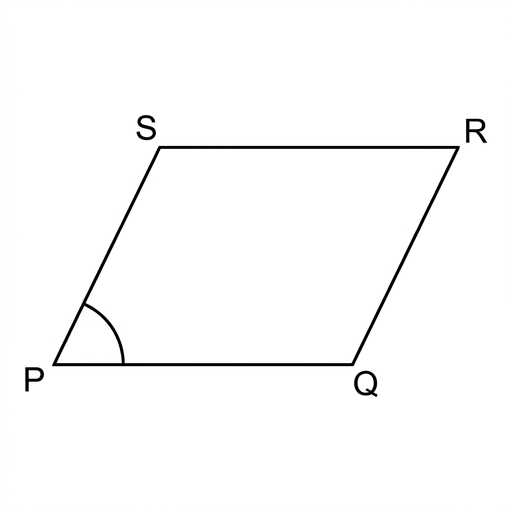
Find the exact area of the parallelogram PQRS.
The area of a parallelogram can be found by splitting it into two congruent triangles. You will need to find the sine of the angle given its cosine. Recall the Pythagorean identity .
Question 3
HardPaper 1 · no calculator14 marksConsider an acute angle such that .
Find the value of .
Find the value of .
The following diagram shows triangle ABC, with , , and AB = 14.
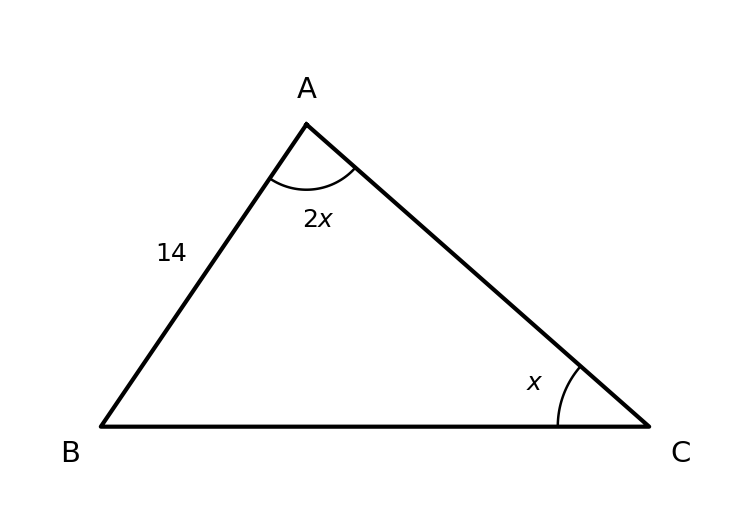
(b) Show that BC = 21.
The line segment CA is extended to a point D such that triangle ABD is isosceles with AB = AD.
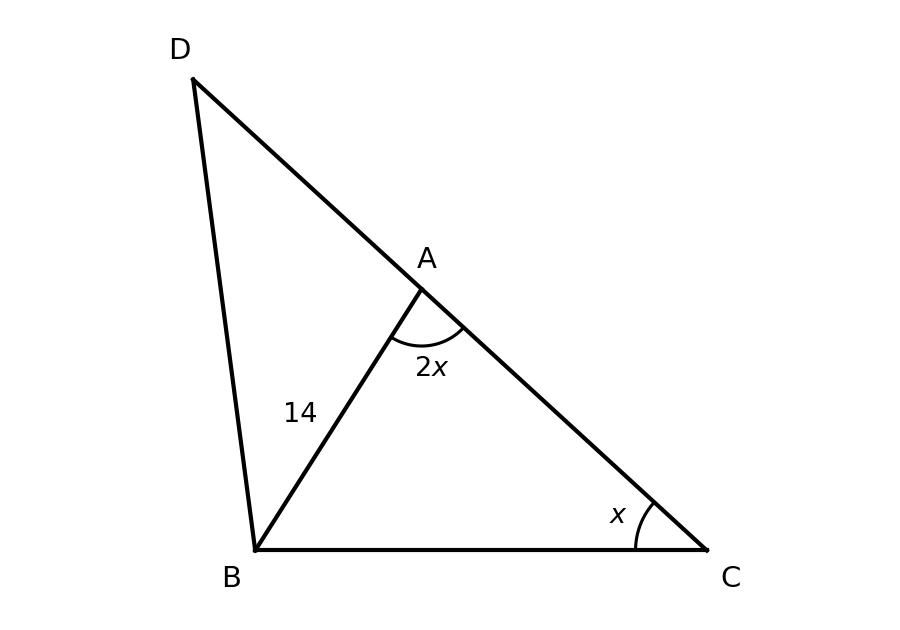
Find the size of angle ADB in terms of .
Find the area of triangle ABD.
Use the Pythagorean identity . Remember to consider the quadrant of angle when taking the square root.
Use a double angle identity for cosine. The identity is the most direct one to use here.
Apply the sine rule to triangle ABC. You will also need to use the double angle identity for sine, .
First, find the angle BÂD. Note that it is supplementary to BÂC. Then, use the properties of the isosceles triangle ABD to find the other angles.
Use the formula for the area of a triangle: Area = . You know the lengths of two sides (AB and AD) and the angle between them (BÂD).
Question 4
MediumPaper 1 · no calculator7 marksThe following diagram shows triangle LMN, with LM = , MN = and LN = .
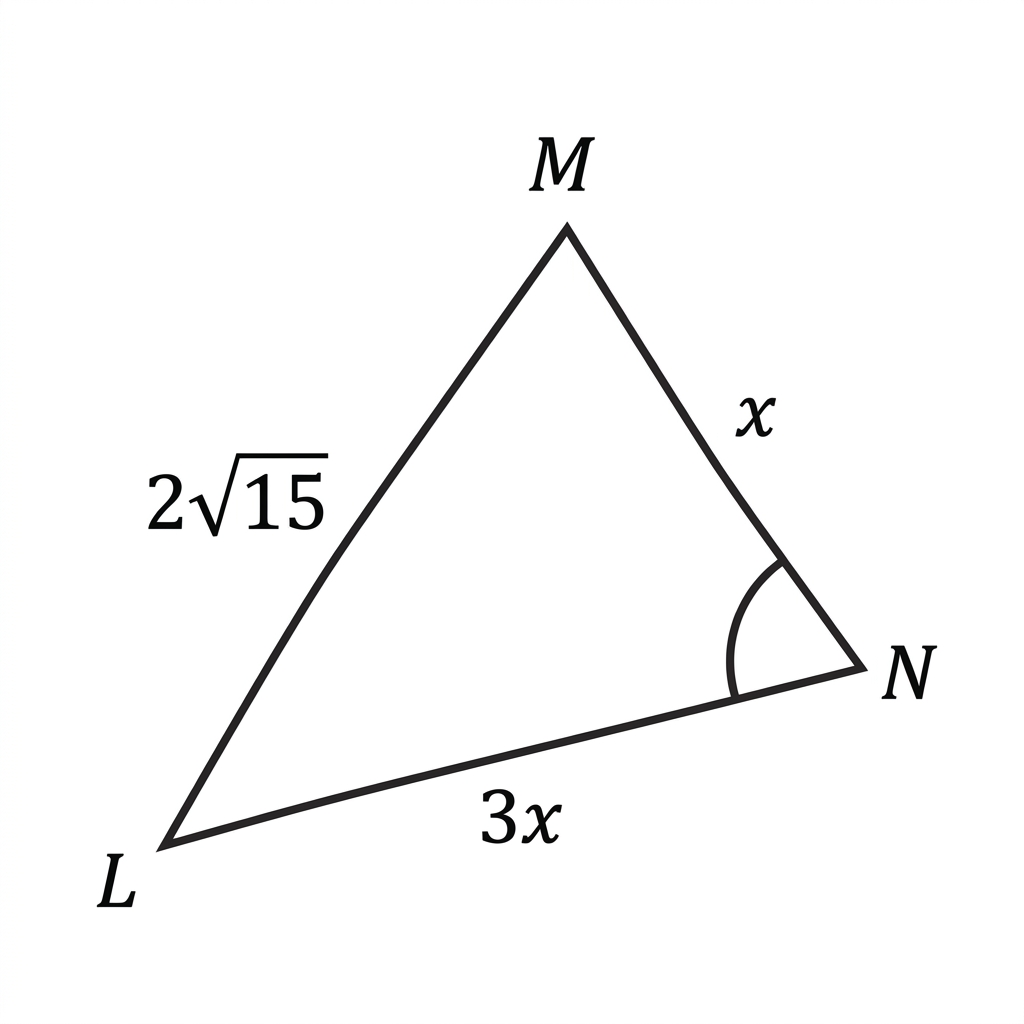
Given that , find the area of the triangle.
Give your answer in the form where .
Start by applying the cosine rule to the triangle to form an equation in terms of . You will also need to find the sine of the given angle to use the area formula.
Question 5
HardPaper 1 · no calculator6 marksIn any triangle ABC, the side lengths opposite to the angles A, B, and C are a, b, and c respectively.
Show that .
Start with the left-hand side of the equation. Use the sine rule to express the side lengths in terms of the sines of the angles. Then, apply appropriate trigonometric identities, such as the sum-to-product and double angle formulas.
Question 6
MediumPaper 1 · no calculator6 marksThe diagram shows a parallelogram PQRS. It is given that cm, cm and .
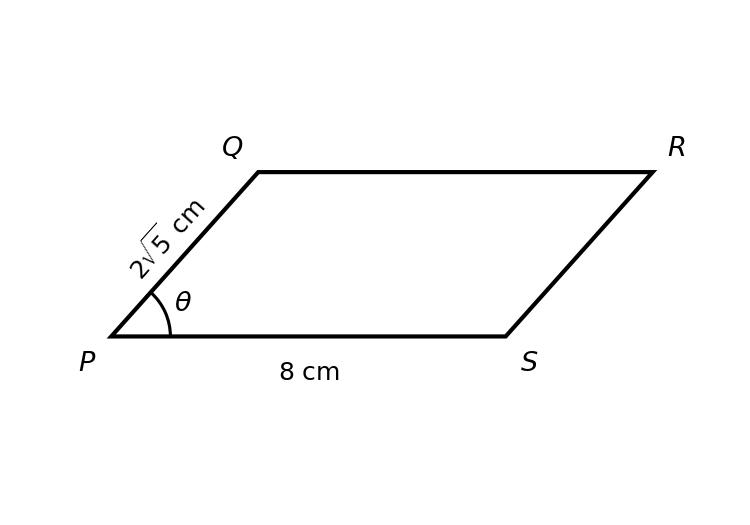
Find the area of the parallelogram PQRS.
The area of a parallelogram can be found using the formula , where and are adjacent sides and is the included angle. You are given the cosine of the angle. How can you find the sine?
Question 7
HardPaper 2 · calculator15 marksA landscape architect is designing a triangular garden bed . The side is fixed at a length of metres. The angle is set to . The architect initially plans for the side to be metres.
(a) Calculate the length of the side .
Due to a change in design, the architect now wants the angle to be . The side remains metres and remains .
(b) Calculate the length of the side .
(c) Calculate the area of the garden bed with the dimensions from part (b).
The architect considers a different design where m and (as before). However, the side is now fixed at metres.
(d) Show that two different triangular garden beds are possible, and find the two possible lengths for the side .
Use the cosine rule to find the length of the side . Remember the formula for the cosine rule: .
First, find the third angle in the triangle. Then, use the sine rule to find the length of . Remember the sine rule: .
Use the formula for the area of a triangle: Area . You have two sides ( and ) and the included angle ().
This scenario involves the ambiguous case of the sine rule. Use the sine rule to find the possible values for angle . Remember that if , then can be or . Then, for each angle , find the corresponding angle and subsequently the length of .
Question 8
MediumPaper 1 · no calculator6 marksThe following diagram shows an isosceles triangle XYZ, where XY = XZ = 5 cm and YZ = cm. Angle YZ = .
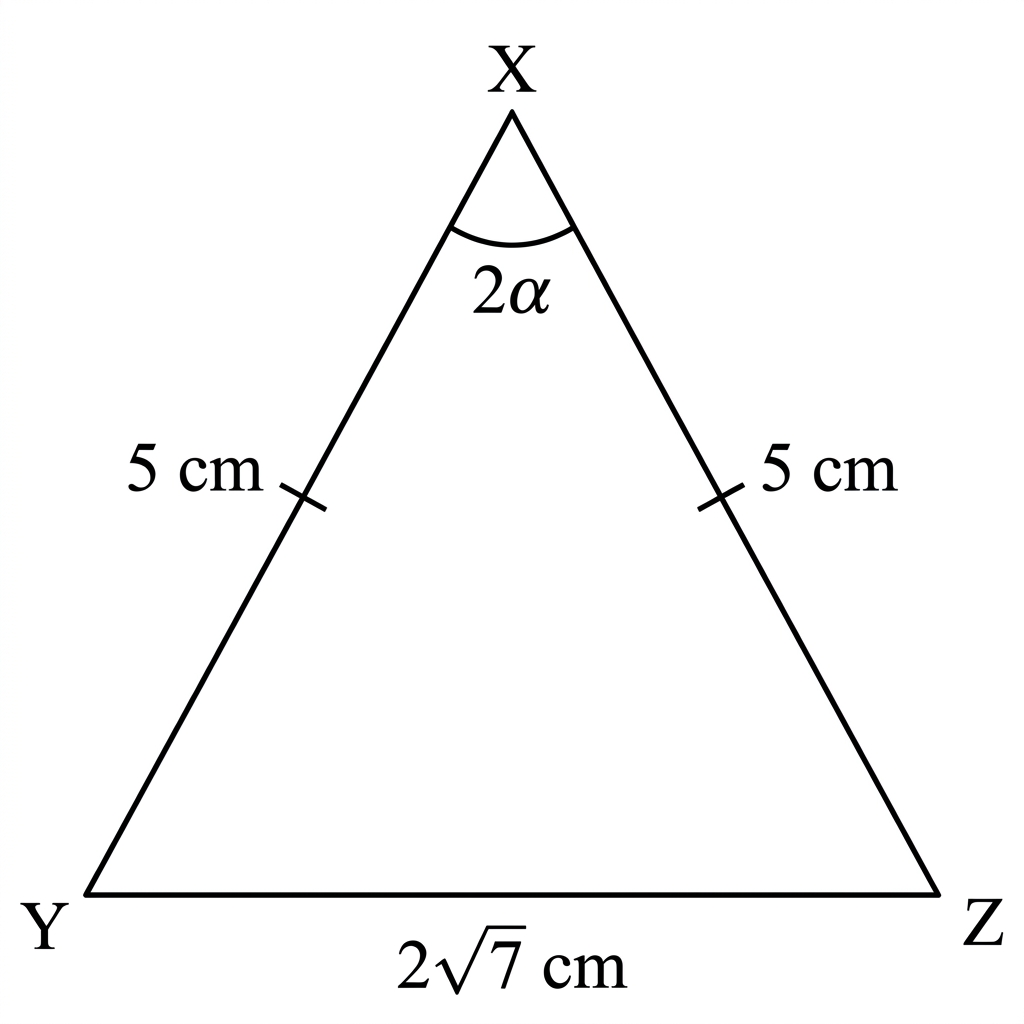
Find the exact value of , giving your answer in the form , where .
You can approach this in two ways. One way is to use the cosine rule in triangle XYZ to find and then use a suitable double angle identity. Alternatively, consider the properties of an isosceles triangle and what happens when you draw an altitude from vertex X.
Question 9
HardPaper 1 · no calculator11 marksFind, in the form , the fourth roots of .
The four roots from part (a) form the vertices of a quadrilateral in an Argand diagram. Determine the exact area of this quadrilateral.
First, convert the complex number into its polar form or . Then, use De Moivre's theorem for finding the -th roots of a complex number.
What kind of quadrilateral is formed by the -th roots of a complex number? Consider the geometric properties of the roots on the Argand diagram. The roots are equally spaced on a circle.
Question 10
MediumPaper 1 · no calculator6 marksThe following diagram shows triangle PQR, with PQ = 8 cm, PR = cm and .
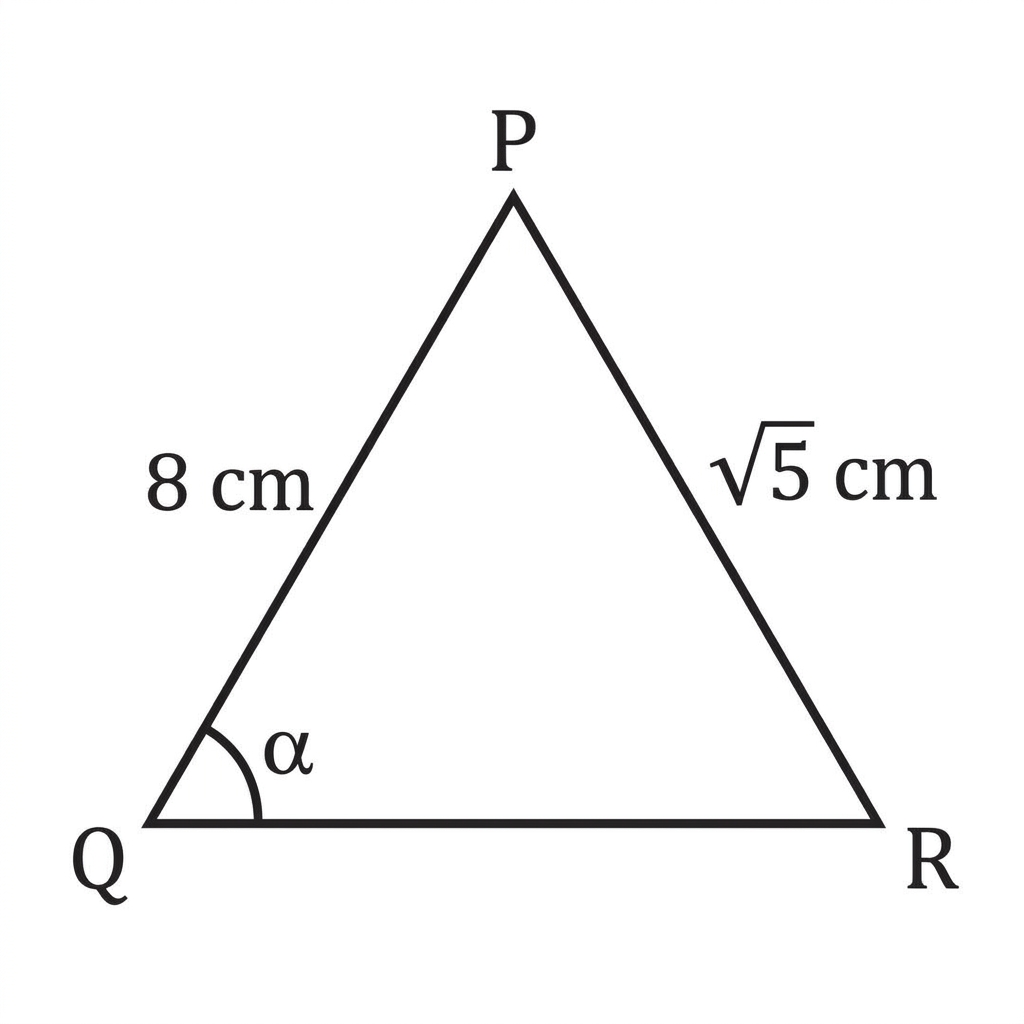
Find the area of triangle PQR.
The formula for the area of a triangle is Area = . You are given two sides and the cosine of the included angle. How can you find the sine of the angle from its cosine?
Question 11
HardPaper 2 · calculator21 marksConsider the non-zero vectors and . Let be the angle between and .
Using the definitions of and in terms of , and , show that .
A triangle PQR has vertices P(1, 0, 1), Q(, 2) and R(4, 1, 1), where .
The vectors and are defined as and .
It is given that and the area of triangle PQR is square units.
Find the value of .
Hence, or otherwise, find the value of .
Hence, or otherwise, find the possible values of and the corresponding values of .
Consider a new point S, the vector is defined as .
It is given that and , and the area of triangle PRS is 10 square units.
Assuming that , find the possible vectors for .
Recall the definitions of the dot product and the magnitude of the cross product in terms of the magnitudes of the vectors and the angle between them. Use the Pythagorean identity for trigonometric functions.
The area of a triangle formed by two vectors is half the magnitude of their cross product.
Use the identity from part (a) and the values you've found for the dot product and the magnitude of the cross product. Remember to calculate the magnitude of first.
Express in terms of and . Set up two equations using the given dot product and the magnitude of found in the previous part. Solve the system of equations.
If is perpendicular to both and , it must be parallel to their cross product. The area of triangle PRS can be found using the magnitude of and and the angle between them.
Question 12
MediumPaper 2 · calculator5 marksA lighthouse (L), a boat (B), and a navigation buoy (N) form a triangle.
The distance from the lighthouse to the boat, LB, is 15 km.
The distance from the lighthouse to the buoy, LN, is 9 km.
The angle at the boat, , is .
Find the smallest possible perimeter of triangle LBN.
This problem involves the ambiguous case of the sine rule or solving a quadratic equation using the cosine rule. There will be two possible lengths for the side BN, leading to two possible perimeters. You need to identify the smaller of these perimeters.
Question 13
HardPaper 1 · no calculator7 marksA parallelogram has adjacent side lengths of 6 cm and 8 cm. Let be the angle between these two sides. The area of the parallelogram is cm.
(a) Show that .
(b) Find the exact lengths of the two diagonals of the parallelogram.
The formula for the area of a parallelogram is given by , where and are the lengths of the adjacent sides and is the angle between them. Substitute the given values into this formula.
The diagonals of the parallelogram can be found by applying the cosine rule to the two triangles formed by the sides and a diagonal. You will first need to find the possible values for using the value of from part (a). Remember that the two adjacent angles in a parallelogram are supplementary.
Question 14
MediumPaper 2 · calculator6 marks(a) A surveyor is mapping a new development. From point A, the distance to a prominent tree (T) is measured as 300 m. From another point B, 250 m away from A, the distance to the same tree (T) is measured as 200 m.
Find the measure of angle ATB.
(b) Find the shortest distance from the tree (T) to the line segment AB.
Use the Cosine Rule to relate the three side lengths of the triangle ATB to the angle at T.
The shortest distance from a point to a line is the perpendicular distance. Consider the area of triangle ATB.
Question 15
MediumPaper 2 · calculator6 marksA geological survey is being conducted in a mountainous region. Three sensor stations, A, B, and C, are set up at different locations. Their coordinates, relative to a central reference point (in meters), are given as:
Station A:
Station B:
Station C:
(a) Find the distance between Station A and Station B.
(b) Find the size of the angle (the angle at Station B).
To find the distance between two points and in 3D space, use the distance formula: . Alternatively, find the displacement vector between the two points and then calculate its magnitude.
To find the angle between three points A, B, and C (angle at B), you can use the dot product of vectors and . Remember the formula . Alternatively, you can use the cosine rule if you find all three side lengths of triangle ABC.
Question 16
MediumPaper 2 · calculator9 marksA landscape architect is designing a triangular shade sail for a patio. The vertices of the sail are defined by points A, B, and C in a 3D coordinate system, where the z-axis represents height.
The coordinates of the vertices are A, B and C, where is a positive constant representing a design parameter.
(a) Show that the vector product is given by .
(b) The architect wants to minimize the tension in the sail, which is proportional to the magnitude of the vector product of two adjacent sides. Find the smallest possible value of .
(c) Calculate the smallest possible area of the shade sail.
First, find the displacement vectors and . Then, use the formula for the cross product of two vectors.
To find the minimum magnitude, consider the square of the magnitude, . This will result in a polynomial in . You can then use calculus (finding the derivative and setting it to zero) or a GDC to find the minimum value for .
The area of a triangle formed by two vectors is half the magnitude of their cross product.
Question 17
MediumPaper 2 · calculator8 marksA lighthouse (L) monitors maritime traffic. At a particular moment, the lighthouse observes a buoy (B) and a ship (S).
The bearing of the buoy from the lighthouse is and its distance is km. The bearing of the ship from the lighthouse is and its distance is km.
Calculate the distance and bearing of the buoy (B) from the ship (S).
First, determine the angle within the triangle formed by the lighthouse, buoy, and ship. Then, use the Cosine Rule to find the distance . For the bearing, apply the Sine Rule to find , and then use this angle along with the back bearing of L from S to find the final bearing of B from S. Remember to consider the relative positions of B and L from S.
Question 18
MediumPaper 1 · no calculator6 marksA plan for a garden is drawn on a coordinate grid, where 1 unit represents 1 metre. The garden consists of a paved patio and a flower bed.
The patio is a quadrilateral with vertices A(-4, 2), B(0, 5), C(4, 2), and D(0, -1).
(a) Find the area of the patio ABCD.
The flower bed is a triangle with vertices C(4, 2), E(9, 4), and F(9, 0).
(b) Find the area of the flower bed CEF.
(c) Hence, find the total area of the garden.
The area of a kite or rhombus can be found using the lengths of its diagonals. First, find the lengths of the diagonals AC and BD. Alternatively, you can split the quadrilateral into two triangles.
The area of a triangle is given by the formula . Identify a suitable base and its corresponding perpendicular height from the coordinates.
The total area of the garden is the sum of the areas of the patio and the flower bed that you calculated in the previous parts.
Question 19
MediumPaper 2 · calculator17 marks(a) Calculate the shortest distance from the apex to the side of the pyramid's base.
(b) Find the total surface area of the four triangular glass panels forming the pyramid's roof.
(c) Calculate the total height of the monument from the ground to the apex .
(d) Determine the size of the angle between the slant edge and the base edge .
(e) A security camera is installed at a point on the vertical edge of the monument. A guard standing at point (a corner of the base of the monument) measures the angle of elevation to point to be . Find the height of the security camera from the ground.
The shortest distance from the apex to a side of the base is the slant height of the triangular face. Consider the right-angled triangle formed by the apex, the midpoint of the base side, and one of the pyramid's slant edges.
You will need the slant height for the faces with base (from part a) and the slant height for the faces with base . Then sum the areas of all four triangles.
The total height is the sum of the prism's height and the pyramid's height. To find the pyramid's height, consider the right-angled triangle formed by the apex, the center of the base, and one of the base's corners.
Consider the triangular face . You know all three side lengths of this triangle. Use the cosine rule to find the angle.
Form a right-angled triangle using the guard's position, the base of the vertical edge, and the camera's position. Use trigonometry to find the height.
Question 20
MediumPaper 2 · calculator8 marks(a) A landscape architect is designing a new park. From a central monument, two paths, Path A and Path B, diverge. Path A is m long, and Path B is m long. The angle between Path A and Path B at the monument is .
Calculate the direct distance between the ends of Path A and Path B.
(b) Calculate the area of the triangular region enclosed by Path A, Path B, and the direct line connecting their ends.
(c) Calculate the angle that Path B makes with the direct line connecting the ends of the paths.
Use the Cosine Rule to find the length of the third side of a triangle when two sides and the included angle are known. Remember the formula .
The area of a triangle can be calculated using the formula , where and are two sides and is the included angle.
Use the Sine Rule. You have all three side lengths (from part (a) ) and one angle. The Sine Rule states .
No question on this page matches those filters. Try another difficulty or paper.
6 more Non-right angle triangles (Sine, cosine rule, area of triangle) questions in the app
Every answer is marked mark by mark, IB-style, and the AI tutor helps when you are stuck.
Where marks are lost
- Using your own wrong value after failing a "show that".