Right angle triangles (SOH CAH TOA): notes and practice questions
- Pythagorean Theorem is used only for right-angled triangles. It states that the square of the hypotenuse () equals the sum of the squares of the two shorter sides ( and ): . You must remember this formula as it is not provided in the booklet.
- Trigonometry (SOHCAHTOA) relates the ratios of side lengths to an angle () in a right-angled triangle.
- SOH:
- CAH:
- TOA: .
- You can use these ratios with inverse functions (like ) to find missing angles, or directly to find missing side lengths, as long as you label the sides correctly relative to the angle .
How it is examined
Paper 2. The choice between the two rules is the assessed decision, and the common error is using the sine rule where the given information is two sides and the included angle. Rounding is a real risk: an intermediate angle rounded to 3 significant figures and then reused loses accuracy in the final answer. 4 to 7 marks.
All four formulas are given.
- Use of sine, cosine and tangent ratios to find the sides and angles of right-angled triangles.
- The sine rule: .
- The cosine rule: ; .
- Area of a triangle as .
Linking questions
- Other contexts: triangulation, map-making.
- International-mindedness: diagrams of Pythagoras' theorem in early Chinese and Indian manuscripts.
Practice questions
11 questions · 10 medium · 1 hardQuestion 1
MediumPaper 1 · no calculator6 marksThe following diagram shows an isosceles triangle XYZ, where XY = XZ = 5 cm and YZ = cm. Angle YZ = .
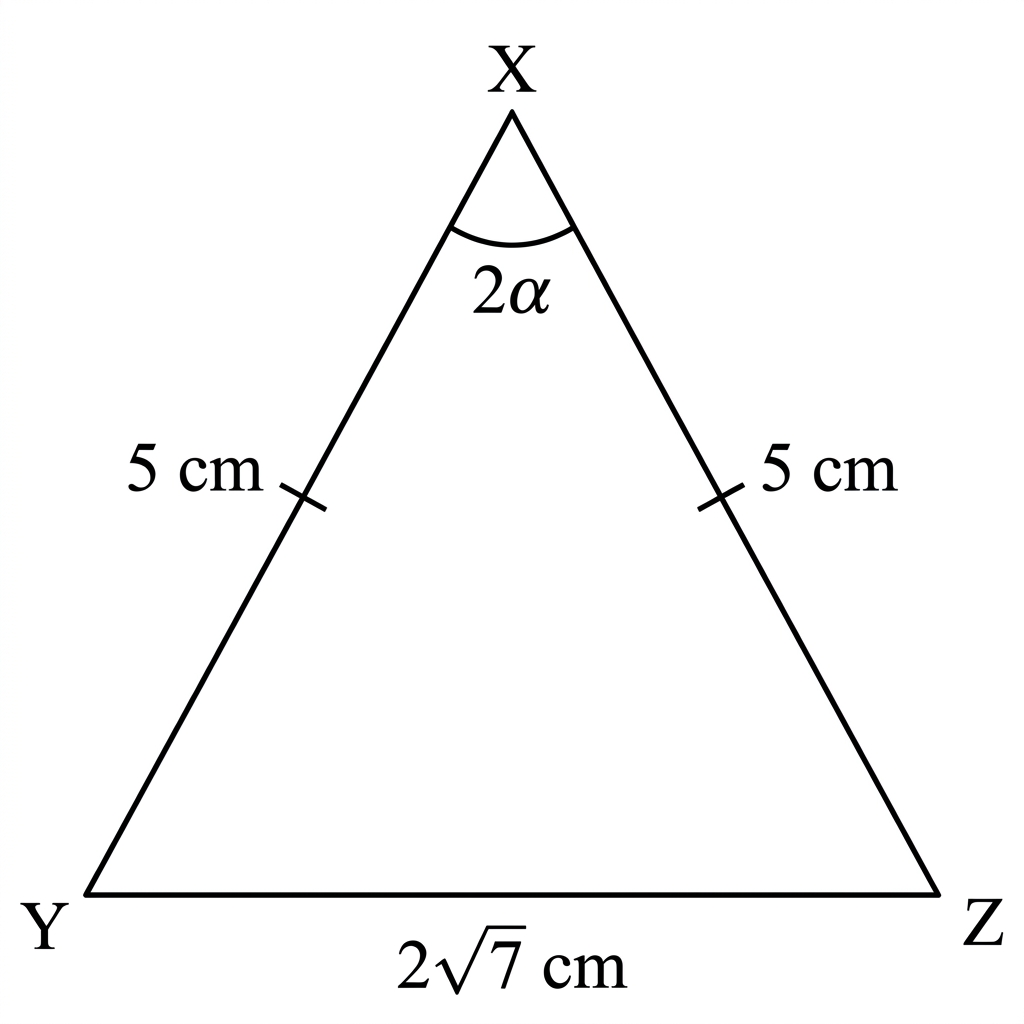
Find the exact value of , giving your answer in the form , where .
You can approach this in two ways. One way is to use the cosine rule in triangle XYZ to find and then use a suitable double angle identity. Alternatively, consider the properties of an isosceles triangle and what happens when you draw an altitude from vertex X.
Question 2
HardPaper 1 · no calculator19 marksA ladder must be placed against a tall vertical building, clearing a monument that is 8 m high and stands on horizontal ground 1 m away from the building's base. The ladder touches the ground, the top corner of the monument, and the wall of the building.
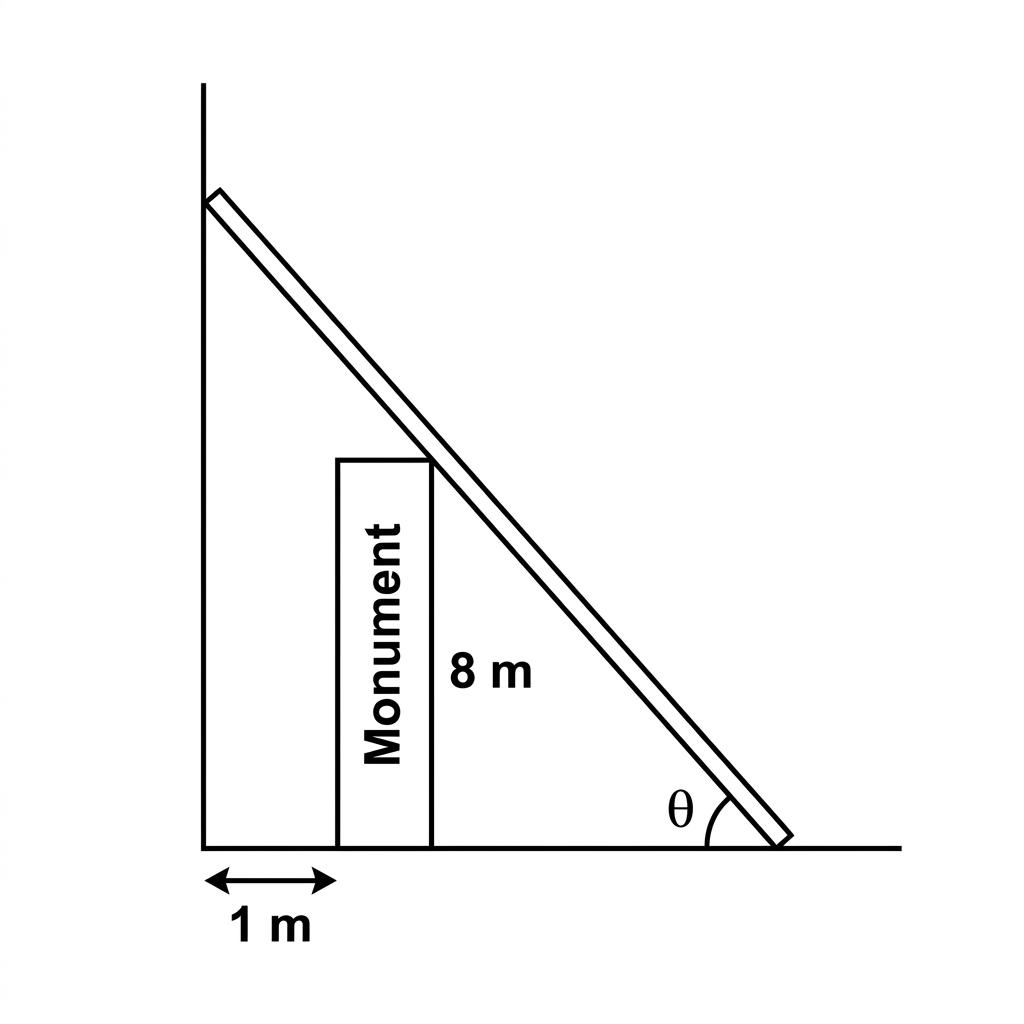
Let be the length of the ladder in metres.
Let be the angle that the ladder makes with the ground, where .
(a) Show that .
(b) (i) Find .
(b) (ii) When , show that .
(c) (i) Find .
(c) (ii) When , find the value of .
(d) (i) Hence, justify that is a minimum when .
(d) (ii) Determine this minimum value of .
(e) A construction company only has ladders with a maximum length of 11 m. Determine whether it is possible to position a ladder against the building over the monument, giving a reason for your answer.
Use trigonometry on the two right-angled triangles formed by the ladder, the ground, the monument, and the wall. Express the two segments of the ladder, divided by the monument's corner, in terms of .
Differentiate the expression for with respect to . You will need to know the derivatives of and .
Set your expression from part (b)(i) equal to zero. Rewrite all trigonometric functions in terms of and and then simplify the equation to find an expression for .
Differentiate your expression for from part (b)(i). You will need to use the product rule for both terms.
If , you can construct a right-angled triangle with opposite side 2 and adjacent side 1. Use this to find the values of , , and any other required trigonometric ratios, then substitute them into your expression for the second derivative.
Use the second derivative test. What does the sign of the second derivative at a stationary point tell you about the nature of that point?
Substitute the trigonometric values corresponding to back into the original expression for from part (a).
Compare the maximum available ladder length (11 m) with the minimum required length you calculated in part (d)(ii). To compare and without a calculator, you can compare their squares.
Question 3
MediumPaper 2 · calculator15 marks(a) A new Ferris wheel is being constructed. From a point A on the ground, 15 metres from the base of the support tower, the angle of elevation to the centre C of the Ferris wheel is 33.7 degrees. Find the height of point C above the ground.
(b) An engineer walks 5 metres closer to the support tower to point B. Find the angle of elevation of point C from point B, giving your answer in radians.
(c) The lowest point a passenger cabin reaches is 1.5 metres above the ground, allowing for easy boarding. Calculate the radius of the Ferris wheel.
(d) The height , in metres, of a passenger cabin above the ground can be modelled by the function , where is the time in seconds after the cabin starts moving from its lowest point. The Ferris wheel completes one full rotation in 40 seconds.
Find the values of , , and .
(e) An observer watches the Ferris wheel for 5 minutes. How many times does a specific cabin pass its highest point during this time?
Recall the SOH CAH TOA rules for right-angled triangles. You are given the adjacent side and an angle, and you need to find the opposite side (height). Make sure your calculator is in degree mode for the given angle.
First, determine the new horizontal distance from point B to the base of the tower. Then, use the height of point C found in part (a) and the tangent function to find the new angle of elevation. Remember to convert your calculator to radian mode or convert the final answer to radians.
The radius of the Ferris wheel is the distance from the center (C) to the lowest point a cabin reaches. Consider the height of the center and the height of the lowest point.
For a trigonometric function of the form : is the amplitude (related to radius), is the vertical shift (related to the center height), and is related to the period by . Since the cabin starts at its lowest point, the negative cosine function is appropriate.
First, convert the total observation time into seconds. Then, determine how many full rotations occur within that time. Consider that the cabin starts at its lowest point at and reaches its highest point halfway through each rotation.
Question 4
MediumPaper 2 · calculator6 marks(a) A surveyor is mapping a new development. From point A, the distance to a prominent tree (T) is measured as 300 m. From another point B, 250 m away from A, the distance to the same tree (T) is measured as 200 m.
Find the measure of angle ATB.
(b) Find the shortest distance from the tree (T) to the line segment AB.
Use the Cosine Rule to relate the three side lengths of the triangle ATB to the angle at T.
The shortest distance from a point to a line is the perpendicular distance. Consider the area of triangle ATB.
Question 5
MediumPaper 1 · no calculator5 marksA decorative object is in the shape of a right square-based pyramid. The base of the pyramid is a square with side length . The perpendicular height of the pyramid is .
Find the total surface area of the object.
The total surface area is the sum of the area of the base and the area of the four triangular faces. To find the area of the triangular faces, you will first need to calculate their slant height using the pyramid's perpendicular height and the dimensions of the base.
Question 6
MediumPaper 2 · calculator6 marksFrom the top of a lighthouse high, an observer spots a boat at sea. The angle of depression to the boat is . The boat sails directly away from the lighthouse, and after eight minutes the angle of depression is . Calculate the speed of the boat in .
Start by drawing a diagram to represent the situation. Use trigonometry to find the initial and final horizontal distances of the boat from the lighthouse. Remember to convert units appropriately for the final speed calculation.
Question 7
MediumPaper 2 · calculator17 marks(a) Calculate the shortest distance from the apex to the side of the pyramid's base.
(b) Find the total surface area of the four triangular glass panels forming the pyramid's roof.
(c) Calculate the total height of the monument from the ground to the apex .
(d) Determine the size of the angle between the slant edge and the base edge .
(e) A security camera is installed at a point on the vertical edge of the monument. A guard standing at point (a corner of the base of the monument) measures the angle of elevation to point to be . Find the height of the security camera from the ground.
The shortest distance from the apex to a side of the base is the slant height of the triangular face. Consider the right-angled triangle formed by the apex, the midpoint of the base side, and one of the pyramid's slant edges.
You will need the slant height for the faces with base (from part a) and the slant height for the faces with base . Then sum the areas of all four triangles.
The total height is the sum of the prism's height and the pyramid's height. To find the pyramid's height, consider the right-angled triangle formed by the apex, the center of the base, and one of the base's corners.
Consider the triangular face . You know all three side lengths of this triangle. Use the cosine rule to find the angle.
Form a right-angled triangle using the guard's position, the base of the vertical edge, and the camera's position. Use trigonometry to find the height.
Question 8
MediumPaper 2 · calculator9 marks(a) A surveyor is measuring a tall communications mast. From a point on the ground, the angle of elevation to the top of the mast is . The total height of the mast from the ground to its top is meters. Calculate the horizontal distance from point to the near edge of the mast's base, giving your answer correct to one decimal place.
(b) Calculate the direct line-of-sight distance from point to the top of the mast, giving your answer correct to one decimal place.
(c) A maintenance platform is located m below the top of the mast. Find the angle of depression from this maintenance platform to point , giving your answer in degrees correct to one decimal place.
Use the tangent function in the right-angled triangle formed by the mast's height, the horizontal distance, and the line of sight to the top of the mast.
You can use the sine function or the Pythagorean theorem with the height of the mast and the horizontal distance calculated in part (a).
First, determine the height of the maintenance platform from the ground. Then, use the horizontal distance from part (a) and the tangent function to find the angle of depression.
Question 9
MediumPaper 2 · calculator11 marksA designer is creating a symmetrical display stand for a museum exhibit. The cross-section of the stand is an isosceles trapezium , where is parallel to . The shorter parallel side measures cm, the longer parallel side measures cm, and the non-parallel sides and each measure cm.
Show that the height of the trapezium is cm.
Hence, find the area of the cross-section of the display stand.
Find the size of the angle , giving your answer to one decimal place.
Calculate the length of the diagonal , giving your answer to three significant figures.
Draw perpendiculars from vertices and to the longer base . This will form right-angled triangles at each end of the trapezium. Use the properties of an isosceles trapezium to find the length of the base of these right-angled triangles, then apply the Pythagorean theorem.
Recall the formula for the area of a trapezium: , where and are the lengths of the parallel sides and is the height.
Consider the right-angled triangle formed in part (a). Use trigonometry (SOH CAH TOA) to find the angle at vertex .
You can use the Pythagorean theorem on a suitable right-angled triangle, or the cosine rule in triangle . For the Pythagorean approach, consider the triangle formed by the height and the segment (where is the foot of the perpendicular from to ).
Question 10
MediumPaper 2 · calculator6 marks(a) The main antenna of a communication tower is located at point . The centre of the rectangular base of the tower is at point . A vertical support beam connects the antenna to the centre of the base. Calculate the length of this support beam, .
(b) The rectangular base of the tower has dimensions m by m. Calculate the length of the diagonal of this base.
(c) A support cable runs from the antenna to one of the corners of the base, say point . Find the size of the angle that this support cable makes with the base platform.
Use the distance formula in three dimensions: .
For a rectangle with sides and , the diagonal .
Consider the right-angled triangle formed by the vertical support beam (), the distance from the centre of the base to a corner (), and the support cable (). The distance is half the diagonal of the base.
Question 11
MediumPaper 2 · calculator15 marksA company produces solid glass paperweights. One model is a right pyramid with a square base of side length 10 cm and a height of 12 cm.
Find the volume of one of these paperweights.
Find the slant height of the pyramid.
The company is investigating a new design for a paperweight, a cuboid with the same square base and the same total surface area as the pyramid.
Show that the total surface area of the pyramid is 360 cm.
Find the height, , of the cuboid-shaped paperweight.
The company wants to choose the design that uses less glass in order to reduce production costs.
State whether they should switch to the cuboid design. Justify your conclusion.
Recall the formula for the volume of a pyramid, which is one-third of the base area multiplied by the height. First, calculate the area of the square base.
To find the slant height, you need to use Pythagoras' theorem. Imagine a right-angled triangle inside the pyramid, with the pyramid's height as one side and half of the base side length as the other.
The total surface area is the sum of the area of the square base and the area of the four triangular faces. You will need the slant height you calculated in part (b) to find the area of the triangles.
The cuboid has the same square base (10 cm by 10 cm) and the same total surface area (360 cm²). Set up an equation for the total surface area of the cuboid and solve for its height, H.
To compare the amount of glass used, you need to compare the volumes. Calculate the volume of the cuboid using the height you found in part (d). Then, compare this to the volume of the pyramid from part (a).
No question on this page matches those filters. Try another difficulty or paper.
Every Right angle triangles (SOH CAH TOA) question, marked for you
Every answer is marked mark by mark, IB-style, and the AI tutor helps when you are stuck.
Where marks are lost
- Using your own wrong value after failing a "show that".