Definite integrals (analytical, area under/between curves): notes and practice questions
- A definite integral calculates the area under a curve between and :
where is the antiderivative of .
- The area between two curves and over :
If in , this gives the net area.
How it is examined
When crosses the axis, the area needs splitting at the root and the negative piece made positive; integrating straight through gives the signed value and scores poorly. Between curves, the order (upper minus lower) matters and the intersections have to be found first. 6 to 8 marks.
Only , the area between a curve and the -axis. There is no "area between two curves" formula in the AA booklet, so is recall.
- Definite integrals, including analytical approach.
- Areas of a region enclosed by a curve and the -axis, where can be positive or negative, without the use of technology.
- Areas between curves.
Extended at AHL 5.17 (areas about the -axis, volumes of revolution).
Linking questions
- The difference from SL 5.5 is that may go negative and no technology is allowed, which is what makes this a Paper 1 subtopic.
Practice questions
78 questions · 43 medium · 35 hardQuestion 1
MediumPaper 1 · no calculator5 marksFind the value of .
The first step is to rewrite the fraction inside the integral. Try splitting the fraction into two separate terms. Then, use the laws of indices to express each term in the form before you integrate.
Question 2
HardPaper 1 · no calculator9 marksFind .
Hence, find the exact value of .
You will need to apply integration by parts twice. Remember to choose your 'u' and 'dv' carefully. A good rule of thumb is to choose 'u' as the function that becomes simpler when you differentiate it.
Use your answer from part (a). Substitute the upper and lower limits of integration and subtract. Be careful with the exact values of the trigonometric functions.
Question 3
MediumPaper 1 · no calculator20 marksThe function is defined by , where .
Find the Maclaurin series for up to and including the term.
Hence, find an approximate value for .
The function is defined by , where .
Show that .
Hence, find the values of and .
Using the result from part (c), find the Maclaurin series for up to and including the term.
Hence, or otherwise, determine the value of .
You can find the Maclaurin series by either multiplying the known series for and , or by repeatedly differentiating and evaluating at . A third method involves using the definition .
Substitute into the Maclaurin series you found in part (a). Then, integrate the resulting polynomial term by term.
Find the first and second derivatives of using the product rule. Remember that and . Alternatively, express in terms of exponential functions first.
Use the relationship and differentiate it repeatedly to find expressions for and . You will need to evaluate first.
You have the values for and from the previous part. You also need to find , , and . Then substitute these values into the Maclaurin series formula.
Substitute the Maclaurin series for that you found in part (d) into the numerator of the limit expression. Simplify and then evaluate the limit. Alternatively, you can use L'Hôpital's rule.
Question 4
HardPaper 1 · no calculator20 marksThe acceleration, , of a particle moving in a straight line at time seconds, , is given by , where is the particle's velocity. At , the particle is at the origin O and has an initial velocity , where .
By solving an appropriate differential equation, show that the particle's velocity at time is given by .
The particle moves in the positive direction until it reaches its maximum displacement from O at time . Show that .
Find an expression for the maximum displacement, , in terms of .
Let represent the particle's velocity seconds before it reaches , where . By using the result from part (b)(i), show that .
Similarly, let represent the particle's velocity seconds after it reaches . Deduce a similar expression for in terms of .
Hence, show that the speed of the particle seconds before it reaches is greater than or equal to its speed seconds after it reaches .
Recall that acceleration is the rate of change of velocity. Set up a differential equation and solve it by separating the variables.
What is the velocity of the particle when it is at its maximum displacement from the origin?
Displacement is the integral of velocity. Remember to use the initial conditions to find the constant of integration, and then substitute the time to find the maximum displacement.
Substitute into the expression for and use the relationship you found in part (b)(i).
Follow a similar process to part (c), but this time substitute .
Speed is the magnitude (absolute value) of velocity. Set up an inequality using your results from parts (c) and (d) and rearrange it to show it is always true.
Question 5
MediumPaper 1 · no calculator7 marksA solid is formed by rotating the curve with equation for by about the -axis. This forms a solid paraboloid.
A cylindrical hole of radius is drilled through the center of the paraboloid, along the -axis. The resulting solid is a ring of height .
This information is shown in the following diagrams.
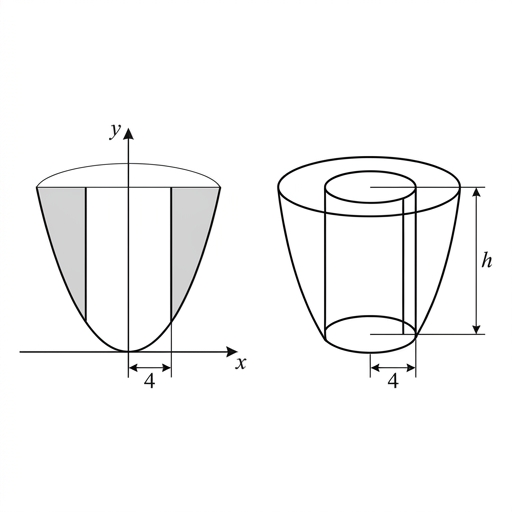
The volume of the ring is .
Find the value of .
The volume of the ring can be found by integrating the difference in the areas of two circles (a 'washer') along the height of the ring. First, determine the limits of integration by considering where the inner wall of the ring (the cylinder) intersects the outer wall (the paraboloid).
Question 6
HardPaper 1 · no calculator17 marksBy using an appropriate substitution, show that .
The following diagram shows part of the curve for .
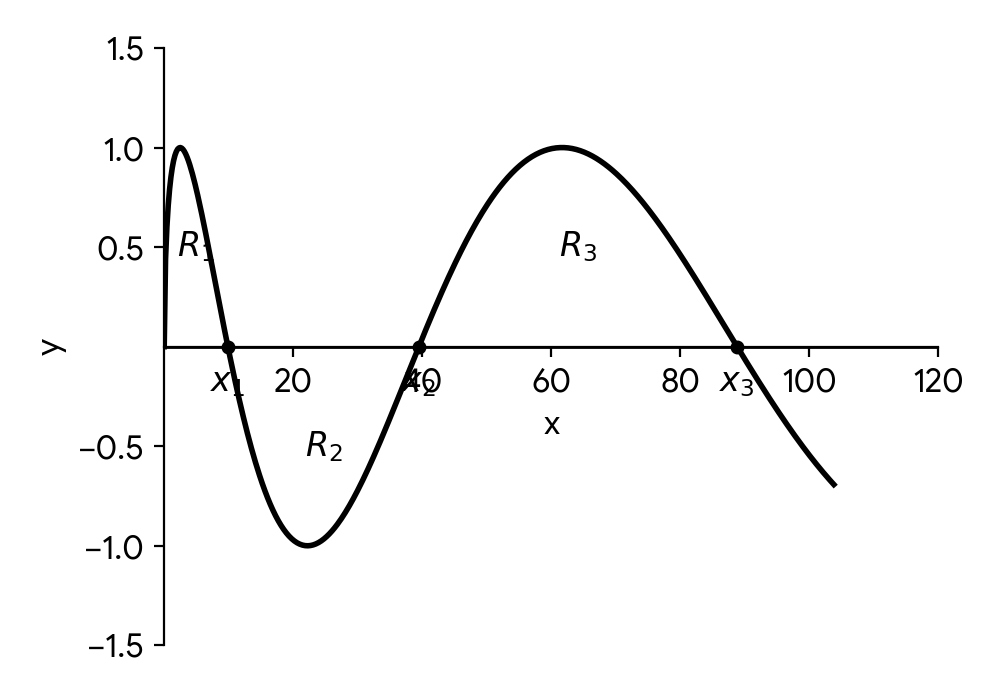
The curve intersects the x-axis at .
The nth x-intercept of the curve, , is given by , where .
Write down an expression for .
The regions bounded by the curve and the x-axis are denoted by as shown on the diagram.
Calculate the area of region .
Give your answer in the form , where .
Hence, show that the areas of the regions form an arithmetic sequence.
Try substituting . After substituting, you will need to use integration by parts.
Simply replace with in the given formula for .
The area of is given by the absolute value of the definite integral from to . Use the result from part (a) and the expressions for the intercepts from part (b).
An arithmetic sequence has a constant common difference. Calculate Area() - Area() and show that it is a constant.
Question 7
MediumPaper 1 · no calculator15 marksConsider the function defined by .
Find the -intercepts of the graph of .
The graph of for is shown below. The graph encloses two regions with the -axis, shaded in the diagram.
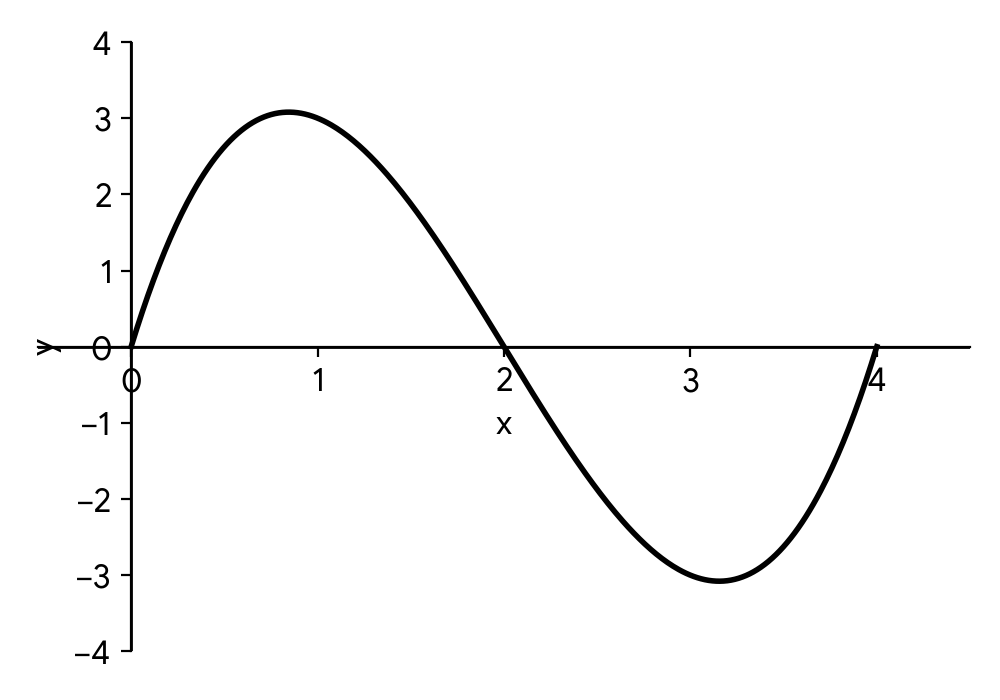
Find the total area of the shaded regions.
The total surface area of a closed right cylinder is 8, equal to the total shaded area found in part (b). The cylinder has a height of .
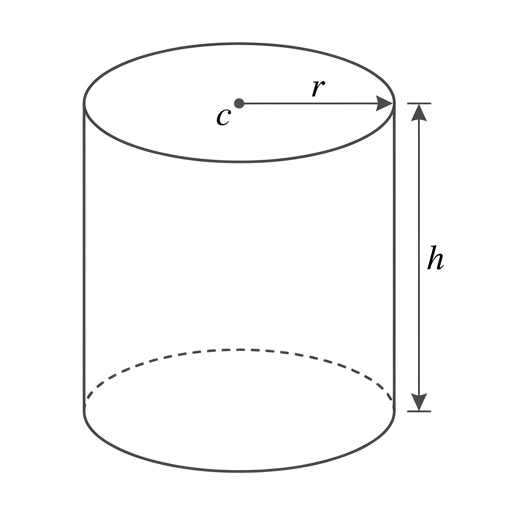
Find the radius, , of the cylinder.
Hence, find the volume of the cylinder.
To find the x-intercepts, you need to solve the equation . Look for a common factor first, then factorize the remaining quadratic.
The total area is the sum of two separate definite integrals. Remember that area must be positive, so you may need to take the absolute value of one of the integrals.
The formula for the total surface area of a closed cylinder is . Set this equal to the area you found, substitute the given height, and solve the resulting quadratic equation for .
The formula for the volume of a cylinder is . Use the values of and you now have.
Question 8
HardPaper 1 · no calculator9 marksFind .
Hence, find the exact value of .
This integral requires the use of integration by parts, . You may need to apply this method more than once.
Use your answer from part (a) and evaluate it at the upper and lower limits of the integral. Remember the exact values of trigonometric functions for angles like and .
Question 9
MediumPaper 1 · no calculator6 marksThe following diagram shows part of the graph of for .
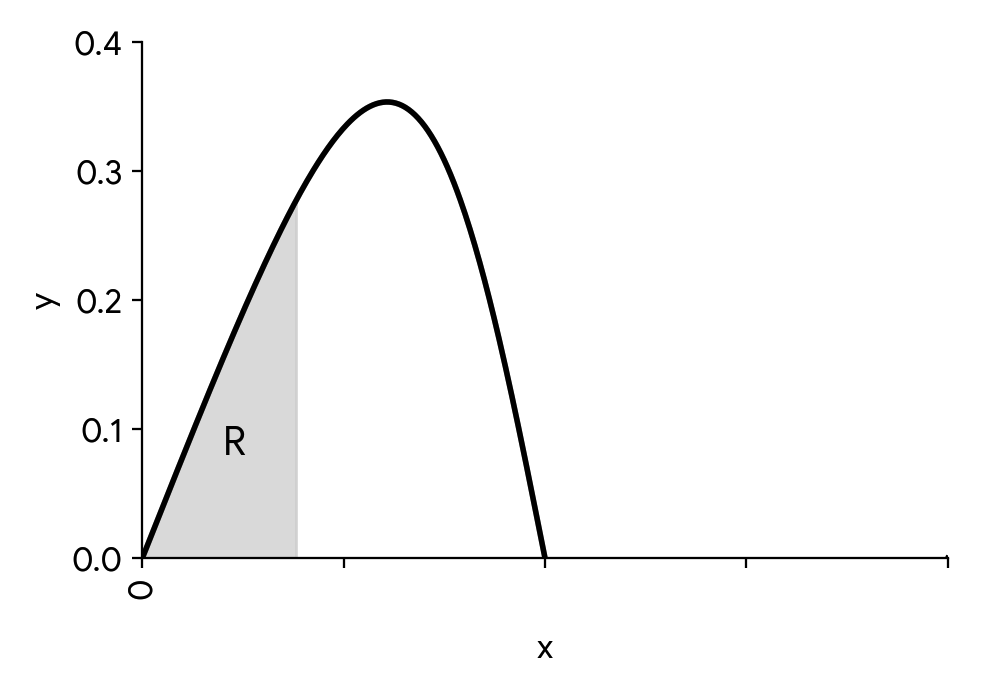
The shaded region is bounded by the curve, the x-axis, the y-axis and the line .
The area of is .
Find the value of .
To find the area of the region R, you need to set up a definite integral. The integral can be solved using a u-substitution. Let be the denominator of the fraction. Once you've found the integral, apply the limits of integration and set the result equal to the given area to solve for .
Question 10
HardPaper 1 · no calculator15 marksA drone takes off from a platform. Its height, metres, above the platform after seconds is given by , for . This is shown in the following diagram.
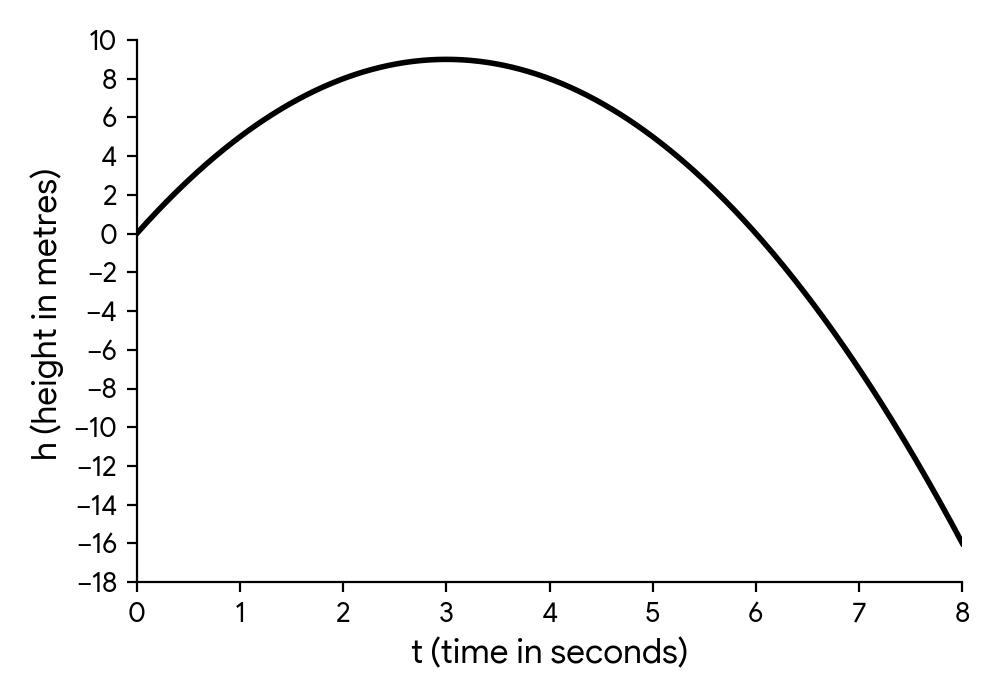
The drone lands back on the platform when .
Find the value of .
The drone reaches its maximum height when .
Find the value of .
Find the drone's maximum height above the platform.
Find the drone's vertical distance from the platform when .
The total vertical distance travelled by the drone in the first 8 seconds is given by .
Find the value of .
A second drone, Drone B, takes off from the same platform. Its velocity is given by , for .
When , the total vertical distance travelled by Drone B is equal to .
Find the value of .
The drone is on the platform when its height is zero. Set the height function equal to zero and solve for time .
The maximum height is reached when the drone's vertical velocity is zero. Find the derivative of the height function, which represents velocity, and set it to zero.
You found the time to reach maximum height in the previous part. Substitute this time back into the original height function.
Substitute into the height function. Remember that distance must be a positive value.
Total distance is not the same as displacement. The drone goes up and then comes down. You need to calculate the distance travelled on the way up and the distance travelled on the way down separately and add them together. The turning point you found in part (b) is crucial here.
First, find the total distance travelled by Drone B as a function of time . This will involve an integral of the absolute value of its velocity. You'll need to find when Drone B changes direction. Then, set this total distance equal to the value of you found in part (d) and solve for .
Question 11
MediumPaper 1 · no calculator5 marksA continuous random variable has probability density function defined by
where is a positive real number.
(a) State in terms of .
(b) Use integration to find in terms of .
For a uniform distribution over an interval , the expected value (or mean) is the midpoint of the interval. What is the midpoint of ?
Recall the formula for variance: . You will need to calculate using the integral definition: .
Question 12
HardPaper 1 · no calculator7 marksConsider the functions and , where .
The graphs of and are shown in the following diagram.
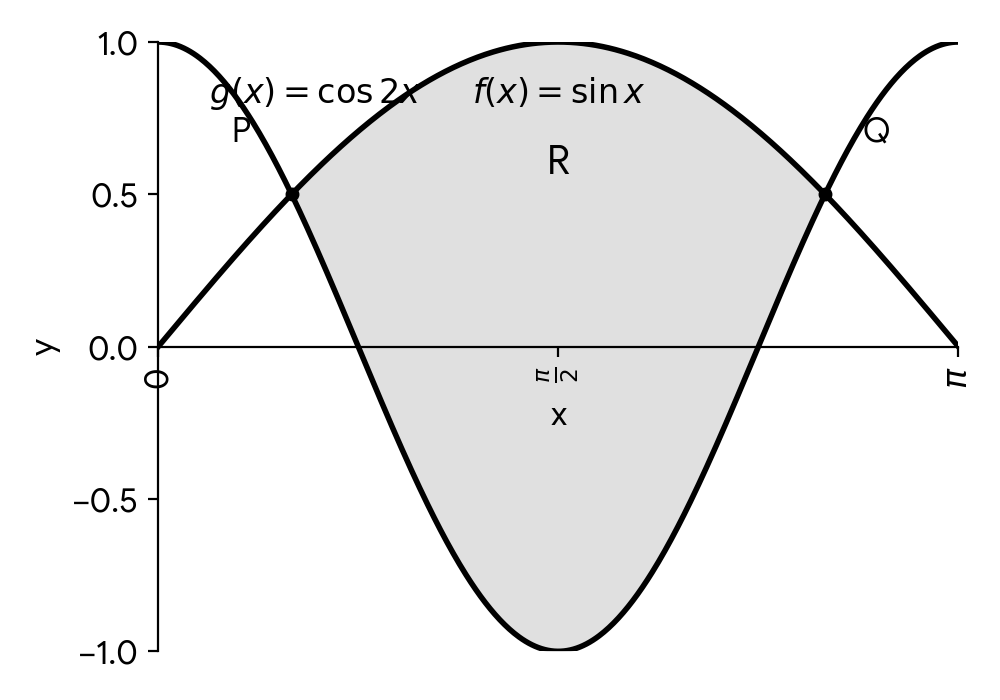
The graphs intersect at points P and Q. The region enclosed by the two graphs is shaded and labelled R.
(a) Find the -coordinates of P and Q.
(b) Find the area of R.
To find the intersection points, set the two functions equal to each other. You will need to use a trigonometric identity to transform the equation into a form that you can solve, likely a polynomial in terms of or .
The area between two curves and from to is given by the definite integral . Use the intersection points you found in part (a) as your limits of integration. You'll need to determine which function is greater on the interval to remove the absolute value.
Question 13
MediumPaper 1 · no calculator6 marksThe expression can be written in the form . Write down the value of and the value of .
Hence, find the value of .
Rewrite the cube root as a power of . Then, split the fraction into two separate terms and use the laws of exponents to simplify each term.
Use your answer from part (a) to set up the integral. Integrate each term using the power rule for integration. Then, evaluate the definite integral by substituting the upper and lower limits.
Question 14
HardPaper 1 · no calculator15 marksExpand and simplify in ascending powers of .
By using a suitable substitution for , show that .
Consider the function .
Show that , where is a positive real constant.
It is given that , where . Find the value of .
You can use the binomial theorem or simply multiply out the brackets .
Compare the given expression with your expansion from part (a)(i). What could 'a' be? Once you've made the substitution, you'll need to use a double angle identity for cosine.
Use your result from part (a)(ii) to simplify the expression for first. The resulting integral can be solved using a substitution.
You can evaluate the definite integral using the antiderivative found in part (b)(i). Alternatively, you can use the property .
Question 15
MediumPaper 1 · no calculator4 marksFind the area of the region enclosed by the curves , and the lines and .
First, determine which function has a greater value over the given interval . Then, set up a definite integral representing the area between the two curves from to . Remember the integration rules for and .
Question 16
HardPaper 1 · no calculator16 marksA particle moves in a straight line. Its velocity, , at time seconds is given by , for . The particle is at the origin at .
The graph of is shown in the following diagram.
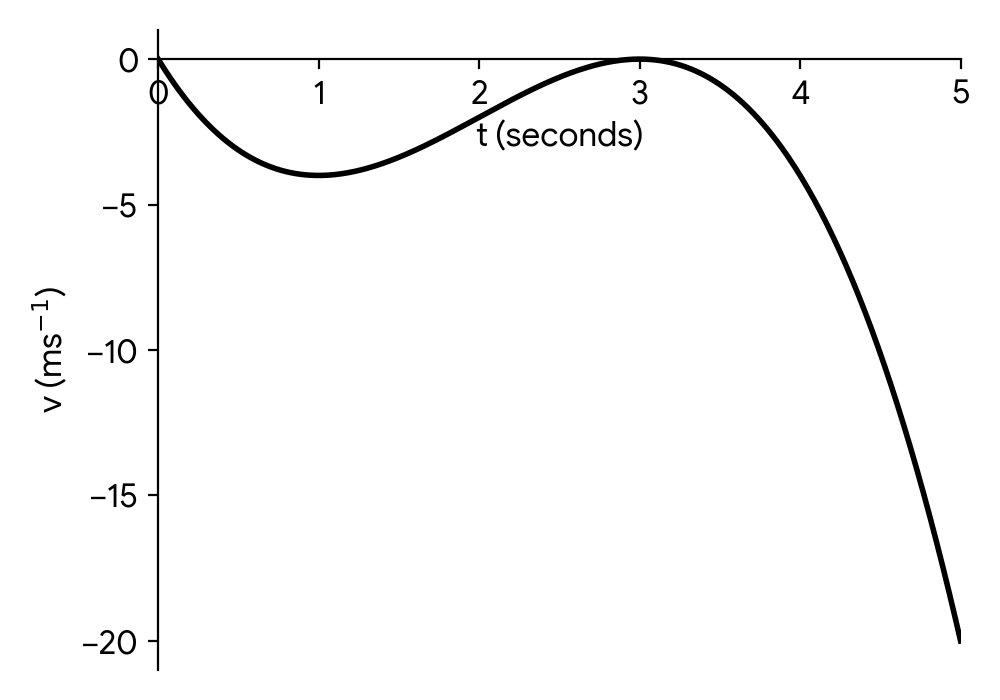
(a) Find the displacement of the particle from the origin at .
(b) Find an expression for the acceleration of the particle.
(c) The particle is momentarily at rest at and again at . Find the greatest speed of the particle in the interval .
(d) Find the greatest speed of the particle for .
(e) Write down an expression that represents the distance travelled by the particle while its speed is increasing. Do not evaluate the expression.
Displacement is the definite integral of the velocity function. Remember to use the initial condition that the particle starts at the origin to find the constant of integration.
Acceleration is the first derivative of the velocity function with respect to time.
First, find the value of by setting the velocity to zero. Then, to find the greatest speed, you need to find the maximum of the absolute value of velocity, , in the interval . This can occur at the endpoints or where the acceleration is zero.
You have already found the greatest speed up to . Now you just need to check the speed at the new endpoint, , and compare.
The speed of the particle is increasing when its velocity and acceleration have the same sign. Determine the sign of and over the domain to find the required time intervals. The distance travelled is the integral of the speed, , over these intervals.
Question 17
MediumPaper 1 · no calculator12 marksConsider the expression , where .
(a) (i) Show that the first four terms in the binomial expansion of are .
(ii) Hence, find an approximation for .
(b) (i) Use your result from part (a)(ii) to find an approximate value for .
(ii) Hence, find an approximation for in the form where .
Rewrite the expression as and use the binomial theorem for a negative integer exponent, . Remember to substitute and .
Integrate the polynomial approximation you found in the previous part term by term. Don't forget the constant of integration.
Substitute the limits of integration, 0 and 1/8, into your polynomial expression for the integral. Be careful with the arithmetic of fractions.
First, find the exact value of the definite integral in terms of a logarithm. Then, equate this exact value to the approximation you found in part (b)(i).
Question 18
HardPaper 1 · no calculator20 marksConsider the family of integrals defined by for , where .
(a) By using integration by parts, show that for .
(b) Hence, find an explicit expression for .
(c) The region is enclosed by the graph of and the -axis for . The region is rotated by radians about the -axis. Find the volume of the solid generated.
(d) Show that for any .
Consider the function .
(e) (i) Find the Maclaurin series for up to and including the term in .
(ii) Hence, find the value of the fourth derivative of at , i.e. .
Choose and and apply the integration by parts formula, .
Apply the reduction formula from part (a) repeatedly, starting with , until you reach an integral you can compute directly (). Then substitute back.
The formula for the volume of revolution about the x-axis is . You will need to evaluate an improper integral using the result from part (b).
Rewrite the expression as a fraction to get an indeterminate form and then apply L'Hôpital's rule.
Recall the standard Maclaurin series for . Substitute and then multiply the entire series by .
The general term in a Maclaurin series is . Compare the coefficient of the term in your series from part (e)(i) with this general form.
Question 19
MediumPaper 2 · calculator7 marksA small reconnaissance drone is performing a vertical ascent and descent. Its vertical velocity, , at time seconds, for , is modelled by the function .
The following diagram shows the graph of .
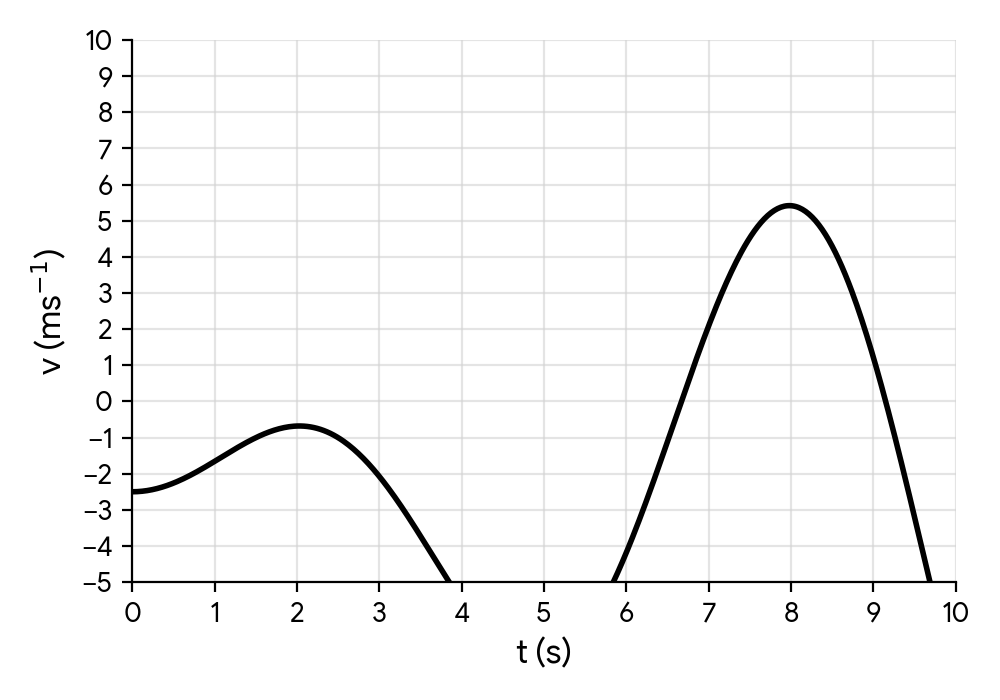
(a) Find the smallest value of for which the drone is momentarily stationary.
(b) Find the total vertical distance travelled by the drone during the first 10 seconds.
(c) Find the vertical acceleration of the drone when seconds.
The drone is momentarily stationary when its vertical velocity is zero. You will need to solve for the smallest positive . A GDC will be useful for this.
Total distance travelled is the integral of the absolute value of velocity over the given time interval. Remember to use your GDC for this calculation.
Acceleration is the derivative of velocity with respect to time. Differentiate to find , then substitute .
Question 20
HardPaper 1 · no calculator13 marksConsider the function defined by for . The graph of is shown in the following diagram.
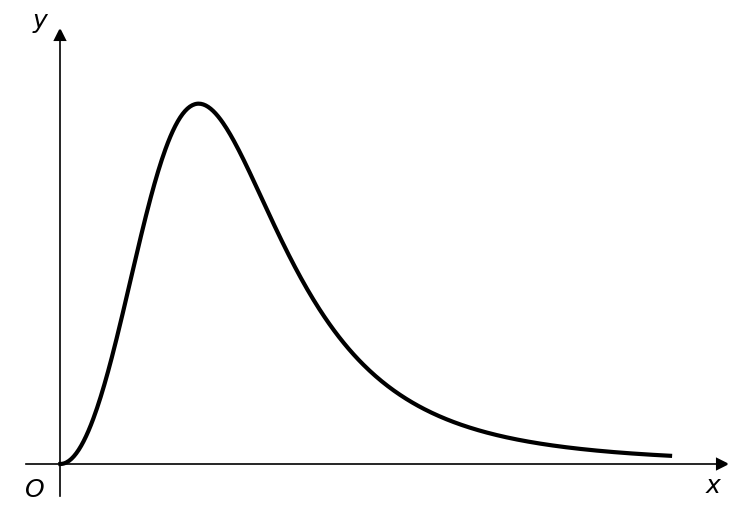
Show that .
Find .
Consider a function defined for . The derivative of is such that , for all .
Let be the region enclosed by the graph of , the graph of , the line and the line . The area of is .
Find the two possible expressions for .
You will need to use the quotient rule for differentiation. Remember to also apply the chain rule when differentiating the denominator, which is a composite function.
Look for a suitable substitution. Notice that the derivative of a part of the denominator is related to the numerator. Don't forget the constant of integration.
If two functions have the same derivative, how are the functions themselves related? The area between two curves and from to is given by the definite integral of the absolute difference of the functions, .
No question on this page matches those filters. Try another difficulty or paper.
58 more Definite integrals (analytical, area under/between curves) questions in the app
Every answer is marked mark by mark, IB-style, and the AI tutor helps when you are stuck.
Where marks are lost
- Using your own wrong value after failing a "show that".