Limits & derivative definition, increasing / decreasing functions: notes and practice questions
- The limit of a function describes its behavior as approaches a certain value:
.
- The derivative is the slope of the tangent to the curve, defined as:
- A function is increasing where and decreasing where .
How it is examined
The "not required" line is a hard boundary for SL generation: no epsilon-delta, no algebraic limit evaluation, nothing beyond reading a limit off a table or a graph. The rate-of-change reading is what carries the marks, usually as "interpret in context" with units. 2 to 4 marks. The answer is an interval and it has to be written as one. Reading intervals off a graph of rather than is the version that separates candidates, because students read the wrong curve. 2 to 4 marks.
- Introduction to the concept of a limit.
- Derivative interpreted as gradient function and as rate of change.
- Increasing and decreasing functions.
- Graphical interpretation of , , .
Not required: formal analytic methods of calculating limits.
Extended at AHL 5.12 (first principles, convergence and divergence) and AHL 5.13 (l'Hopital's rule).
Linking questions
- Links to other subjects: marginal cost, marginal revenue, marginal profit (economics); kinematics, induced emf, simple harmonic motion (physics).
- Feeds SL 5.7 and SL 5.8, where the same signs are used for concavity and for classifying stationary points.
Practice questions
40 questions · 1 easy · 22 medium · 17 hardQuestion 1
EasyPaper 2 · calculator4 marksConsider a function which has a first derivative given by , where .
Find the range of values of for which is increasing.
A function is increasing when its first derivative is positive. Try setting and solving for .
Question 2
MediumPaper 1 · no calculator12 marksA function is defined by , where . The graph of is tangent to the line with equation .
(a) Show that .
(b) The function can be expressed in the form , where .
Find the value of and the value of .
(c) The function can also be expressed in the form , where .
Find the value of and the value of .
(d) Hence find the values of where the graph of is both positive and decreasing.
For a line to be tangent to a curve, they must intersect at exactly one point. Set the equations for the curve and the line equal to each other and use the discriminant of the resulting quadratic equation.
Substitute the value of you found in part (a) into the expression for and then factorize the quadratic to find its roots.
You can find the vertex of the parabola by completing the square, using the formula , or by finding the midpoint of the roots found in part (b).
Consider the information you found in the previous parts. Where are the roots (from part b)? This tells you where the function is positive or negative. Where is the vertex (from part c)? This tells you where the function is increasing or decreasing. Find the interval of x-values that satisfies both conditions.
Question 3
HardPaper 3 · calculator16 marksIn a study of wave propagation, a mathematical model uses the function , where , to describe a certain physical quantity. This function is also known as the hyperbolic sine function, .
Verify that satisfies the differential equation .
Another related function, the hyperbolic cosine, is defined as , also known as . Show that .
The functions and can be extended to complex numbers. Using Euler's formula , where , express in terms of and .
Similarly, express in terms of and .
Hence, show that .
In a design project, a component's profile is described by a hyperbola with parametric equations and , where are positive constants and .
Given that the component's profile passes through the point and has asymptotes , find the values of and .
Recall the derivatives of and . Differentiate the function twice.
Substitute the definitions of and into the expression and simplify.
Substitute into the definition of and use Euler's formula.
Substitute into the definition of and use Euler's formula.
Use your results from part (c) and trigonometric identities.
Substitute the parametric equations into the standard hyperbola form . Use the given point to find one constant and the asymptote equation to find the other.
Question 4
MediumPaper 2 · calculator7 marksA small reconnaissance drone is performing a vertical ascent and descent. Its vertical velocity, , at time seconds, for , is modelled by the function .
The following diagram shows the graph of .
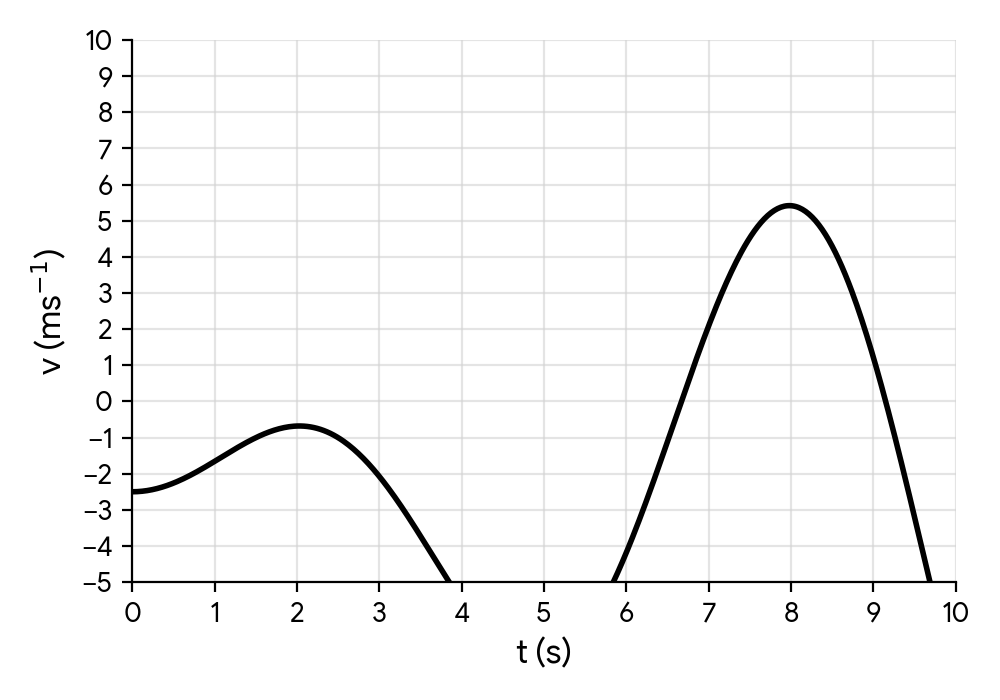
(a) Find the smallest value of for which the drone is momentarily stationary.
(b) Find the total vertical distance travelled by the drone during the first 10 seconds.
(c) Find the vertical acceleration of the drone when seconds.
The drone is momentarily stationary when its vertical velocity is zero. You will need to solve for the smallest positive . A GDC will be useful for this.
Total distance travelled is the integral of the absolute value of velocity over the given time interval. Remember to use your GDC for this calculation.
Acceleration is the derivative of velocity with respect to time. Differentiate to find , then substitute .
Question 5
HardPaper 3 · calculator24 marksA biologist is modelling the growth of two different bacterial colonies. The first colony, A, grows such that its population at time is given by , where is a growth factor and . The second colony, B, grows linearly such that its population at time is .
Consider the cases where the growth factor and . On the same set of axes, sketch the following three graphs for :
Clearly label each graph with its equation and state the coordinates of any non-zero -axis intercepts.
In parts (b) and (c), consider the case where the growth factor .
Use calculus to find the minimum value of the expression , justifying that this value is a minimum.
Hence deduce that for all .
There exist values of for which the graph of and the line have different numbers of intersection points. The following table gives three intervals for the value of .
| Interval | Number of intersection points |
|---|---|
By investigating the graph of for different values of , write down the values of and .
In parts (e) and (f), consider .
For , a value of exists such that the line is a tangent to the graph of at a point P.
Find the exact coordinates of P and the exact value of .
Write down the exact set of values for such that the graphs of and have
(i) two intersection points;
(ii) no intersection points.
Ensure your sketch accurately reflects the general shape and relative positions of exponential functions with different bases and the line . Pay attention to intercepts and asymptotic behaviour.
Recall how to find local extrema using calculus by analyzing the first and second derivatives.
Consider the implications of the minimum value found in part (b) for the expression .
Visualize how the graph of changes as the value of changes, especially relative to the line . Consider the general shapes for and .
For tangency, both the function values and their derivatives must be equal at the point of contact. Let the point of tangency be .
Relate the critical value of found in part (e) to the number of intersection points. Consider the graphical behavior.
Relate the critical value of found in part (e) to the number of intersection points. Consider the graphical behavior.
Question 6
MediumPaper 2 · calculator7 marksA mini-submarine is performing a test dive. Its velocity, in m/s, at time seconds is given by , for .
(a) Calculate the time(s) when the submarine is momentarily at rest.
(b) Find the acceleration of the submarine when it first changes direction.
(c) Determine the total distance travelled by the submarine during the first 8 seconds of its dive.
The submarine is momentarily at rest when its velocity is zero. You will need to use your GDC to solve the equation .
The submarine changes direction when its velocity is zero and the sign of the velocity changes. Acceleration is the derivative of the velocity function.
To find the total distance travelled, you need to integrate the absolute value of the velocity function over the given time interval. Remember to use your GDC for numerical integration.
Question 7
HardPaper 1 · no calculator14 marks(a) Prove by mathematical induction that for .
(b) Hence or otherwise, determine the Maclaurin series of in ascending powers of , up to and including the term in .
(c) Hence or otherwise, determine the value of .
Start by verifying the formula for n=1. Then, assume the formula is true for n=k and use this assumption to prove it is true for n=k+1 by differentiating the expression for the k-th derivative.
You can either use the general formula for a Maclaurin series and the result from part (a), or you can rewrite the function and use the well-known geometric series expansion.
Consider substituting the Maclaurin series you found in part (b) into the expression. Alternatively, try to simplify the expression inside the limit algebraically before evaluating it.
Question 8
MediumPaper 2 · calculator14 marksThe amount of a certain pollutant, in tonnes, in a lake weeks after a major clean-up operation began, can be modelled by , .
Find the initial amount of pollutant in the lake.
Find the amount of pollutant in the lake five weeks after the clean-up operation began.
Write down the value of .
Interpret the meaning of your answer to part (b) in the given context.
The clean-up operation is considered successful when the amount of pollutant in the lake is below 20 tonnes.
Find the least possible integer value of , in weeks, for which the amount of pollutant is below 20 tonnes.
As the clean-up operation continues indefinitely, the amount of pollutant in the lake approaches a constant level.
Find this constant level of pollutant.
Find the limit of as approaches infinity.
To find the initial amount, consider the value of at the start of the clean-up operation.
Substitute the given time value into the function and calculate the result.
First, find the derivative . Then, substitute into the derivative.
The derivative represents the rate of change. Consider what a negative rate means in this context and include units.
Set the function less than 20 and solve for . Remember to round up to the nearest integer for the 'least possible integer value'.
Consider what happens to the exponential term as time approaches infinity.
Consider what happens to the derivative function as time approaches infinity.
Question 9
HardPaper 2 · calculator21 marksThe growth of a bacterial colony, , in a petri dish can be modelled by the logistic differential equation
where is the time measured in hours and are positive constants.
The constant represents the maximum number of bacteria the petri dish can sustain indefinitely due to limited nutrients.
In the context of this bacterial growth model, interpret the meaning of .
Show that .
Hence show that the bacterial colony will grow at its maximum rate when . Justify your answer.
Hence determine the maximum value of in terms of and .
Let be the initial number of bacteria.
By solving the logistic differential equation, show that its solution can be expressed in the form
.
After 5 hours, the number of bacteria is . It is known that .
Find the value of for this bacterial growth model.
Consider what a derivative represents in a physical context, especially when it's a quantity with respect to time.
You will need to differentiate with respect to . Remember that is a function of , so implicit differentiation or the chain rule will be necessary. Consider expanding the expression for first, or using the product rule.
To find the maximum rate of growth, you need to find the maximum of . This involves setting the second derivative, , to zero. Remember to justify that it is indeed a maximum.
Substitute the value of at which the growth rate is maximum into the original differential equation.
This is a separable differential equation. Separate the variables and use partial fractions to integrate the term involving . Remember to apply the initial condition ( when ) to find the constant of integration.
Substitute the given values for , , and into the solution obtained in part (e) and solve for . Remember will cancel out.
Question 10
MediumPaper 2 · calculator5 marksA buoy floats on the surface of a lake. Its vertical displacement, metres, from its equilibrium position at time seconds is modelled by the function , for .
(a) Find the first time, seconds, when the buoy momentarily comes to rest.
(b) Find the total distance that the buoy travels in the first seconds.
The buoy comes to rest when its velocity is zero. Remember to differentiate the displacement function to find the velocity function.
The total distance travelled is the sum of the absolute displacements between turning points. Since is the first time the buoy comes to rest, it only changes direction once (or not at all) within this interval. Consider the initial displacement and the displacement at time .
Question 11
HardPaper 2 · calculator8 marksConsider the limit , where .
Show that a finite limit only exists for .
Using l'Hôpital's rule, show algebraically that the value of the limit is .
For a limit of the form to be finite when , what must be true about ?
Remember to check if the limit is still an indeterminate form after the first application of l'Hôpital's rule. You might need to apply it more than once. Be careful with the product rule for differentiation.
Question 12
MediumPaper 2 · calculator5 marksA drone's altitude, metres, above the ground at time seconds is modelled by the function , for .
(a) Find the first time, seconds, when the drone's vertical velocity is zero.
(b) Find the total vertical distance that the drone travels in the first seconds.
To find when the vertical velocity is zero, you need to first find the velocity function by differentiating the altitude function with respect to time. Then, set the velocity function equal to zero and solve for . Remember to find the first positive value of .
Since is the first time the drone's vertical velocity is zero, it represents the first turning point in its motion. The total distance travelled up to this point can be found by calculating the absolute difference between its initial altitude and its altitude at time .
Question 13
HardPaper 2 · calculator8 marksThe concentration of a specific chemical, , in a reaction vessel (in moles per litre) after minutes is modelled by the function .
Write down the initial concentration of the chemical in the reaction vessel.
Calculate the concentration of the chemical in the reaction vessel after 10 minutes.
Calculate the number of minutes that will have passed when the chemical concentration reaches 200 moles per litre.
Show that, when governed by this model, the concentration of the chemical in the reaction vessel cannot exceed 625 moles per litre.
The initial concentration occurs at time . Substitute this value into the given function.
Substitute into the function and evaluate the expression. Remember to round your answer to an appropriate number of significant figures.
Set the function equal to 200 and solve for . This will involve algebraic manipulation to isolate .
Consider the behaviour of the function as approaches infinity. This relates to finding the horizontal asymptote of the rational function.
Question 14
MediumPaper 1 · no calculator13 marks(a) Use the principle of mathematical induction to prove that
for all .
(b) Hence, find the value of .
(c) Hence, show that the infinite series converges, and find its sum.
Follow the standard three-step process for proof by induction: establish the base case (n=1), state the inductive hypothesis (assume it's true for n=k), and then prove the inductive step (show it's true for n=k+1). The algebraic manipulation in the inductive step is key.
You can express the sum from r=5 to 15 as the difference of two sums, both starting from r=1. Use the formula you proved in part (a).
The sum of an infinite series is defined as the limit of its sequence of partial sums, , as approaches infinity. Use the formula for from part (a) to evaluate this limit.
Question 15
HardPaper 2 · calculator15 marksA remote-controlled drone is launched from a platform and moves horizontally in a straight line. Its velocity, m s, at time seconds after launch, is given by , for .
(a) Find the drone's initial velocity.
(b) Find the time when the drone is at rest.
(c) Find the drone's acceleration at the instant it comes to rest.
(d) Determine the time interval(s) when the drone is:
(i) slowing down
(ii) speeding up.
The initial velocity refers to the velocity at time . Substitute into the given velocity function.
The drone is at rest when its velocity is equal to zero. Set the velocity function to zero and solve for . Remember to check for extraneous solutions after squaring both sides of an equation.
Acceleration is the derivative of velocity with respect to time, . First, find the expression for , then substitute the time found in part (b) into .
The drone is slowing down when its velocity and acceleration have opposite signs. Analyze the signs of and over the domain . Remember that at and is always positive for .
The drone is speeding up when its velocity and acceleration have the same sign. Use your analysis from part (d.i).
Question 16
MediumPaper 2 · calculator9 marksA new drug is administered to a patient, and its concentration, , in the bloodstream (in mg/L) after hours is modelled by the function .
(a) Write down the initial concentration of the drug in the bloodstream.
(b) Calculate the concentration of the drug in the bloodstream after 5 hours.
(c) Determine the number of hours that will have passed when the drug concentration reaches 12 mg/L.
(d) Show that, according to this model, the drug concentration in the bloodstream can never exceed 18 mg/L.
What is the value of at the beginning of the process?
Substitute the given time value into the function. Remember to use consistent units.
Set the function equal to the target concentration and solve the resulting equation for .
Consider the behavior of the function as becomes very large. What is the horizontal asymptote of a rational function?
Question 17
HardPaper 1 · no calculator13 marksConsider the function , for , where is a positive real constant.
(a) Find the zero of .
(b) Find the intervals where is increasing and where it is decreasing.
(c) Find the range of .
(d) Find the intervals where the graph of is concave up and where it is concave down.
To find the zero of a function, you need to solve the equation . Remember that the exponential function is never zero.
To determine where a function is increasing or decreasing, you need to analyze the sign of its first derivative, . Start by finding the derivative using the product rule.
The range is the set of all possible output values. Use the information from part (b) to find the maximum or minimum value of the function. Also, consider the behavior of the function as approaches positive and negative infinity.
The concavity of a function is determined by the sign of its second derivative, . Find and then find where it is positive (concave up) and negative (concave down).
Question 18
MediumPaper 1 · no calculator10 marksLet , for , where is a positive constant.
(a) Find expressions for and .
(b) Find, in terms of , the interval(s) where is increasing and the interval(s) where is decreasing.
(c) Show that the graph of is concave up for all values of in its domain.
Use the power rule for the first term and the standard derivative for the natural logarithm. Then differentiate again to find the second derivative.
First, find the stationary point by solving . Then, test the sign of on either side of the stationary point to determine where the function is increasing () or decreasing ().
The concavity of a function is determined by the sign of its second derivative, . Consider the given constraints on and the domain of to determine the sign of .
Question 19
HardPaper 1 · no calculator14 marksFind the following limits, if they exist.
(a)
(b)
(c)
(d)
(e)
(f)
Since this is a polynomial function, it is continuous everywhere. What does this imply about how you can evaluate the limit at a specific point?
Check if direct substitution is possible. Does the denominator become zero at x=4?
The square root function is continuous on its domain. Can you substitute the value x=0 directly into the expression?
Substituting x = -2 results in an indeterminate form 0/0. Try to simplify the fraction by factoring the numerator.
When dealing with limits at infinity for rational-like functions, a common technique is to divide the numerator and denominator by the highest power of x. Be careful with the square root and the fact that x approaches negative infinity.
To find the limit at infinity of a rational function, divide both the numerator and the denominator by the highest power of x that appears in the denominator.
Question 20
MediumPaper 1 · no calculator8 marksConsider the following three graphs of functions, labelled Graph 1, Graph 2, and Graph 3.
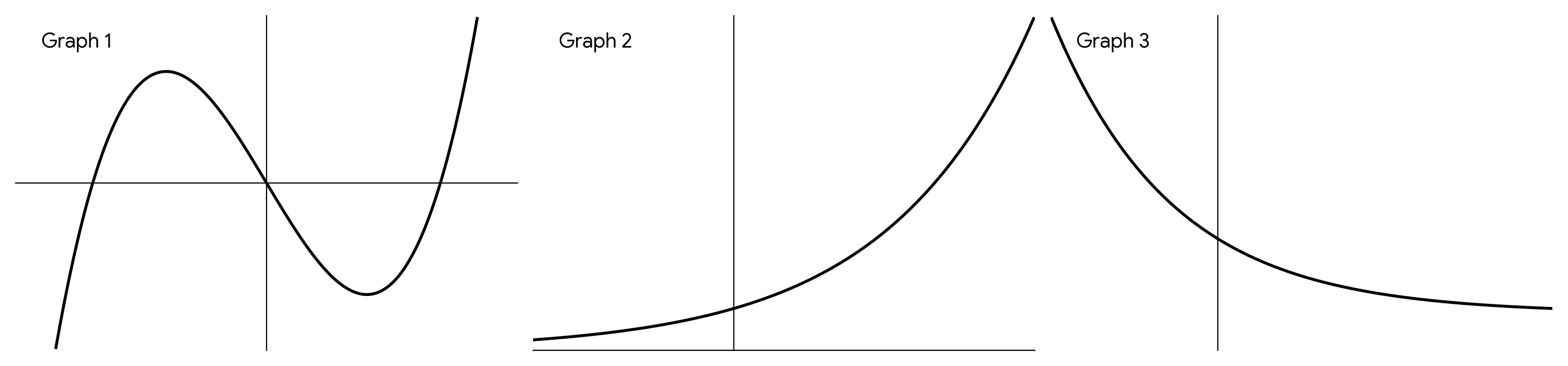
For each condition below, state which graph (1, 2, or 3) satisfies the condition, providing a reason for your choice.
(a) The function has the property that for exactly two distinct values of .
(b) The function has the property that for all in its domain.
(c) The function has the property that , where is a finite positive constant.
(d) The function has the property that and for all in its domain.
The derivative represents the gradient of the tangent to the curve . What does it mean for the gradient to be zero? Which of the graphs has this feature at two different points?
What does a positive first derivative tell you about the behaviour of a function? Look for a graph that consistently exhibits this behaviour from left to right.
The limit of a function as approaches infinity describes the long-term behavior of the graph to the far right. What graphical feature does this correspond to?
Consider the meaning of the first and second derivatives separately. What does imply about the function's direction? What does imply about the function's curvature?
No question on this page matches those filters. Try another difficulty or paper.
20 more Limits & derivative definition, increasing / decreasing functions questions in the app
Every answer is marked mark by mark, IB-style, and the AI tutor helps when you are stuck.
Where marks are lost
- Using your own wrong value after failing a "show that".