Vector equations in 2&3D (+ angle between two lines): notes and practice questions
- A line in 2D or 3D is defined by a fixed point and a direction vector.
- Vector equation: , where is a position vector, is the direction vector, and is a scalar parameter.
- Parametric and Cartesian equations can be derived from the vector form.
- The angle between two lines uses the dot product of their direction vectors: .
- In 3D, lines can be parallel, intersecting, skew, or coincident.
- Skew lines are non-parallel and do not intersect; this is only possible in 3D.
How it is examined
The kinematics reading is the one that carries the applied questions: two particles with position vectors in , do they collide, and what is the minimum distance between them. "Collide" needs the same in both, "intersect" does not, and that distinction is a marking point. 6 to 9 marks across parts.
The vector, parametric and Cartesian forms are given.
- Vector equation of a line in two and three dimensions: .
- The angle between two lines.
- Simple applications to kinematics.
Linking questions
- Other contexts: modelling linear motion in three dimensions; GPS.
Practice questions
20 questions · 1 easy · 7 medium · 12 hardQuestion 1
EasyPaper 1 · no calculator6 marksThe path of a drone, , can be modelled by the vector equation . A communication beacon is located at point B with coordinates . The drone passes through the location of the beacon.
(a) Find the value of .
A second drone, , starts at the point and travels on a path parallel to .
(b) Write down a vector equation for the path of .
A point lies on a line if its coordinates satisfy the line's equation for some value of the parameter. Set up three separate equations for the x, y, and z coordinates and solve for the parameter first using the known coordinates.
Parallel lines share the same direction vector. What is the direction vector of drone ? What is the position vector for the starting point of drone ?
Question 2
MediumPaper 2 · calculator7 marksA laser beam travels along the line L, given by the equations and . The laser beam strikes a reflective surface, a plane P, given by the equation . The angle between the laser beam and the plane is , where , .
Find the value of .
Recall the relationship between the angle between a line and a plane, and the angle between the line's direction vector and the plane's normal vector. The scalar product formula will be useful.
Question 3
HardPaper 1 · no calculator19 marksConsider the line with vector equation .
(a) (i) Find a Cartesian equation for the line .
(ii) Show that the point lies on .
Consider a second line with direction vector . The acute angle between and is , where .
(b) Find the possible values of .
Let a third line, , be defined by the vector equation . The lines and intersect at a point B.
(c) Find the value of and the coordinates of B.
Express the parameter in terms of , , and from the components of the vector equation. Then, set these expressions for equal to each other.
Substitute the coordinates of point P into the Cartesian equation you found in part (a)(i) and verify that the equalities hold. Alternatively, use the vector equation and show that there is a single value of that produces the point P.
Recall the formula for the angle between two vectors using the scalar (dot) product: . Since the angle between lines is typically taken as the acute angle, use the formula . This will lead to a quadratic equation in .
For the lines to intersect, there must be values of and that make their vector equations equal. Set the corresponding and components equal to each other to form a system of three linear equations in three variables (). Solve for and using two of the equations, then substitute into the third to find . Finally, use either or in its respective line equation to find the coordinates of the intersection point.
Question 4
MediumPaper 2 · calculator8 marksA drone's flight path, denoted by line , is determined by the intersection of two virtual guidance planes, and . The equations of these planes are given by:
Verify that a vector equation of is , where .
The drone's home base is located at the origin . Find the coordinates of the point P on the flight path that is nearest to the origin.
To verify the vector equation of the line of intersection, you can either substitute the general point from the line into both plane equations and show they hold, or you can check if the given point on the line satisfies both plane equations and if the direction vector of the line is perpendicular to the normal vectors of both planes.
The shortest distance from the origin to a line occurs when the position vector of the point on the line is perpendicular to the direction vector of the line. Alternatively, you can minimize the square of the distance from the origin to a general point on the line.
Question 5
HardPaper 1 · no calculator19 marksTwo spacecraft, S1 and S2, travel along straight paths, represented by the lines and respectively. The paths of the spacecraft intersect at a docking station D. A probe is located at a point P on the path of . This is shown in the following diagram.
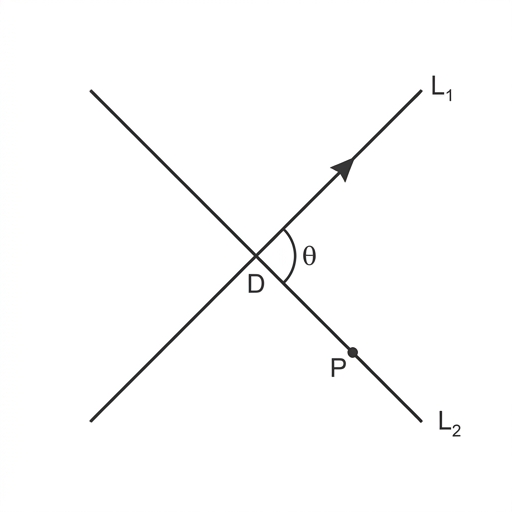
The direction vector of is . The vector is given by , where .
The acute angle between the paths and is , where .
(a) Show that .
(b) Find the value of .
(c) Hence, find the shortest distance from the probe at P to the path .
The paths and lie on a plane, .
(d) Find a vector normal to the plane .
A satellite dish is modelled as a right circular cone with its vertex at V. The base of the cone lies in the plane and is centred at P. The path is tangent to the circular base of the cone. The volume of the cone is cubic units. The position vector of P is .
(e) Find the two possible position vectors for V.
Use the scalar product formula for the angle between two vectors, .
Square both sides of the equation from part (a) to eliminate the square root, then solve the resulting quadratic equation.
The shortest distance from a point P to a line L1 can be found using trigonometry. Consider the right-angled triangle formed by P, D, and the point on L1 closest to P. The distance is given by . Alternatively, use the vector product formula for the distance.
A normal vector to a plane containing two lines can be found by taking the vector product of their direction vectors.
The radius of the cone's base is the shortest distance from P to L1. Use the volume formula to find the cone's height, . The vertex V is located at a distance from the centre P, along the direction of the normal vector to the plane. Remember there are two possible directions along the normal.
Question 6
MediumPaper 2 · calculator18 marksTwo automated guided vehicles (AGVs), AGV-1 and AGV-2, are moving along straight paths in a 3D warehouse. The path of AGV-1 is given by the vector equation where .
The path of AGV-2 is given by the vector equation where .
All coordinates are in meters.
(a) Show that the paths of AGV-1 and AGV-2 intersect at a point P and find the position vector of P.
(b) A safety sensor plane is installed in the warehouse. The plane is given by the equation . Verify that the paths of both AGV-1 and AGV-2 lie entirely within this safety sensor plane .
(c) An emergency charging station is located at point Q with position vector .
(i) A charging drone is dispatched from Q and travels along a path perpendicular to the plane . This drone lands on the plane at point R. Find the position vector of R.
(ii) Calculate the shortest distance from the emergency charging station Q to the safety sensor plane .
(d) Due to a system malfunction, AGV-1 needs to be redirected to a virtual point Q' which is the reflection of the emergency charging station Q in the plane . Find the position vector of Q'.
To show that two lines intersect, you need to find values for the parameters (s and t) that satisfy all three component equations. Then, substitute these parameters back into one of the vector equations to find the intersection point.
For a line to lie entirely within a plane, two conditions must be met: the direction vector of the line must be perpendicular to the normal vector of the plane, and any point on the line must satisfy the plane's equation.
The line from Q to R is perpendicular to the plane, so its direction vector is the normal vector of the plane. Find the equation of this line, then find its intersection with the plane .
The shortest distance from point Q to the plane is the magnitude of the vector QR, where R is the projection of Q onto the plane.
The point R (found in part c.i) is the midpoint of the line segment QQ'. Use the midpoint formula to find the coordinates of Q'.
Question 7
HardPaper 1 · no calculator21 marksThe plane has equation .
(a) Show that the point lies on the plane .
The plane is given by , where and .
(b) In the case where , is perpendicular to and point A lies on . Given that , find the value of and the value of .
For parts (c), (d) and (e) it is now given that is parallel to .
(c) Given that , determine the value of .
It is also given that .
The line through A that is perpendicular to meets at the point B.
(d) (i) Find the coordinates of B.
(ii) Hence, find the perpendicular distance between and .
(e) Find the equation of a third parallel plane which is also a perpendicular distance of from .
To show that a point lies on a plane, substitute the coordinates of the point into the equation of the plane and verify that the equation holds true.
Recall the condition for two planes to be perpendicular in terms of their normal vectors. The dot product of the normal vectors must be zero. After finding the value of 'a', use the fact that point A lies on to find 'd'.
For two planes to be parallel, their normal vectors must be scalar multiples of each other. Set up a proportionality relationship between the components of the normal vectors.
First, write down the vector equation of the line passing through point A. The direction vector of this line is the normal vector of plane . Then, find the point of intersection of this line with plane by substituting the parametric equations of the line into the equation of the plane.
The perpendicular distance between the two parallel planes is the distance between point A (on ) and point B (on ). Calculate the magnitude of the vector .
The plane is on the opposite side of from . Point A is on . You found point B on by moving from A along the normal vector. To find a point C on , you need to move from A in the opposite direction by the same distance.
Question 8
MediumPaper 1 · no calculator8 marksThe flight paths of two small drones, A and B, are modelled by the vector equations:
where and are real parameters.
A robotics engineer needs to determine if their paths will cross. Determine if the flight paths are skew.
To determine if two lines are skew, you first need to check if they are parallel. If they are not parallel, you then need to check if they intersect. If they are not parallel and do not intersect, they are skew.
Question 9
HardPaper 1 · no calculator19 marks(a) The line passes through the point Q(2, 0, 5) and has a direction vector .
Write down a vector equation for .
(b) A second line, , passes through the points C(3, 1, 0) and D(4, 3, -2).
Find a vector equation for .
(c) Show that and are skew.
(d) Find in terms of , where M is a general point on .
(e) Hence, find the coordinates of the point M on that is closest to Q.
(f) The origin is denoted by O(0, 0, 0). Find the equation of the plane that contains the points O, Q and the point M found in part (e). Give your answer in the form , where .
The vector equation of a line is given by , where is the position vector of a point on the line and is the direction vector of the line.
To find the vector equation of a line passing through two points, first find the direction vector by subtracting the position vectors of the two points. Then use one of the points as the position vector in the equation.
To show that two lines are skew, you must demonstrate two things: they are not parallel, and they do not intersect. Check if their direction vectors are scalar multiples of each other. Then, set the vector equations equal to each other and try to solve the resulting system of linear equations.
First, express the position vector of a general point M on using the parameter . Then find the vector by subtracting the position vector of Q from the position vector of M. Finally, calculate the scalar (dot) product of and the direction vector of , which is .
The point M on closest to Q is such that the vector is perpendicular to the direction vector of . This means their scalar product is zero. Use your result from part (d).
To find the equation of a plane, you need a point on the plane and a normal vector. You have three points (O, Q, M). You can form two vectors in the plane, for example and . The normal vector to the plane is perpendicular to both of these vectors, so you can find it by calculating their vector (cross) product.
Question 10
MediumPaper 2 · calculator10 marksA drone's initial flight path from its base station at the origin is represented by a displacement vector . Let , , and be the angles that makes with the positive -axis, -axis, and -axis respectively.
Show that .
If the drone's initial displacement vector is meters, calculate the angles , , and to one decimal place.
A security laser beam is emitted from the base station (origin) along a direction perpendicular to the drone's initial flight path. Show that the equation of the plane containing this laser beam can be expressed in the form , where , , and are the angles found in part (b).
Consider the dot product of the vector with the unit vectors , , and . Recall that . What is the magnitude of the unit vectors?
First, calculate the magnitude of the vector . Then use the formulas for the direction cosines: , , . Remember to use the inverse cosine function to find the angles in degrees.
A plane passing through the origin has the general equation . The vector is the normal vector to the plane. How is the normal vector related to the direction of the drone's flight path?
Question 11
HardPaper 2 · calculator20 marksThree points , and lie on the plane .
Find the vector and the vector .
Hence find the equation of , expressing your answer in the form , where .
Plane has equation .
The line is the intersection of and . Verify that the vector equation of can be written as .
The plane is given by . The line and the plane intersect at the point .
Show that at the point , .
Hence find the coordinates of .
The point lies on .
Find the reflection of the point in the plane .
Hence find the vector equation of the line formed when is reflected in the plane .
To find a vector between two points, subtract the coordinates of the initial point from the coordinates of the terminal point.
The cross product of two vectors lying in a plane gives a normal vector to the plane. Then use the formula where is the normal vector and is a point on the plane.
To verify the line equation, substitute the general point of the line into the equations of both planes. Both equations should hold true for any value of . Alternatively, check if the direction vector is perpendicular to the normal vectors of both planes and if the position vector lies on both planes.
Substitute the parametric equations of line into the equation of plane and solve for .
Substitute the value of found in part (d.i) back into the vector equation of line to find the coordinates of point .
Find the equation of the line passing through and perpendicular to . Find the intersection point of this line with (this is the midpoint between and its reflection ). Use the midpoint formula to find .
The reflected line passes through point (the intersection of and ) and the reflected point found in part (e.i). Find the direction vector using these two points.
Question 12
MediumPaper 2 · calculator8 marksA satellite dish is positioned at a ground control station . The dish is designed to track a celestial object whose path can be modelled by a line with vector equation , where .
The plane of the satellite dish contains the line and passes through the ground control station .
Show that the Cartesian equation of the plane is .
Consider three large display screens in a museum, represented by the planes:
where .
For a special holographic effect, the three planes must intersect along a single line.
Find the value of and the value of .
To find the Cartesian equation of a plane, you need a normal vector and a point on the plane. You can find two direction vectors within the plane: one from the given line, and another by connecting a point on the line to the given point . The cross product of these two direction vectors will give you the normal vector to the plane.
For three planes to intersect in a line, the system of linear equations must have infinitely many solutions. This implies two conditions: the determinant of the coefficient matrix must be zero, and the system must be consistent (i.e., no contradictions arise during row reduction, leading to a row of zeros in the augmented matrix).
Question 13
HardPaper 2 · calculator20 marksTwo drones, Drone X and Drone Y, have position vectors with respect to an origin O given respectively by
where represents the time in minutes and .
Entries in each column vector give the displacement east of O, the displacement north of O and the distance above sea level, all measured in kilometres.
(a) Find the three-figure bearing on which Drone Y is travelling.
(b) Show that Drone X travels at a greater speed than Drone Y.
(c) Find the acute angle between the two drones' lines of flight. Give your answer in degrees.
The two drones' lines of flight cross at point P.
(d) (i) Find the coordinates of P.
(ii) Determine the length of time between the first drone arriving at P and the second drone arriving at P.
(e) Let represent the distance between Drone X and Drone Y for .
Find the minimum value of .
The bearing is determined by the horizontal components (East and North) of the direction vector. Remember bearings are measured clockwise from North.
The speed of a drone is the magnitude of its direction vector.
Use the dot product formula for the angle between two vectors: . Remember to find the acute angle.
Set the two vector equations equal to each other, using different time parameters for each drone (e.g., and ). Solve the resulting system of equations.
The time values you found in part (d)(i) represent when each drone arrives at P. Find the difference between these times.
First, find the vector representing the displacement between the two drones, . Then, find the magnitude of this vector, . To minimize , it's often easier to minimize . Use calculus (derivative) to find the minimum.
Question 14
MediumPaper 2 · calculator5 marksTwo drones, X and Y, are flying over a large, flat field. Their positions are monitored from a control tower at the origin (0, 0, 0). At time minutes after 10:00 am, their position vectors, with distances in metres, are given by:
Find the minimum distance between the two drones.
The distance between the two drones can be represented by the magnitude of their relative position vector, . Find an expression for this distance as a function of time, , and then find the minimum value of this function using your GDC.
Question 15
HardPaper 1 · no calculator9 marksA laser beam is emitted from a source at point . The beam reflects off a flat mirror which lies on the plane . The reflected beam appears to originate from a virtual source at point , where is the reflection of in the plane .
Determine the coordinates of .
Find the exact distance between the laser source and the virtual source .
The line segment is perpendicular to the plane of the mirror. First, find the equation of the line that passes through and is normal to the plane. Then, find the point where this line intersects the plane. This intersection point is the midpoint of the segment .
You can use the distance formula between two points in 3D space, using the coordinates of A and the coordinates of B you found in part (a). Alternatively, you can find the perpendicular distance from point A to the plane and double it.
Question 16
HardPaper 2 · calculator13 marksTwo drones, Drone Alpha and Drone Beta, are flying in a 3D space. At a particular instant, Drone Alpha passes through point and then point .
(a) Find a vector equation of the line representing Drone Alpha's path.
At the same instant, Drone Beta passes through point and then point .
(b) Find a vector equation of the line representing Drone Beta's path.
(c) Hence, or otherwise, find the shortest distance between the paths of Drone Alpha and Drone Beta.
Recall that a vector equation of a line can be expressed as , where is the position vector of a point on the line and is the direction vector of the line.
Similar to part (a), identify a position vector and a direction vector for Drone Beta's path.
The shortest distance between two skew lines and is given by the formula .
Question 17
HardPaper 1 · no calculator11 marksA plane has the Cartesian equation . A point B has coordinates .
(a) Find the vector equation of the line that passes through the point B and is perpendicular to the plane .
(b) Find the coordinates of the point of intersection, N, of the line and the plane . Hence, find the exact distance between the point B and the plane .
(c) The point P has coordinates .
Show that the distance between the point P and the plane is given by
The direction vector of a line perpendicular to a plane is the same as the normal vector of the plane. How can you find the normal vector from the plane's equation?
First, write the equation of the line in parametric form. Then, substitute these parametric equations into the equation of the plane to find the value of the parameter at the point of intersection.
You can follow the same procedure as in part (b), but use the general point instead of . Alternatively, consider the scalar projection of the vector from any point on the plane to P onto the normal vector of the plane.
Question 18
HardPaper 2 · calculator15 marksA laser beam is modelled by the line with equation . The beam strikes a flat mirror surface, which lies on the plane with equation .
(a) Find the coordinates of the point where the laser beam hits the mirror.
(b) Determine the acute angle between the laser beam and the mirror surface.
(c) Find the vector equation of the reflected laser beam.
Convert the line equation into parametric form and substitute these expressions into the plane equation to solve for the parameter . Then use this value to find the coordinates of the intersection point.
The angle between a line and a plane can be found using the dot product of the line's direction vector and the plane's normal vector. Remember to use the sine formula for the angle between a line and a plane, .
The reflected beam will also pass through the point of intersection found in part (a). To find its direction, choose another point on the original laser beam, find its reflection across the mirror plane, and then use these two points to determine the direction vector of the reflected beam.
Question 19
HardPaper 2 · calculator20 marksA drone is programmed to follow a straight flight path . The path is described by the Cartesian equation .
Find the vector equation of the drone's flight path , expressing your answer in the form , where .
A ground control station is located at the origin .
Determine the minimum distance from the ground control station to the drone's flight path .
A security laser grid is set up, forming a plane with the equation .
Verify that the drone's flight path lies entirely within the security laser grid .
A second drone is launched from a point . This drone's flight path, , is parallel to the security laser grid and is designed to intersect the -axis.
Find the vector equation of the second drone's flight path , expressing your answer in the form , where .
To convert from Cartesian to vector form, set the given expression equal to a parameter . Then, express , , and in terms of to find the position vector and the direction vector .
Consider the vector from the origin to a general point on the line. What condition must this vector satisfy for the distance to be minimal? Alternatively, you can minimize the squared distance function.
For a line to lie within a plane, two conditions must be met: the line must be parallel to the plane, and at least one point on the line must lie on the plane.
Recall that a line parallel to a plane has its direction vector orthogonal to the plane's normal vector. Also, consider the coordinates of a point on the -axis.
Question 20
HardPaper 1 · no calculator14 marksLet P(1, 0, 1), Q(1, 2, 0), and R(k+1, 1, -1) be three points in , where k > 0.
Let be the plane containing the points P, Q, and R.
(a) Find a Cartesian equation for the plane in terms of k.
(b) Let N be the midpoint of the line segment [PR]. A line L passes through N and is perpendicular to the plane . Find a vector equation for the line L in terms of k.
(c) Let be the line defined by the equations . Show that the line L does not intersect the line for any k > 0.
To find the equation of a plane, you need a point on the plane and a vector normal to the plane. You can find the normal vector by taking the cross product of two non-parallel vectors that lie in the plane, such as and .
The direction vector of a line perpendicular to a plane is the normal vector of that plane. You also need a point on the line, which is given as the midpoint of [PR].
To check for intersection, set the corresponding components of the two lines' equations equal to each other. This will give you a system of equations. Try to solve this system and see if you arrive at a contradiction.
No question on this page matches those filters. Try another difficulty or paper.
Every Vector equations in 2&3D (+ angle between two lines) question, marked for you
Every answer is marked mark by mark, IB-style, and the AI tutor helps when you are stuck.
Where marks are lost
- Using your own wrong value after failing a "show that".