Volume of revolutions + HL area problems: notes and practice questions
- Calculate the area between curves by integrating the difference between the upper and lower functions with respect to x or y.
- If limits are not provided, find them by solving for intersection points.
- For volumes of revolution, integrate times the square of the function(s) with respect to the axis of rotation.
- When rotating the area between two curves, use the washer method: .
- Always sketch the graphs to identify relevant regions and functions.
- Pay attention to whether an exact value or decimal approximation is required.
How it is examined
Rotating about the -axis means writing in terms of and changing the limits to values, and doing neither is the common failure. The gets dropped often enough that it is worth a marking point of its own. Volume between two curves is , not . 6 to 8 marks.
and are given.
- Area of the region enclosed by a curve and the -axis in a given interval.
- Volumes of revolution about the -axis or -axis.
Linking questions
- Other contexts: industrial design.
Practice questions
6 questions · 1 easy · 3 medium · 2 hardQuestion 1
EasyPaper 2 · calculator4 marksConsider the function . If the region enclosed between the function, x-axis and y-axis is rotated through about the x-axis, find the volume of revolution.
Apply the volume of revolution formula about the x-axis.
Question 2
MediumPaper 1 · no calculator7 marksA solid is formed by rotating the curve with equation for by about the -axis. This forms a solid paraboloid.
A cylindrical hole of radius is drilled through the center of the paraboloid, along the -axis. The resulting solid is a ring of height .
This information is shown in the following diagrams.
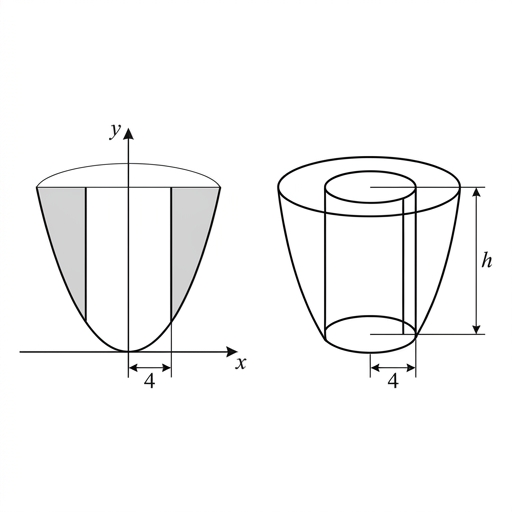
The volume of the ring is .
Find the value of .
The volume of the ring can be found by integrating the difference in the areas of two circles (a 'washer') along the height of the ring. First, determine the limits of integration by considering where the inner wall of the ring (the cylinder) intersects the outer wall (the paraboloid).
Question 3
HardPaper 1 · no calculator20 marksConsider the family of integrals defined by for , where .
(a) By using integration by parts, show that for .
(b) Hence, find an explicit expression for .
(c) The region is enclosed by the graph of and the -axis for . The region is rotated by radians about the -axis. Find the volume of the solid generated.
(d) Show that for any .
Consider the function .
(e) (i) Find the Maclaurin series for up to and including the term in .
(ii) Hence, find the value of the fourth derivative of at , i.e. .
Choose and and apply the integration by parts formula, .
Apply the reduction formula from part (a) repeatedly, starting with , until you reach an integral you can compute directly (). Then substitute back.
The formula for the volume of revolution about the x-axis is . You will need to evaluate an improper integral using the result from part (b).
Rewrite the expression as a fraction to get an indeterminate form and then apply L'Hôpital's rule.
Recall the standard Maclaurin series for . Substitute and then multiply the entire series by .
The general term in a Maclaurin series is . Compare the coefficient of the term in your series from part (e)(i) with this general form.
Question 4
MediumPaper 1 · no calculator6 marksThe function is defined as , where .
Consider the shaded region R enclosed by the graph of , the -axis and the line , as shown in the following diagram.
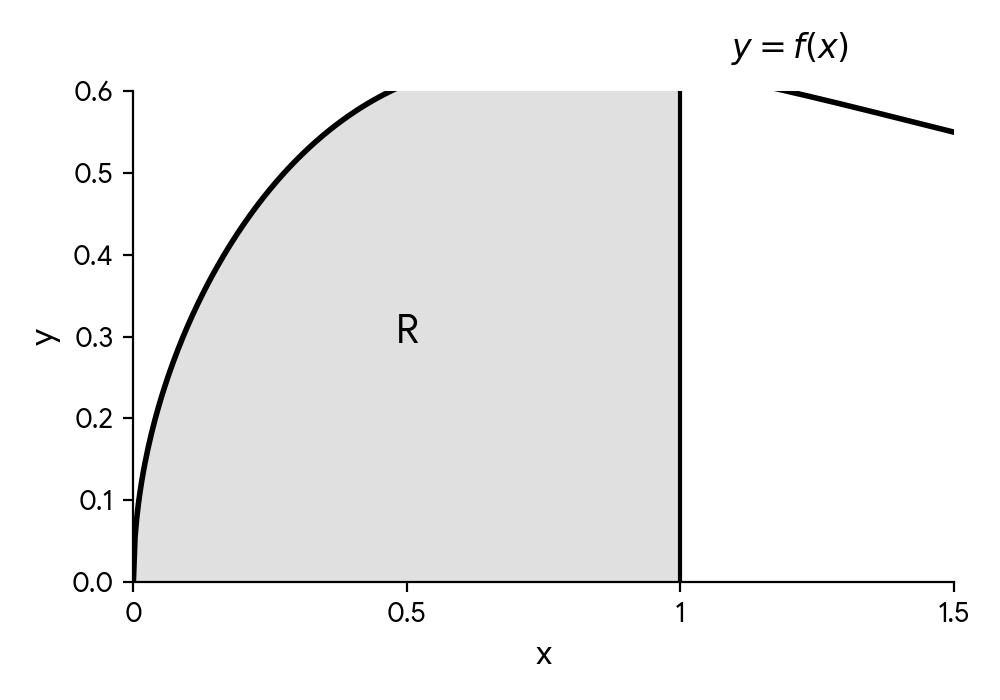
The shaded region R is rotated by radians about the -axis to form a solid.
Show that the volume of the solid is .
Start by setting up the integral for the volume of revolution. Look at the resulting integrand. Does it have a structure that suggests a particular integration technique, like substitution or integration by parts? Consider the relationship between the different parts of the integrand.
Question 5
HardPaper 2 · calculator20 marksA designer is creating a decorative glass container shaped like a dome. The outer profile of the container can be modelled by the function , where and and are measured in metres.
Sketch the curve , clearly indicating the coordinates of the endpoints.
Show that the inverse function of is given by .
State the domain and range of .
The container is formed by rotating the curve by about the y-axis. Show that the volume, , of liquid in the container when it is filled to a height of metres is given by .
Hence, determine the maximum volume of the container.
At , the container is empty. Liquid is then added to the container at a constant rate of .
Find the time it takes to fill the container to its maximum volume.
Find the rate of change of the height of the liquid when the container is filled to half its maximum volume.
Remember that the domain restricts the part of the curve you need to sketch. Identify the y-values at the given x-endpoints.
To find the inverse function, interchange and and then solve for . Remember the range of the original function.
The domain of an inverse function is the range of the original function, and vice versa.
The formula for volume of revolution about the y-axis is . Express in terms of from the original function.
The maximum height the liquid can reach is determined by the range of the original function.
Time equals total volume divided by the filling rate.
First, find the height when the volume is half the maximum. Then, use the chain rule . You'll need to differentiate the volume formula with respect to .
Question 6
MediumPaper 1 · no calculator7 marksConsider the function , for .
Determine the range of .
The region bounded by the graph of , the -axis and the lines and is rotated radians about the -axis.
Find the volume of the solid generated.
To find the range of a function on a closed interval, you should check the values of the function at the endpoints and at any local maximum or minimum points within the interval. For a cosecant function, the minimum value occurs when its reciprocal, the sine function, is at its maximum.
The formula for the volume of a solid generated by rotating a curve about the x-axis between and is . You will need to know the integral of .
No question on this page matches those filters. Try another difficulty or paper.
Every Volume of revolutions + HL area problems question, marked for you
Every answer is marked mark by mark, IB-style, and the AI tutor helps when you are stuck.
Where marks are lost
- Using your own wrong value after failing a "show that".