Simple deductive proofs (LHS = RHS): notes and practice questions
- A proof is a series of logical steps used to show that a result is true for all specified values, usually algebraically.
- To prove a statement, you must show that the left-hand side (LHS) is the same as the right-hand side (RHS).
- Start with one side (usually the LHS) and manipulate it through logical steps until it is identical to the other side.
- You must not move terms from one side of the statement to the other.
- A mathematical identity is a statement that is true for all values and is identified by the symbol .
- You can conclude your proof by writing `LHS = RHS` or `QED`.
How it is examined
Always `Show that` or `Prove`, so the answer is the working and there is no mark for the final line on its own. The distinction between and is assessable. A student who starts from the required result and works back to something true has not done a LHS to RHS proof. 3 to 5 marks, Paper 1.
- Simple deductive proof, numerical and algebraic; how to lay out a left-hand side to right-hand side (LHS to RHS) proof.
- The symbols and notation for equality and identity.
Linking questions
- TOK: is mathematical reasoning different from scientific reasoning, or reasoning in other areas of knowledge?
Practice questions
29 questions · 1 easy · 20 medium · 8 hardQuestion 1
EasyPaper 1 · no calculator3 marks(a) Show that .
Start by expanding the brackets on the Left-Hand Side (LHS) of the equation. Remember the order of operations (PEMDAS/BODMAS) when dealing with the squared term.
Question 2
MediumPaper 1 · no calculator5 marks(a) Show that the sum of the squares of any two consecutive even integers is equal to , where .
(b) Hence, or otherwise, prove that the sum of the squares of any two consecutive even integers is always a multiple of 4.
Start by representing two consecutive even integers algebraically using a variable, for example, and . Then, expand and simplify the sum of their squares.
Refer to the expression derived in part (a). How can you manipulate this expression to clearly show it is a multiple of 4? Remember that a number is a multiple of 4 if it can be written as for some integer .
Question 3
HardPaper 2 · calculator9 marksShow that the identity is true for all
The equation has two distinct real roots, and .
Consider the equation , where , which has roots and .
Without finding the values of and , determine the values of and .
Start with the right-hand side of the identity and expand the terms. It might be helpful to simplify the expression inside the main parentheses first.
Use Vieta's formulas to find the sum () and product () of the roots of the first equation. The sum and product of the roots of the second equation are and respectively. You will need the identity from part (a) to find the sum of the new roots.
Question 4
MediumPaper 1 · no calculator5 marks(a) Show that the sum of the squares of any two consecutive even integers is equal to , where .
(b) Hence, or otherwise, prove that the sum of the squares of any two consecutive even integers is always a multiple of 4.
Start by representing two consecutive even integers algebraically using a variable, for example, and . Then, expand and simplify the sum of their squares.
Refer to the expression derived in part (a). How can you manipulate this expression to clearly show it is a multiple of 4? Remember that a number is a multiple of 4 if it can be written as for some integer .
Question 5
HardPaper 3 · calculator16 marksIn a study of wave propagation, a mathematical model uses the function , where , to describe a certain physical quantity. This function is also known as the hyperbolic sine function, .
Verify that satisfies the differential equation .
Another related function, the hyperbolic cosine, is defined as , also known as . Show that .
The functions and can be extended to complex numbers. Using Euler's formula , where , express in terms of and .
Similarly, express in terms of and .
Hence, show that .
In a design project, a component's profile is described by a hyperbola with parametric equations and , where are positive constants and .
Given that the component's profile passes through the point and has asymptotes , find the values of and .
Recall the derivatives of and . Differentiate the function twice.
Substitute the definitions of and into the expression and simplify.
Substitute into the definition of and use Euler's formula.
Substitute into the definition of and use Euler's formula.
Use your results from part (c) and trigonometric identities.
Substitute the parametric equations into the standard hyperbola form . Use the given point to find one constant and the asymptote equation to find the other.
Question 6
MediumPaper 1 · no calculator5 marksA mathematician is investigating properties of integers. They consider three consecutive integers.
(a) Show that the sum of the squares of three consecutive integers, where is the middle integer, can be expressed as .
(b) Hence, or otherwise, prove that the sum of the squares of three consecutive integers is even if the middle integer is even, and odd if the middle integer is odd.
Represent the three consecutive integers algebraically, with as the middle term. Then, write out the sum of their squares and simplify the expression.
Consider two separate cases for the middle integer : when is even and when is odd. Use the result from part (a) and the definitions of even () and odd () integers.
Question 7
HardPaper 1 · no calculator20 marksThe acceleration, , of a particle moving in a straight line at time seconds, , is given by , where is the particle's velocity. At , the particle is at the origin O and has an initial velocity , where .
By solving an appropriate differential equation, show that the particle's velocity at time is given by .
The particle moves in the positive direction until it reaches its maximum displacement from O at time . Show that .
Find an expression for the maximum displacement, , in terms of .
Let represent the particle's velocity seconds before it reaches , where . By using the result from part (b)(i), show that .
Similarly, let represent the particle's velocity seconds after it reaches . Deduce a similar expression for in terms of .
Hence, show that the speed of the particle seconds before it reaches is greater than or equal to its speed seconds after it reaches .
Recall that acceleration is the rate of change of velocity. Set up a differential equation and solve it by separating the variables.
What is the velocity of the particle when it is at its maximum displacement from the origin?
Displacement is the integral of velocity. Remember to use the initial conditions to find the constant of integration, and then substitute the time to find the maximum displacement.
Substitute into the expression for and use the relationship you found in part (b)(i).
Follow a similar process to part (c), but this time substitute .
Speed is the magnitude (absolute value) of velocity. Set up an inequality using your results from parts (c) and (d) and rearrange it to show it is always true.
Question 8
MediumPaper 1 · no calculator6 marks(a) Consider any three consecutive positive integers. Show that their sum is a multiple of 3.
(b) Prove that the sum of the squares of any three consecutive positive integers can be written in the form , where is an integer.
Represent the three consecutive integers algebraically, for example as . Then find their sum and simplify.
Using the same algebraic representation for the three integers, write an expression for the sum of their squares. Expand and simplify, then try to factor out a 3 from part of the expression.
Question 9
HardPaper 1 · no calculator16 marksThe following diagram shows the graph of for , with asymptotes at and .
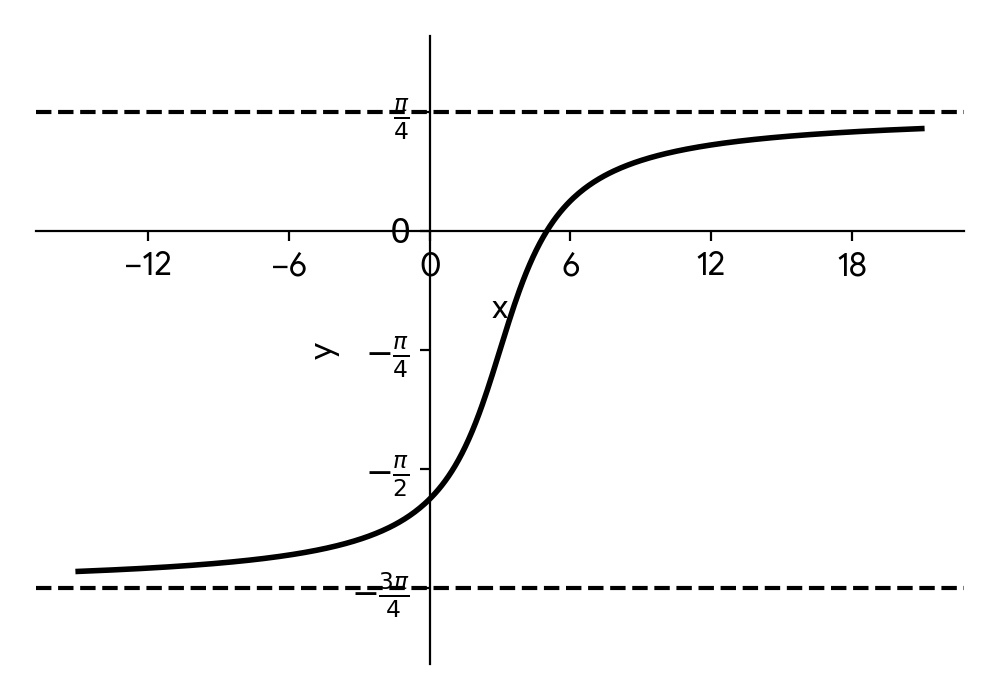
Describe a sequence of transformations that transforms the graph of to the graph of for .
Show that where and .
Using mathematical induction and the result from part (b), prove that
for .
Consider the transformations in the form . Think about the order of transformations, especially for the horizontal stretch and shift.
Let and . Express and in terms of and . Then use the compound angle formula for .
For the inductive step, assume the formula is true for . Then consider the sum for , which is the sum for plus the -th term. Use the identity from part (b) to combine the terms.
Question 10
MediumPaper 1 · no calculator6 marksLet two consecutive positive odd integers be represented by and , where .
(a) Show that the sum of these two integers is a multiple of 4.
(b) Prove that the sum of the squares of these two integers is 2 more than a multiple of 8.
Start by writing an expression for the sum of the two consecutive odd integers. Then, simplify the expression and see if you can factor out a 4.
Write an expression for the sum of the squares. Expand the terms carefully using the formula . Simplify the resulting expression and try to write it in the form .
Question 11
HardPaper 1 · no calculator14 marksA curve is given by the equation for .
(a) Use implicit differentiation to show that .
(b) Show that .
(c) Find an expression for in terms of and .
(d) Hence, find the Maclaurin series for up to and including the term in .
Differentiate both sides of the equation with respect to . Remember to use the chain rule for the term involving . Then, make the subject and use the original equation to simplify.
Differentiate the expression for you found in part (a), or differentiate the expression using the product rule.
Differentiate the equation from part (b) with respect to . Remember to use the chain rule for the term .
You need to find the values of and its first four derivatives at . Use the results from previous parts to help you calculate these values recursively. Then substitute these values into the formula for a Maclaurin series.
Question 12
MediumPaper 1 · no calculator7 marks(a) Show that , for .
(b) Hence or otherwise, solve the equation for , .
To show that the two expressions are equal, you can either start with the left-hand side and combine the terms into a single fraction, or start with the right-hand side and perform algebraic long division.
Notice the structure of the equation in this part is the same as the expression in part (a). Let and use the result from part (a) to form a simpler equation. This will lead to a quadratic equation in terms of .
Question 13
HardPaper 2 · calculator18 marksA company models the average cost per unit, , in thousands of dollars, for producing thousand units of a specialized component using the function , where represents the number of units in thousands, and is a positive constant.
(a) Write down the equations of the vertical and horizontal asymptotes of the graph of .
(b) Show that .
(c) Show that the graph of has no turning points.
(d) Find the equation, in terms of , of the normal to the graph of at .
(e) The horizontal and vertical asymptotes of meet at the point . The normal to the graph of at passes through for certain values of .
Show that these values of satisfy the equation .
(f) Hence, find the values of for which the normal to the graph of at passes through .
Recall how to find vertical asymptotes by setting the denominator to zero, and horizontal asymptotes by considering the limit as for rational functions.
Use the quotient rule for differentiation: if , then .
Turning points occur where the first derivative is equal to zero. Analyze the expression for to see if it can ever be zero.
First, find the coordinates of the point on the curve at . Then, calculate the gradient of the tangent at using . The gradient of the normal is the negative reciprocal of the tangent's gradient. Finally, use the point-gradient form of a line.
The point is the intersection of the asymptotes found in part (a). Substitute the coordinates of into the equation of the normal found in part (d) and simplify the resulting algebraic expression.
Solve the cubic equation from part (e). Remember that is a positive constant.
Question 14
MediumPaper 1 · no calculator4 marksShow that the product of any two consecutive positive even integers, when increased by 1, is a perfect square.
Start by representing two consecutive positive even integers algebraically, for example, as and . Then find their product and add 1. Can you factorize the resulting expression?
Question 15
HardPaper 3 · calculator28 marks(a) A cubic equation with real coefficients has roots and .
(i) Write down the third root.
(ii) Verify that the real part of the complex roots is 3.
(b) Let . Show that the line is tangent to the curve at the point .
(c) Sketch the curve and the tangent to the curve at point , clearly showing where the tangent crosses the -axis.
(d) Let a general cubic function be given by , where and .
(i) Show that .
(ii) Hence, or otherwise, prove that the tangent to the curve at the point intersects the -axis at the point .
(e) Deduce from part (d)(ii) that the complex roots of the equation can be expressed as .
(f) Consider a cubic function of the form . Given that and , and the -coordinate of the point of tangency is .
(i) Use this information to determine the roots of the corresponding equation for .
(ii) State the coordinates of the complex conjugate root with negative imaginary part, , in the Argand diagram.
(g) The point of inflection for the curve is denoted by .
(i) Show that the -coordinate of is . You are not required to demonstrate a change in concavity.
(ii) Hence describe numerically the horizontal position of point relative to the horizontal positions of the points and .
(h) Consider the special case where .
(i) Sketch the curve for and .
(ii) For and , state in terms of , the coordinates of points and .
For a polynomial equation with real coefficients, if a complex number is a root, its conjugate must also be a root.
The real part of a complex number is . Consider the two complex roots.
To show a line is tangent to a curve at a point, verify two conditions: first, the point lies on both the curve and the line. Second, the gradient of the curve at that point is equal to the gradient of the line.
Identify the real root of the cubic function and the -intercept of the tangent line. Note that is a positive cubic function.
Use the product rule for differentiation: if , then . Here, let and .
First, find the -coordinate of point , . Then, use the expression for from part (d)(i) to find the gradient of the tangent at , which is . Form the equation of the tangent line and find its -intercept.
Recall that the complex roots are . Use the relationship found in part (d)(ii) between and .
Use the formula for derived in part (d)(ii): . Substitute the given values to find , then identify all the roots.
The complex roots are of the form . The complex conjugate root with a negative imaginary part is . Its coordinates in the Argand diagram are .
The -coordinate of the point of inflection is found by setting the second derivative, , to zero. Use the expression for from part (d)(i) to find .
Point has -coordinate , and point has -coordinate . Express in terms of and to see its relative position.
Substitute and into the function. Analyze the derivative to determine if there are any stationary points and the point of inflection.
Use the formulas for the -coordinate of from (g)(i) and the -coordinate of from (d)(ii), substituting . Then find the -coordinate for as well.
Question 16
MediumPaper 1 · no calculator4 marksConsider two consecutive odd positive integers.
Show that the difference between their squares is equal to twice their sum.
First, represent two consecutive odd positive integers using a variable, for example, and . Then, set up an expression for the difference of their squares and another for twice their sum. Simplify both expressions to show they are equal.
Question 17
HardPaper 3 · calculator30 marksA pharmaceutical company is formulating a new drug. They are testing two active ingredients, and , such that their total concentration is mg/mL. The drug's efficacy is modelled by the product of the concentrations of the two ingredients.
Find the efficacy, , as a function of only.
Determine the concentration of that maximizes the drug's efficacy.
Hence, show that the maximum efficacy for two ingredients with a total concentration of mg/mL is .
Let represent the maximum efficacy for a drug with active ingredients and a total concentration of mg/mL. For , the maximum efficacy can be expressed as .
Verify that is true for .
The relationship between the geometric mean and arithmetic mean states that for positive real numbers , their geometric mean is always less than or equal to their arithmetic mean .
Show that the geometric mean and arithmetic mean are equal when .
Use this result to prove that .
Using the formula for , determine the value of:
;
;
.
For a fixed total concentration of mg/mL, the company wants to find the optimal number of active ingredients, , to maximize the drug's efficacy. Let denote this maximum efficacy.
Write down the value of and the value of at which it occurs.
Determine the value of and the value of at which it occurs.
Consider the continuous function , defined by , where . A sketch of the graph of is shown in the following diagram. Point A is the maximum point on this graph.
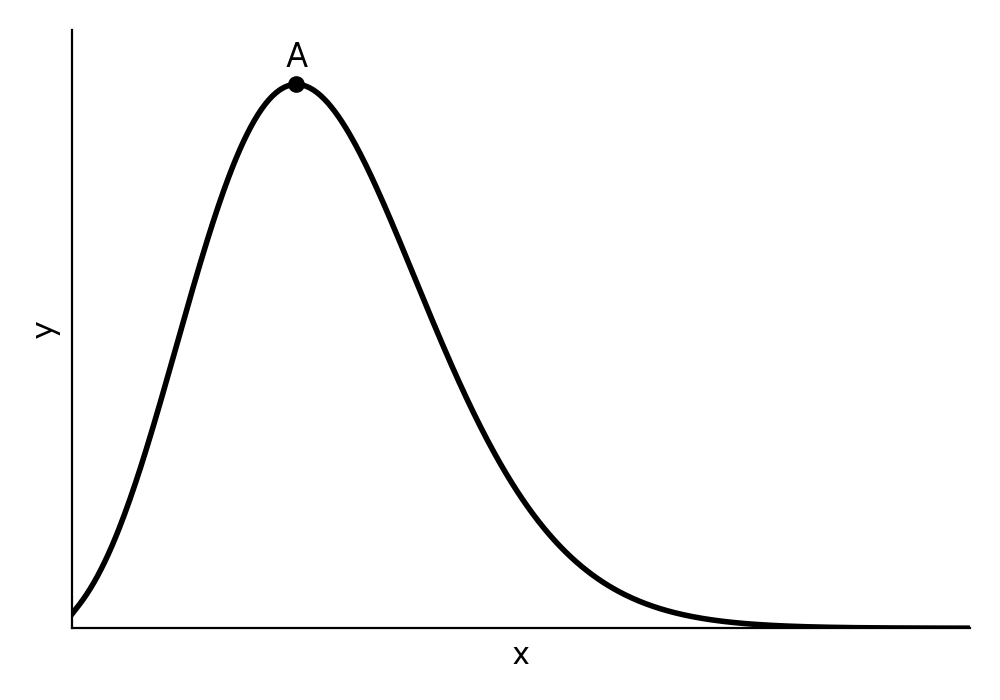
Find, in terms of , the -coordinate of point A.
Verify that , when .
The company has a total concentration of mg/mL available. Use your answer to part (h) to find the largest possible efficacy. Give your answer in the form , where and .
Express in terms of using the given total concentration. Then substitute this into the product expression.
The function is a quadratic. You can find its maximum by finding the vertex or by using calculus (setting the first derivative to zero).
Substitute the value of found in part (b.i) into the efficacy function .
Substitute into the given formula for and compare the result with your answer from part (b.ii).
Assume all are equal to a single variable, say . Substitute this into both sides of the inequality and simplify.
Start with the AM-GM inequality. Use the fact that the sum of the is . The maximum product occurs when the equality holds.
Substitute and into the formula .
Substitute and into the formula .
Substitute and into the formula .
Calculate for integer values of around the expected maximum (which can be estimated using ). Compare these values to find the largest.
Similar to part (f), calculate for integer values of around .
To find the maximum point, differentiate with respect to and set the derivative to zero. Remember to use the product rule and chain rule.
Use the properties of logarithms to rewrite the expression for and then convert it back to .
The optimal number of ingredients must be an integer. Use the result from part (h) to find the continuous maximum, then test the integer values of immediately surrounding this continuous maximum.
Question 18
MediumPaper 1 · no calculator7 marksShow that , for .
Hence or otherwise, solve the equation for .
To show that the two expressions are equal, you can either start with the left-hand side and combine the terms into a single fraction, or you can start with the right-hand side and perform polynomial division.
Notice the similarity between the equation in this part and the expression from part (a). Let and use the result you proved to simplify the equation into a quadratic form.
Question 19
MediumPaper 1 · no calculator4 marksProve that is divisible by 8 for all .
Consider expanding the two squared terms, or think about a common algebraic identity that could simplify the expression before expansion.
Question 20
MediumPaper 1 · no calculator7 marksA student claims that for all integers .
(a) Show that for all integers .
(b) Use mathematical induction and the result from part (a) to prove that the student's claim is valid for all integers .
Expand the right-hand side of the inequality. Then, rearrange the inequality to form a quadratic in terms of n. Consider the properties of this quadratic function for the given domain of n.
Follow the standard steps for proof by induction. First, show the base case is true (n=5). Then, assume the statement is true for n=k. For the inductive step, you need to show it's true for n=k+1. Start with and use your assumption and the result from part (a) to show it's greater than .
No question on this page matches those filters. Try another difficulty or paper.
9 more Simple deductive proofs (LHS = RHS) questions in the app
Every answer is marked mark by mark, IB-style, and the AI tutor helps when you are stuck.
Where marks are lost
- Using your own wrong value after failing a "show that".