Trig identities (pythagorean identity, double angle) & relationships: notes and practice questions
- Pythagorean identity:
Derived forms:
,
- Double angle formulas:
or or .
How it is examined
"Without finding " is the giveaway phrase and it means an exact-value chain through the identities, on Paper 1. The sign ambiguity when taking a square root of the Pythagorean identity is where marks go, and the quadrant information in the question is what resolves it. 4 to 6 marks.
The Pythagorean identity and the double angle identities for sine and cosine are given, with all three forms of .
- The Pythagorean identity .
- Double angle identities for sine and cosine.
- The relationship between trigonometric ratios.
Extended at AHL 3.9 (the other two Pythagorean identities) and AHL 3.10 (compound angles, and the double angle identity for tan).
Linking questions
- Feeds SL 3.8, where identities are the route into solving equations.
Practice questions
75 questions · 1 easy · 45 medium · 29 hardQuestion 1
EasyPaper 1 · no calculator5 marksSolve in the interval
Start by using the identity in the formula booklet with to rewrite the equation. After that, notice how it becomes a quadratic equation.
Question 2
MediumPaper 1 · no calculator5 marksFind .
Hence, evaluate .
You should use one of the double angle identities to remove the squared cosine.
Plug in the boundaries into your previous answer
Question 3
HardPaper 1 · no calculator7 marksSolve the equation , for .
Start by combining the two logarithmic terms using the properties of logarithms. Then, try to simplify the argument of the logarithm, looking for a familiar trigonometric identity. Don't forget to consider the domain for which the logarithms are defined.
Question 4
MediumPaper 1 · no calculator5 marksFind .
Hence, evaluate .
You should use one of the double angle identities to remove the squared cosine.
Plug in the boundaries into your previous answer
Question 5
HardPaper 3 · calculator16 marksIn a study of wave propagation, a mathematical model uses the function , where , to describe a certain physical quantity. This function is also known as the hyperbolic sine function, .
Verify that satisfies the differential equation .
Another related function, the hyperbolic cosine, is defined as , also known as . Show that .
The functions and can be extended to complex numbers. Using Euler's formula , where , express in terms of and .
Similarly, express in terms of and .
Hence, show that .
In a design project, a component's profile is described by a hyperbola with parametric equations and , where are positive constants and .
Given that the component's profile passes through the point and has asymptotes , find the values of and .
Recall the derivatives of and . Differentiate the function twice.
Substitute the definitions of and into the expression and simplify.
Substitute into the definition of and use Euler's formula.
Substitute into the definition of and use Euler's formula.
Use your results from part (c) and trigonometric identities.
Substitute the parametric equations into the standard hyperbola form . Use the given point to find one constant and the asymptote equation to find the other.
Question 6
MediumPaper 1 · no calculator7 marks(a) Show that .
(b) Hence, solve the equation for .
Start with the left-hand side and use a double angle identity for . Think about which of the three forms of the identity would be most useful here.
Use your result from part (a) to substitute into the equation. Then, rearrange the equation so that one side is zero and try to factorize. Be careful not to divide by a term that could be zero.
Question 7
HardPaper 1 · no calculator19 marksA ladder must be placed against a tall vertical building, clearing a monument that is 8 m high and stands on horizontal ground 1 m away from the building's base. The ladder touches the ground, the top corner of the monument, and the wall of the building.
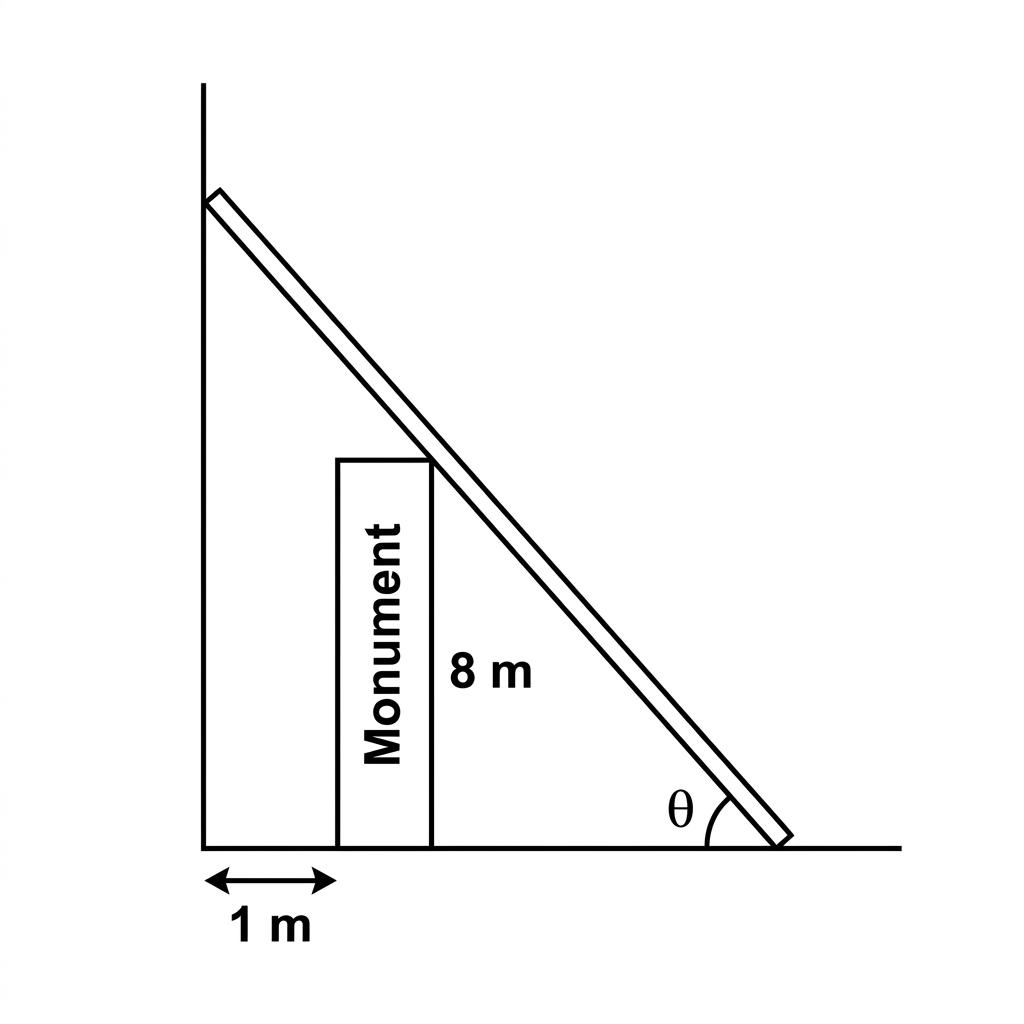
Let be the length of the ladder in metres.
Let be the angle that the ladder makes with the ground, where .
(a) Show that .
(b) (i) Find .
(b) (ii) When , show that .
(c) (i) Find .
(c) (ii) When , find the value of .
(d) (i) Hence, justify that is a minimum when .
(d) (ii) Determine this minimum value of .
(e) A construction company only has ladders with a maximum length of 11 m. Determine whether it is possible to position a ladder against the building over the monument, giving a reason for your answer.
Use trigonometry on the two right-angled triangles formed by the ladder, the ground, the monument, and the wall. Express the two segments of the ladder, divided by the monument's corner, in terms of .
Differentiate the expression for with respect to . You will need to know the derivatives of and .
Set your expression from part (b)(i) equal to zero. Rewrite all trigonometric functions in terms of and and then simplify the equation to find an expression for .
Differentiate your expression for from part (b)(i). You will need to use the product rule for both terms.
If , you can construct a right-angled triangle with opposite side 2 and adjacent side 1. Use this to find the values of , , and any other required trigonometric ratios, then substitute them into your expression for the second derivative.
Use the second derivative test. What does the sign of the second derivative at a stationary point tell you about the nature of that point?
Substitute the trigonometric values corresponding to back into the original expression for from part (a).
Compare the maximum available ladder length (11 m) with the minimum required length you calculated in part (d)(ii). To compare and without a calculator, you can compare their squares.
Question 8
MediumPaper 1 · no calculator4 marksIt is given that , where . Find the exact value of .
First, determine which quadrant the angle lies in by considering both the sign of the secant function and the given domain. Then, use a Pythagorean identity such as or a right-angled triangle to find the magnitude of . Finally, combine the sign and magnitude for your answer.
Question 9
HardPaper 1 · no calculator16 marks(a) Find the binomial expansion of . Give your answer in the form where and are expressed in terms of and .
(b) By using De Moivre's theorem and your answer to part (a), show that .
(c) Hence, find the four distinct roots of the equation , expressing them in the form where .
(d) By considering the roots of the equation in part (c), or otherwise, find the exact value of .
Use the binomial theorem . Remember that .
De Moivre's theorem states . Equate the real parts of the two expressions for . You will need to use the identity .
Let and use the result from part (b). This transforms the polynomial equation into a trigonometric equation. Solve for to find the roots.
You can use Vieta's formulas for the product of roots of a polynomial. Alternatively, consider a substitution like to turn the quartic into a quadratic equation. A third approach might use trigonometric identities directly.
Question 10
MediumPaper 1 · no calculator7 marksConsider the functions and for .
(a) Find an expression for .
(b) Hence, solve the equation for .
Recall that means . You need to substitute the expression for into the function wherever you see .
Start by using your result from part (a). You will get an equation involving and . Try using the compound angle identities to expand these terms.
Question 11
HardPaper 1 · no calculator8 marksConsider the function , where and .
(a) Show that is an even function.
(b) Given that , find the value of .
To show a function is even, you need to prove that . Remember the property of the cosine function: .
The limit is of the indeterminate form . You can use L'Hôpital's rule, Maclaurin series expansion for , or a trigonometric identity to simplify the expression before taking the limit.
Question 12
MediumPaper 1 · no calculator7 marksConsider the functions and , where and .
The graph of is obtained by two transformations of the graph of .
Describe these two transformations.
The -intercept of the graph of is at .
Given that the maximum value of is less than or equal to 1, find the largest possible value of .
Look at how the input to the cosine function has changed, and how the entire function has been shifted vertically.
First, determine the maximum value of in terms of . Use the given condition to find the minimum possible value for . Then, calculate the y-intercept, , and use your result for to find the largest possible value of .
Question 13
HardPaper 1 · no calculator17 marksFind the binomial expansion of . Give your answer in the form where and are expressed in terms of and .
By using De Moivre's theorem and your answer to part (a), show that .
Hence, show that and are solutions of the equation .
Hence, find the exact value of .
Recall the binomial theorem . Remember to simplify the powers of : .
Use De Moivre's theorem to find another expression for . Then, equate the real parts of this expression and your answer from part (a). You will need to use the identity .
Consider the equation . What are the principal values of that satisfy this? How does this relate to the identity you proved in part (b)?
The equation from part (b) is a polynomial in terms of . Can you make a substitution, like , to turn it into a quadratic equation? Then you can find the roots of this quadratic and relate them to the specific values of from part (c)(i).
Question 14
MediumPaper 1 · no calculator6 marksSolve the equation for .
The equation involves both and as arguments. Try to use a trigonometric identity to express everything in terms of a single argument, . This should lead to a quadratic equation in terms of .
Question 15
HardPaper 1 · no calculator8 marksShow that .
Hence, solve the equation for .
Start with the left-hand side (LHS) and use the double angle identities for and . Choose the identity for that will help you simplify the expression.
Use the result from part (a) to substitute into the equation. Then, look for a common factor that you can take out to simplify the equation into two separate, solvable trigonometric equations.
Question 16
MediumPaper 1 · no calculator6 marksThe diagram shows a parallelogram PQRS where PQ = cm, PS = 7 cm and .
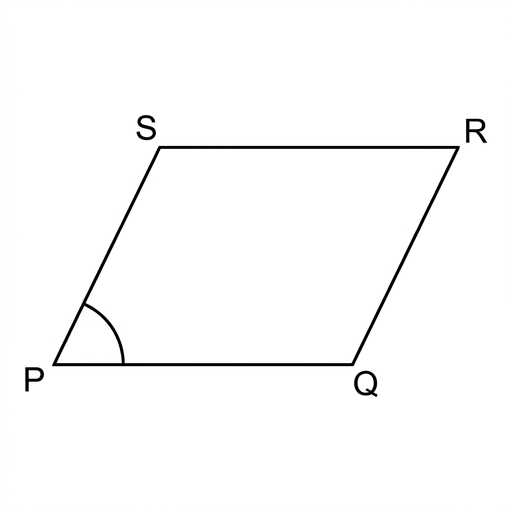
Find the exact area of the parallelogram PQRS.
The area of a parallelogram can be found by splitting it into two congruent triangles. You will need to find the sine of the angle given its cosine. Recall the Pythagorean identity .
Question 17
HardPaper 1 · no calculator7 marksConsider the functions and , where .
The graphs of and are shown in the following diagram.
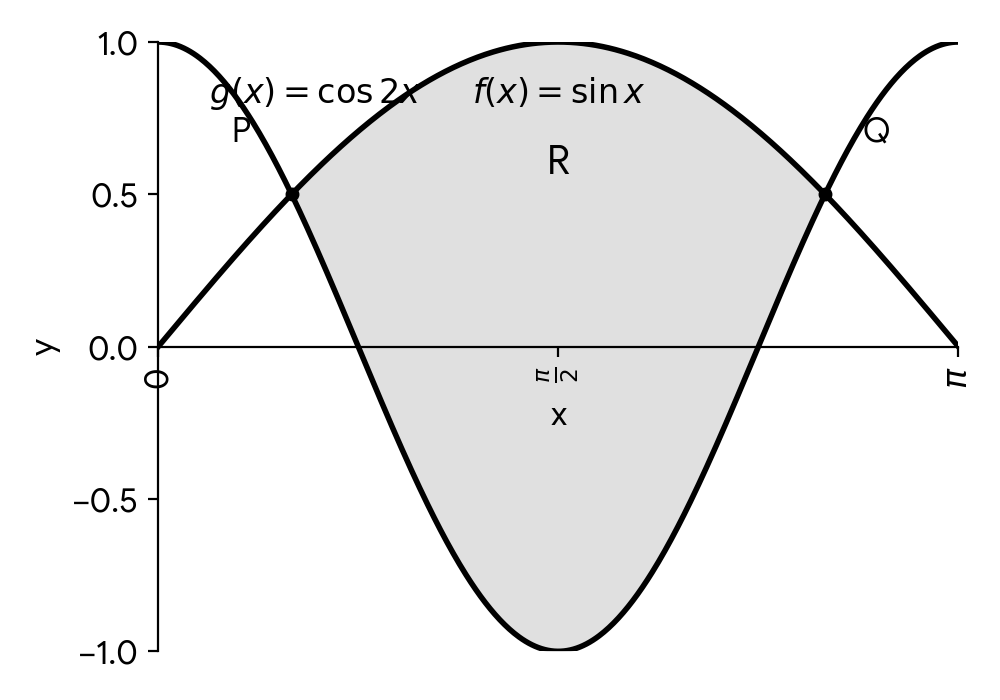
The graphs intersect at points P and Q. The region enclosed by the two graphs is shaded and labelled R.
(a) Find the -coordinates of P and Q.
(b) Find the area of R.
To find the intersection points, set the two functions equal to each other. You will need to use a trigonometric identity to transform the equation into a form that you can solve, likely a polynomial in terms of or .
The area between two curves and from to is given by the definite integral . Use the intersection points you found in part (a) as your limits of integration. You'll need to determine which function is greater on the interval to remove the absolute value.
Question 18
MediumPaper 1 · no calculator7 marksSolve the equation , for .
Try to rewrite the equation so it is in terms of a single trigonometric function. You might need to use a Pythagorean identity. This should lead to a quadratic equation.
Question 19
HardPaper 1 · no calculator14 marksA curve is given by the equation for .
(a) Use implicit differentiation to show that .
(b) Show that .
(c) Find an expression for in terms of and .
(d) Hence, find the Maclaurin series for up to and including the term in .
Differentiate both sides of the equation with respect to . Remember to use the chain rule for the term involving . Then, make the subject and use the original equation to simplify.
Differentiate the expression for you found in part (a), or differentiate the expression using the product rule.
Differentiate the equation from part (b) with respect to . Remember to use the chain rule for the term .
You need to find the values of and its first four derivatives at . Use the results from previous parts to help you calculate these values recursively. Then substitute these values into the formula for a Maclaurin series.
Question 20
MediumPaper 1 · no calculator7 marksThe following diagram shows triangle LMN, with LM = , MN = and LN = .
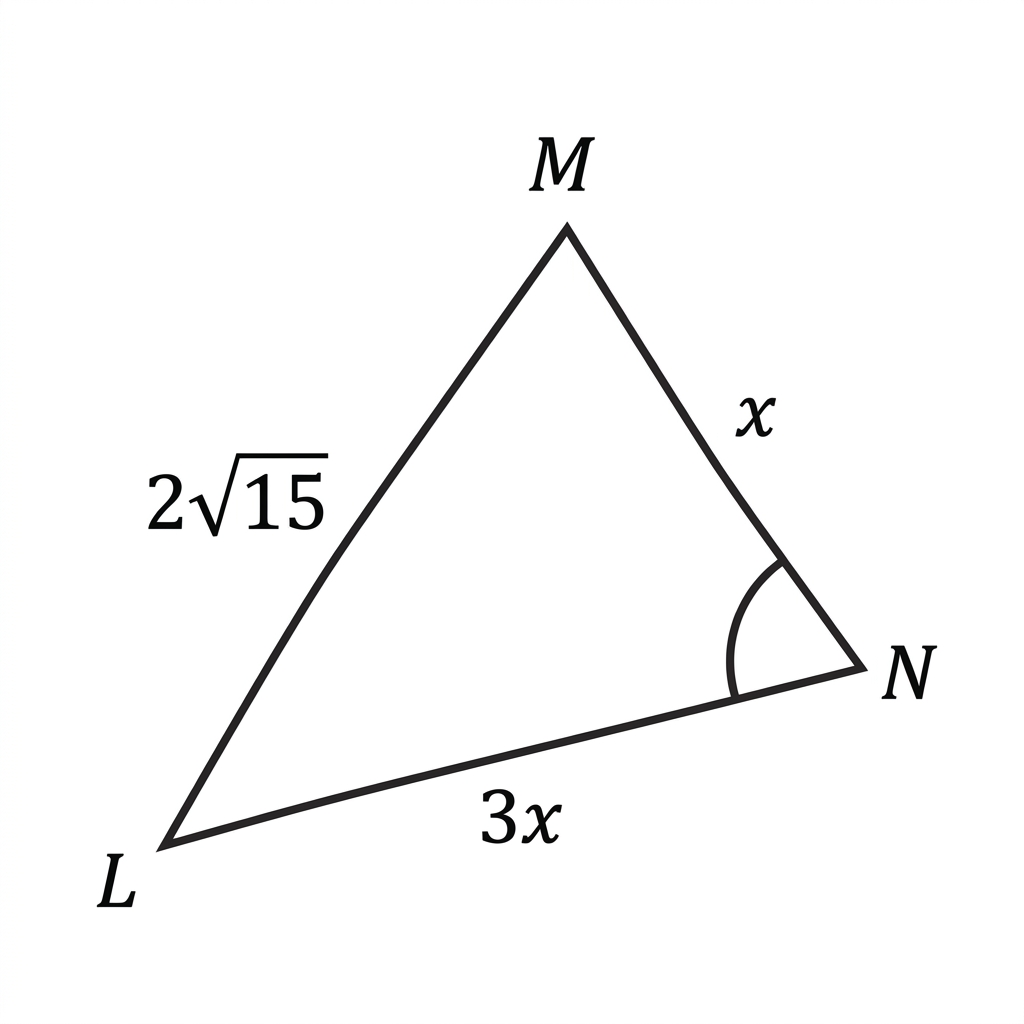
Given that , find the area of the triangle.
Give your answer in the form where .
Start by applying the cosine rule to the triangle to form an equation in terms of . You will also need to find the sine of the given angle to use the area formula.
No question on this page matches those filters. Try another difficulty or paper.
55 more Trig identities (pythagorean identity, double angle) & relationships questions in the app
Every answer is marked mark by mark, IB-style, and the AI tutor helps when you are stuck.
Where marks are lost
- Using your own wrong value after failing a "show that".
- Using an alternative method after "Hence".