Integration by parts (+ repeated by parts): notes and practice questions
- Integration by parts uses the product rule in reverse to integrate products of functions.
- The formula is .
- Choose to simplify upon differentiation and to be easily integrable, often following the LIATE order (Logarithmic, Inverse Trig, Algebraic, Trigonometric, Exponential).
- For polynomial exponential/trig, let be the polynomial to reduce its power.
- For logarithms or inverse trig functions, let be that function and to eliminate it.
- Cyclic integrals (exponential trig) require two applications and algebraic solving.
- For definite integrals, evaluate at the limits and subtract the integrated remaining part.
How it is examined
The substitution rule is a gift for question generation: if the integral is not the reverse chain rule shape, the question must supply the substitution. Changing the limits when substituting in a definite integral, rather than substituting back, is the standard examiner complaint. needs the by-parts twice and then rearranging for the original integral, which is a full question on its own. 6 to 8 marks.
The by-parts formula is given.
- Integration by substitution.
- Integration by parts.
- Repeated integration by parts.
Linking questions
- and are by parts with , which is the trick worth teaching and worth asking.
Practice questions
15 questions · 3 medium · 12 hardQuestion 1
MediumPaper 1 · no calculator7 marksSolve the differential equation , for , given that when .
Give your answer in the form .
This is a first-order linear differential equation. Try to get it into the form and find an integrating factor. Alternatively, notice that the left-hand side of the equation is the result of a product rule differentiation.
Question 2
HardPaper 1 · no calculator9 marksFind .
Hence, find the exact value of .
You will need to apply integration by parts twice. Remember to choose your 'u' and 'dv' carefully. A good rule of thumb is to choose 'u' as the function that becomes simpler when you differentiate it.
Use your answer from part (a). Substitute the upper and lower limits of integration and subtract. Be careful with the exact values of the trigonometric functions.
Question 3
MediumPaper 1 · no calculator6 marksFind .
This integral requires the use of integration by parts. You may need to apply the technique more than once. Consider if a substitution could simplify the problem first.
Question 4
HardPaper 1 · no calculator17 marksBy using an appropriate substitution, show that .
The following diagram shows part of the curve for .
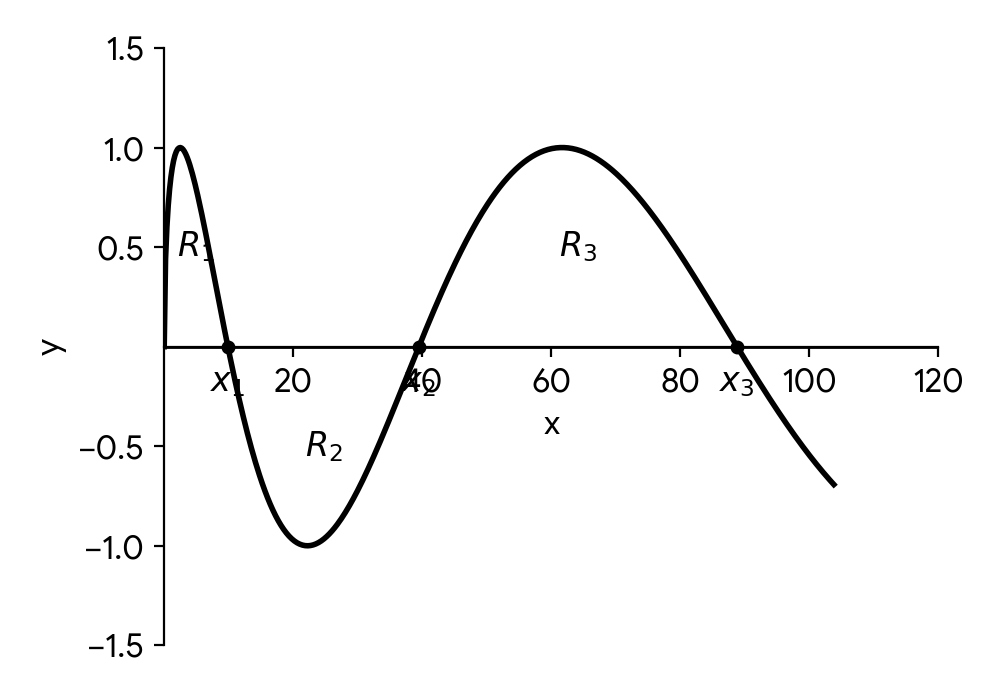
The curve intersects the x-axis at .
The nth x-intercept of the curve, , is given by , where .
Write down an expression for .
The regions bounded by the curve and the x-axis are denoted by as shown on the diagram.
Calculate the area of region .
Give your answer in the form , where .
Hence, show that the areas of the regions form an arithmetic sequence.
Try substituting . After substituting, you will need to use integration by parts.
Simply replace with in the given formula for .
The area of is given by the absolute value of the definite integral from to . Use the result from part (a) and the expressions for the intercepts from part (b).
An arithmetic sequence has a constant common difference. Calculate Area() - Area() and show that it is a constant.
Question 5
MediumPaper 1 · no calculator5 marksFind
Consider using integration by parts. What would be a good choice for 'u' and 'dv/dx'? Remember the derivative of arctan(x).
Question 6
HardPaper 1 · no calculator9 marksFind .
Hence, find the exact value of .
This integral requires the use of integration by parts, . You may need to apply this method more than once.
Use your answer from part (a) and evaluate it at the upper and lower limits of the integral. Remember the exact values of trigonometric functions for angles like and .
Question 7
HardPaper 1 · no calculator20 marksConsider the family of integrals defined by for , where .
(a) By using integration by parts, show that for .
(b) Hence, find an explicit expression for .
(c) The region is enclosed by the graph of and the -axis for . The region is rotated by radians about the -axis. Find the volume of the solid generated.
(d) Show that for any .
Consider the function .
(e) (i) Find the Maclaurin series for up to and including the term in .
(ii) Hence, find the value of the fourth derivative of at , i.e. .
Choose and and apply the integration by parts formula, .
Apply the reduction formula from part (a) repeatedly, starting with , until you reach an integral you can compute directly (). Then substitute back.
The formula for the volume of revolution about the x-axis is . You will need to evaluate an improper integral using the result from part (b).
Rewrite the expression as a fraction to get an indeterminate form and then apply L'Hôpital's rule.
Recall the standard Maclaurin series for . Substitute and then multiply the entire series by .
The general term in a Maclaurin series is . Compare the coefficient of the term in your series from part (e)(i) with this general form.
Question 8
HardPaper 1 · no calculator7 marksFind .
This integral requires repeated application of the integration by parts formula. A systematic approach, such as the tabular method, can be helpful to keep track of the terms.
Question 9
HardPaper 1 · no calculator11 marksFind .
The region is enclosed by the curve , the -axis, and the lines and . Show that the area of is .
This integral is a product of two different types of functions. Which integration technique is suitable for this? Consider letting .
The area under a curve from to is given by the definite integral . Use your result from part (a) and evaluate it at the given limits. Remember the exact values for trigonometric functions of and properties of logarithms.
Question 10
HardPaper 1 · no calculator9 marksFind .
This integral requires the use of integration by parts, . You may need to apply the technique more than once. Look out for the original integral reappearing on the right-hand side of your equation.
Question 11
HardPaper 2 · calculator19 marksA pharmaceutical company is testing a new drug. The concentration of the drug, , in the bloodstream of a patient, in micrograms per millilitre (), hours after administration, is modelled by the function , for .
Sketch the graph of for , clearly indicating the coordinates of the initial concentration point , the maximum concentration point , and the concentration point at hours.
State the range of the concentration during the observed period.
Find the equation of the straight line connecting the initial concentration point and the concentration point at hours.
Show that the rate of change of the drug concentration is given by .
At a certain time, the rate of change of the drug concentration is parallel to the line AB. Find the equation of the tangent line to the graph of at this time. Give all coefficients in your equation correct to significant figures.
Calculate the area of the region enclosed by the graph of and the line AB.
To sketch the graph, first find the coordinates of the end-points of the interval and any local maximum or minimum points within the interval. For the maximum point, find the derivative of and set it to zero.
The range is determined by the minimum and maximum values of the function over the given interval. Refer to your calculated points from part (a).
Use the coordinates of points and to find the gradient of the line. Then use the point-slope form to write the equation of the line.
Use the product rule for differentiation: if , then .
If the tangent is parallel to line AB, their gradients must be equal. Set equal to the gradient of line AB found in part (c) and solve for . Then find the corresponding value to get the point of tangency.
The area enclosed by two curves and over an interval is given by . Determine which function is above the other and then perform the definite integration. You will need to use integration by parts for the term .
Question 12
HardPaper 1 · no calculator38 marksFind the general solution to the following differential equation. (a)
(b)
(c) Find the particular solution to the differential equation , given the initial condition .
(d)
(e)
(f) for .
(g) for .
This is a separable differential equation. The integral involving will require the use of partial fractions.
Separate the variables. The integral of can be solved using a substitution or by using a double angle identity.
This is a separable differential equation. After finding the general solution, use the given initial condition to find the value of the constant of integration.
This is a separable differential equation. Rearrange the equation to have all terms on one side and all terms on the other.
This is a linear first-order differential equation. Find the integrating factor and then proceed. You will need to use integration by parts.
Rearrange the equation into the standard form for a linear first-order differential equation, , and then find the integrating factor.
This is a linear first-order differential equation. The integrating factor will involve a natural logarithm.
Question 13
HardPaper 1 · no calculator17 marksThe lifetime, (in years), of a certain electronic component is modelled by a continuous random variable with probability density function given by
where is a positive constant.
(a) Show that .
(b) Find the mode of the distribution of .
(c) Find the mean lifetime of the component, .
(d) Find the variance of .
The total probability for any probability density function must be equal to 1. You need to set up a definite integral of over its domain and equate it to 1. Solving this integral for will require using integration by parts multiple times.
The mode corresponds to the maximum value of the probability density function . To find this, you need to differentiate with respect to , set the derivative equal to zero, and solve for .
The mean or expected value, , is calculated by evaluating the integral of over the entire domain of the variable . A substitution might simplify the integration.
The variance is given by the formula . You have already found . Now you need to calculate by evaluating the integral of .
Question 14
HardPaper 1 · no calculator12 marksA continuous random variable has probability density function
Show that .
Find the variance of .
The total probability for any probability density function must be equal to 1. Set up the definite integral of over its domain and set it equal to 1. You will need to use integration by parts to solve the integral.
Recall that the variance is given by . You will need to calculate the expected value and the expected value of the square, , by setting up and solving the appropriate definite integrals, again using integration by parts.
Question 15
HardPaper 1 · no calculator7 marksSolve the differential equation , for .
Given that when , find the solution in the form .
This is a first-order linear differential equation. First, try to rearrange it into the standard form and find the integrating factor. Alternatively, look closely at the left-hand side of the equation and see if it reminds you of a differentiation rule.
No question on this page matches those filters. Try another difficulty or paper.
Every Integration by parts (+ repeated by parts) question, marked for you
Every answer is marked mark by mark, IB-style, and the AI tutor helps when you are stuck.
Where marks are lost
- Using your own wrong value after failing a "show that".