Second derivative, points of inflection, testing max / min points, optimisation: notes and practice questions
- Points of Inflection: Occur when or undefined, and the concavity changes (verify by checking sign changes in ).
- Testing Max/Min Points:
- identifies critical points.
- : Minimum, : Maximum.
- Optimisation: Involves finding maximum or minimum values of functions in real-world contexts.
How it is examined
"Here is the graph of , sketch " and its variants are the reasoning question and they are hard for students. Zeros of are stationary points of , zeros of with a sign change are inflexion points of . 3 to 5 marks. The counterexample is explicit syllabus content, so a question can ask why is not enough, and the answer must mention the sign change. Optimization questions want the constraint used to reduce to one variable, then a justification that the stationary point is the maximum, and that justification is a separate mark. 6 to 9 marks across parts.
- The second derivative.
- Graphical behaviour of functions, including the relationship between the graphs of , and .
- Local maximum and minimum points.
- Testing for maximum and minimum.
- Extended at AHL 5.12 (higher derivatives, ).
- Extended at AHL 5.14 (optimisation including cases where the optimum is at an end point).
Linking questions
- Feeds SL 5.8 immediately; in practice they are taught and examined together.
- Other contexts: profit, area, volume.
- Links to other subjects: allocative efficiency (economics).
Practice questions
65 questions · 1 easy · 33 medium · 31 hardQuestion 1
EasyPaper 1 · no calculator5 marksConsider the function , where . At there is a point of inflection. Find the value of .
When two terms containing the variable "x" are multiplied remember to use the product rule to find the derivative of the equation.
Question 2
MediumPaper 1 · no calculator8 marksConsider the function , which has the derivative where .
Knowing that the y coordinate of the vertex of is equal to 9, find the value of .
For what values of is the graph of concaved upwards. Justify your answer.
Remember that in quadratic equations
Find point of inflexion where the second derivative is equal to zero.
Question 3
HardPaper 3 · calculator24 marksA biologist is modelling the growth of two different bacterial colonies. The first colony, A, grows such that its population at time is given by , where is a growth factor and . The second colony, B, grows linearly such that its population at time is .
Consider the cases where the growth factor and . On the same set of axes, sketch the following three graphs for :
Clearly label each graph with its equation and state the coordinates of any non-zero -axis intercepts.
In parts (b) and (c), consider the case where the growth factor .
Use calculus to find the minimum value of the expression , justifying that this value is a minimum.
Hence deduce that for all .
There exist values of for which the graph of and the line have different numbers of intersection points. The following table gives three intervals for the value of .
| Interval | Number of intersection points |
|---|---|
By investigating the graph of for different values of , write down the values of and .
In parts (e) and (f), consider .
For , a value of exists such that the line is a tangent to the graph of at a point P.
Find the exact coordinates of P and the exact value of .
Write down the exact set of values for such that the graphs of and have
(i) two intersection points;
(ii) no intersection points.
Ensure your sketch accurately reflects the general shape and relative positions of exponential functions with different bases and the line . Pay attention to intercepts and asymptotic behaviour.
Recall how to find local extrema using calculus by analyzing the first and second derivatives.
Consider the implications of the minimum value found in part (b) for the expression .
Visualize how the graph of changes as the value of changes, especially relative to the line . Consider the general shapes for and .
For tangency, both the function values and their derivatives must be equal at the point of contact. Let the point of tangency be .
Relate the critical value of found in part (e) to the number of intersection points. Consider the graphical behavior.
Relate the critical value of found in part (e) to the number of intersection points. Consider the graphical behavior.
Question 4
MediumPaper 1 · no calculator13 marksA function, , has its derivative given by , where . The following diagram shows part of the graph of .
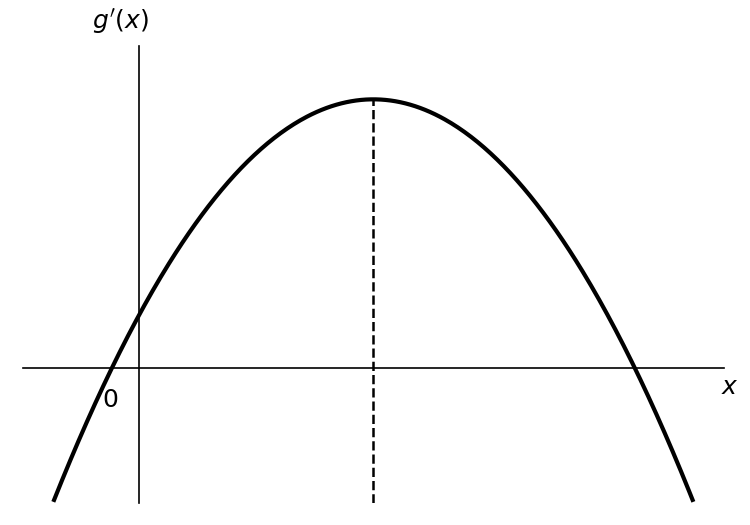
The graph of has an axis of symmetry .
(a) Find the value of .
(b) The vertex of the graph of has a y-coordinate of 10. Find the value of .
(c) Find the equation of the tangent to the graph of at .
The graph of has a point of inflexion at .
(d) (i) Find the value of .
(ii) Find the values of for which the graph of is concave-up. Justify your answer.
The axis of symmetry of a parabola is given by the formula . Alternatively, the vertex (and thus the axis of symmetry) occurs where the derivative of the function is zero.
The vertex lies on the axis of symmetry. Use the value of you found in part (a) as the x-coordinate of the vertex, and the given y-coordinate, to form an equation and solve for .
To find the equation of a tangent line, you need a point on the line and the gradient of the line. The point is found by evaluating . The gradient is found by evaluating the derivative of at .
A point of inflexion on the graph of occurs where the second derivative, , is equal to zero.
The graph of is concave-up when its second derivative, , is positive. Set up and solve the inequality .
Question 5
HardPaper 1 · no calculator19 marksA ladder must be placed against a tall vertical building, clearing a monument that is 8 m high and stands on horizontal ground 1 m away from the building's base. The ladder touches the ground, the top corner of the monument, and the wall of the building.
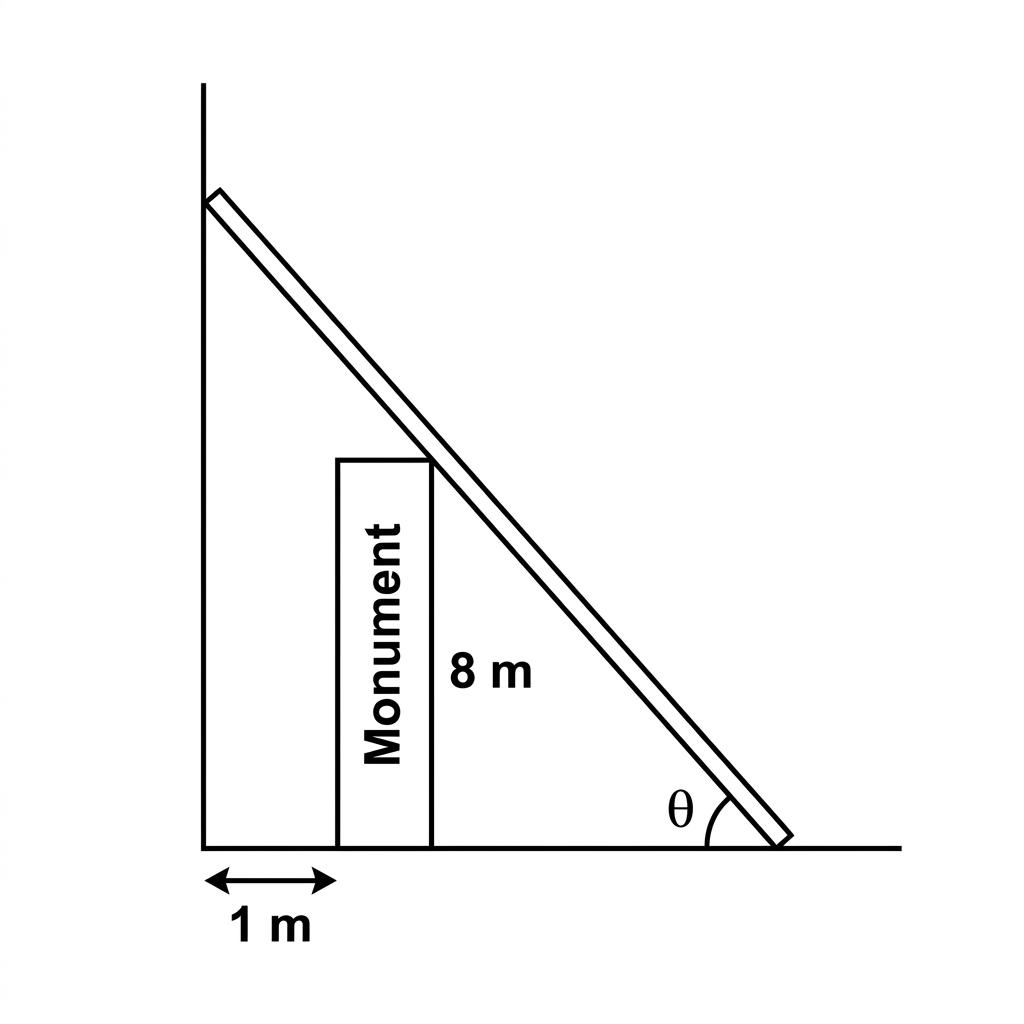
Let be the length of the ladder in metres.
Let be the angle that the ladder makes with the ground, where .
(a) Show that .
(b) (i) Find .
(b) (ii) When , show that .
(c) (i) Find .
(c) (ii) When , find the value of .
(d) (i) Hence, justify that is a minimum when .
(d) (ii) Determine this minimum value of .
(e) A construction company only has ladders with a maximum length of 11 m. Determine whether it is possible to position a ladder against the building over the monument, giving a reason for your answer.
Use trigonometry on the two right-angled triangles formed by the ladder, the ground, the monument, and the wall. Express the two segments of the ladder, divided by the monument's corner, in terms of .
Differentiate the expression for with respect to . You will need to know the derivatives of and .
Set your expression from part (b)(i) equal to zero. Rewrite all trigonometric functions in terms of and and then simplify the equation to find an expression for .
Differentiate your expression for from part (b)(i). You will need to use the product rule for both terms.
If , you can construct a right-angled triangle with opposite side 2 and adjacent side 1. Use this to find the values of , , and any other required trigonometric ratios, then substitute them into your expression for the second derivative.
Use the second derivative test. What does the sign of the second derivative at a stationary point tell you about the nature of that point?
Substitute the trigonometric values corresponding to back into the original expression for from part (a).
Compare the maximum available ladder length (11 m) with the minimum required length you calculated in part (d)(ii). To compare and without a calculator, you can compare their squares.
Question 6
MediumPaper 1 · no calculator15 marksA function is defined by , for .
The following diagram shows part of the graph of .
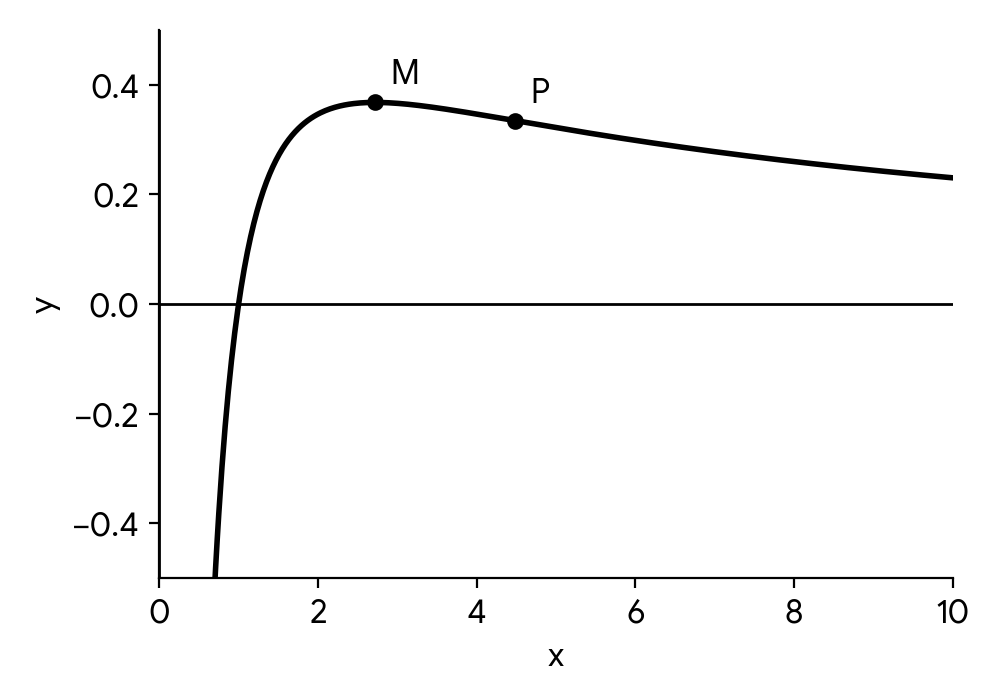
(a) Find the coordinates of the x-intercept of the graph of .
(b) Find .
The graph of has a local maximum at point M.
(c) Hence, find the exact coordinates of M.
(d) (i) Show that .
The graph of has a point of inflection at point P.
(d) (ii) Hence, find the exact coordinates of P.
The x-intercept is the point where the graph crosses the x-axis. At this point, the y-coordinate is zero. Set and solve for .
To differentiate a function that is a fraction of two other functions, you should use the quotient rule: .
A local maximum occurs at a stationary point, where the first derivative is equal to zero. Set your expression for from part (b) to zero and solve for . Then, substitute this -value back into the original function to find the corresponding -coordinate.
You need to find the second derivative, , by differentiating . You will need to use the quotient rule again.
A point of inflection occurs where the second derivative changes sign. This can happen where . Set the expression for to zero and solve for . Then find the corresponding -coordinate.
Question 7
HardPaper 1 · no calculator14 marksA rectangle is inscribed in an ellipse with equation . The sides of the rectangle are parallel to the coordinate axes. The vertices of the rectangle are located at , where and .
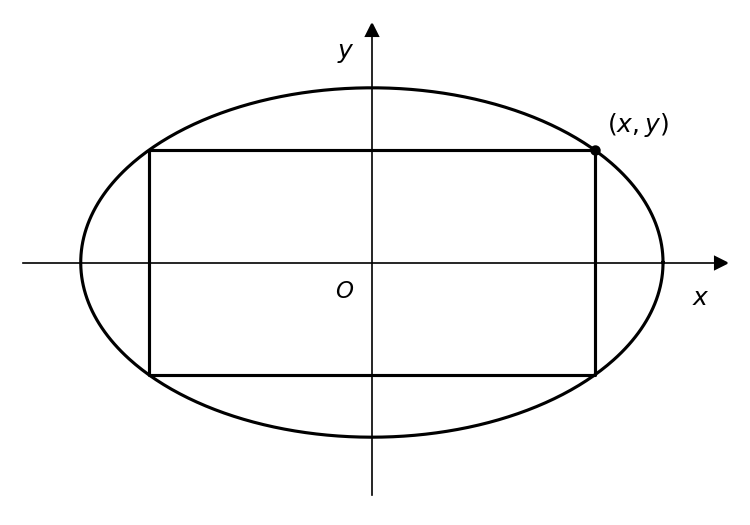
(a) Show that the area of the rectangle, , can be expressed as .
(b) Show that .
(c) Hence, find the exact dimensions of the rectangle with the maximum possible area.
The area of the rectangle is given by its width times its height. Express the width and height in terms of and . Then, use the equation of the ellipse to express in terms of and substitute this into your area formula.
You will need to use the product rule, , and the chain rule to differentiate the expression for the area with respect to .
To find the maximum area, you need to find the value of for which the derivative of the area is zero. Set the expression for from part (b) equal to zero and solve for . Then use this value of to find the corresponding value of and the dimensions of the rectangle.
Question 8
MediumPaper 1 · no calculator5 marksConsider the function , where .
The graph of has a local minimum point at where .
Find the value of and the value of .
To find the coordinates of a local minimum, you first need to find the derivative of the function. Then, set the derivative equal to zero to find the x-coordinates of the stationary points. Use the condition given in the question to select the correct x-coordinate.
Question 9
HardPaper 1 · no calculator15 marksA drone takes off from a platform. Its height, metres, above the platform after seconds is given by , for . This is shown in the following diagram.
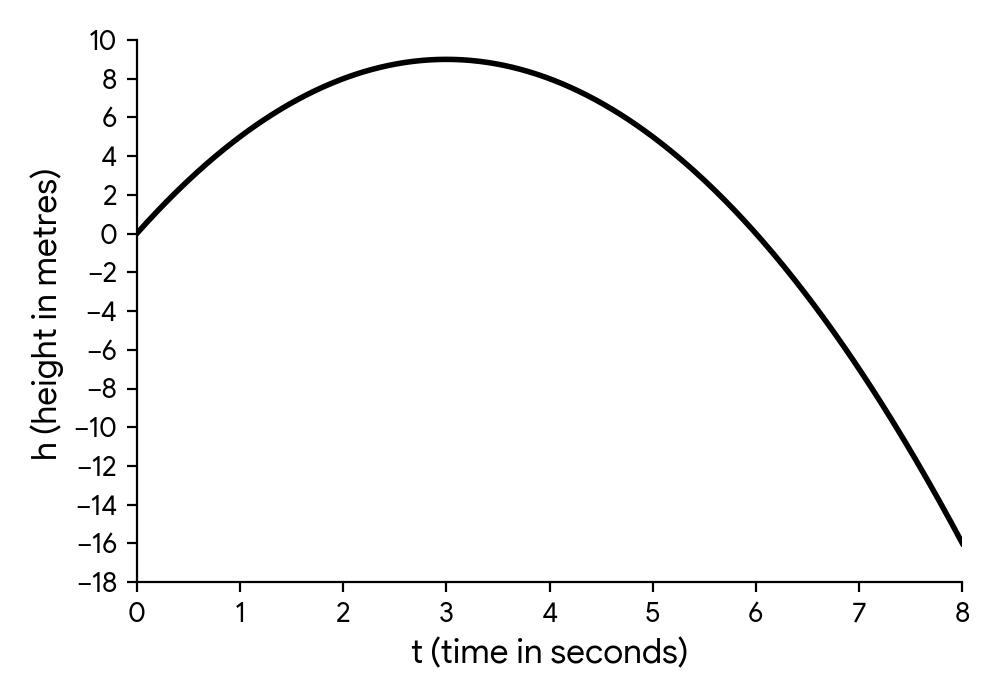
The drone lands back on the platform when .
Find the value of .
The drone reaches its maximum height when .
Find the value of .
Find the drone's maximum height above the platform.
Find the drone's vertical distance from the platform when .
The total vertical distance travelled by the drone in the first 8 seconds is given by .
Find the value of .
A second drone, Drone B, takes off from the same platform. Its velocity is given by , for .
When , the total vertical distance travelled by Drone B is equal to .
Find the value of .
The drone is on the platform when its height is zero. Set the height function equal to zero and solve for time .
The maximum height is reached when the drone's vertical velocity is zero. Find the derivative of the height function, which represents velocity, and set it to zero.
You found the time to reach maximum height in the previous part. Substitute this time back into the original height function.
Substitute into the height function. Remember that distance must be a positive value.
Total distance is not the same as displacement. The drone goes up and then comes down. You need to calculate the distance travelled on the way up and the distance travelled on the way down separately and add them together. The turning point you found in part (b) is crucial here.
First, find the total distance travelled by Drone B as a function of time . This will involve an integral of the absolute value of its velocity. You'll need to find when Drone B changes direction. Then, set this total distance equal to the value of you found in part (d) and solve for .
Question 10
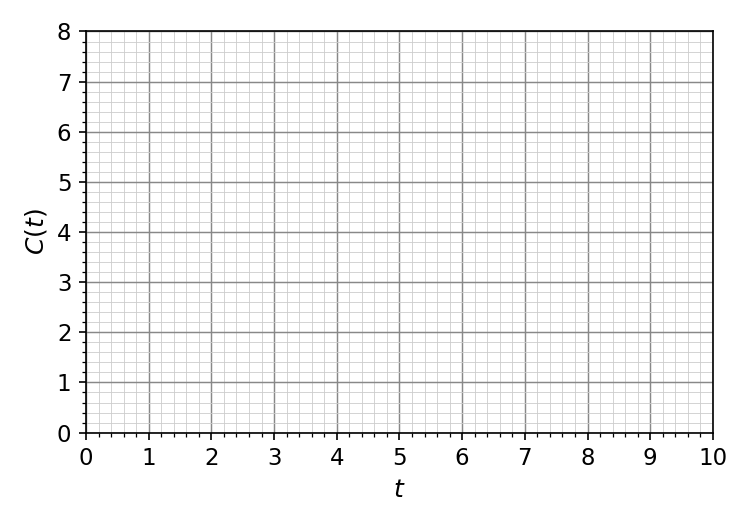
MediumPaper 2 · calculator5 marksA pharmaceutical company is testing a new drug. The concentration of the drug in a patient's bloodstream, , in mg/L, hours after administration, is modeled by the function , for .
Sketch the graph of on the grid below.
(b) Find the time, in hours, at which the concentration of the drug in the bloodstream is at its maximum.
Use your GDC to plot the function. Pay attention to the domain, the general shape of the curve, the coordinates of the local maximum, and the values at the endpoints.
The maximum concentration occurs when the rate of change of concentration with respect to time is zero. This means finding the value of for which . Use your GDC's maximum finding feature or solve .
Question 11
HardPaper 1 · no calculator17 marksA hollow pipe is manufactured by removing a smaller cylinder of radius from the centre of a larger cylinder of radius . Both cylinders have the same height, . This is shown in the following diagram.
All lengths are measured in centimetres.
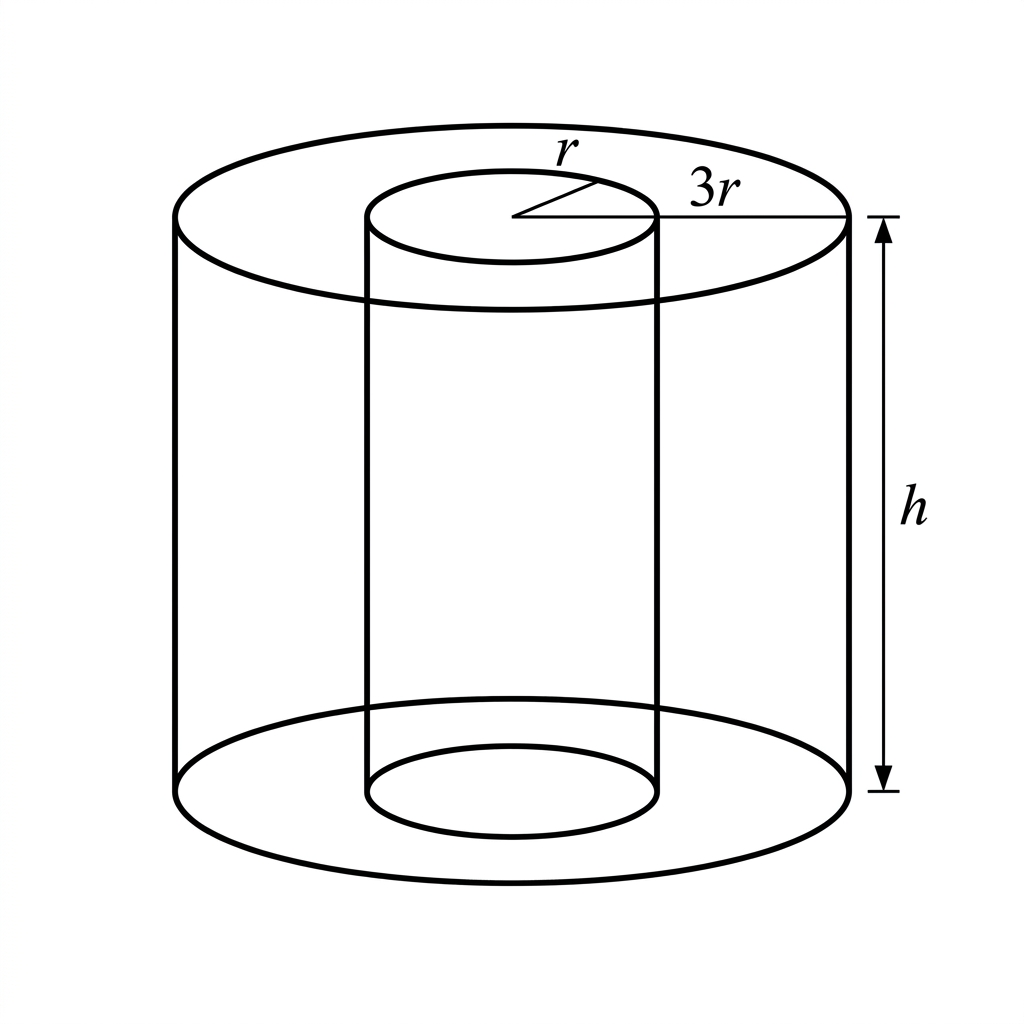
The total surface area of the hollow pipe, in cm, is given by .
(a) Show that .
The total surface area of the hollow pipe is .
(b) Show that the volume of the pipe, , is given by .
(c) Find an expression for .
(d) The hollow pipe has its maximum volume when , where . Find the value of .
(e) Hence, find this maximum volume, giving your answer in the form , where .
The total surface area is the sum of the areas of the top and bottom rings, the outer curved surface, and the inner curved surface.
First, use the given surface area to write an equation for in terms of . Then, write the formula for the volume of the pipe and substitute your expression for .
Use the power rule for differentiation on the expression for from part (b).
The volume is at a maximum when its derivative with respect to the radius is equal to zero. Set up and solve this equation.
Substitute the value of you found in part (d) into the volume formula from part (b). Be careful when simplifying the surds.
Question 12
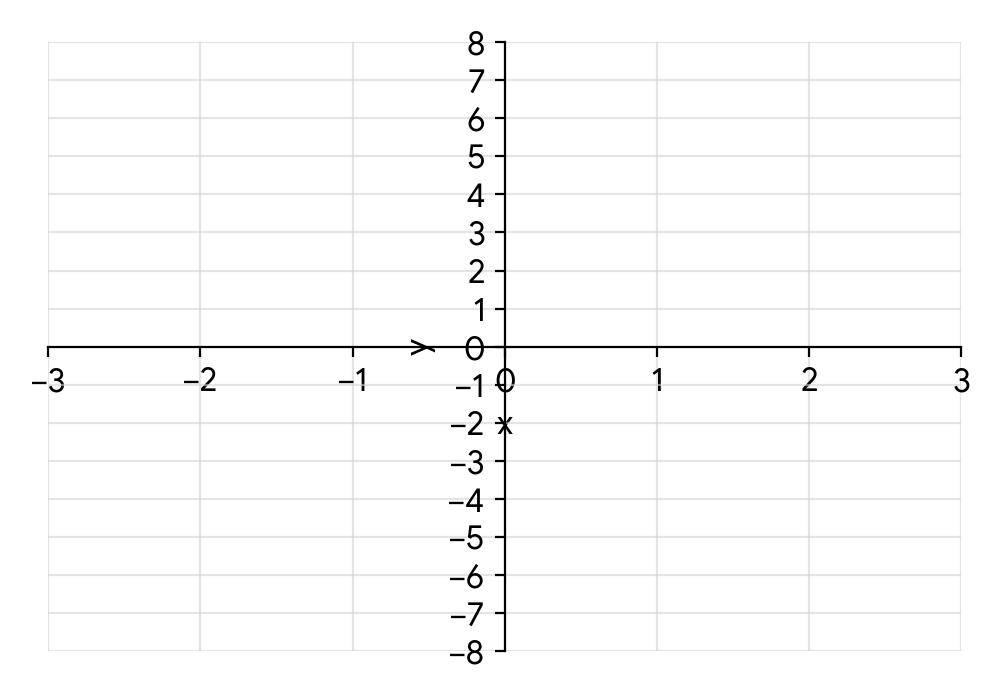
MediumPaper 2 · calculator5 marksConsider the function .
On the following axes, sketch the graph of for .
The function is defined by .
The graph of is obtained from the graph of (from part a) by a horizontal stretch with scale factor , followed by a vertical translation of units.
Find the value of and the value of .
To sketch the graph accurately, identify key features such as x-intercepts (roots), the y-intercept, local minimum or maximum points, and the function's values at the endpoints of the given domain. You may need to use a GDC to find the roots and the exact coordinates of the local minimum.
Consider how the input changes to for a horizontal stretch and how a constant is added or subtracted for a vertical translation. Compare the form of to .
Question 13
HardPaper 1 · no calculator16 marksA particle moves in a straight line. Its velocity, , at time seconds is given by , for . The particle is at the origin at .
The graph of is shown in the following diagram.
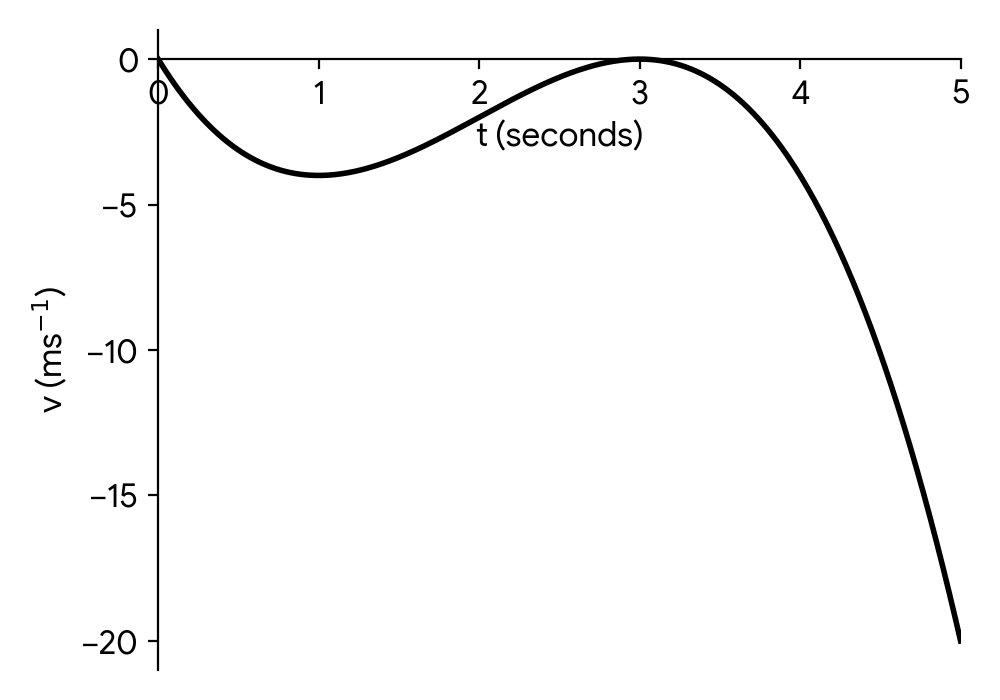
(a) Find the displacement of the particle from the origin at .
(b) Find an expression for the acceleration of the particle.
(c) The particle is momentarily at rest at and again at . Find the greatest speed of the particle in the interval .
(d) Find the greatest speed of the particle for .
(e) Write down an expression that represents the distance travelled by the particle while its speed is increasing. Do not evaluate the expression.
Displacement is the definite integral of the velocity function. Remember to use the initial condition that the particle starts at the origin to find the constant of integration.
Acceleration is the first derivative of the velocity function with respect to time.
First, find the value of by setting the velocity to zero. Then, to find the greatest speed, you need to find the maximum of the absolute value of velocity, , in the interval . This can occur at the endpoints or where the acceleration is zero.
You have already found the greatest speed up to . Now you just need to check the speed at the new endpoint, , and compare.
The speed of the particle is increasing when its velocity and acceleration have the same sign. Determine the sign of and over the domain to find the required time intervals. The distance travelled is the integral of the speed, , over these intervals.
Question 14
MediumPaper 2 · calculator14 marksAn engineer is designing an open-top rectangular container with a square base. The container must have a volume of .
Let the side length of the square base be metres and the height of the container be metres.
Show that the total surface area, , of the material used for the container is given by .
Find an expression for .
Hence, find the exact value of for which the surface area is a local minimum or maximum.
Find an expression for .
Use the second derivative of to justify that is a minimum when .
Find the minimum surface area of the container.
Start by writing down the formula for the volume of the container in terms of and . Then, express the surface area in terms of and . Use the volume constraint to eliminate from the surface area formula.
Remember the power rule for differentiation: . Rewrite as before differentiating.
A local minimum or maximum occurs when the first derivative is equal to zero. Set your expression for to zero and solve for .
Differentiate your expression for with respect to . Remember that can be written as .
Substitute the value of found in part (b.ii) into the second derivative. If the result is positive, it indicates a local minimum. If it's negative, it's a local maximum.
Substitute the value of that gives the minimum surface area (found in part (b.ii) ) back into the original surface area formula, .
Question 15
HardPaper 2 · calculator20 marksA civil engineer is analyzing the structural integrity of a new bridge design. The deflection of a certain point on the bridge, , in millimeters, is modeled by the function , where represents the horizontal distance in meters from a central support. The model is valid for , , .
Find the value of and the value of .
Find an expression for .
The graph of has exactly one point of inflexion.
Find the x-coordinate of the point of inflexion.
Sketch the graph of for , showing the values of any axes intercepts, the coordinates of any local maxima and local minima (if they exist), and giving the equations of any asymptotes.
Consider a related model for stress distribution, for , .
Find the equations of all the asymptotes on the graph of .
The engineer needs to identify the regions where the bridge deflection is less than mm. Solve for .
The function is undefined when the denominator is zero. Set the denominator equal to zero and solve for x.
Use the quotient rule for differentiation: If , then .
A point of inflexion occurs where the second derivative, , is zero or undefined, and the concavity changes. You may need to use a GDC to find the root of .
Identify vertical and horizontal asymptotes, x and y-intercepts. Determine if there are any local maxima or minima by analyzing the first derivative. Plot key points and sketch the curve's behavior around asymptotes.
For vertical asymptotes, set the denominator to zero. For oblique asymptotes, perform polynomial long division to express in the form .
Rearrange the inequality to have zero on one side. Find the critical values by setting the numerator and denominator to zero. Use a sign table or graph to determine the intervals where the inequality holds.
Question 16
MediumPaper 2 · calculator14 marksA packaging company is designing a new cylindrical can. The can must have a fixed volume of cm. The company wants to minimize the amount of material used, which corresponds to minimizing the total surface area of the can.
Let the radius of the can be cm and its height be cm.
Show that the total surface area, cm, of the can is given by .
The total surface area of the can has a local minimum value when .
(i) Find an expression for .
(ii) Hence, find the exact value of .
(i) Find an expression for .
(ii) Use the second derivative of to justify that is a minimum when .
(iii) Find the minimum surface area of the can.
Start by writing down the formula for the volume of a cylinder and the total surface area of a closed cylinder. Use the given volume to express the height in terms of the radius, then substitute this into the surface area formula.
Remember the power rule for differentiation: . Rewrite as before differentiating.
To find the minimum value, set the first derivative equal to zero and solve for .
Differentiate your expression for with respect to .
Evaluate the second derivative at the critical point . If the value is positive, it indicates a local minimum.
Substitute the value of (the radius that minimizes the surface area) back into the original surface area formula .
Question 17
HardPaper 2 · calculator20 marksTwo drones, Drone X and Drone Y, have position vectors with respect to an origin O given respectively by
where represents the time in minutes and .
Entries in each column vector give the displacement east of O, the displacement north of O and the distance above sea level, all measured in kilometres.
(a) Find the three-figure bearing on which Drone Y is travelling.
(b) Show that Drone X travels at a greater speed than Drone Y.
(c) Find the acute angle between the two drones' lines of flight. Give your answer in degrees.
The two drones' lines of flight cross at point P.
(d) (i) Find the coordinates of P.
(ii) Determine the length of time between the first drone arriving at P and the second drone arriving at P.
(e) Let represent the distance between Drone X and Drone Y for .
Find the minimum value of .
The bearing is determined by the horizontal components (East and North) of the direction vector. Remember bearings are measured clockwise from North.
The speed of a drone is the magnitude of its direction vector.
Use the dot product formula for the angle between two vectors: . Remember to find the acute angle.
Set the two vector equations equal to each other, using different time parameters for each drone (e.g., and ). Solve the resulting system of equations.
The time values you found in part (d)(i) represent when each drone arrives at P. Find the difference between these times.
First, find the vector representing the displacement between the two drones, . Then, find the magnitude of this vector, . To minimize , it's often easier to minimize . Use calculus (derivative) to find the minimum.
Question 18
MediumPaper 2 · calculator9 marksA landscape architect is designing a triangular shade sail for a patio. The vertices of the sail are defined by points A, B, and C in a 3D coordinate system, where the z-axis represents height.
The coordinates of the vertices are A, B and C, where is a positive constant representing a design parameter.
(a) Show that the vector product is given by .
(b) The architect wants to minimize the tension in the sail, which is proportional to the magnitude of the vector product of two adjacent sides. Find the smallest possible value of .
(c) Calculate the smallest possible area of the shade sail.
First, find the displacement vectors and . Then, use the formula for the cross product of two vectors.
To find the minimum magnitude, consider the square of the magnitude, . This will result in a polynomial in . You can then use calculus (finding the derivative and setting it to zero) or a GDC to find the minimum value for .
The area of a triangle formed by two vectors is half the magnitude of their cross product.
Question 19
HardPaper 2 · calculator21 marksThe growth of a bacterial colony, , in a petri dish can be modelled by the logistic differential equation
where is the time measured in hours and are positive constants.
The constant represents the maximum number of bacteria the petri dish can sustain indefinitely due to limited nutrients.
In the context of this bacterial growth model, interpret the meaning of .
Show that .
Hence show that the bacterial colony will grow at its maximum rate when . Justify your answer.
Hence determine the maximum value of in terms of and .
Let be the initial number of bacteria.
By solving the logistic differential equation, show that its solution can be expressed in the form
.
After 5 hours, the number of bacteria is . It is known that .
Find the value of for this bacterial growth model.
Consider what a derivative represents in a physical context, especially when it's a quantity with respect to time.
You will need to differentiate with respect to . Remember that is a function of , so implicit differentiation or the chain rule will be necessary. Consider expanding the expression for first, or using the product rule.
To find the maximum rate of growth, you need to find the maximum of . This involves setting the second derivative, , to zero. Remember to justify that it is indeed a maximum.
Substitute the value of at which the growth rate is maximum into the original differential equation.
This is a separable differential equation. Separate the variables and use partial fractions to integrate the term involving . Remember to apply the initial condition ( when ) to find the constant of integration.
Substitute the given values for , , and into the solution obtained in part (e) and solve for . Remember will cancel out.
Question 20
MediumPaper 2 · calculator17 marksA toy rocket is launched vertically upwards from a platform. Its height, metres above the ground, seconds after launch, is modelled by the function .
Find the initial height of the platform from which the rocket is launched.
Find the maximum height reached by the rocket.
Calculate the time it takes for the rocket to hit the ground.
Write down the domain of the function in the context of this real-life scenario.
Determine the length of time for which the height of the rocket is greater than .
The initial height corresponds to the time seconds.
The maximum height of a quadratic function occurs at the vertex. You can find the time at the vertex using or by setting the derivative .
The rocket hits the ground when its height is 0. You will need to solve a quadratic equation.
Consider when the rocket is launched and when it hits the ground.
Set up an inequality and solve for . You will need to find the times when .
No question on this page matches those filters. Try another difficulty or paper.
45 more Second derivative, points of inflection, testing max / min points, optimisation questions in the app
Every answer is marked mark by mark, IB-style, and the AI tutor helps when you are stuck.
Where marks are lost
- Using your own wrong value after failing a "show that".