Straight line (gradient-int, general, point gradient form): notes and practice questions
- A straight line can be expressed in different forms:
- Gradient-Intercept Form:
where is the gradient (slope) and is the y-intercept.
- General Form:
- Point-Gradient Form:
where is the gradient, and is a point on the line.
- Key Concepts:
- Gradient between two points and :
- Parallel lines have the same gradient.
- Perpendicular lines satisfy .
How it is examined
Rarely a question on its own past the first item of Paper 1 section A. It turns up inside calculus questions as "find the equation of the normal", where the perpendicular rule is the marking point. `Find`, `Write down`. 2 to 4 marks.
The three forms and the gradient formula are in the prior learning section of the booklet.
- Different forms of the equation of a straight line.
- Gradient; intercepts.
- Lines with gradients and .
- Parallel lines .
Linking questions
- Links to other subjects: exchange rates, price elasticity, demand and supply curves (economics); graphical analysis in experimental work (sciences).
Practice questions
35 questions · 5 easy · 23 medium · 7 hardQuestion 1
EasyPaper 1 · no calculator5 marksIf a line L passes through point A(5,15) and is parallel to BC such that their coordinates are B(-2,1) and C (10,13).
(a) Find the equation of line L.
If line L passes through a point (c,-5)
(b) Find the value of c.
Use the slope formula between two points given their coordinates,
A point passing through a line will satisfy its equation
Question 2
MediumPaper 1 · no calculator8 marksA kite PQRS is shown on the following set of axes.
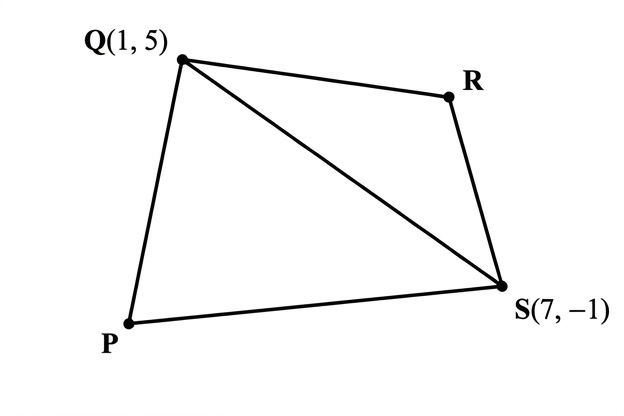
The kite has vertices Q(1, 5) and S(7, -1) and is symmetrical about the diagonal [PR].
(i) Write down the coordinates of the midpoint of [QS].
(ii) Hence, find the equation of the line containing the diagonal [PR].
(b) Given that vertex P lies on the y-axis and the x-coordinate of R is 6, find the area of the kite PQRS.
Recall the midpoint formula, which finds the average of the x-coordinates and the average of the y-coordinates.
The diagonal of symmetry in a kite is the perpendicular bisector of the other diagonal. You will need to find the gradient of [QS] and then use the property of perpendicular lines.
First, determine the coordinates of vertices P and R using the given information and the equation you found in part (a)(ii). Then, calculate the lengths of the two diagonals, [PR] and [QS], and use the formula for the area of a kite.
Question 3
HardPaper 2 · calculator16 marksConsider the function f defined by for .
The graph of f and the line intersect at point P.
Find the x-coordinate of P.
The line L has a gradient of -2 and is a tangent to the graph of f at the point Q.
Find the exact coordinates of Q.
Show that the equation of L is .
The shaded region A is enclosed by the graph of f and the lines and L.
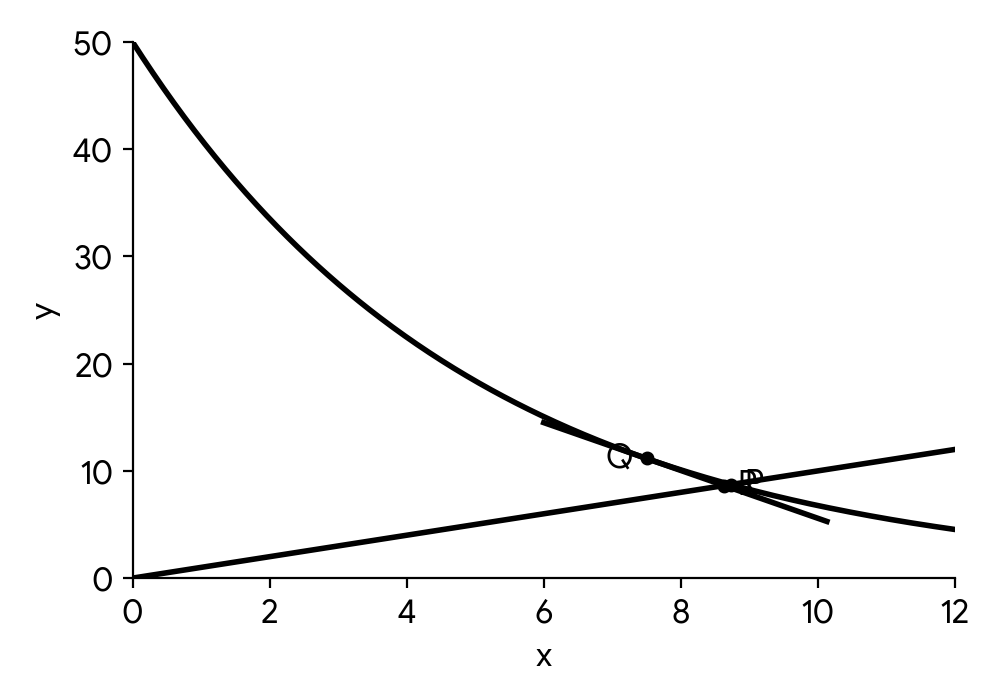
Find the x-coordinate of the point where L intersects the line .
Hence, find the area of A.
The line L is tangent to the graphs of both f and the inverse function .
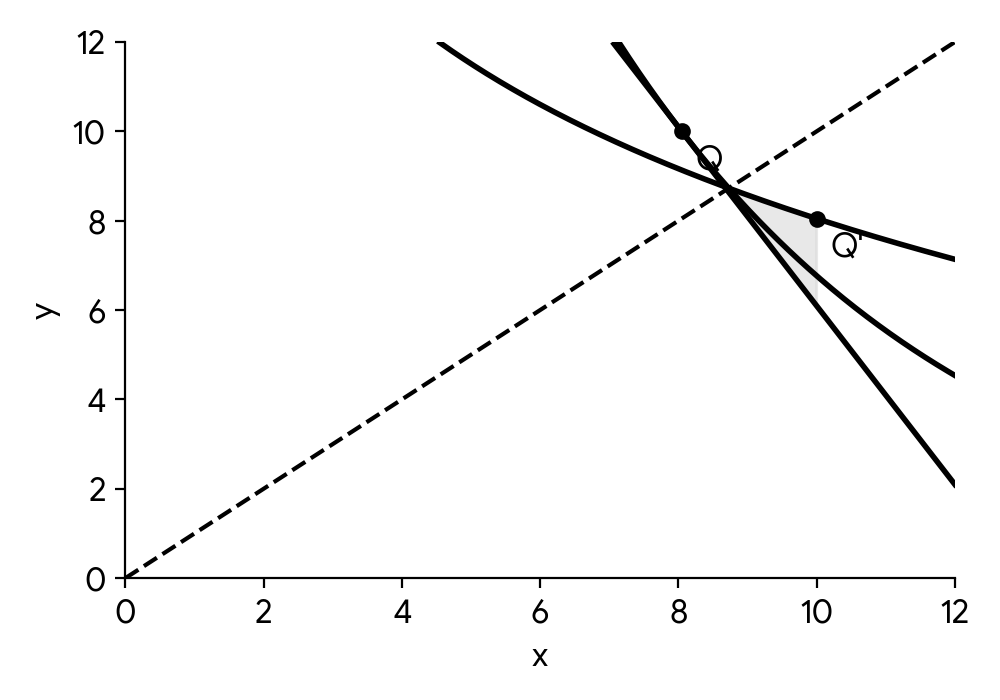
Find the shaded area enclosed by the graphs of f and and the line L.
To find the x-coordinate of P, you need to solve the equation . This is a transcendental equation, so a GDC will be useful to find the numerical solution.
First, find the derivative of . Then, set the derivative equal to the given gradient to find the x-coordinate of Q. Substitute this x-value back into to find the y-coordinate. Remember to provide exact values.
Use the point-gradient form of a line: , with the coordinates of Q and the gradient of L.
Set the equation of line L equal to and solve for x.
The area can be found by splitting it into two integrals. Identify the upper and lower bounding functions and the correct limits of integration based on the intersection points found in previous parts.
The graphs of a function and its inverse are symmetric about the line . How does this relate to the area calculated in part (d.ii)?
Question 4
EasyPaper 2 · calculator3 marksThe line passes through the points and .
(a) Find the equation of , giving your answer in the form , where .
Use the coordinates of A and B to find the gradient, then use the point-slope form.
Question 5
MediumPaper 1 · no calculator5 marksThe points P(1, 8), Q(–5, –2) and R(7, 4) are the vertices of a triangle.
(a) Find the equation of the altitude from vertex P to the side [QR].
(b) The altitude found in part (a) intersects the x-axis at the point D. Find the coordinates of D.
The altitude from a vertex is perpendicular to the opposite side. First, find the gradient of the line segment [QR]. Then, use the property of perpendicular lines to find the gradient of the altitude. Finally, use the point-gradient form with the coordinates of P.
A point on the x-axis has a y-coordinate of 0. Substitute this value into the equation of the altitude you found in part (a).
Question 6
HardPaper 1 · no calculator13 marksA function is defined by .
(a) Find the equation of the tangent to the graph of at the point where .
(b) The tangent line found in part (a) intersects the graph of at a second point, P. Find the coordinates of P.
(c) Find the exact area of the finite region enclosed by the graph of and the tangent line.
To find the equation of a tangent line, you need a point on the line and its gradient. The gradient can be found by differentiating the function and evaluating it at the given x-value.
The points of intersection are found by setting the equation of the curve equal to the equation of the tangent line. You already know one solution to this equation, which corresponds to the point of tangency.
The area between two curves, and , from to is given by the integral . The limits of integration are the x-coordinates of the intersection points.
Question 7
EasyPaper 1 · no calculator5 marksA map is drawn on a Cartesian plane. A straight road connects two towns, Ashton, located at A(1, 7), and Brixton, located at B(9, -1).
(a) A service station is planned to be built at the midpoint of the road connecting the two towns. Find the coordinates of the service station.
A new road, represented by the line , is to be built perpendicular to the road [AB]. This new road will pass through the service station.
(b) Find the gradient of the line .
(c) Hence, write down the equation of the line .
Recall the midpoint formula: the coordinates of the midpoint are the average of the x-coordinates and the average of the y-coordinates of the endpoints.
First, find the gradient of the line segment [AB]. Then, use the relationship between the gradients of perpendicular lines () to find the gradient of .
You have the gradient of line and a point it passes through (the service station). Use the point-slope form .
Question 8
MediumPaper 1 · no calculator8 marksThe functions and are defined for by
where and are constants.
The vertex of the graph of and the vertex of the graph of both lie on the line with equation .
(a) Show that .
(b) Given that , find the value of .
First, find the coordinates of the vertex of the parabola . The x-coordinate can be found using the formula . Then, use the fact that this vertex must satisfy the equation of the given line.
Follow a similar process as in part (a), but for the function . The coordinates of the vertex will be in terms of . Substitute these into the line equation to form an equation in terms of . You should get a quadratic equation to solve.
Question 9
HardPaper 2 · calculator19 marksA pharmaceutical company is testing a new drug. The concentration of the drug, , in the bloodstream of a patient, in micrograms per millilitre (), hours after administration, is modelled by the function , for .
Sketch the graph of for , clearly indicating the coordinates of the initial concentration point , the maximum concentration point , and the concentration point at hours.
State the range of the concentration during the observed period.
Find the equation of the straight line connecting the initial concentration point and the concentration point at hours.
Show that the rate of change of the drug concentration is given by .
At a certain time, the rate of change of the drug concentration is parallel to the line AB. Find the equation of the tangent line to the graph of at this time. Give all coefficients in your equation correct to significant figures.
Calculate the area of the region enclosed by the graph of and the line AB.
To sketch the graph, first find the coordinates of the end-points of the interval and any local maximum or minimum points within the interval. For the maximum point, find the derivative of and set it to zero.
The range is determined by the minimum and maximum values of the function over the given interval. Refer to your calculated points from part (a).
Use the coordinates of points and to find the gradient of the line. Then use the point-slope form to write the equation of the line.
Use the product rule for differentiation: if , then .
If the tangent is parallel to line AB, their gradients must be equal. Set equal to the gradient of line AB found in part (c) and solve for . Then find the corresponding value to get the point of tangency.
The area enclosed by two curves and over an interval is given by . Determine which function is above the other and then perform the definite integration. You will need to use integration by parts for the term .
Question 10
EasyPaper 1 · no calculator9 marksA landscape architect is designing a garden on a coordinate grid. Key points in the design are located at P(–3, 5), Q(1, 7), and S(0, -2).
(a) A straight path connects points P and Q. Find the equation of this path.
(b) A second path is to be laid parallel to the path PQ, passing through point S. Find the equation of the line for this second path.
(c) A third path is perpendicular to the path PQ and passes through point Q. Find the equation of this third path.
(d) A straight decorative fence is to be placed horizontally, passing through point P. Write down the equation of the line representing the fence.
First, find the gradient of the line connecting the two points. Then use the point-slope form of a linear equation, .
Parallel lines have the same gradient. The given point S is the y-intercept, which simplifies finding the equation in the form .
The gradient of a perpendicular line is the negative reciprocal of the original line's gradient (i.e., ). Use this new gradient and the coordinates of point Q to find the equation.
A horizontal line has a gradient of zero. What does this imply about its equation and its relationship to the y-coordinates of the points it passes through?
Question 11
MediumPaper 2 · calculator12 marksThe trajectory of a small drone flying over a landscape can be modelled by the function , where is the horizontal distance in meters from the launch point and is the altitude in meters. The drone passes through a checkpoint A at a horizontal distance of 2 meters.
(a) (i) Find the gradient of the tangent to the drone's trajectory at checkpoint A.
(a) (ii) Hence, write down the gradient of the normal to the drone's trajectory at checkpoint A.
(b) Write down the equation of the normal to the drone's trajectory at checkpoint A.
(c) A searchlight beam is directed along the normal line found in part (b). This beam intersects the drone's trajectory again at a second point B. Find the coordinates of B.
To find the gradient of the tangent, you need to calculate the derivative of the function, , and then evaluate it at the given x-coordinate of point A.
The product of the gradients of a tangent and its normal at the same point is -1.
You have the gradient of the normal from part (a.ii) and the coordinates of point A. Use the point-slope form: . Remember to find the y-coordinate of A first.
To find the intersection points, set the equation of the drone's trajectory equal to the equation of the normal line. This will result in a quadratic equation. One solution will be the x-coordinate of point A; the other will be the x-coordinate of point B.
Question 12
HardPaper 1 · no calculator17 marksThe function is defined by , for .
(a) Show that the curve has only one point of inflection in its domain, and determine its coordinates.
(b) Find the equations of the tangent and the normal to the curve at the point where .
(c) Calculate the area of the triangle formed by this tangent, this normal, and the -axis.
To find a point of inflection, you need to analyze the second derivative of the function, . Find where and check if the concavity changes at that point.
The equation of a line is . For the tangent, the gradient is the value of the first derivative at the given point. The normal is perpendicular to the tangent.
The three lines form a triangle. Find the coordinates of the three vertices of this triangle. Two of the vertices will be the y-intercepts of the tangent and normal. The third vertex is where the tangent and normal intersect.
Question 13
EasyPaper 1 · no calculator3 marksA biologist is studying the relationship between the concentration of a nutrient, (in mg/L), and the weekly growth rate of a particular plant, (in cm/week). The relationship is found to be linear. The regression line of on passes through the mean point and has a gradient of .
Estimate the weekly growth rate of a plant when the nutrient concentration is mg/L.
The regression line is a straight line. First, find the equation of this line using the given point and gradient. Then, substitute the given concentration value into your equation.
Question 14
MediumPaper 2 · calculator8 marksA civil engineer is designing a parabolic arch for a pedestrian bridge. The shape of the arch can be modelled by the function , where is the horizontal distance in meters from one end of the bridge and is the height of the arch above the ground in meters.
A support cable needs to be attached to the arch at a point A where .
(i) Calculate the gradient of the tangent to the arch at point A.
(ii) Hence, write down the gradient of the line perpendicular to the tangent at point A.
The support cable is designed to be perpendicular to the arch at point A. Write down the equation of the line representing this support cable.
The support cable (represented by the normal line) is extended and intersects the parabolic arch again at a second point B. Find the coordinates of point B.
Recall that the gradient of the tangent to a curve at a point is given by the derivative of the function evaluated at that point.
The product of the gradients of two perpendicular lines is -1.
Use the point-gradient form of a straight line equation: . Remember point A is .
Set the equation of the arch equal to the equation of the normal line and solve for . You already know one solution for (from point A).
Question 15
HardPaper 3 · calculator26 marksAn architect is designing a decorative archway for a garden entrance. The shape of the archway's inner curve is modelled by the equation , where and are in meters.
(a.i) On the same set of axes, sketch the curve for , clearly indicating any points of intersection with the coordinate axes. Assume a suitable range for and that shows the key features.
(a.ii) On the same set of axes, sketch the curve for , clearly indicating any points of intersection with the coordinate axes. Assume a suitable range for and that shows the key features.
(a.iii) By considering each curve from part (a), identify two key features that would distinguish from .
(b.i) For the curve , show that for .
(b.ii) Find the -coordinates of any local maximum or minimum points on .
(c) The curve has points of inflexion. Find the -coordinate of these points, giving your answer in the form where .
Consider a different archway design modelled by the curve , for .
(d.i) The point P(-1, -1) is a rational point on . Find the equation of the tangent to at P.
(d.ii) This tangent intersects at another rational point Q. Find the coordinates of Q, expressing each coordinate as a fraction.
(e) The point S(-1, 1) also lies on . The line [QS] intersects at a further point R. Determine the coordinates of R.
For , consider the domain of and the symmetry about the -axis. Identify where the curve intersects the axes.
For , factor out to find the -intercepts. Consider the domain and the symmetry.
Compare the intercepts, domains, and types of points (e.g., cusps) on each curve.
Use implicit differentiation with respect to . Remember that differentiates to . Then substitute for .
Local extrema occur where . Consider the numerator of the derivative.
Points of inflexion occur where . Differentiate implicitly again. Remember to substitute to eliminate .
First, find using implicit differentiation. Then, substitute the coordinates of P to find the gradient of the tangent. Use the point-slope form of a line.
Substitute the equation of the tangent into the equation of the curve . You will get a cubic equation. Since P is a point of tangency, its -coordinate will be a repeated root.
First, find the equation of the line passing through Q and S. Then, substitute this equation into the curve 's equation. You will get a cubic equation, and you already know two roots (from Q and S).
Question 16
MediumPaper 2 · calculator10 marksA school is organizing a field trip to the local science museum. The cost to rent a bus for the day is .
Additionally, there is an entry fee of per student.
(a) Write down a formula connecting the total cost of the trip () with the number of students attending ().
(b) Explain why is a function.
(c) Derive an expression for in terms of .
The school has a maximum budget of for the field trip.
(d) Hence, calculate the greatest number of students that can attend the trip.
(e) Given that only students attend the trip, calculate how much each student should be charged so that the school covers its costs.
Identify the fixed cost and the variable cost per student. The total cost will be the sum of these two components.
Recall the definition of a function. What makes a relationship a function?
You need to rearrange the formula from part (a) to make 's' the subject.
Use the expression you derived in part (c) and substitute the maximum budget for 'T'. Remember that the number of students must be an integer.
First, calculate the total cost for 20 students using the formula from part (a). Then, divide the total cost by the number of students to find the charge per student.
Question 17
HardPaper 3 · calculator29 marksThis question asks you to examine linear and quadratic functions constructed in systematic ways using geometric sequences.
Consider the function for where and .
Let be the root of .
If and , in that order, are in geometric sequence, then is said to be a GS-linear function.
Show that is a GS-linear function.
Consider .
Show that .
Given that is a GS-linear function, show that .
State any further restrictions on the value of , assuming the common ratio .
There are only two integer values of (excluding ) for which is a GS-linear function with a common ratio . One of these gives .
Use part (b) to determine the other GS-linear function with integer values of and that satisfies the condition.
Consider the function for where and .
Let be the roots of .
Write down an expression for
(i) the sum of roots, , in terms of and .
(ii) the product of roots, , in terms of and .
If are in arithmetic sequence, AND are in geometric sequence, then is said to be a GS-Quadratic function.
Given that is a GS-Quadratic function, show that , where .
Hence or otherwise, show that or .
Consider the case where .
Determine the two GS-Quadratic functions that satisfy this condition, given that . Give your answers in the form .
Consider the case where .
Determine the two GS-Quadratic functions that satisfy this condition, given that .
First, find the root of the given linear function. Then, check if the sequence forms a geometric sequence by calculating the ratio between consecutive terms.
The root of a function is the value of for which . Set to zero and solve for in terms of and .
Use the definition of a geometric sequence () and the expression for the root from part (b)(i). Express in terms of .
Recall the relationship between and derived in part (b)(ii). Apply the given restriction on to find the restriction on .
From part (b)(ii), . For to be integers, must be an integer. Consider integer values for other than (from part b.iii).
Recall Vieta's formulas for the sum of roots of a quadratic equation.
Recall Vieta's formulas for the product of roots of a quadratic equation.
Use the definitions of arithmetic and geometric sequences. Express and in terms of , , and . Then substitute these into the arithmetic sequence condition for .
Consider the equation . What happens if ? What happens if ? Also, think about specific cases for the coefficients or roots that might simplify the equation.
If , then . Use the equation to find the possible values for . Then use and the expressions for and in terms of to find the quadratic functions.
If , then . Use the equation to find the possible values for . Then use the given values for and the expressions for and in terms of to find the quadratic functions.
Question 18
MediumPaper 2 · calculator20 marksA designer is creating a large decorative arch for a garden entrance. The arch has the shape of a parabola. Its base rests on the ground (the x-axis) and spans a width of . The maximum height of the arch is . The arch is symmetrical about the y-axis.
(a) Write down the coordinates of the points where the arch meets the ground and the highest point of the arch.
(b) Find the equation of the parabolic arch.
A designer is creating a large decorative arch for a garden entrance. The arch has the shape of a parabola. Its base rests on the ground (the x-axis) and spans a width of . The maximum height of the arch is . The arch is symmetrical about the y-axis. A rectangular banner is placed underneath the arch with its base on the ground. Let one of the vertices of the banner in the first quadrant be .
(c) Express the width and height of the rectangular banner in terms of .
A designer is creating a large decorative arch for a garden entrance. The arch has the shape of a parabola. Its base rests on the ground (the x-axis) and spans a width of . The maximum height of the arch is . The arch is symmetrical about the y-axis. A rectangular banner is placed underneath the arch with its base on the ground. Let one of the vertices of the banner in the first quadrant be .
(d) Write down an expression for the area of the rectangular banner, , in terms of .
A designer is creating a large decorative arch for a garden entrance. The arch has the shape of a parabola. Its base rests on the ground (the x-axis) and spans a width of . The maximum height of the arch is . The arch is symmetrical about the y-axis. A rectangular banner is placed underneath the arch with its base on the ground. Let one of the vertices of the banner in the first quadrant be .
(e) Find the value of for which the area of the banner is maximized.
A designer is creating a large decorative arch for a garden entrance. The arch has the shape of a parabola. Its base rests on the ground (the x-axis) and spans a width of . The maximum height of the arch is . The arch is symmetrical about the y-axis. A rectangular banner is placed underneath the arch with its base on the ground. Let one of the vertices of the banner in the first quadrant be .
(f) Calculate the dimensions (width and height) of the banner that yield the maximum area.
A designer is creating a large decorative arch for a garden entrance. The arch has the shape of a parabola. Its base rests on the ground (the x-axis) and spans a width of . The maximum height of the arch is . The arch is symmetrical about the y-axis. A rectangular banner is placed underneath the arch with its base on the ground. Let one of the vertices of the banner in the first quadrant be .
(g) Find the maximum possible area of the inscribed rectangular banner.
Consider the symmetry of the parabolic arch about the y-axis and that its base is on the x-axis. The total width is 10 m, so half of that distance from the y-axis gives the x-coordinates of the base points.
The general equation for a parabola with x-intercepts at and is . Use the coordinates of the base points and the apex to find the constant .
Since the banner's base is on the x-axis and one vertex is at in the first quadrant, consider the symmetry to find the full width. The height will be determined by the parabola's equation at that x-value.
The area of a rectangle is its width multiplied by its height. Use your expressions from part (c).
To find the maximum area, differentiate the area function with respect to , set the derivative to zero, and solve for . Remember to verify that this value corresponds to a maximum.
Substitute the optimal value of found in part (e) into the expressions for width and height from part (c).
Multiply the width and height found in part (f), or substitute the optimal into the area function from part (d).
Question 19
HardPaper 1 · no calculator15 marksThe following diagram shows part of the graph of a quadratic function representing the path of a thrown ball.
The graph of has its vertex at and it passes through point as shown.
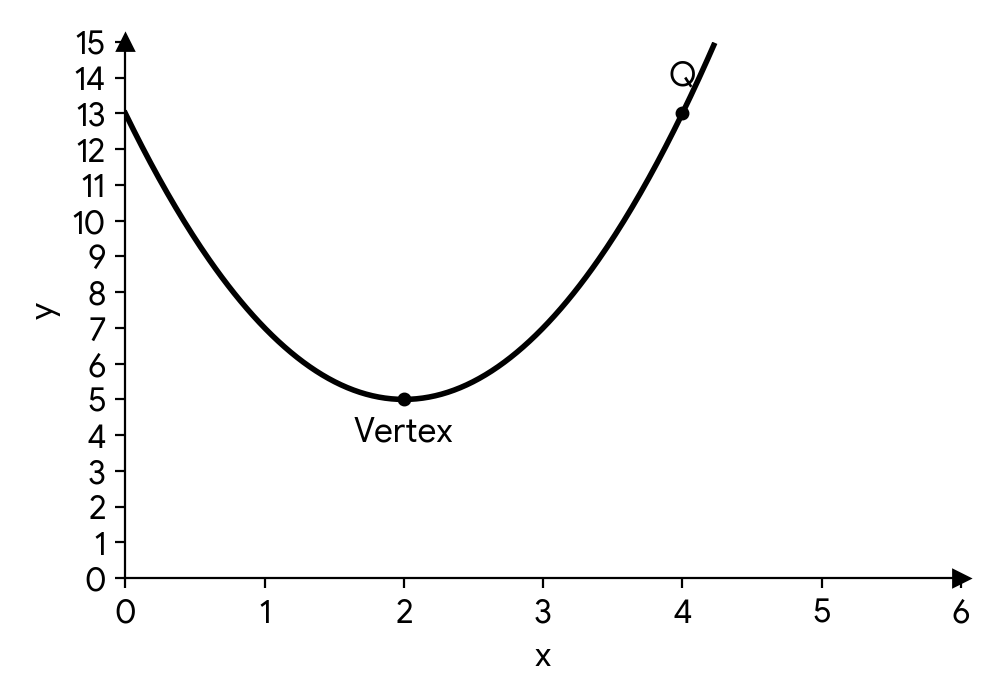
The function can be written in the form .
Write down the equation of the axis of symmetry.
(b) Write down the values of and .
(c) Point has coordinates . Find the value of .
(d) The line is tangent to the graph of at . Find the equation of .
(e) Now consider another function . The derivative of is given by , where . Find the values of for which is an increasing function.
(f) Find the values of for which the graph of is concave-up.
Recall that for a quadratic function in vertex form , the axis of symmetry is a vertical line passing through the vertex.
The vertex form of a quadratic function is , where are the coordinates of the vertex.
Substitute the coordinates of point and the values of and into the vertex form of the quadratic function and solve for .
To find the equation of the tangent line, you need its gradient and a point it passes through. The gradient of the tangent at is given by .
A function is increasing when its derivative is greater than zero. Consider the minimum value of .
A function is concave-up when its second derivative is greater than zero. Remember that .
Question 20
MediumPaper 2 · calculator8 marksA landscape architect is designing a new garden. A straight path is to be built, and its boundary can be modelled by the equation , where and are distances in metres.
(a) Write down the equation of the line in the form .
The garden's main feature is a triangular flower bed, with vertices at the origin O(0,0), and the points where the path intersects the -axis (point A) and the -axis (point B).
(b) Given that the line intersects the -axis at point A and the -axis at point B, find the coordinates of A and B.
A landscape architect is designing a new garden. A straight path is to be built, and its boundary can be modelled by the equation , where and are distances in metres. The garden's main feature is a triangular flower bed, with vertices at the origin O(0,0), and the points where the path intersects the -axis (point A) and the -axis (point B).
(c) Calculate the area of triangle OAB.
To convert the equation to the form , you need to isolate on one side of the equation.
For the x-intercept, set . For the y-intercept, set .
The triangle OAB is a right-angled triangle with vertices at the origin and the x and y-intercepts. The base and height can be found from the coordinates of A and B.
No question on this page matches those filters. Try another difficulty or paper.
15 more Straight line (gradient-int, general, point gradient form) questions in the app
Every answer is marked mark by mark, IB-style, and the AI tutor helps when you are stuck.
Where marks are lost
- Using your own wrong value after failing a "show that".