Unit circle, exact values of main trig ratios, ambiguous case: notes and practice questions
- The unit circle has a radius of 1, centered at , with trigonometric values derived from .
- Exact values for angles are used frequently.
- Ambiguous case applies to non-right triangles (SSA condition), where 0, 1, or 2 triangles may be possible based on given values.
How it is examined
Paper 1, where the calculator is gone and the exact values are the point. The ambiguous case lives here rather than at SL 3.2, so a "find the two possible values of the angle" question is legitimate and giving only the acute answer is half marks. Answers stay exact and surds stay rationalised where the mark scheme says so. 3 to 6 marks.
- Definition of and in terms of the unit circle.
- Definition of as .
- Exact values of trigonometric ratios of , , , , and their multiples.
- Extension of the sine rule to the ambiguous case.
Linking questions
- International-mindedness: the first work to refer explicitly to the sine as a function of an angle is the Aryabhatiya of Aryabhata (ca 510).
Practice questions
33 questions · 2 easy · 21 medium · 10 hardQuestion 1
EasyPaper 1 · no calculator3 marksA landscape designer is creating a triangular garden bed. Two sides of the garden bed measure 8 m and 10 m, and the angle between them is . Find the exact area of the garden bed.
Recall the formula for the area of a non-right-angled triangle that uses two side lengths and the angle between them. Remember to use the exact value for the trigonometric function.
Question 2
MediumPaper 1 · no calculator7 marks(a) Show that , for .
(b) Hence or otherwise, solve the equation for , .
To show that the two expressions are equal, you can either start with the left-hand side and combine the terms into a single fraction, or start with the right-hand side and perform algebraic long division.
Notice the structure of the equation in this part is the same as the expression in part (a). Let and use the result from part (a) to form a simpler equation. This will lead to a quadratic equation in terms of .
Question 3
HardPaper 1 · no calculator7 marksConsider the complex numbers and , where and .
(a) Find an expression for in terms of .
(b) Hence, given that , find all possible values of .
Remember the standard procedure for multiplying two complex numbers in the form . Distribute the terms as you would with binomials and recall that .
Recall that for a complex number , . You will need to know the exact value of . This will lead to a quadratic equation in .
Question 4
EasyPaper 1 · no calculator6 marksSolve the following equations for in the interval . Give your answers as multiples of .
(a)
(b)
(c)
First, find the reference angle (the acute angle) for which the cosine is . Then, use the unit circle or a CAST diagram to determine the quadrants where cosine is negative to find the two possible values for in the given range.
Find the reference angle for which sine is . Then, identify the quadrants where sine is negative to find the solutions for within the interval .
Determine the reference angle for which tangent is . Use this to find the angles in the quadrants where tangent is negative, within the specified domain.
Question 5
MediumPaper 1 · no calculator4 marksIt is given that , where . Find the exact value of .
First, determine which quadrant the angle lies in by considering both the sign of the secant function and the given domain. Then, use a Pythagorean identity such as or a right-angled triangle to find the magnitude of . Finally, combine the sign and magnitude for your answer.
Question 6
HardPaper 1 · no calculator19 marksA ladder must be placed against a tall vertical building, clearing a monument that is 8 m high and stands on horizontal ground 1 m away from the building's base. The ladder touches the ground, the top corner of the monument, and the wall of the building.
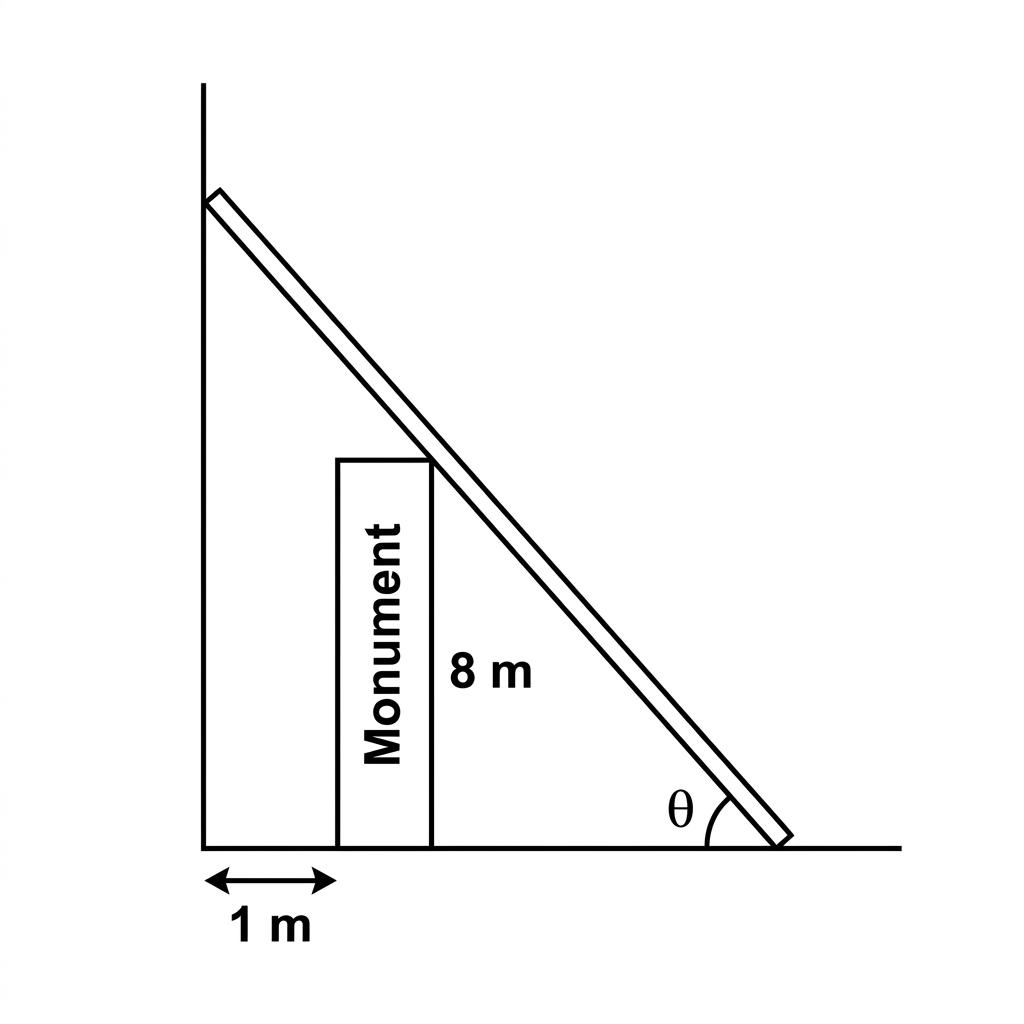
Let be the length of the ladder in metres.
Let be the angle that the ladder makes with the ground, where .
(a) Show that .
(b) (i) Find .
(b) (ii) When , show that .
(c) (i) Find .
(c) (ii) When , find the value of .
(d) (i) Hence, justify that is a minimum when .
(d) (ii) Determine this minimum value of .
(e) A construction company only has ladders with a maximum length of 11 m. Determine whether it is possible to position a ladder against the building over the monument, giving a reason for your answer.
Use trigonometry on the two right-angled triangles formed by the ladder, the ground, the monument, and the wall. Express the two segments of the ladder, divided by the monument's corner, in terms of .
Differentiate the expression for with respect to . You will need to know the derivatives of and .
Set your expression from part (b)(i) equal to zero. Rewrite all trigonometric functions in terms of and and then simplify the equation to find an expression for .
Differentiate your expression for from part (b)(i). You will need to use the product rule for both terms.
If , you can construct a right-angled triangle with opposite side 2 and adjacent side 1. Use this to find the values of , , and any other required trigonometric ratios, then substitute them into your expression for the second derivative.
Use the second derivative test. What does the sign of the second derivative at a stationary point tell you about the nature of that point?
Substitute the trigonometric values corresponding to back into the original expression for from part (a).
Compare the maximum available ladder length (11 m) with the minimum required length you calculated in part (d)(ii). To compare and without a calculator, you can compare their squares.
Question 7
MediumPaper 1 · no calculator7 marksConsider the functions and for .
(a) Find an expression for .
(b) Hence, solve the equation for .
Recall that means . You need to substitute the expression for into the function wherever you see .
Start by using your result from part (a). You will get an equation involving and . Try using the compound angle identities to expand these terms.
Question 8
HardPaper 1 · no calculator17 marksBy using an appropriate substitution, show that .
The following diagram shows part of the curve for .
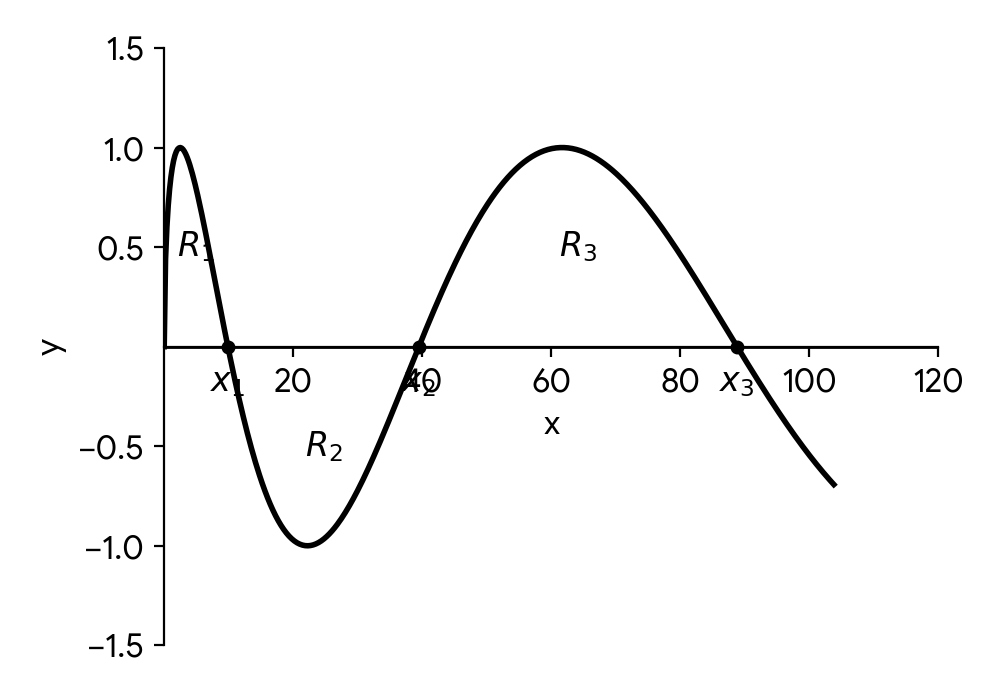
The curve intersects the x-axis at .
The nth x-intercept of the curve, , is given by , where .
Write down an expression for .
The regions bounded by the curve and the x-axis are denoted by as shown on the diagram.
Calculate the area of region .
Give your answer in the form , where .
Hence, show that the areas of the regions form an arithmetic sequence.
Try substituting . After substituting, you will need to use integration by parts.
Simply replace with in the given formula for .
The area of is given by the absolute value of the definite integral from to . Use the result from part (a) and the expressions for the intercepts from part (b).
An arithmetic sequence has a constant common difference. Calculate Area() - Area() and show that it is a constant.
Question 9
MediumPaper 1 · no calculator6 marksShow that the equation may be written in the form
.
Hence, solve the equation , for .
Recall the Pythagorean identity that connects and . Substitute this into the original equation and rearrange.
Use the result from part (a). Let to form a standard quadratic equation. Solve for , and then find the corresponding values of in the given domain.
Question 10
HardPaper 1 · no calculator7 marksConsider the functions and , where and .
The graph of is obtained by two transformations of the graph of .
(a) Describe these two transformations.
The -intercept of the graph of is at .
(b) Given that the maximum value of is 1, find the value of .
Look at the changes inside the cosine function for the horizontal transformation and the changes outside the function for the vertical transformation. Remember the sign conventions for translations.
First, find the maximum value of the function in terms of . Use the given information that this maximum value is 1 to find the value of . Then, calculate the -intercept, , by evaluating .
Question 11
MediumPaper 1 · no calculator7 marksShow that , for .
Hence or otherwise, solve the equation for .
To show that the two expressions are equal, you can either start with the left-hand side and combine the terms into a single fraction, or you can start with the right-hand side and perform polynomial division.
Notice the similarity between the equation in this part and the expression from part (a). Let and use the result you proved to simplify the equation into a quadratic form.
Question 12
HardPaper 1 · no calculator14 marksConsider an acute angle such that .
Find the value of .
Find the value of .
The following diagram shows triangle ABC, with , , and AB = 14.
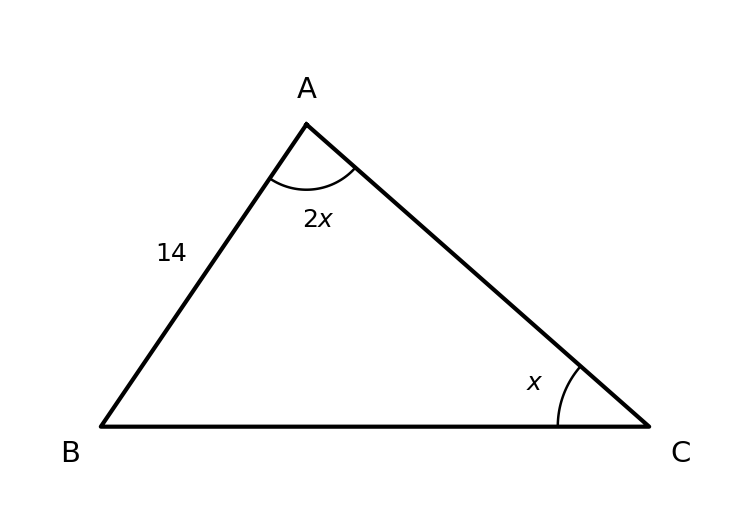
(b) Show that BC = 21.
The line segment CA is extended to a point D such that triangle ABD is isosceles with AB = AD.
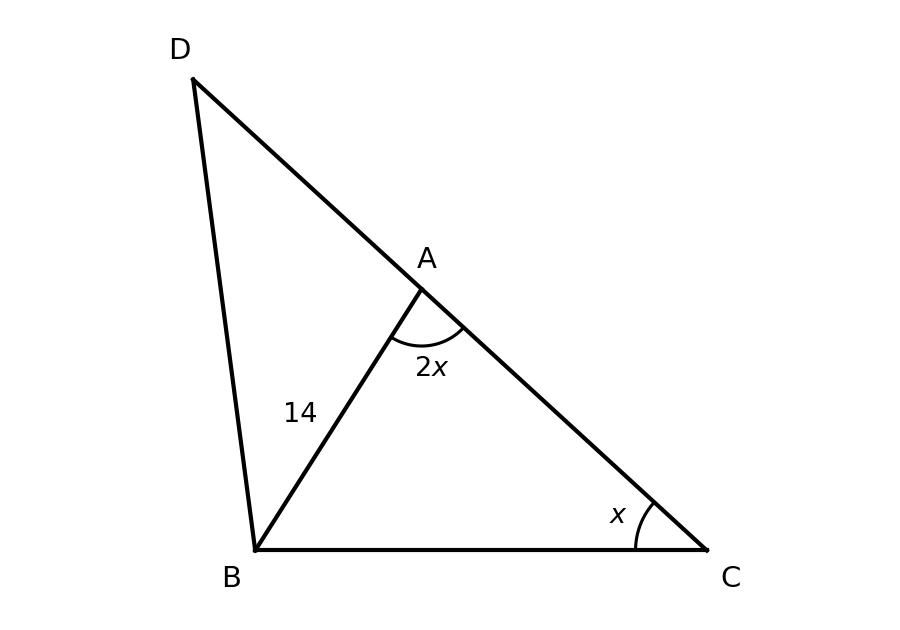
Find the size of angle ADB in terms of .
Find the area of triangle ABD.
Use the Pythagorean identity . Remember to consider the quadrant of angle when taking the square root.
Use a double angle identity for cosine. The identity is the most direct one to use here.
Apply the sine rule to triangle ABC. You will also need to use the double angle identity for sine, .
First, find the angle BÂD. Note that it is supplementary to BÂC. Then, use the properties of the isosceles triangle ABD to find the other angles.
Use the formula for the area of a triangle: Area = . You know the lengths of two sides (AB and AD) and the angle between them (BÂD).
Question 13
MediumPaper 1 · no calculator6 marksThe function is defined as , where .
Consider the shaded region R enclosed by the graph of , the -axis and the line , as shown in the following diagram.
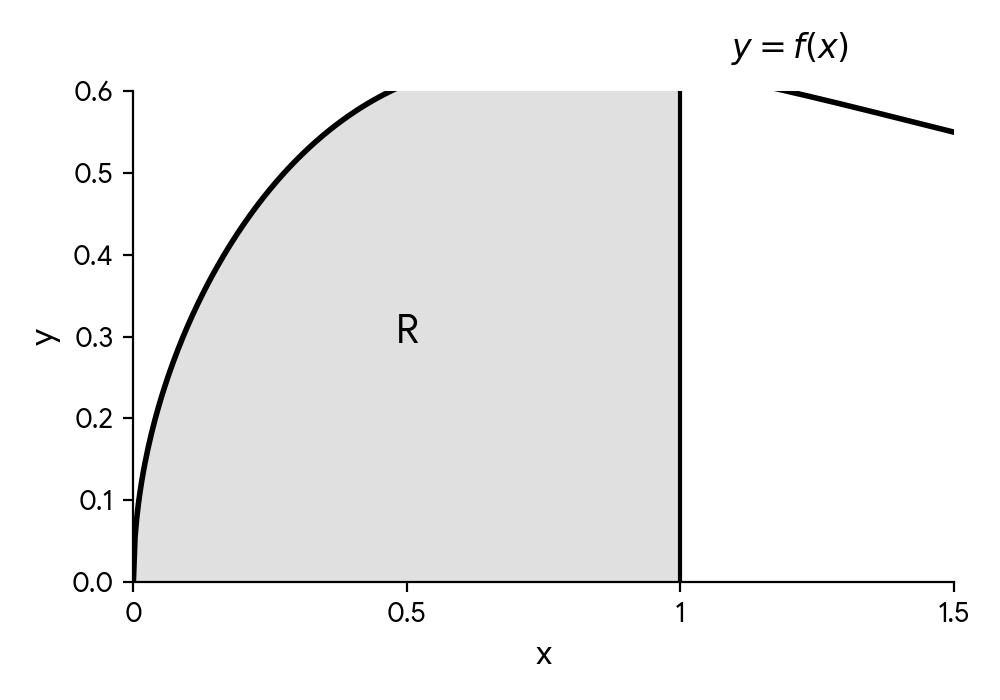
The shaded region R is rotated by radians about the -axis to form a solid.
Show that the volume of the solid is .
Start by setting up the integral for the volume of revolution. Look at the resulting integrand. Does it have a structure that suggests a particular integration technique, like substitution or integration by parts? Consider the relationship between the different parts of the integrand.
Question 14
HardPaper 1 · no calculator22 marksConsider the complex number .
(a) (i) Express in modulus-argument form.
(a) (ii) Find the smallest positive integer for which is a real number.
Consider the equation , where .
(b) Show that the roots of the equation are given by for .
(c) (i) By using the binomial expansion, show that the equation in part (b) can be written as .
(c) (ii) Let the roots of the equation in (c)(i) be . Without finding the roots, show that .
(d) Hence, find the exact value of .
Recall how to find the modulus and argument of a complex number . Be careful with the quadrant for the argument.
Use De Moivre's theorem to express in terms of . For a complex number to be real, what must be true about its imaginary part?
Start by rearranging the equation to the form . Then find the roots of unity for and solve for . You may need the identities and .
Expand both and using the binomial theorem. Observe which terms cancel when you subtract the two expansions.
Recall Vieta's formulas for the sum of roots and the sum of roots taken in pairs for a polynomial. There is an identity connecting the sum of squares with these two sums: .
The equation from part (c)(i) is a quadratic in . Solve for and determine which of the two solutions corresponds to by considering the behavior of the cotangent function in the first quadrant.
Question 15
MediumPaper 1 · no calculator7 marksConsider the functions and .
(a) Find .
(b) Solve the equation for .
To find the composite function , you need to substitute the function into every instance of in the function .
Start by substituting your answer from part (a) into the equation. Then, try to rearrange the equation so that you have a single trigonometric function (like tan, sin, or cos) on one side.
Question 16
HardPaper 2 · calculator15 marksA team of engineers is testing two autonomous robots, Alpha and Beta, on a straight track. Their positions are measured as the distance from a fixed starting point. The experiment runs for 10 minutes.
The position of Robot Alpha, metres, at time minutes can be modelled by the function , where .
The position of Robot Beta, metres, at time minutes can be modelled by the function , where .
Use the engineers' models to find the initial position of
(i) Robot Beta;
(ii) Robot Alpha correct to three significant figures.
Find the values of when Robot Alpha and Robot Beta are at the same position. Give your answers correct to three significant figures.
For , prove that Robot Alpha was always ahead of Robot Beta.
For , find the total amount of time when the speed of Robot Beta was greater than the speed of Robot Alpha. Give your answer correct to three significant figures.
The initial position corresponds to the time . Substitute this value into the function for Robot Beta.
Substitute into the function for Robot Alpha. Remember that the argument of the sine function is in radians.
Set the two position functions equal to each other, . This equation will involve a trigonometric term and a linear term, so you will need to use your GDC to find the solutions within the given domain .
To prove Robot Alpha was always ahead, show that for . Consider the minimum value of the trigonometric term in the difference function.
Speed is the magnitude of velocity, which is the derivative of position with respect to time. Find and . Then solve the inequality for within the given domain. This will involve a trigonometric inequality.
Question 17
MediumPaper 1 · no calculator6 marksShow that the equation can be written in the form .
Hence, solve , for .
Recall the double angle identities for . Which one would be most useful to express the equation entirely in terms of ?
First, solve the quadratic equation from part (a) for . You can use factoring or the quadratic formula. Then, for each value of you find, determine the corresponding angles in the given domain using the unit circle.
Question 18
HardPaper 1 · no calculator11 marksFind .
The region is enclosed by the curve , the -axis, and the lines and . Show that the area of is .
This integral is a product of two different types of functions. Which integration technique is suitable for this? Consider letting .
The area under a curve from to is given by the definite integral . Use your result from part (a) and evaluate it at the given limits. Remember the exact values for trigonometric functions of and properties of logarithms.
Question 19
MediumPaper 1 · no calculator7 marksConsider the function , for .
Determine the range of .
The region bounded by the graph of , the -axis and the lines and is rotated radians about the -axis.
Find the volume of the solid generated.
To find the range of a function on a closed interval, you should check the values of the function at the endpoints and at any local maximum or minimum points within the interval. For a cosecant function, the minimum value occurs when its reciprocal, the sine function, is at its maximum.
The formula for the volume of a solid generated by rotating a curve about the x-axis between and is . You will need to know the integral of .
Question 20
HardPaper 1 · no calculator10 marksGiven that , and ,
find and .
Solve for .
Use the Pythagorean identity to find the value of . Remember to consider the given domain for to determine the correct sign. Then, use the identity .
First, express in terms of and . Then, rearrange the equation so that one side is zero and factorize. This will lead to two separate trigonometric equations to solve.
No question on this page matches those filters. Try another difficulty or paper.
13 more Unit circle, exact values of main trig ratios, ambiguous case questions in the app
Every answer is marked mark by mark, IB-style, and the AI tutor helps when you are stuck.
Where marks are lost
- Using your own wrong value after failing a "show that".