Tangents & Normals at a given point: notes and practice questions
- The tangent to a curve at a point is a line that touches the curve without crossing it. Its slope is the derivative at that point.
Tangent equation:
- The normal is perpendicular to the tangent. Its slope is .
Normal equation:
How it is examined
The normal gradient is and forgetting the negative reciprocal is the single most common loss in this subtopic. Paper 1 wants the equation left in an exact form. 4 to 6 marks.
Tangents and normals at a given point, and their equations.
Linking questions
- Links to other subjects: instantaneous velocity and optics, equipotential surfaces (physics); price elasticity (economics).
Practice questions
49 questions · 1 easy · 34 medium · 14 hardQuestion 1
EasyPaper 1 · no calculator9 marksConsider the function .
(a) Find .
(b) Find the equation of the tangent line at .
(c) For the equation of the normal line at .
This function contains a constant and terms of the shape so to derive use the power rule.
The point of tangency is a point common between the tangent line and the function's curve.
The normal and tangent lines are perpendicular to each other.
Question 2
MediumPaper 1 · no calculator7 marksThe function is defined for all . The line with equation is the tangent to the graph of at .
(a) Write down the value of .
(b) Find .
The function is defined for all where and .
(c) Find .
(d) Hence, find the equation of the tangent to the graph of at .
The derivative of a function at a point gives the gradient of the tangent line at that same point. What is the gradient of the given tangent line?
The point of tangency lies on both the function's graph and the tangent line. Substitute the x-coordinate of the point of tangency into the equation of the tangent line.
To find , you first need to calculate the value of the inner function, . Then, use this result as the input for the outer function, .
To find the equation of a tangent line, you need a point and a gradient. You found the point in part (c). To find the gradient, you need to calculate . Remember to use the chain rule to differentiate .
Question 3
HardPaper 3 · calculator24 marksA biologist is modelling the growth of two different bacterial colonies. The first colony, A, grows such that its population at time is given by , where is a growth factor and . The second colony, B, grows linearly such that its population at time is .
Consider the cases where the growth factor and . On the same set of axes, sketch the following three graphs for :
Clearly label each graph with its equation and state the coordinates of any non-zero -axis intercepts.
In parts (b) and (c), consider the case where the growth factor .
Use calculus to find the minimum value of the expression , justifying that this value is a minimum.
Hence deduce that for all .
There exist values of for which the graph of and the line have different numbers of intersection points. The following table gives three intervals for the value of .
| Interval | Number of intersection points |
|---|---|
By investigating the graph of for different values of , write down the values of and .
In parts (e) and (f), consider .
For , a value of exists such that the line is a tangent to the graph of at a point P.
Find the exact coordinates of P and the exact value of .
Write down the exact set of values for such that the graphs of and have
(i) two intersection points;
(ii) no intersection points.
Ensure your sketch accurately reflects the general shape and relative positions of exponential functions with different bases and the line . Pay attention to intercepts and asymptotic behaviour.
Recall how to find local extrema using calculus by analyzing the first and second derivatives.
Consider the implications of the minimum value found in part (b) for the expression .
Visualize how the graph of changes as the value of changes, especially relative to the line . Consider the general shapes for and .
For tangency, both the function values and their derivatives must be equal at the point of contact. Let the point of tangency be .
Relate the critical value of found in part (e) to the number of intersection points. Consider the graphical behavior.
Relate the critical value of found in part (e) to the number of intersection points. Consider the graphical behavior.
Question 4
MediumPaper 1 · no calculator7 marksConsider the functions and where .
(a) Find .
The graphs of and have a common tangent at the point where .
(b) Show that .
(c) Hence, find the value of .
To find the derivative of , you can use the power rule for differentiation.
For two functions to have a common tangent at a specific point, their gradients must be equal at that point. Start by finding the derivative of and then set .
If the functions have a common tangent at a point, they must also pass through that same point. This means their y-values are equal at . Set and use the value of you found in part (b).
Question 5
HardPaper 1 · no calculator9 marksA function is defined by , where .
The graph of is shown below.
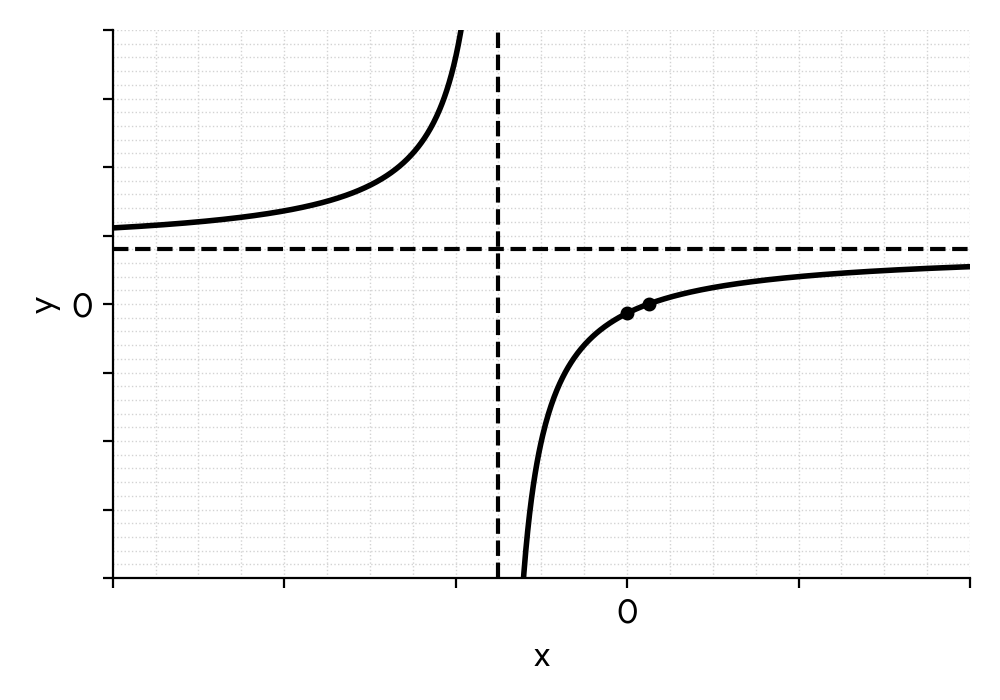
(a) Write down the equation of the horizontal asymptote.
Consider the function , where .
(i) Write down the number of solutions to for .
(ii) Determine the value of such that has only one solution for .
(iii) Determine the range of values for for which has two distinct solutions for .
The horizontal asymptote is determined by the behavior of the function as approaches . For a rational function where the degree of the numerator and denominator are the same, the asymptote is the ratio of the leading coefficients.
The line passes through the y-intercept of . Sketch a line with a negative slope passing through this point on the given graph. How many times does it intersect the curve ?
A single solution occurs when the line is tangent to the curve . Since the line always passes through the y-intercept of the curve, the point of tangency must be the y-intercept. Therefore, the slope of the line, , must be equal to the gradient of the curve at that point. Alternatively, you can set up the equation , rearrange it into a quadratic, and use the discriminant or analyze the roots.
From the previous part, you found the two solutions for in terms of . One solution is always . For there to be two distinct solutions for , what condition must the other solution satisfy?
Question 6
MediumPaper 1 · no calculator5 marksConsider the curve with equation , where and .
The normal to the curve at the point where is parallel to the line .
Find the value of .
First, find the derivative of the function using the product rule. Then, determine the gradient of the tangent at the given point. Remember the relationship between the gradient of a tangent and the gradient of the normal. Finally, find the gradient of the given line and set up an equation.
Question 7
HardPaper 1 · no calculator14 marksA function is defined by . The following diagram shows part of the graph of .
The graph has a vertex at V and intersects the y-axis at point P.
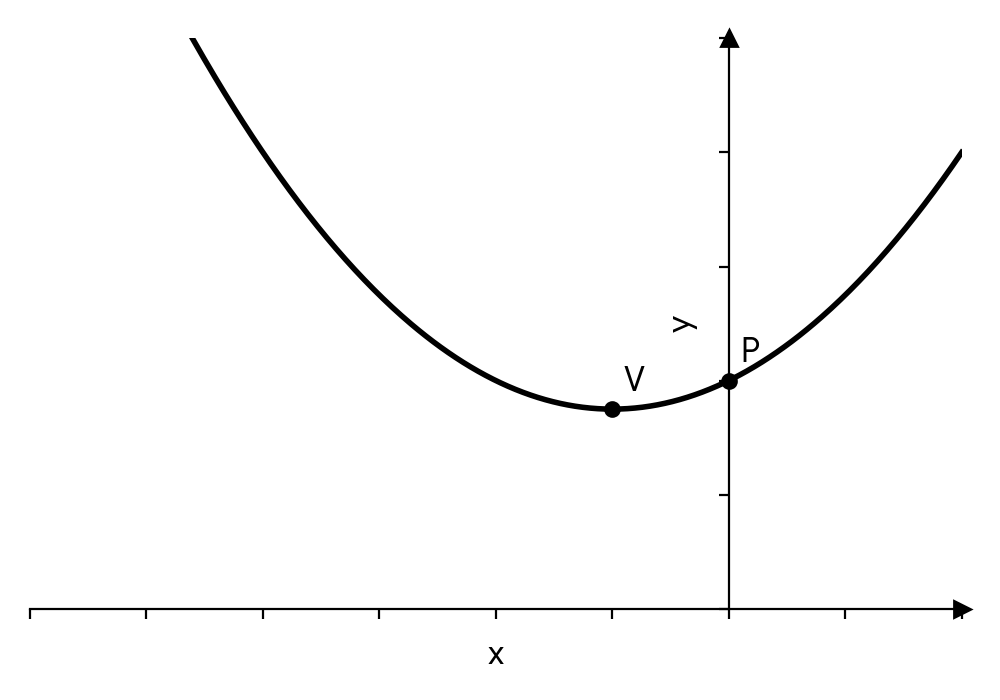
(a) Find the coordinates of the vertex V.
(b) Write down the coordinates of the y-intercept, P.
(c) The line L is the normal to the graph of at point P. Find the equation of L, giving your answer in the form .
(d) The line L intersects the graph of at a second point, Q. Calculate the distance between P and Q.
The x-coordinate of the vertex of a parabola can be found using the formula . Alternatively, you can find the derivative and solve for . Once you have the x-coordinate, substitute it back into the function to find the y-coordinate.
The y-intercept of a graph occurs when the x-coordinate is 0. Substitute into the function .
First, find the derivative of . Then, evaluate the derivative at the x-coordinate of P to find the gradient of the tangent. The gradient of the normal is the negative reciprocal of the tangent's gradient. Finally, use the point-slope form to find the equation of the line.
To find the coordinates of Q, set the equation for the function equal to the equation for the line L and solve the resulting quadratic equation for x. One solution will be the x-coordinate of P. The other will be for Q. Substitute this new x-value back into either equation to find the y-coordinate of Q. Finally, use the distance formula.
Question 8
MediumPaper 1 · no calculator8 marksThe functions and are defined by and , for .
The curves and intersect at a point P whose x-coordinate is .
Show that .
Hence, show that the tangent to the curve at P and the tangent to the curve at P are perpendicular.
Find the value of . Give your answer in the form , where and .
At the point of intersection, the y-values of the two functions are equal. Use a trigonometric identity for .
Find the derivatives of both functions. To show that two lines are perpendicular, what must be true about the product of their gradients?
Use the result from part (a) and the Pythagorean identity to form a quadratic equation in terms of .
Question 9
HardPaper 1 · no calculator7 marksConsider the curve defined by the equation , where is a positive constant. The tangent to the curve at a point on the curve intersects the x-axis at the point and the y-axis at the point .
Show that the length of the line segment is equal to .
Start by finding the derivative using implicit differentiation. Then, find the equation of the tangent line at the general point . Use this equation to find the coordinates of the intercepts and . Finally, use the distance formula and the fact that lies on the curve to simplify your expression for the length of .
Question 10
MediumPaper 1 · no calculator7 marksConsider the functions and where .
The graphs of and have a common tangent at .
(a) Find .
(b) Show that .
(c) Hence, find the value of .
Recall the rule for differentiating a natural logarithm function, and apply the chain rule.
For two functions to have a common tangent at a point, their gradients must be equal at that point. Set the derivatives of and equal to each other at .
For the functions to have a common tangent, they must also pass through the same point. This means their y-values are equal at . Set and substitute the value of you found in part (b).
Question 11
HardPaper 2 · calculator18 marksA company models the average cost per unit, , in thousands of dollars, for producing thousand units of a specialized component using the function , where represents the number of units in thousands, and is a positive constant.
(a) Write down the equations of the vertical and horizontal asymptotes of the graph of .
(b) Show that .
(c) Show that the graph of has no turning points.
(d) Find the equation, in terms of , of the normal to the graph of at .
(e) The horizontal and vertical asymptotes of meet at the point . The normal to the graph of at passes through for certain values of .
Show that these values of satisfy the equation .
(f) Hence, find the values of for which the normal to the graph of at passes through .
Recall how to find vertical asymptotes by setting the denominator to zero, and horizontal asymptotes by considering the limit as for rational functions.
Use the quotient rule for differentiation: if , then .
Turning points occur where the first derivative is equal to zero. Analyze the expression for to see if it can ever be zero.
First, find the coordinates of the point on the curve at . Then, calculate the gradient of the tangent at using . The gradient of the normal is the negative reciprocal of the tangent's gradient. Finally, use the point-gradient form of a line.
The point is the intersection of the asymptotes found in part (a). Substitute the coordinates of into the equation of the normal found in part (d) and simplify the resulting algebraic expression.
Solve the cubic equation from part (e). Remember that is a positive constant.
Question 12
MediumPaper 1 · no calculator9 marksConsider the function f defined by for .
The following diagram shows part of the graph of f which crosses the x-axis at point A, with coordinates . The line L is the tangent to the graph of f at the point B.
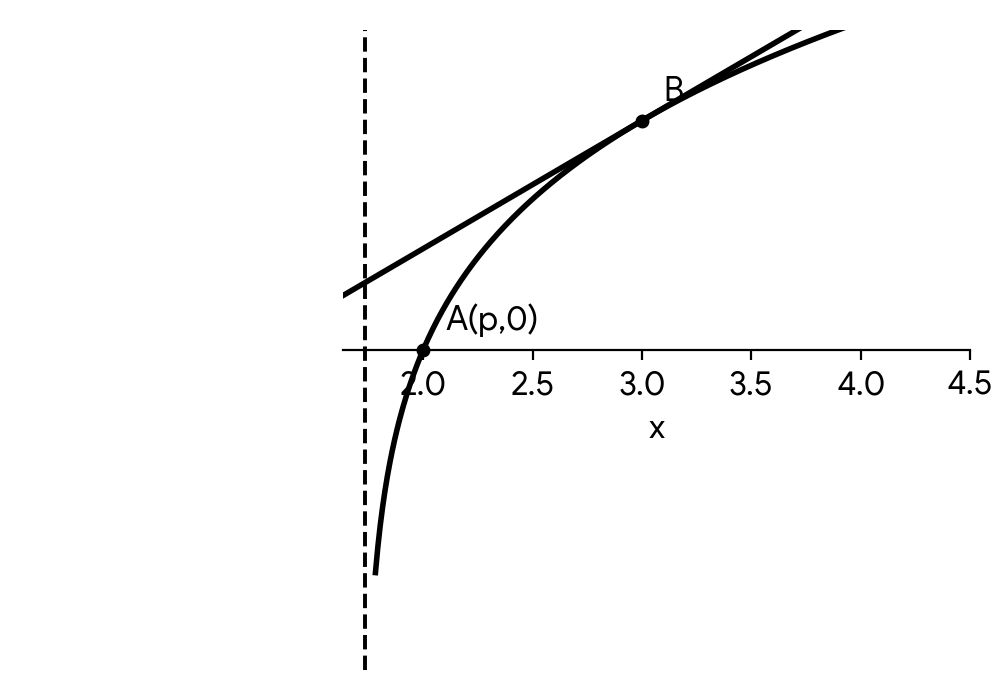
(a) Find the exact value of .
(b) Given that the gradient of L is , find the x-coordinate of B.
To find the x-intercept, you need to solve the equation . Remember the property that if , then .
First, you need to find the derivative of the function . Then, set the derivative equal to the given gradient and solve the resulting equation for .
Question 13
HardPaper 1 · no calculator9 marksFind the equation of the normal to the curve defined by the equation at the point .
You will need to use implicit differentiation to find an expression for . Remember to apply the product rule for terms like and . Once you have the gradient of the tangent at the given point, how do you find the gradient of the normal?
Question 14
MediumPaper 1 · no calculator7 marksThe function is defined for all . The line with equation is the tangent to the graph of at .
Write down the value of .
Find the value of .
The function is defined for all where . The function is defined as .
Find the value of .
Hence, find the equation of the tangent to the graph of at .
The derivative of a function at a point gives the gradient of the tangent line at that same point. What is the gradient of the given tangent line?
The point of tangency lies on both the curve of the function and the tangent line. Substitute the x-coordinate of the point of tangency into the equation of the tangent line to find the y-coordinate.
To find the derivative of a composite function like , you need to use the chain rule: . First, find the derivative of .
The equation of a tangent line is given by , where is the gradient at the point . You found the gradient, , in the previous part. Now you need to find the y-coordinate, .
Question 15
HardPaper 1 · no calculator13 marksA function is defined by .
(a) Find the equation of the tangent to the graph of at the point where .
(b) The tangent line found in part (a) intersects the graph of at a second point, P. Find the coordinates of P.
(c) Find the exact area of the finite region enclosed by the graph of and the tangent line.
To find the equation of a tangent line, you need a point on the line and its gradient. The gradient can be found by differentiating the function and evaluating it at the given x-value.
The points of intersection are found by setting the equation of the curve equal to the equation of the tangent line. You already know one solution to this equation, which corresponds to the point of tangency.
The area between two curves, and , from to is given by the integral . The limits of integration are the x-coordinates of the intersection points.
Question 16
MediumPaper 1 · no calculator6 marksConsider the curve with equation , where and .
The normal to the curve at the point where is parallel to the line with equation .
Find the value of .
First, find the derivative of the function using the product rule. Then, determine the gradient of the normal from the given line. Use the relationship between the gradient of the normal and the gradient of the tangent. Finally, evaluate the derivative at the given point and set it equal to the gradient of the tangent to solve for .
Question 17
HardPaper 2 · calculator19 marksA pharmaceutical company is testing a new drug. The concentration of the drug, , in the bloodstream of a patient, in micrograms per millilitre (), hours after administration, is modelled by the function , for .
Sketch the graph of for , clearly indicating the coordinates of the initial concentration point , the maximum concentration point , and the concentration point at hours.
State the range of the concentration during the observed period.
Find the equation of the straight line connecting the initial concentration point and the concentration point at hours.
Show that the rate of change of the drug concentration is given by .
At a certain time, the rate of change of the drug concentration is parallel to the line AB. Find the equation of the tangent line to the graph of at this time. Give all coefficients in your equation correct to significant figures.
Calculate the area of the region enclosed by the graph of and the line AB.
To sketch the graph, first find the coordinates of the end-points of the interval and any local maximum or minimum points within the interval. For the maximum point, find the derivative of and set it to zero.
The range is determined by the minimum and maximum values of the function over the given interval. Refer to your calculated points from part (a).
Use the coordinates of points and to find the gradient of the line. Then use the point-slope form to write the equation of the line.
Use the product rule for differentiation: if , then .
If the tangent is parallel to line AB, their gradients must be equal. Set equal to the gradient of line AB found in part (c) and solve for . Then find the corresponding value to get the point of tangency.
The area enclosed by two curves and over an interval is given by . Determine which function is above the other and then perform the definite integration. You will need to use integration by parts for the term .
Question 18
MediumPaper 1 · no calculator13 marksA function, , has its derivative given by , where . The following diagram shows part of the graph of .
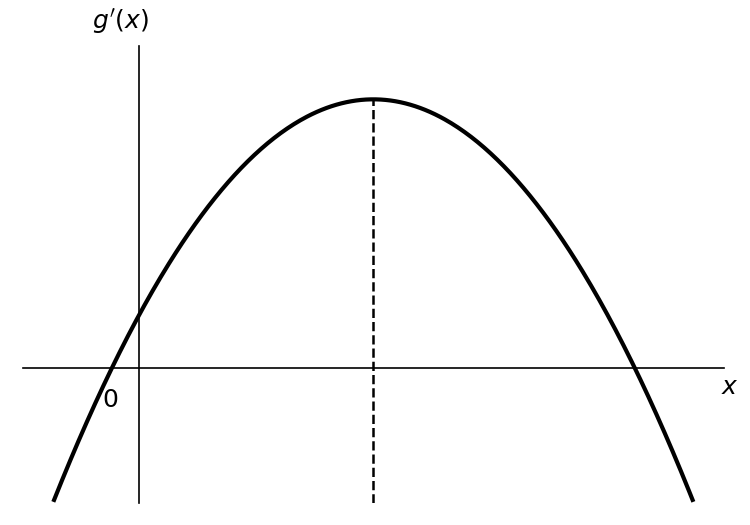
The graph of has an axis of symmetry .
(a) Find the value of .
(b) The vertex of the graph of has a y-coordinate of 10. Find the value of .
(c) Find the equation of the tangent to the graph of at .
The graph of has a point of inflexion at .
(d) (i) Find the value of .
(ii) Find the values of for which the graph of is concave-up. Justify your answer.
The axis of symmetry of a parabola is given by the formula . Alternatively, the vertex (and thus the axis of symmetry) occurs where the derivative of the function is zero.
The vertex lies on the axis of symmetry. Use the value of you found in part (a) as the x-coordinate of the vertex, and the given y-coordinate, to form an equation and solve for .
To find the equation of a tangent line, you need a point on the line and the gradient of the line. The point is found by evaluating . The gradient is found by evaluating the derivative of at .
A point of inflexion on the graph of occurs where the second derivative, , is equal to zero.
The graph of is concave-up when its second derivative, , is positive. Set up and solve the inequality .
Question 19
HardPaper 1 · no calculator17 marksThe function is defined by , for .
(a) Show that the curve has only one point of inflection in its domain, and determine its coordinates.
(b) Find the equations of the tangent and the normal to the curve at the point where .
(c) Calculate the area of the triangle formed by this tangent, this normal, and the -axis.
To find a point of inflection, you need to analyze the second derivative of the function, . Find where and check if the concavity changes at that point.
The equation of a line is . For the tangent, the gradient is the value of the first derivative at the given point. The normal is perpendicular to the tangent.
The three lines form a triangle. Find the coordinates of the three vertices of this triangle. Two of the vertices will be the y-intercepts of the tangent and normal. The third vertex is where the tangent and normal intersect.
Question 20
MediumPaper 2 · calculator12 marksThe trajectory of a small drone flying over a landscape can be modelled by the function , where is the horizontal distance in meters from the launch point and is the altitude in meters. The drone passes through a checkpoint A at a horizontal distance of 2 meters.
(a) (i) Find the gradient of the tangent to the drone's trajectory at checkpoint A.
(a) (ii) Hence, write down the gradient of the normal to the drone's trajectory at checkpoint A.
(b) Write down the equation of the normal to the drone's trajectory at checkpoint A.
(c) A searchlight beam is directed along the normal line found in part (b). This beam intersects the drone's trajectory again at a second point B. Find the coordinates of B.
To find the gradient of the tangent, you need to calculate the derivative of the function, , and then evaluate it at the given x-coordinate of point A.
The product of the gradients of a tangent and its normal at the same point is -1.
You have the gradient of the normal from part (a.ii) and the coordinates of point A. Use the point-slope form: . Remember to find the y-coordinate of A first.
To find the intersection points, set the equation of the drone's trajectory equal to the equation of the normal line. This will result in a quadratic equation. One solution will be the x-coordinate of point A; the other will be the x-coordinate of point B.
No question on this page matches those filters. Try another difficulty or paper.
29 more Tangents & Normals at a given point questions in the app
Every answer is marked mark by mark, IB-style, and the AI tutor helps when you are stuck.
Where marks are lost
- Using your own wrong value after failing a "show that".