Compound angle identities, other HL trig identities: notes and practice questions
- Pythagorean Identities: Fundamental relations like simplify expressions.
- Reciprocal & Ratio Identities: Convert between trigonometric functions (e.g., ).
- Compound & Double Angle Identities: Expand or combine trigonometric terms for angles (e.g., , ).
- Power Reduction Formulas: Useful for integration, derived from double angle identities (e.g., ).
- Sum-to-Product & Product-to-Sum: Transform sums/differences into products and vice-versa, aiding equation solving and integration.
- Inverse Trigonometric Functions: Defined with specific domain/range restrictions and have distinct derivatives crucial for calculus.
How it is examined
`Show that` and `Prove`, on Paper 1, with the exact-value payoff ( from ). The derivation of the double angle identities from the compound ones is explicitly in scope, so "hence show that" is a fair second part. 4 to 7 marks. Almost never a standalone question. It is the step that lets a student write a second solution to a trigonometric equation, or show a function is odd. Treat it as supporting content when generating: put it inside a bigger AHL 3.10 or SL 3.8 question rather than asking for it directly. 1 to 3 marks.
The compound angle identities for , and are given, as is .
- Compound angle identities.
- Double angle identity for tan.
- Relationships between trigonometric functions and the symmetry properties of their graphs.
Linking questions
- The derivation link to De Moivre means an identity question can be set from either direction, expanding or using compound angles.
- Links to other subjects: simple harmonic motion graphs (physics).
Practice questions
11 questions · 7 medium · 4 hardQuestion 1
MediumPaper 1 · no calculator9 marks(a) Show that .
(b) Hence, solve the equation for .
Use the double angle formula for cosine, , twice. First, consider as .
Rearrange the given equation so that you can use the expression from part (a). You might need to multiply or divide the whole equation by a constant.
Question 2
HardPaper 1 · no calculator5 marksShow that .
Hence, or otherwise, find the exact value of .
Consider the compound angle identity for . Let and . What is ?
Use your result from part (a) to substitute for . You may need to use another identity for the sum of two arctan functions, such as , or consider the case where the denominator in the formula is zero.
Question 3
MediumPaper 1 · no calculator4 marksShow that .
Consider writing as and then apply the compound angle formula for cosine.
Question 4
HardPaper 1 · no calculator16 marksThe following diagram shows the graph of for , with asymptotes at and .
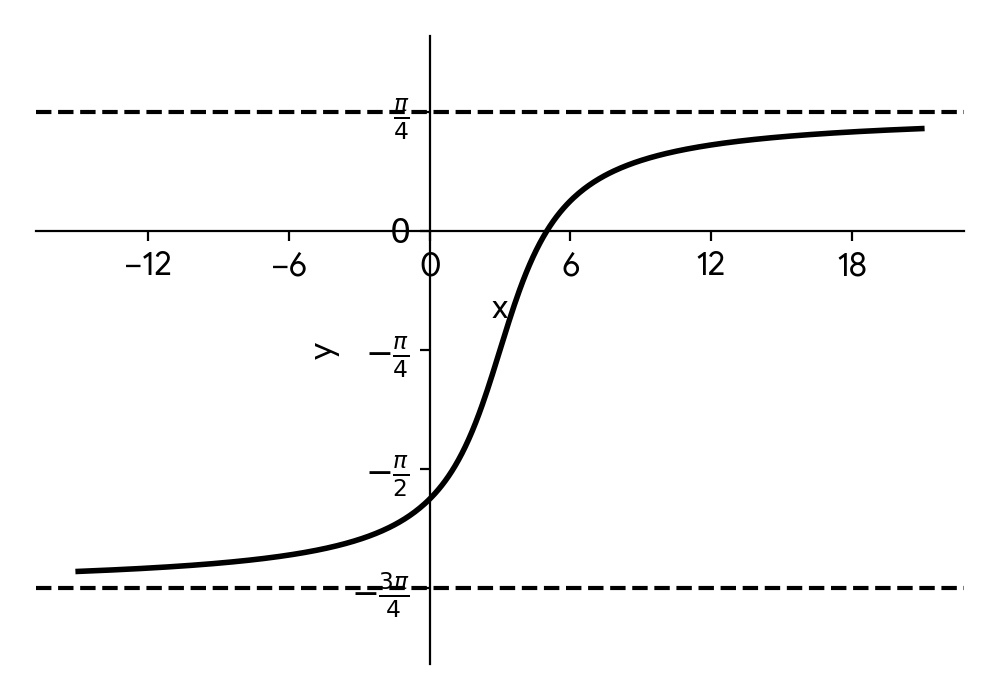
Describe a sequence of transformations that transforms the graph of to the graph of for .
Show that where and .
Using mathematical induction and the result from part (b), prove that
for .
Consider the transformations in the form . Think about the order of transformations, especially for the horizontal stretch and shift.
Let and . Express and in terms of and . Then use the compound angle formula for .
For the inductive step, assume the formula is true for . Then consider the sum for , which is the sum for plus the -th term. Use the identity from part (b) to combine the terms.
Question 5
MediumPaper 1 · no calculator10 marks(a) Solve the equation for .
(b) Given that and , find the exact value of .
Start by expanding the term using the compound angle formula.
Recall the compound angle identity for and substitute the given values.
Question 6
HardPaper 1 · no calculator10 marksProve that , where .
Hence, solve the equation for .
Start with the left-hand side and use the identity for or . Then, express everything in terms of and and look for opportunities to use double angle formulas.
Look at the identity you proved in part (a). How can you relate the expression to the identity? Consider a substitution like .
Question 7
MediumPaper 1 · no calculator8 marksGiven that and , find the value of .
Find the value of .
Find the value of .
Use the Pythagorean identity . Remember to consider the quadrant is in to determine the correct sign.
Recall the double angle identity for sine: . Use the values you have for and .
Use the compound angle identity for cosine: . You will also need the exact values for and .
Question 8
HardPaper 1 · no calculator6 marksIn any triangle ABC, the side lengths opposite to the angles A, B, and C are a, b, and c respectively.
Show that .
Start with the left-hand side of the equation. Use the sine rule to express the side lengths in terms of the sines of the angles. Then, apply appropriate trigonometric identities, such as the sum-to-product and double angle formulas.
Question 9
MediumPaper 1 · no calculator7 marksLet be an acute angle and be an obtuse angle, such that and .
Show that .
Start by expanding using the compound angle formula. You will then need to find the values of , , , and . Remember to consider the quadrants of angles and when determining the signs of their trigonometric ratios.
Question 10
MediumPaper 1 · no calculator4 marksShow that .
Write as and use the compound angle identity for sine.
Question 11
MediumPaper 1 · no calculator4 marksShow that .
Write as and use the compound angle identity for sine.
No question on this page matches those filters. Try another difficulty or paper.
Every Compound angle identities, other HL trig identities question, marked for you
Every answer is marked mark by mark, IB-style, and the AI tutor helps when you are stuck.
Where marks are lost
- Using your own wrong value after failing a "show that".